1-Minute Scalping Strategy (VWAP + MACD + RSI) – Complete Guide for Beginners
Blog by Aliceblue News Desk
03 April 2026
18 minutes
You open the chart and spot a perfect move. Before you can click buy, the price shoots up, and you’re left thinking, “I knew that was going to happen.” If that sounds familiar, you’re not alone.
Many traders struggle with timing. The market moves fast, opportunities come and go in seconds, and waiting for the “perfect trade” often means missing it completely. That’s where a 1 minute scalping strategy with clear rules can help.
Instead of chasing big moves, this approach focuses on small, quick profits by getting in and out of trades within minutes using clear, structured signals.
Quick answer: The 1 minute scalping strategy takes a trade only when price is on the right side of VWAP, MACD crosses the same way and RSI confirms momentum. Every trade has a fixed stop loss, and the target must still pay after brokerage, STT and slippage.
In this guide, you’ll learn how to use VWAP, MACD and RSI together to spot setups, manage risk and check whether costs leave any profit.
Table of Contents
Table of Contents
What is the 1-Minute Scalping Strategy?
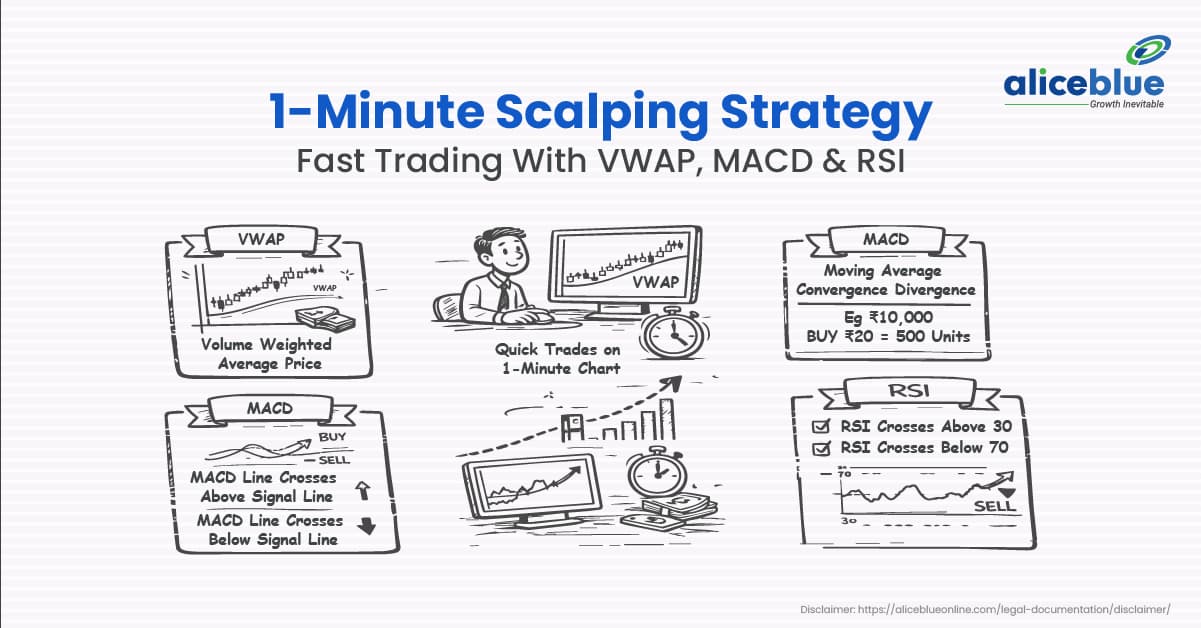
The 1 minute scalping strategy is a short term trading method where traders enter and exit trades within seconds or minutes using a 1 minute chart. It aims to capture small price moves using three indicators: VWAP (Volume Weighted Average Price), MACD (Moving Average Convergence Divergence) and RSI (Relative Strength Index). Every trade follows strict risk management rules.
It’s popular among traders who:
- Prefer quick decisions
- Like active trading sessions
- Want multiple opportunities in a single day
But scalping isn’t “easy money”. It requires:
- Quick execution
- Strong focus
- Strict risk management
Done carelessly, it can lead to fast losses. SEBI’s study of individual traders in equity derivatives found that 87.7% of them made net losses in FY26 after transaction costs.
Chart Setup for 1-Minute Scalping
Use a 1 minute chart with three indicators: VWAP on default settings, MACD at 8, 17, 9 and RSI at 9. Keep the chart clean and simple before you take any trade.
Timeframe:
1-minute chart
Indicators:
- VWAP (default settings)
- MACD (8, 17, 9)
- RSI (9)
For Nifty, apply these indicators on the Nifty futures chart. The Nifty 50 index itself has no traded volume, so VWAP cannot be calculated on the index chart.
Indicator | Recommended Settings for 1 Minute Scalping | Purpose | Best Time Window (India) |
VWAP | Default daily VWAP (resets at 9:15 AM IST) | Trend bias (above VWAP is bullish, below VWAP is bearish) | 9:30 AM to 11:00 AM and 1:30 PM to 2:30 PM IST |
MACD | Fast: 8, Slow: 17, Signal: 9 | Momentum trigger (crossover plus histogram) | High volume sessions |
RSI | Period: 9 (levels 30 and 70) | Overbought and oversold filter plus divergence | Morning momentum bursts |
Understanding the Indicators
VWAP sets the trend bias, MACD times the momentum and RSI confirms the strength of the move. Here is how each one works.
1. VWAP (Volume Weighted Average Price):
VWAP shows the average price at which an asset has traded during the day since 9:15 AM IST, weighted by volume. Institutions use it as a benchmark for their buying and selling.
- Price above VWAP: bullish bias (buyers are in control of the market)
- Price below VWAP: bearish bias (sellers are in control of the market)
VWAP resets automatically every day at 9:15 AM, so you always get a fresh line for that trading session. Because VWAP needs volume data, use index futures charts for Nifty and Bank Nifty, not the index charts.
Best Time to Use VWAP for 1 Minute Scalping in India
The best window for 1 minute scalping on NSE is 9:30 AM to 11:00 AM IST, when volume is heavy and VWAP has settled. A second window runs from 1:30 PM to 2:30 PM IST.
- Golden window: 9:30 AM to 11:00 AM IST, the 90 minutes after the opening noise settles
- Second good window: 1:30 PM to 2:30 PM IST
- Avoid the first 15 minutes (9:15 AM to 9:30 AM). Price is usually choppy because VWAP is just starting to form.
- Skip the last 15 minutes of the session unless you’re very experienced.
VWAP works well on futures charts during these hours because many institutional execution algorithms benchmark their orders against VWAP.
2. MACD (Moving Average Convergence Divergence):
For scalping on 1-minute charts, the default 12-26-9 settings are too slow. Use these faster settings instead:
MACD is a momentum indicator that shows the relationship between two moving averages. It shows the speed of price movement through two lines and a histogram.
- MACD line (faster): the difference between two EMAs (Exponential Moving Averages)
- Signal line (slower): a 9 period EMA of the MACD line
- Histogram: the visual gap between the two lines (green means bullish momentum, red means bearish momentum)
- Bullish crossover: the MACD line crosses above the signal line, which signals possible upward momentum
- Bearish crossover: the MACD line crosses below the signal line, which signals possible downward momentum
- Fast Length: 8
- Slow Length: 17
- Signal Smoothing: 9
3. RSI (Relative Strength Index):
RSI measures the strength of price movements on a scale of 0 to 100.
- Above 70: overbought
- Below 30: oversold
- Around 50: neutral zone
Many traders read RSI below 30 as a possible bounce zone and above 70 as a possible pullback zone. On a 1 minute chart, RSI can stay in these zones for a long time during strong trends. So in this strategy, RSI is a filter that confirms momentum and entry timing, not a standalone buy or sell signal.
RSI Trading Signals:
- Bullish divergence: Price makes lower lows, but RSI makes higher lows. Selling momentum is weakening even as price drops, which hints at a possible upward reversal. It is most reliable when RSI is below 30 to 40.
- Bearish divergence: Price makes higher highs, but RSI makes lower highs. Buying momentum is fading, which hints at a possible downward reversal. It is most reliable when RSI is above 60 to 70.
- Hidden bullish divergence: Price makes a higher low during an uptrend pullback, but RSI makes a lower low. The uptrend remains strong and the pullback is likely temporary, so it suits buying the dip.
- Hidden bearish divergence: Price makes a lower high during a downtrend rally, but RSI makes a higher high. The downtrend remains dominant and the rally is weak, so it suits selling on rallies.
The 1-Minute Scalping Strategy (VWAP + MACD + RSI)
Take a long trade only when price is above VWAP, MACD crosses up and RSI is above 30 and rising. Take a short trade only when all three point down. If any one indicator disagrees, skip the trade.
Long Setup:
- Price clearly above VWAP
- MACD line crosses above the signal line, and the histogram is green
- RSI is above 30 and climbing (not in the oversold range)
- Enter on candle close
Short Setup:
- Price clearly below VWAP
- MACD line crosses below the signal line, and the histogram is red
- RSI is below 70 and falling (not in the overbought range)
- Enter on candle close
Example Trade:
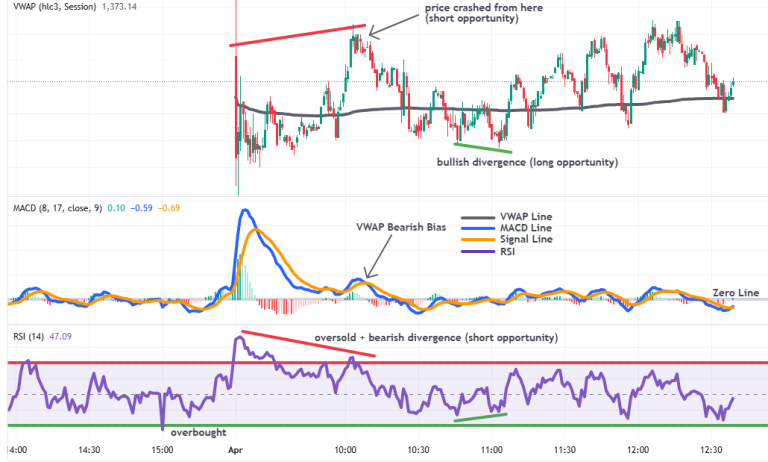
Long vs Short Setup Summary
Condition | Long (Buy) Setup | Short (Sell) Setup |
VWAP Bias | Price clearly above VWAP | Price clearly below VWAP |
MACD Signal | MACD line crosses above signal line, green histogram | MACD line crosses below signal line, red histogram |
RSI Filter | Above 30 and climbing | Below 70 and falling |
Entry | On candle close | On candle close |
Stop Loss | Below the recent swing low | Above the recent swing high |
Risk to Reward | Minimum 1:1.5 to 1:2 after costs | Minimum 1:1.5 to 1:2 after costs |
Pros and Cons of the VWAP + MACD + RSI Scalping Strategy
The main strength of this strategy is its clear rules. The main weakness is that costs and screen time can outweigh small gains.
Aspect | Pros | Cons |
Clarity | Very clear entries based on fixed rules | Requires constant screen time |
Applicability | Works on stocks, futures and options | Spreads, brokerage and STT eat small profits |
Filters | Combines trend, momentum and exhaustion | Emotionally demanding |
Best Conditions | High volume trending sessions | Poor in sideways or low volume markets |
Entry, Stop Loss & Target
Enter only after a confirmation candle closes, place the stop loss beyond the recent swing and set a target that still gives at least 1:1.5 after costs. This is where most scalpers fail.
Entry:
- Enter after a confirmation candle closes in your direction
- Avoid jumping in too early
Stop Loss:
- Place below the recent swing low (for buy trades)
- Place above the recent swing high (for sell trades)
Entry:
- Keep targets small and realistic
- Aim for a risk-reward ratio of 1:1 or slightly higher
Risk Management & Position Sizing
Risk no more than 0.5% to 1% of your account on any single trade. Take no more than 12 trades a day, and stop for the day once losses reach 2% of your account.
Category | Recommendation | Why It Matters |
Risk per Trade | Maximum 0.5% to 1% of the account | Protects capital during losing streaks |
Daily Trades | 5 to 12 high quality setups, never more than 12 | Prevents overtrading |
Daily Loss Limit | Stop after a 2% loss | Saves you from revenge trading |
Best Sessions | 9:30 AM to 11:00 AM IST (heavy volume) | Cleanest signals and lower slippage |
More trades do not mean better results. SEBI’s FY26 study found that loss rates rose with turnover. They went from 86.4% for traders with yearly turnover under ₹1 lakh to 89.7% for those above ₹1 crore.
Tip: Scalping is fast and emotional. If you feel the urge for revenge trading (trying to win back losses quickly), close the platform immediately.
Best Market Conditions for Scalping
The 1 minute scalping strategy works best in trending, high volume sessions, especially in the first one to two hours after the 9:15 AM open. It works poorly in sideways or low volume markets.
Works Best In:
- Trending markets
- High-volume sessions
- Market open (first one to two hours)
Avoid:
- Sideways or choppy markets
- Low-volume periods
If the market seems unclear, better to stay away than force a trade.
Common 1 Minute Scalping Mistakes to Avoid
Most beginners struggle with scalping because they ignore VWAP, enter before all three indicators agree, overtrade in quiet hours or trade without a stop loss. Here are the mistakes to watch for:
- Ignoring VWAP bias
- Entering before all three indicators align (entering without confirmation of signals)
- Overtrading during low volume hours
- Trading without a predefined profit target or stop loss
- Setting targets without accounting for brokerage, STT and slippage
Pro Tips for Better Results
- Wait for all indicators to align, and don’t rush trades
- Trade only during high volume hours
- Take a few quality trades instead of many random ones
- If you miss a move, let it go; another opportunity will come
- Add the 9 and 21 EMA crossover for extra trend confirmation
- During strong trends, relax RSI levels to 25 and 75
- Create a TradingView alert for a MACD cross with price above or below VWAP to reduce screen time
Sometimes, the best trade is no trade at all.
Conclusion
The 1 minute scalping strategy works because it combines trend (VWAP), momentum (MACD) and timing (RSI) into one simple system with clear rules for fast intraday trades.
But success doesn’t come from knowing the strategy alone. It comes from:
- Discipline
- Patience
- Risk control
Focus on high quality setups, keep losses small, check costs before every trade and stay consistent.
A reliable trading platform makes chart analysis and order placement faster. Platforms like Alice Blue ANT offer tools that support indicator based trading, so you can test and refine your approach in real market conditions.
Frequently Asked Questions
There’s no fixed number, but most professional scalpers limit themselves to 5-12 high-quality trades per day. Taking too many trades usually leads to over-trading and unnecessary losses.
It depends on what you trade. Small amounts work only for learning or small equity intraday positions.
- ₹5,000 to ₹10,000: learning phase, paper trading or small equity intraday trades
- ₹25,000 and above: more flexibility with risk management in equity intraday
- Index futures: SEBI raised the minimum contract value of index derivatives to ₹15 lakh to ₹20 lakh from 20 November 2024, so futures need far more margin
Check the exact margin on your broker’s margin calculator. The key is not capital size, but proper position sizing and discipline.
They matter a lot. Choose a broker with low brokerage (₹20 or less per order) and tight spreads on futures. Factor in 2-4 points of slippage in your stop-loss and target calculations. If your average winner is 12-15 points, a bad broker can turn a winning strategy into a losing one.
Yes, but a larger screen works better. This strategy needs you to see all three indicators confirm at once. On mobile, charts are smaller, candle updates can lag slightly, and switching between indicator views can cost you 3 to 5 seconds.
On any device, look for a platform with low latency, fast order execution and advanced charting with custom indicator settings.
Don’t chase the trade. When price is stretched far above or below VWAP, it is called overextension. If price is far above VWAP, avoid a long entry even if MACD is bullish. Price often pulls back toward VWAP, so wait for it to return and consolidate before your next entry.
This is one of the most overlooked parts of 1-minute scalping in India. Since you take many trades for small point gains, the combined cost of brokerage, STT, GST, and other charges can easily eat away 30% to 60% of your gross profits. Especially after the STT hike effective from April 2026. To stay profitable, use a flat-fee brokerage plan (₹20 or less per order) and make sure your average winning trade is large enough.
Leverage can amplify profits, but also losses. Beginners should use low leverage and focus on risk management. High leverage and fast trading are high risk if not controlled properly.
A good platform can make a big difference in execution speed and accuracy, so look for platforms that offer low latency, fast order execution, and advanced charting (like TradingView integration).
- EMA (9 & 21) for trend confirmation
- Stochastic RSI for faster signals
- Volume Indicators for breakout strength
However, adding too many indicators can reduce clarity. Try to keep your setup simple and consistent.
This usually happens for a variety of reasons, such as entering late (after the move already started), trading during choppy/low-volume markets, or ignoring overall trend context. Even the best strategy has losing trades. Try to focus on execution consistency and not perfection.
While the logic applies to both, it is generally more accurate for futures because VWAP is calculated using volume, which is more “pure” in the futures market. If you’re scalping options, be mindful of time decay. In a 1-minute window, a stagnant price means your option value is dropping even if the setup remains valid.
To minimise slippage, always use limit orders instead of market orders when possible and only trade assets with a “thin” spread (high liquidity). If the gap between the “buy” and “sell” price is too wide, the trade isn’t worth the risk.
No trade. The strength of the 1-minute scalp strategy lies in the “confluence”. If the MACD crosses but the RSI is flat, it suggests the move lacks internal strength.
It works very well on index options, especially during the first 90 minutes after 9:15 AM. Trade ATM or slightly OTM options with good liquidity. Just remember that time decay works against you, so keep every trade under 8 minutes and never hold overnight.
Most disciplined traders see a 55-65% win rate when they strictly follow the three-indicator rules. Expect 4-8 quality trades per day during high-volume sessions, aiming for 0.8-1.5% net profit on your capital after commissions and slippage. Backtest at least 200 trades before expecting consistent income.
Open TradingView, switch to the 1-minute timeframe on Nifty or Bank Nifty, and add the three indicators with the exact settings mentioned above (MACD 8-17-9, RSI 9 or 14). Scroll back 30-60 trading days and manually mark every setup that met all three rules. Track win/loss, risk-reward, and time of day. This will show the real edge in the Indian market conditions.
For 1-minute scalping in the Indian market, the faster 8-17-9 settings are strongly recommended. The default 12-26-9 is too slow and often misses the quick momentum moves that happen in Nifty and Bank Nifty. Test both on historical data; most traders switch to the faster version within a week.

Blog by Aliceblue News Desk