
Algo Trading in F&O Markets in India: How It Works, Benefits, Risks & SEBI Rules (2026)
Blog by Aliceblue News Desk
22 June 2026
9 minutes
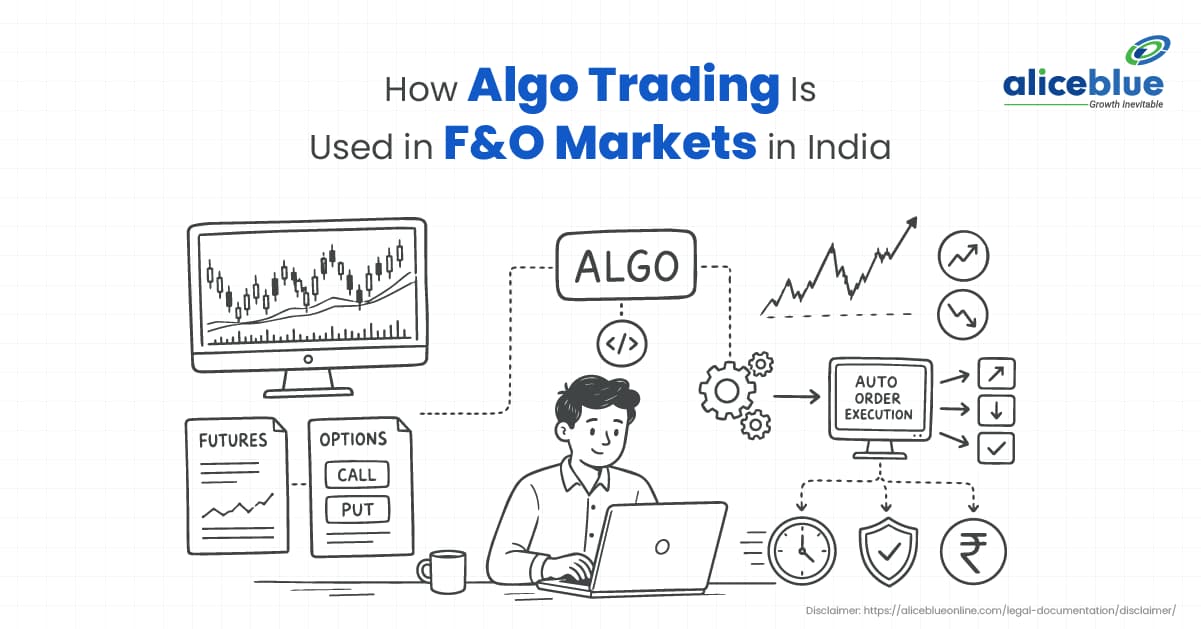
Imagine it is 9:20 AM on a highly volatile expiry Thursday. You’re watching the Nifty spot index break out of its opening range and attempt to execute a multi-leg option strategy manually. By the time you select your strike prices and hit “buy,” the premiums have spiked sharply, slippage chips away at your potential profit, and the moment is gone.
Many derivatives traders face this exact execution lag daily. This is why algorithmic trading in futures and options in India has seen massive adoption.
The National Stock Exchange (NSE) continues to report that automated orders constitute a significant majority of the total derivatives turnover in India. As trading infrastructure becomes accessible to individual retail participants, understanding algorithmic trading in futures and options in India has become increasingly important for active derivatives traders.
In this guide, you will learn how algo trading works in India’s F&O market, how algorithms execute futures and options trades, the benefits and risks involved, key SEBI compliance requirements, and how beginners can get started with automated trading.
Quick Definition
Algo trading in the F&O market refers to using pre-programmed software code to automatically analyse market data, calculate options greeks, and execute multi-leg futures or options orders via a broker API without manual human intervention. All automated orders are executed based on strict mathematical parameters such as time, price, volume, or technical indicators.
Read our detailed guide on Futures and Options Trading to understand how F&O contracts work before exploring algorithmic strategies.
What Is Algo Trading in F&O Markets?
Futures and options prices can change very quickly, especially during market openings, expiry days, or major news events. Because prices move fast, traders may miss opportunities when placing orders manually.
Algorithmic systems exist to eliminate human emotional bias and execution delays. Instead of checking charts and option prices manually, an algorithm can monitor multiple market conditions at the same time and place trades automatically when predefined conditions are met. It continuously tracks market prices and can enter, exit, or adjust trades instantly when the rules set by the trader are triggered.
In India, this concept operates directly through structured infrastructure provided by stockbrokers, allowing everyday retail participants to access tools that were once mainly used by institutional traders.
How Does Algo Trading Work in India's F&O Market?
Deploying an automated strategy in the Indian derivatives segment follows a highly structured, code-to-exchange workflow. This sequence ensures your trades are executed correctly while staying fully compliant with current market regulations.
- Step 1: Coding or Selecting the Logic: The trader defines strict entry and exit criteria. This could be a transparent “White Box” strategy (e.g., shorting a Straddle when the Relative Strength Index hits a specific level).
- Step 2: Secure Login and Access Setup: To prevent unauthorised system access, the trader binds their secure account API key to a whitelisted static IPv4 address provided by their Internet Service Provider (ISP). The trader completes a mandatory Two-Factor Authentication (2FA) login each morning before the pre-open market session to activate the system.
- Step 3: Market Scanning: The automated script streams real-time market feeds (tick-by-tick data) directly from the exchange via the broker’s data servers.
- Step 4: Order Placement: When an entry condition is met, the system prepares the order. Under current guidelines for unregistered strategies, the algorithm ensures throughput stays within the safe limit of 10 Orders Per Second (OPS) per exchange.
- Step 5: Sending Orders to the Exchange: The order is instantly routed using secure broker API trading. The broker automatically attaches a mandatory, unique Exchange Strategy ID to the order before passing it to the NSE or BSE for instant execution.
Example of an Automated F&O Trade
Let us look at a realistic scenario involving an automated option selling algo trading in India:
A systematic options trader sets up an automated 9:20 AM Short Straddle strategy on the Nifty Index using an execution platform.
- At 9:20 AM: The underlying Nifty index is trading exactly at 23,000. The algorithm immediately scans the option chain, identifies the At-The-Money (ATM) 23,000 Call (CE) and 23,000 Put (PE), and sells both options simultaneously at a premium of ₹100 each. Total premium collected is ₹200.
- The Risk Rule: The code contains a hardcoded risk management parameter: a 30% individual stop-loss per leg. This means if either premium touches ₹130, that specific option leg must be closed instantly.
- Market Movement: At 11:15 AM, Nifty suddenly spikes upward. The 23,000 CE premium surges rapidly to ₹131.
- Automated Execution: The algorithm detects the breach in milliseconds. Without waiting for human approval, it fires an immediate market order via the API to exit the Call position at ₹130. Simultaneously, it leaves the Put option open to continue decaying or adjusts its strike price automatically to mitigate overall portfolio risk.
Key Features of F&O Algo Trading
- Rule-Based Architecture: Operates strictly on mathematical conditions, ensuring trades are never placed based on gut feelings or market rumours.
- Order Rate Management: Systems natively throttle execution speeds to remain safely below the exchange’s 10 orders per second limit for regular API accounts.
- Mandatory Security Safeguards: Requires fixed static IP addresses and automated daily token resets to maintain highly secure server connections.
- Complete Traceability: Every single automated order carries a digital fingerprint via a unique broker-assigned strategy tag, ensuring complete transparency with regulators.
Benefits of Algo Trading in Futures and Options
Using F&O trading automation delivers distinct competitive advantages to systematic participants:
- Mitigation of Emotional Bias: It removes psychological traps like revenge trading, greed, or the hesitation to cut a losing trade when a stop-loss is reached.
- Superior Execution Speed: Algorithms calculate, route, and fill complex, multi-leg options strategies in milliseconds, vastly reducing expensive execution slippage.
- Simultaneous Portfolio Monitoring: An automated setup can effortlessly run multiple distinct strategies across Nifty, Bank Nifty, and FinNifty concurrently, a task impossible for a manual trader.
- Scientific Backtesting Capacity: Traders can rigorously test their ideas against years of historical derivatives tick data to verify statistical edge before risking live capital.
Risks of Algorithmic Trading in F&O
While automation provides significant efficiency benefits, a balanced approach requires understanding its core operational challenges:
- The Trap of Overfitting: It is common to over-optimise an algorithm’s historical performance parameters until its past results look flawless. However, these strategies often fail in live, unpredictable market regimes.
- Technical Dependency Risks: If your local internet connection drops, your cloud server loses power, or your broker’s API endpoints experience heavy lag during peak market openings, trades can fail or get stuck.
- The Static IP Hurdle: Since Indian exchanges strictly reject orders originating from dynamic or unverified IP addresses, any unexpected IP rotation by your internet service provider will instantly stop your algorithm from executing.
SEBI Rules for Algo Trading in India
If you use algorithmic trading in India, keep these important rules in mind:
- Use an Approved Connection
- Your broker may require a registered or approved IP address for API-based trading.
- This helps improve account security and prevents unauthorised access.
- Daily Login Verification
- Traders must complete Two-Factor Authentication (2FA) before using API trading each day.
- This adds an extra layer of security.
- Order Speed Limits
- Retail algorithms generally operate within exchange-defined order limits.
- Strategies that generate very high order volumes may require additional approvals.
- Strategy Transparency
- If you build and use your own strategy, you can generally use it for personal trading.
- Vendors offering automated strategies to the public must comply with applicable SEBI regulations.
- Risk Controls
- Brokers may apply safeguards such as price protection checks to reduce the risk of incorrect or extreme orders.
Tips for Beginners Starting F&O Algo Trading
If you are a retail participant looking to enter the retail algo trading in the Indian derivatives market, follow these fundamental habits to safeguard your capital:
- Begin with Paper Trading: Always run a new strategy through a virtual forward-testing sandbox for at least two to three weeks to observe how it handles live slippage and real-time data feeds.
- Enforce Hard Account-Level Stops: Code a global daily loss limit into your system. For example, instruct the script to automatically kill all active connections and close all positions if the net account equity drops by 2% on any single day.
- Stay Well Below the OPS Limit: Design your loops carefully so your code never spams the exchange with quick modifications, keeping your order frequency comfortably under the 10 orders per second threshold.
- Maintain Cash Margin Buffer: Always adhere strictly to the exchange’s 50:50 margin requirement, keeping a clean balance of clear cash alongside your pledged collateral components to avoid sudden margin penalties.
Algo Trading vs Manual Trading: Key Differences
Feature | Algorithmic F&O Trading | Manual F&O Trading |
Execution Speed | Extremely high (milliseconds) | Low (seconds to minutes) |
Emotional Discipline | Follows predefined rules | Prone to fear, greed, and hesitation |
Slippage Management | Optimized via immediate limit/market routing | High, especially during volatile expiries |
Regulatory Compliance | Requires whitelisted Static IP & daily 2FA | Standard mobile or web app login |
Strategy Multi-Tasking | Can scan and trade dozens of strikes at once | Limited to a few monitor screens |
Common Mistakes to Avoid
- Ignoring Transaction Costs: Beginners often ignore the impact of statutory transaction fees. Following recent updates, Securities Transaction Tax (STT) stands at 0.05% for Futures and 0.15% on Option premiums. High-frequency algorithms with tiny profit targets can easily be drained by these costs and exchange charges.
- Failing to Verify Vendor Licenses: If you are purchasing a pre-built “Black Box” strategy from a third-party marketplace where the core logic is hidden, always verify that the provider holds a valid SEBI Research Analyst (RA) license. Relying on unregistered platforms is a major regulatory and capital risk.
- Leaving Systems Completely Unmonitored: “Set-and-forget” is a myth. Even the most robust systems require human oversight to handle Black Swan geopolitical events, unexpected exchange tech glitches, or internet drops.
Who Should Use Algo Trading?
Algorithmic setups are highly suited for disciplined, systematic traders who operate structured, rule-based methodologies. It is especially beneficial for active option sellers who specialize in time-decay strategies and require multi-leg precision across rapid market expiries.
Conversely, this approach is completely unsuited for long-term equity delivery investors, macro wealth-builders, or discretionary traders who rely purely on subjective chart patterns, intuition, and flexible, non-quantifiable market interpretations.
Conclusion
Automated systems have changed how many traders execute derivatives strategies. Understanding how algorithmic trading is used in F&O markets in India shows that success relies entirely on structural discipline, rigorous validation, and compliance with the current SEBI algo trading rules. Technology provides an execution vehicle, but it cannot fix a flawed underlying trading edge.
Focus on thorough backtesting F&O strategies in India, respect your risk parameters, and use automation as an efficiency tool to streamline your systematic trading operations.
Disclaimer: Algorithmic trading involves market risk. Past performance from backtests or paper trading does not guarantee future results. Traders should evaluate strategies carefully and ensure compliance with current exchange and regulatory requirements.
Frequently Asked Questions
Yes. Many brokers and trading platforms now offer no-code or low-code tools that allow beginners to automate simple trading strategies without advanced programming knowledge.
Not always. Some platforms provide drag-and-drop strategy builders, while others require coding knowledge in languages such as Python.
There is no fixed amount. The capital required depends on the strategy, margin requirements, and risk management rules used by the trader.
No. Algorithmic trading can improve speed and discipline, but profitability depends on the quality of the strategy, market conditions, and risk management.
Yes. Algo trading is legal in India when conducted through approved brokers and in accordance with SEBI and exchange regulations.

Blog by Aliceblue News Desk


