What Is a Marketplace in Algo Trading and Who Is It For?
Blog by Aliceblue News Desk
28 September 2026
9 minutes
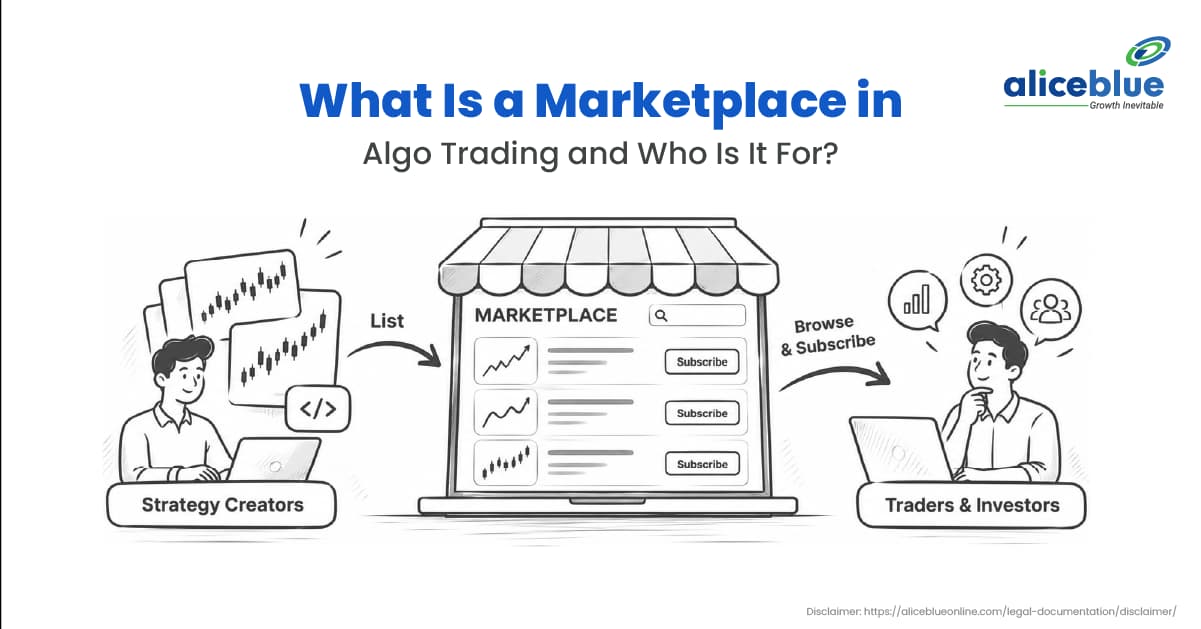
A trader may want to use an automated trading strategy but may not know how to create one. Another trader may have a strategy and want to make it available to clients. A Market Place brings these two needs together.
In simple terms, a Marketplace is a section where users can browse and subscribe to ready-made trading strategies. On 1LyAlgos, clients can explore strategies provided by external partner providers, review details such as capital, returns, and drawdown, and subscribe according to the provider’s terms. Eligible partners, vendors, and SEBI-registered Research Analysts can build, test, and list strategies for clients.
Quick Answer
A marketplace in algo trading is a platform where users can find and subscribe to ready-made trading strategies. It is meant for clients who want rule-based trading without writing code and for eligible strategy creators who want to build, test, and list their strategies. Before subscribing, users should check the strategy rules, capital requirement, drawdown, charges, and provider details.
What Is a Marketplace in Algo Trading?
A marketplace is a section of an algo trading platform where trading strategies are listed for users to review and subscribe to.
A listed strategy may have rules that decide:
- When to enter a trade.
- When to exit a trade.
- Where to place a stop loss.
- When to adjust a position.
- When to stop taking new trades.
The strategy follows these rules after it is connected to a trading account. The client does not need to create the strategy from the beginning. However, the client should understand what the strategy trades, how it works, and how much money could be lost.
The 1LyAlgos guide identifies two main users:
- Clients who want to subscribe to listed strategies.
- Partners, vendors and SEBI registered Research Analysts who want to build, test and list strategies for clients.
Market Place and Ready to Subscribe
Market Place strategies and Ready to Subscribe strategies serve a similar purpose, but they come from different providers.
Parameter | Ready to Subscribe | Market Place |
Provider | Created and maintained by Alice Blue | Provided by external partner strategy providers |
Selection | Strategies available from Alice Blue | Strategies listed by different partners |
Client action | Review and subscribe | Browse, compare, review and subscribe |
Information available | Backtest, performance, signals and drawdown | P&L, returns, equity curve, drawdown and risk details |
Cost | No strategy subscription fee according to the product page | Capital and subscription terms depend on the provider |
Suitable for | Users who want Alice Blue listed strategies | Users who want to explore partner strategies |
The current 1LyAlgos product information states that Ready to Subscribe strategies are created and maintained by Alice Blue, while Marketplace strategies are provided by external partner providers.
How Does a Marketplace Work?
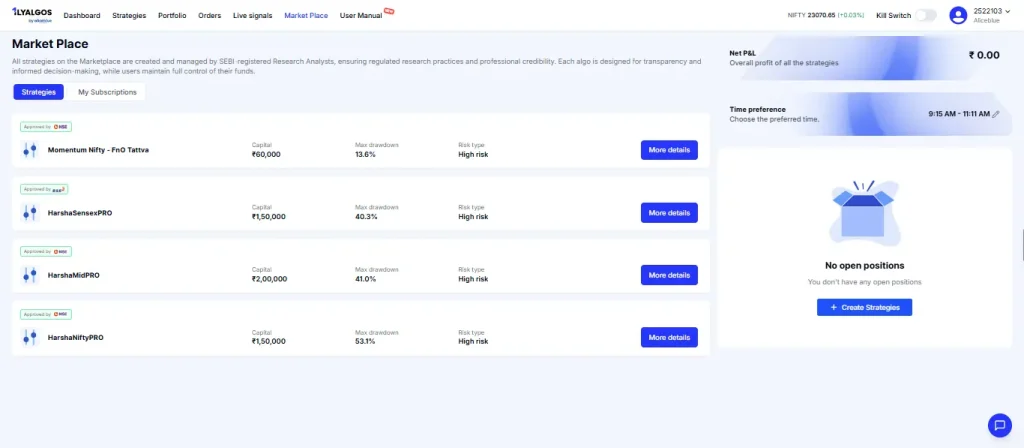
1. Open the Marketplace
A client can access the section through:
1LyAlgos, Marketplace, Strategies
The exact navigation may differ between the website and application.
2. Browse listed strategies
The user can review strategies based on the market segment, trading style, capital requirement, and risk level.
A strategy may trade:
- Equity.
- Futures.
- Options.
- Intraday positions.
- Swing positions.
- Expiry day positions.
- Technical indicator signals.
- Multi-leg options positions.
Do not select a strategy only because it shows a high return. A high historical return may also come with a large fall in capital.
3. Review the available information
Before subscribing, check:
- Backtest period.
- Historical returns.
- Maximum drawdown.
- Largest losing trade.
- Number of trades.
- Losing periods.
- Capital requirement.
- Slippage and trading costs.
- Live or simulated performance.
A backtest shows how a strategy performed using earlier market data. It does not guarantee future returns.
4. Understand drawdown
Drawdown means the fall in a strategy’s value from an earlier high.
For example, suppose a strategy grows from ₹1,00,000 to ₹1,20,000 and then falls to ₹1,08,000.
The fall from the highest value is ₹12,000. This is the drawdown from the high.
A user should check whether they can tolerate this type of fall before subscribing.
5. Check the subscription terms
The strategy may have a monthly or quarterly subscription. Capital requirements and charges may differ between providers.
Include these costs in your calculation:
- Strategy subscription fee.
- Brokerage.
- Exchange charges.
- Goods and Services Tax.
- Securities Transaction Tax, where applicable.
- Stamp duty.
- Slippage.
- Margin requirements.
SEBI’s February 2025 circular states that algo providers using a broker’s Application Programming Interface act as the broker’s agent for this purpose. It also requires brokers to use controls such as client-specific API access, authentication, and identification of algo orders.
6. Connect and deploy
After completing the required steps, the user may connect an eligible trading account and deploy the strategy.
The strategy can then send orders according to its rules. The client should still check the account for:
- Open positions.
- Available margin.
- Order rejections.
- Technical alerts.
- Unusual losses.
- Changes in drawdown.
Automated execution reduces manual order placement. It does not remove the need to monitor the account.
Practical Example
Suppose a client reviews a listed strategy with these details:
- Capital allocated: ₹1,00,000.
- Historical maximum drawdown: ₹10,000.
- Monthly subscription fee: ₹800.
- Estimated monthly trading costs: ₹500.
These figures are only an example. They are not a return estimate or a promise of performance.
If the strategy produces a gross gain of 3% in one month:
- Gross trading gain is ₹3,000.
- Less subscription fee is ₹800.
- Less estimated trading costs are ₹500.
- Amount left before taxes is approximately ₹1,700.
If the strategy produces a 4% loss in another month:
- Trading loss is ₹4,000.
- Subscription fee is ₹800.
- Estimated trading costs are ₹500.
- Total reduction before taxes is approximately ₹5,300.
This example shows why a user should consider all costs. A gross return does not equal the final amount received by the client.
Who Is the Marketplace For?
- Busy professionals
People who cannot watch charts throughout the trading session may consider a rule-based strategy. They should still understand the strategy and monitor the trading account.
2. Non coders
Users who understand basic trading but do not want to write computer code can explore ready-made strategies.
3. Beginners learning about algo trading
A marketplace can help beginners understand concepts such as entry rules, exits, drawdown, and automated execution. It should not be treated as a shortcut to guaranteed returns.
4. Experienced traders
Experienced traders may compare strategies, study performance data or use a partner strategy alongside their own trading system.
5. Strategy creators
Partners, vendors and eligible SEBI-registered Research Analysts can use strategy builders and testing tools to create, test, deploy and list strategies. The 1LyAlgos guide mentions a Leg Builder, Technical Indicators, and a Custom Strategy builder.
Who Should Be Careful?
A Market Place may not suit someone who:
- Expects fixed returns.
- Cannot afford a trading loss.
- Does not understand the instrument being traded.
- Uses borrowed money without understanding the risk.
- Chooses a strategy only because of its past return.
- Cannot monitor the account or respond to technical issues.
- Needs the money for household expenses or near-term commitments.
Benefits of Using a Marketplace
- Less setup work
Clients can explore listed strategies without creating the entire system themselves.
2. More strategy choices
Partner listings may provide access to different trading styles and market segments.
3. Performance details
Users can review information such as backtest results, returns, equity curves, and drawdown where available.
4. Rule-based trading
The strategy uses preset conditions instead of requiring the user to make every decision manually.
5. Tools for strategy creators
Eligible creators can use strategy builders and testing environments before listing their strategies for clients.
6. Comparison before subscription
Users can compare capital requirements, risk type, strategy logic, and subscription terms before making a decision.
Risks and Limitations
- Backtests do not guarantee future results
A strategy that worked in the past may not work in the same way in the future.
2. Live results may differ
Slippage, order delays, liquidity, rejected orders, and price gaps can affect live performance.
3. Options can lose value quickly
Option buyers can lose the premium paid. Option sellers may face large losses if the market moves sharply or risk controls do not work as expected.
4. Charges reduce returns
Subscription fees and trading costs reduce the amount left after a profitable trade.
5. Technical issues can affect orders
A broker outage, API problem, data delay or internet issue may affect order placement or execution.
A strategy may perform differently in changing markets
A strategy designed for a rising market may not perform well when prices move sideways or fall.
SEBI’s framework also provides for exchange supervision, algo order identification, and a kill switch that can stop trading activity in certain circumstances. These controls are intended to support safer participation, but they do not prevent losses from market movements.
Beginner Checklist Before Subscribing
Before using a strategy, ask:
- What does the strategy trade?
- Is it for intraday or positional trading?
- How much capital is required?
- What was the maximum historical drawdown?
- What was the longest losing period?
- Are trading costs included in the results?
- Who provides the strategy?
- Has it been tested in live market conditions?
- Can I pause the strategy?
- What happens to open positions if execution stops?
- Can I afford the possible loss?
Common Mistakes to Avoid
- Choosing the highest return
A high historical return may come with high risk. Review drawdown and losing periods as well.
2. Treating backtesting as a guarantee
Backtesting explains past performance. It cannot predict the exact result of your future trades.
3. Ignoring the trading segment
Equity, futures, and options have different risks. Learn the product before subscribing.
4. Using all your capital
Do not allocate your entire trading capital to one strategy. Use an amount that matches your risk capacity.
5. Ignoring charges
Brokerage, taxes, subscription fees, and slippage can reduce the final result.
6. Assuming automation means no supervision
Check your positions, available margin, order status, and alerts regularly.
Conclusion
A marketplace in algo trading allows clients to explore and subscribe to ready-made trading strategies. It also gives eligible strategy creators tools to build, test, and list their systems. The platform can reduce coding and manual order placement, but it does not remove market risk. Before subscribing, review the strategy rules, trading segment, capital requirement, drawdown, charges, provider details, and execution process. Treat backtests as historical information, not as a promise of future returns.
Frequently Asked Questions
A Marketplace is a platform where users can find and subscribe to ready-made trading strategies. These strategies use preset rules for entries, exits, and risk controls.
Clients can use it to explore partner-listed strategies without creating their own code. Eligible strategy creators can use the platform to build, test, and list strategies for clients.
No. A client does not usually need to write code to subscribe to a listed strategy. The client still needs to understand the strategy, its risks, and its costs.
It can be used by beginners, but it is not risk-free. New users should start with limited capital, understand the strategy, and avoid using money needed for essential expenses.
Check the instrument, capital requirement, maximum drawdown, losing periods, backtest duration, charges, provider details, and execution process.
Ready to Subscribe strategies are created and maintained by Alice Blue. Market Place strategies are provided by external partner strategy providers, according to the available 1LyAlgos product information.
The 1LyAlgos guide states that partners, vendors, and eligible SEBI-registered Research Analysts can use the Leg Builder, Technical Indicators, or Custom Strategy Builder to create and test strategies before listing them.

Blog by Aliceblue News Desk