
What Is Dematerialisation? Meaning, Process, and Benefits for Indian Investors
Blog by Aliceblue News Desk
19 February 2023
5 minutes
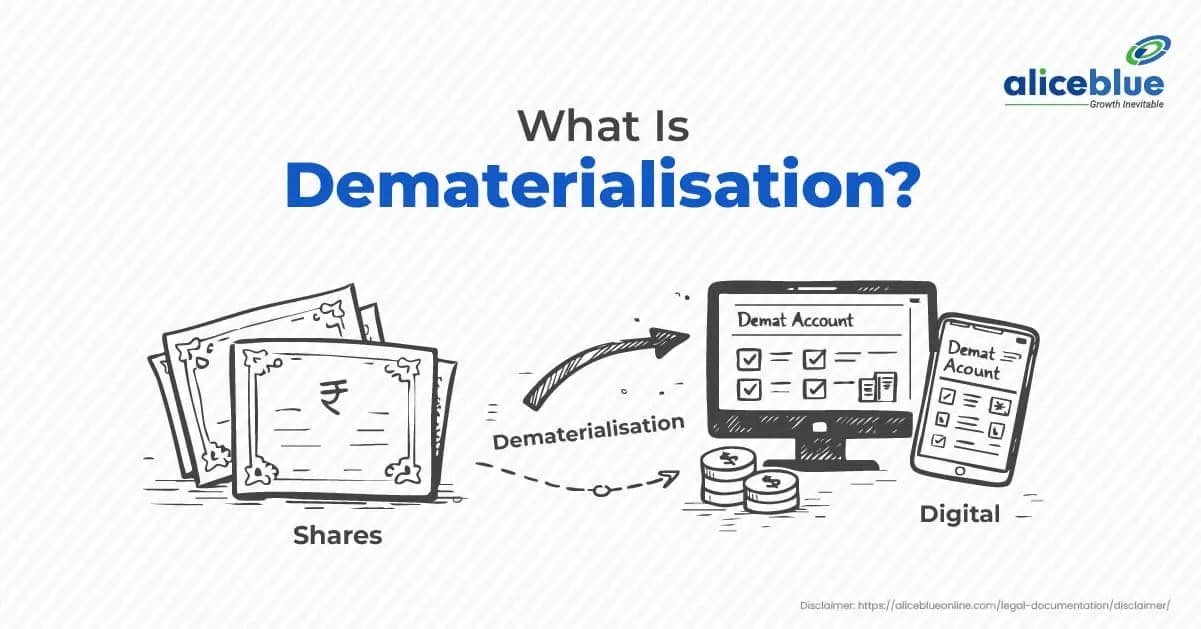
Before 1996, buying shares in India meant waiting for a paper certificate to arrive by post. You stored it in a locker, hoped it wouldn’t get lost, and handed it over in person when you wanted to sell. The process took weeks, sometimes months.
That system is gone. Today, when you buy a share, it appears in your account within one business day, no paper, no courier, no signature required. That shift occurred due to dematerialisation, and understanding it is the first step to understanding how the Indian stock market actually works.
What Is Dematerialisation?
Dematerialisation is the process of converting physical share certificates into electronic records stored in a Demat account. The shares themselves do not change, your ownership remains the same. What changes is the format in which that ownership is recorded and held.
In India, two depositories manage all dematerialised securities:
- NSDL (National Securities Depository Limited) — Set up in 1996, currently holds over 3.5 crore Demat accounts with 278 registered Depository Participants
- CDSL (Central Depository Services Limited) — Set up in 1999, currently holds over 15 crore Demat accounts with 599 registered Depository Participants
SEBI regulates both. Together, they hold the electronic records for every share owned by every investor in India.
History of Dematerialisation in India
The story starts with the 1991 economic reforms. As India opened its markets, trading volumes at stock exchanges began to rise rapidly. The existing paper-based system could not keep up. Settlement delays were common. Certificate forgeries were a real problem. Disputes over share transfers piled up.
SEBI, established in 1992, identified dematerialisation as the solution. The Depositories Act was enacted in 1996, and NSDL was established that same year as India’s first depository. CDSL followed in 1999 to bring competition and a wider reach.
By 2018, SEBI made it mandatory for unlisted public companies to hold securities only in electronic form. Today, all new share issuances from listed companies are in Demat form by default. Physical certificates remain in some older portfolios, but they cannot be traded until they are dematerialized.
How the Dematerialisation Process Works
If you invest through a broker today, your shares are automatically held electronically after every transaction. The steps below apply when you want to convert physical certificates to a tradable electronic format.
Step 1 — Open a Demat account
You need a Demat account with a Depository Participant (DP). A DP is an intermediary, a broker or a bank that connects you to NSDL or CDSL.
Step 2 — Fill the Dematerialisation Request Form (DRF)
Collect this form from your DP. Write “Surrendered for Dematerialisation” on the face of each physical certificate before submitting. This is mandatory; skipping it results in rejection.
Step 3 — Submit to your DP
Hand over the completed DRF, along with the physical certificates, to your DP. They verify the documents and forward everything to the company’s Registrar and Transfer Agent (RTA).
Step 4 — RTA verifies the certificates
The RTA verifies that the certificates are genuine and that the details match your registered records. Any mismatch, a name difference, or a missing signature, and the request is sent back.
Step 5 — Physical certificates are destroyed
Once the RTA approves, the physical certificates are officially cancelled and destroyed. The shares are credited electronically to your Demat account. Each security gets a unique 12-digit ISIN (International Securities Identification Number) that identifies it in the depository system.
The process typically takes 15 to 30 days.
A Practical Example
Anjali lives in Pune. While reviewing her late father’s documents, she finds 200 physical share certificates for a well-known FMCG company dated 1994. The company still exists and is listed, and the shares have significant value, but she cannot sell them in their current form.
She opens a Demat account with a broker, collects the DRF, writes “Surrendered for Dematerialisation” on each certificate, and submits the certificates and the completed form to her DP. The DP verifies her documents and forwards them to the company’s RTA.
Twenty-two days later, the certificates are cancelled, and 200 shares are credited to her Demat account. She can now check her holdings on her phone, sell when she wants, and receive dividends directly in her bank account, all without handling a single piece of paper.
Key Features of Dematerialisation
- All securities are held electronically in a Demat account linked to either NSDL or CDSL
- Each security has a unique ISIN number for identification and tracking
- Dividends, bonus shares, rights issues, and stock splits are credited directly to your account without manual follow-up
- No stamp duty applies to the transfer of dematerialised securities
- A single Demat account can hold shares, bonds, debentures, government securities, and mutual fund units
- Both NSDL and CDSL provide account statements and transaction alerts for all activity
Benefits and Advantages of Dematerialisation
No risk of losing your investment
With physical certificates, a house fire, flood, or simple misplacement could destroy your entire holding. Electronic records stored at a depository cannot be lost, burned, or stolen. Even if your broker shuts down, your securities remain safe with the depository.
Transactions that actually settle on time
India now operates on a T+1 settlement cycle. When you sell shares today, the funds will be credited to your account by tomorrow. Before dematerialisation, this kind of speed was impossible.
Buy one share if you want
Earlier, odd-lot trading, buying less than a standard market lot, was a logistical headache with physical certificates. Today, you can buy or sell a single share of any company with no restrictions.
Every corporate benefit reaches you automatically
When a company declares a dividend, announces a bonus issue, or offers a rights issue, the benefit is credited directly to your Demat account and bank account. You do not have to write to the company or track it manually.
One account for your entire portfolio
Shares, bonds, mutual fund units, and government securities are all in one place. At any time, you can see exactly what you hold and its value.
Risks and Limitations
Technology failures can block access temporarily
If your broker’s platform goes down or your internet connection fails, you cannot view or trade your holdings until it is restored. This rarely affects your actual securities, but it can affect your ability to act quickly during market hours.
Cybersecurity is your responsibility as well
Demat accounts are a common target for phishing attacks and SIM swap fraud. Enabling two-factor authentication and using a strong, unique password are basic steps that many investors skip. One compromised login can lead to unauthorised transactions.
Annual Maintenance Charges add up
Every Demat account comes with an Annual Maintenance Charge (AMC). Depending on your DP, the annual fee ranges from ₹0 to ₹900. For someone holding only a small number of shares, this becomes a disproportionate cost relative to their portfolio value. Compare AMC fees before choosing a DP.
Intermediary dependency
You cannot access the depository directly. You always go through a DP. If your DP experiences operational issues, you may experience delays, though your securities remain safe at the depository level.
Mandatory Dematerialisation: What Changed in 2018
A point that many beginner investors miss: dematerialisation is not just for listed company shares.
In 2018, SEBI made it mandatory for unlisted public companies to hold all securities in Demat form and to issue new shares or process transfers only electronically. This was a significant change that brought a much larger universe of companies under the dematerialisation framework.
If you hold shares in an unlisted public company, you must now hold them in a Demat account. Transferring or transmitting them without dematerialisation is not permitted under current SEBI rules.
Dematerialisation vs Rematerialisation
Rematerialisation is the reverse process, converting electronic shares back into physical certificate form. It is rarely used today, but the option exists.
|
Point |
Dematerialisation |
Rematerialisation |
|
Direction |
Physical → Electronic |
Electronic → Physical |
|
Form Required |
Dematerialisation Request Form (DRF) |
Rematerialisation Request Form (RRF) |
|
Certificate Handling |
Physical certificates are destroyed |
New physical certificates are issued |
|
Security Risk |
No risk of physical loss |
Risk of loss, forgery, or damage |
|
Trading |
Immediate digital trading |
Requires a physical transfer process |
|
Practical Use |
Standard for all investors |
Extremely rare today |
Common Mistakes Beginners Make
Forgetting to write “Surrendered for Dematerialisation” on the certificates
This is not optional. This required step prevents misuse of the certificate during processing. Submitting without it will result in your request being rejected.
Confusing a Demat account with a trading account
These are two separate accounts. Your Demat account stores your shares. Your trading account is where you place buy and sell orders. You need both, but they serve different purposes.
Not checking for name mismatches
If the name on your physical certificate does not exactly match the name registered in your Demat account or PAN, the RTA will reject the request. If your name has changed due to marriage or other reasons, you must complete a name-change procedure at the company level first.
Choosing a DP based only on AMC fees
A low AMC is attractive, but also consider transaction charges, customer service quality, and whether the DP is linked to NSDL, CDSL, or both. A DP with poor support can cause delays when you need help most.
Sitting on old physical certificates for too long
Some investors discover old certificates and delay dematerialising them. The longer you wait, the more complicated it can get, especially if the company has merged, been delisted, or changed its RTA. Act early.
Who Should Understand This
If you invest in Indian stocks, mutual funds, bonds, or any listed securities, this applies to you. Dematerialisation is not an advanced concept. It is the foundation on which Indian markets operate.
If you have inherited physical certificates, dematerialisation is the only way to make them tradable. If you are a new investor opening your first account, your shares will be dematerialised automatically with every purchase.
The only person this is irrelevant to is someone who does not invest in the Indian securities market.
India’s shift to dematerialisation was not just a technology upgrade. It fixed a broken system, one where investors could lose their life savings to a forged certificate or a misplaced envelope.
Today, crores of investors hold their portfolios entirely in electronic form, trade within seconds, and receive corporate benefits without manual intervention. That is the direct result of a regulation introduced thirty years ago that most people never think about but use every single day.
If you are new to investing, open your Demat account. If you have old physical certificates at home, start the dematerialisation process. The longer those certificates sit in a drawer, the harder they can become to convert.

Blog by Aliceblue News Desk
The Alice Blue Team is a passionate group of analysts delivering expert market insights, comprehensive coverage of stocks, economy, commodities, and personal finance through clear, actionable research.


