
Guide for a Mutual Fund Distributor to Choose the Right Schemes
Blog by Aliceblue News Desk
11 June 2026
10 minutes
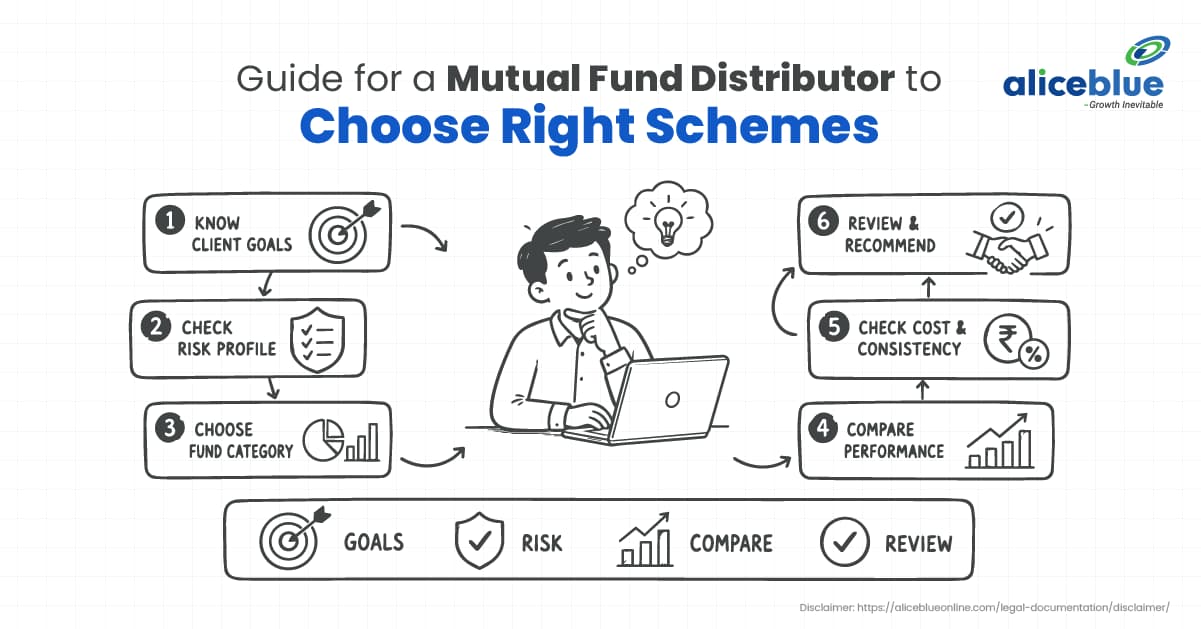
Picture this. You are a mutual fund distributor in Mumbai. A client walks in asking which mutual fund they should invest in. They have 40000 rupees monthly to invest, but do not know whether to choose a large-cap fund, a flexi-cap fund, or a hybrid fund. This is a common challenge every mutual fund distributor faces.
Choosing the wrong scheme hurts client returns and your reputation. That is why this guide for a mutual fund distributor to choose the right schemes exists. It gives you a clear process to match clients with suitable funds based on goals, risk, time horizon, and liquidity.
In 2025, SIP inflows reached 3.34 lakh crore, and India mutual fund industry AUM grew 21 percent to 80.55 lakh crore, showing how fast investor participation is rising. For more on mutual fund basics, see Alice Blue’s blog on Mutual Funds Explained 2026: Types, Returns, Risks & How to Start Investing in India.
This guide for a mutual fund distributor to choose the right schemes covers risk profiling, goal mapping, fund evaluation, compliance, and practical review methods.
What Is This Guide for a Mutual Fund Distributor to Choose the Right Schemes
This guide for a mutual fund distributor to choose the right schemes is a structured framework that helps distributors recommend suitable mutual fund investments to clients based on their unique financial situation, not just the fund with the highest recent returns.
SEBI and NISM place suitability at the center of distribution practice, and NISM Series VA covers scheme selection based on investor need, preference, and risk profile. AMFI requires a valid NISM certification before ARN registration, which makes informed recommendations a basic requirement for every distributor.
In practice, this framework means:
- Understand the client’s goal, income pattern, and need for liquidity.
- Assess risk tolerance before discussing products.
- Choose the right category first and the right scheme next.
- Keep records of the recommendation and the reason behind it.
- Review the portfolio regularly.
For more on mutual fund units and how funds work, see Alice Blue’s Units in Mutual Funds: Meaning, Calculation, Types & Benefits.
The 2 Step Process for Scheme Selection
Most mistakes happen because distributors and investors compare individual schemes before choosing the right category.
Step 1: Choose the right category, such as large cap, flexi cap, debt, or hybrid.
Step 2: Choose the best scheme within that category.
A small-cap fund and a large-cap fund should not be compared directly because they serve different purposes and carry different risk levels.
How to Choose the Right Schemes Step by Step
Step 1: Ask About Financial Goals
Start with the purpose of the investment.
Goal Type | Time Frame | Example Goals | Suitable Fund Category |
Short term | 1 to 3 years | Emergency fund, travel, and car down payment | Liquid funds, ultra-short duration funds |
Medium term | 3 to 7 years | House down payment, wedding, child’s school fees | Aggressive hybrid funds, large and mid-cap funds |
Long term | 7 plus years | Retirement, child college, wealth creation | Equity funds such as flexi cap, mid cap, and small cap |
A client saving for a house in 2 years should not be placed in equity because a market fall can force redemption at a loss. For long-term investing strategies, see Alice Blue’s Long Term Investing in Indian Stocks Guide.
Step 2: Assess Risk Profile
Not every investor reacts to risk in the same way. A proper risk profile helps you match client behavior with product risk.
Risk Type | Typical Investor | Equity Allocation | Suitable Funds |
Conservative | Near retirement, capital protection focused | 10 to 20 percent | Debt funds, liquid funds, conservative hybrid |
Moderate | Stable income, accepts some volatility | 40 to 60 percent | Aggressive hybrid, large cap, flexi cap |
Aggressive | Young investor, long horizon, high return focus | 70 to 90 percent | Mid-cap, small-cap, sector funds |
Use a standard risk questionnaire and the scheme risk meter shown in official fund documents instead of making assumptions from casual conversation.
Step 3: Check Investment Horizon
Time horizon changes what is suitable.
- A 25-year-old investing for retirement can take 80 to 90 percent equity.
- A 45-year-old saving for a child’s education in 10 years may stay near 50 to 60 percent equity.
- A 58-year-old planning retirement in 5 years should shift closer to debt and hybrid exposure.
A simple thumb rule often used is 100 minus age for rough equity allocation, though it should never replace proper goal-based planning.
Step 4: Check Liquidity Needs
Liquidity means how soon the client may need money.
If money is needed in less than 1 year, equity funds are usually unsuitable because short-term volatility can hurt capital. If the client can stay invested for several years, equity and hybrid funds become more practical because compounding works better when money remains invested for longer periods.
Step 5: Compare Fund Against Benchmark and Category
Before recommending a scheme, compare it in the correct context.
Against benchmark
- A large-cap fund should be compared with a large-cap benchmark such as the Nifty 50.
- If the benchmark return is 10 percent and the fund return is 8 percent over the same period, the fund underperformed.
Against category
- Compare only with funds in the same category.
- A small-cap fund must be compared with other small-cap funds, not with large-cap or hybrid funds.
Step 6: Evaluate the Right Fund Metrics
Do not rely only on 1-year returns. Review a mix of return, risk, cost, and stability factors.
Metric | What It Shows | What to Look For |
5-year CAGR | Return consistency over time | 12 to 15 percent plus can be strong for equity funds |
Sharpe Ratio | Return earned for each unit of risk | Above 1.0 is generally healthy |
Alpha | Excess return over benchmark | Positive alpha is better |
Beta | Volatility compared to the market | Lower than 1 means lower volatility than the market |
Standard Deviation | Return fluctuation | Lower is better when returns are similar |
Expense Ratio | Annual cost | Direct plans are usually lower, and regular plans are higher |
AUM | Fund size and investor participation | Large stable AUM can indicate trust and operational scale |
Fund Manager Tenure | Continuity in fund management | Longer tenure gives more track record to evaluate |
Exit Load | Cost of early redemption | Lower is better |
Direct plans usually have expense ratios lower by 0.5 to 1 percent than regular plans, and over long periods, that gap can reduce the final corpus by about 15 to 20 percent because of compounding.
Step 7: Use the 4 Ps Framework
Quantum Mutual Fund highlights a practical 4 Ps framework for fund selection.
Fund House Pedigree
Check AMC history, scheme management quality, and research strength.
Philosophy
Understand whether the fund follows value, growth, or another style.
Process
Look for clear research and decision systems, not ad hoc stock picking.
Predictability
Choose schemes that show steadier performance across different market cycles instead of only one strong year.
Step 8: Check Strategy Match
The fund strategy should match the client’s mindset.
If a client wants passive investing, index funds may fit better than active funds. If the client believes in long-term value investing, a high churn momentum strategy may create discomfort and trigger early exits.
Step 9: Explain Direct and Regular Plans Clearly
Direct and regular plans invest in the same portfolio. The main difference is cost and advisory support.
Feature | Direct Plan | Regular Plan |
Purchase mode | Investor buys from AMC or the platform directly | Bought through a distributor |
Expense ratio | Lower | Higher due to distribution cost |
Advisory support | Usually none | Included through the distributor’s help |
Suitable for | DIY investors | Investors who need guidance |
A distributor should explain this honestly. Regular plans make sense when the client needs help with planning, tracking, and staying disciplined through market cycles.
Tracking and Management Tools
Distributors need practical tools to manage client portfolios.
- Advisorkhoj Mutual Fund Selector for category-based fund comparison
- Value Research Online for ratings, portfolio data, and cost comparison
- Morningstar India for average AUM by AMC and fund research tools
- MF Central for tracking mutual funds in one place
For more on tracking, read Alice Blue’s How to Track All Mutual Funds in One Place (India 2026 Guide).
These tools help compare schemes faster and reduce manual research time.
Practical Example for a Distributor
Consider this client case.
- Age: 35
- Monthly SIP: 35000 rupees
- Goal: Child’s higher education in 15 years
- Existing investments: Mostly FDs
- Risk profile: Moderate
Selection process
- The goal is long-term, so equity exposure is possible.
- Risk profile is moderate, so 60 to 70 percent equity is suitable.
- The aggressive hybrid category fits because it keeps a mix of equity and debt.
- Compare schemes in the same category.
Fund | 5 Year CAGR | Sharpe Ratio | Expense Ratio | AUM | Manager Tenure |
HDFC Equity and Debt Fund | 14.2% | 1.3 | 0.85% | 4500 Cr | 8 years |
ICICI Prudential Equity and Debt | 13.8% | 1.1 | 0.92% | 2800 Cr | 6 years |
SBI Equity Hybrid Fund | 15.1% | 0.9 | 1.05% | 1200 Cr | 3 years |
HDFC Equity and Debt Fund stands out here because it balances return, risk-adjusted performance, cost, size, and manager stability better than the other options. Assuming a 12 percent annualized return, a SIP of 35000 rupees for 15 years can build a corpus of about 1.5 crore rupees.
For more on long-term SIP planning, see Alice Blue’s Best SIP Investment Plan for 15 Years in India.
Diversification and Risk Management
Even mutual funds need a diversification review.
- Avoid placing all client money in one AMC.
- Avoid too much exposure to one sector.
- Avoid too many overlapping schemes in the same category.
- Spread across categories only when the client’s goal requires it.
Taxation and Compliance
Tax affects final returns and should be explained before investment.
Equity funds
- Long-term capital gains above 1.25 lakh are taxed at 12.5 percent after 12 months.
- Short-term capital gains are taxed at 20 percent if sold within 12 months
Debt funds
- Gains are taxed at the slab rate and no longer get long-term indexation benefit for recent investments.
SEBI and AMFI compliance
- Maintain risk assessment records
- Keep documentation of recommendations
- Avoid misleading claims about guaranteed returns
- Follow client suitability principles
Common Mistakes in Scheme Selection
- Chasing last year’s winners
A top performer in one year may not repeat that performance next year. - Ignoring risk profile
A high-risk fund can cause panic redemption if the client cannot tolerate volatility. - Ignoring time horizon
Short-term goals should not be placed into volatile equity funds. - Overlooking the expense ratio
Small cost differences matter a lot over long periods. - Using too many schemes
Too many funds create clutter without improving diversification. - Failing to review manager changes
A strong fund may change after a key manager exits. - Not documenting recommendations
Poor records create compliance and trust issues later.
Who Benefits Most from This Guide
This guide for a mutual fund distributor to choose the right schemes suits:
- New mutual fund distributors starting their practice
- Experienced MFDs who want a clear selection process
- Financial advisors serving retail investors
- Relationship managers recommending mutual funds
It is less useful for self-directed investors who understand categories, taxation, risk, and scheme evaluation well enough to use direct plans independently.
Conclusion
This guide for a mutual fund distributor to choose the right schemes shows that scheme selection is about matching funds to client needs, not picking the fund with the most attractive recent return. A good distributor starts with the client goal, checks risk, reviews horizon and liquidity, compares only the right category, and then explains cost, taxation, and monitoring clearly.
The Indian mutual fund market is growing fast, with SIP inflows at 3.34 lakh crore in 2025 and industry AUM crossing 80 lakh crore, which makes careful scheme selection more important than ever. A disciplined process helps distributors improve client outcomes, build trust, and stay compliant.
Alice Blue’s blog library supports this approach with related content on Mutual Funds Explained 2026 and Units in Mutual Funds.
Frequently Asked Questions
The first step is understanding the client’s financial goal and investment time frame because category selection depends on purpose before scheme comparison begins.
Use a formal risk profiling questionnaire and refer to the scheme risk meter rather than relying on personal assumptions.
A large-cap fund, a small-cap fund, and a hybrid fund serve different purposes and risk levels, so a valid comparison should happen only within the same category.
Key metrics include 5-year CAGR, Sharpe ratio, alpha, beta, standard deviation, expense ratio, AUM, manager tenure, and exit load.
Both invest in the same portfolio, but direct plans have lower expense ratios while regular plans include distributor support and guidance.

Blog by Aliceblue News Desk


