
Butterfly Spread Options Strategy: How to Set It Up and Profit from It
Blog by Aliceblue News Desk
22 June 2026
12 minutes
Most traders look at a quiet Nifty chart and do nothing. No big move expected, no news around the corner, and the index has been sitting near the same level for three sessions. That is actually a good setup for a trade, just not the kind most people think of.
The butterfly spread is built exactly for that situation. You pick a price level where you think Nifty will close at expiry, build a position around it, and pay a small amount to enter. Your risk is fixed, your profit zone is clear, and you do not need Nifty to move at all.
This guide covers how the strategy works, how to calculate profit and loss, what affects the trade mid-way, and what mistakes to avoid before you put real money in.
What Is the Butterfly Spread Options Strategy?
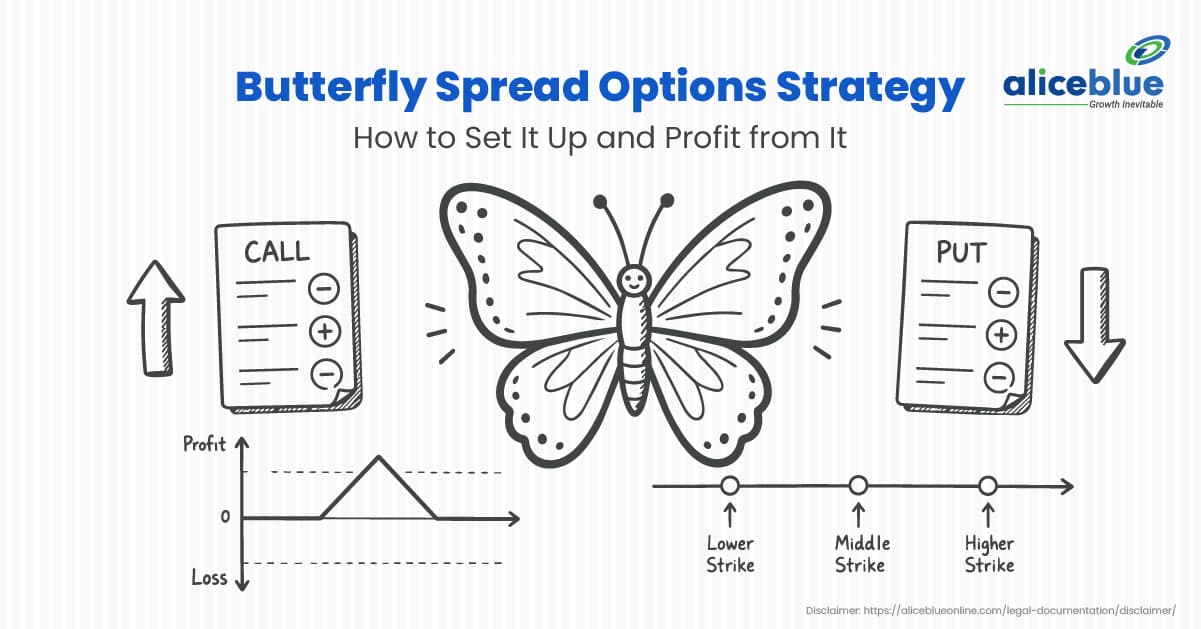
A butterfly spread uses four option contracts at three strike prices, all expiring on the same date. The trade profits when the underlying, Nifty or BankNifty, closes near the middle strike at expiry.
The name comes from what the profit and loss graph looks like. The middle strike is the peak. The outer strikes are the wings. The shape is a tent, wider at the base and pointed at the top.
The structure:
- Buy 1 option at the lower strike
- Sell 2 options at the middle strike
- Buy 1 option at the higher strike
Both your maximum profit and your maximum loss are locked in the moment you enter. You will never lose more than the premium you paid, no matter how far Nifty moves.
How the Long Call Butterfly Is Set Up
The most common version beginners use is the long call butterfly. The setup has three parts:
- Buy one call at the lower strike. This is the left wing.
- Sell two calls at the middle strike. This is the body.
- Buy one call at the higher strike. This is the right wing.
The gap between strikes must be equal. If the middle strike is 24,000, your lower strike goes at 23,800 and your upper strike at 24,200, each 200 points away from the centre.
The two calls you sell at the middle strike bring in premium. That premium pays for most of the cost of buying the two wings. What you pay after netting it out is called the net debit, and that is your total risk on the trade.
Net Debit Calculation
Action | Option | Premium |
Buy | 23,800 CE | Rs. 170 |
Sell | 2 x 24,000 CE | Rs.100 x 2 = Rs.200 |
Buy | 24,200 CE | Rs. 50 |
Left wing cost: Rs. 170
Right-wing cost: Rs. 50
Premium collected from selling middle: Rs. 200
Net debit = Rs.170 + Rs.50 minus Rs.200 = Rs.20 per unit
With a lot size of 75, your total outgo = Rs. 20 x 75 = Rs. 1,500
That Rs. 1,500 is all you can lose on this trade, no matter what happens.
Key Numbers to Calculate Before Entry
Term | Formula |
Net Debit | Wings’ premium paid minus the middle premium received |
Maximum Profit | (Strike difference minus net debit) x lot size |
Maximum Loss | Net debit x lot size |
Lower Breakeven | Lower strike plus net debit |
Upper Breakeven | Upper strike minus net debit |
For this example:
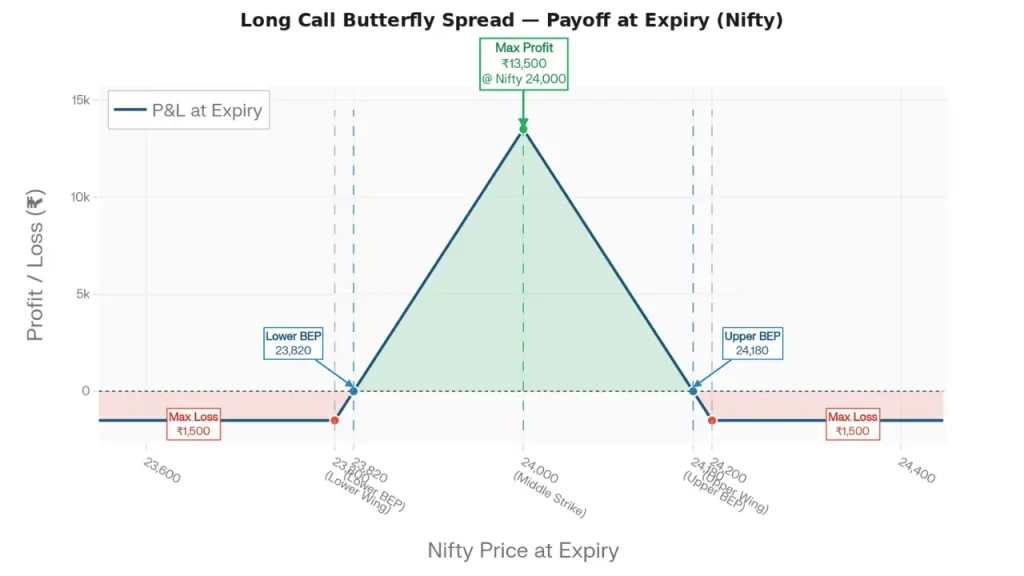
Maximum profit = (200 minus 20) x 75 = Rs.13,500
Lower breakeven = 23,800 + 20 = 23,820
Upper breakeven = 24,200 minus 20 = 24,180
Payoff Chart
The chart below shows the exact profit and loss at every Nifty price level at expiry for this trade. The green zone is where the trade makes money. The red zones on both sides are where the maximum loss of Rs. 1,500 is locked in. The peak sits at 24,000, where the trade earns its maximum profit of Rs. 13,500.
Full Payoff Table
Nifty at Expiry | What Happens |
Below 23,800 | Rs. 1,500 maximum loss |
23,820 | Breakeven, no gain, no loss |
Between 23,820 and 24,180 | Partial profit |
24,000 | Rs. 13,500 maximum profit |
24,180 | Breakeven, no gain, no loss |
Above 24,200 | Rs. 1,500 maximum loss |
What Happens at Expiry: Three Real Scenarios
Scenario 1: Nifty closes exactly at 24,000
Your 23,800 CE is worth Rs. 200 intrinsic value.
Your two 24,000 CE short calls expire worthless.
Your 24,200 CE expires worthless.
Net = (Rs. 200 minus Rs. 20 net debit) x 75 = Rs. 13,500 profit.
Scenario 2: Nifty closes at 24,100
23,800 CE is worth Rs. 300. Two 24,000 CE are worth Rs. 100 each = Rs. 200 combined. 24,200 CE is worthless.
Net payoff per unit = Rs. 300 minus Rs. 200 minus Rs. 20 = Rs. 80.
Total = Rs. 80 x 75 = Rs. 6,000 partial profit.
Scenario 3: Nifty closes at 23,800 or 24,200
The wings and the body cancel each other out. Net = minus Rs.20 per unit.
Total loss = Rs. 1,500, your maximum loss.
Smaller Capital Setup With Tighter Strikes
If you are working with a smaller account, a 100-point gap works well.
Action | Option | Premium |
Buy | 23,900 CE | Rs. 120 |
Sell | 2 x 24,000 CE | Rs.75 x 2 = Rs.150 |
Buy | 24,100 CE | Rs. 40 |
Net debit = Rs.120 + Rs.40 minus Rs.150 = Rs.10 per unit
Total risk = Rs.10 x 75 = Rs.750
Maximum profit = (100 minus 10) x 75 = Rs.6,750
Lower breakeven = 23,910
Upper breakeven = 24,090
Payoff Table for Smaller Setup
Nifty at Expiry | What Happens |
Below 23,900 | Rs. 750 maximum loss |
23,910 | Breakeven |
24,000 | Rs. 6,750 maximum profit |
24,090 | Breakeven |
Above 24,100 | Rs. 750 maximum loss |
Tighter strikes cost less but give you a narrower profit window. Wider strikes cost more but give Nifty more room to land in the profit zone.
How Theta and Vega Change the Trade Mid-Way
Two forces are working on this position from the day you enter.
Theta is working for you. Every day that passes, the two short calls at 24,000 are losing value. That is time decay eating into the options you sold. As long as Nifty stays near your centre strike, this daily decay is making your position more valuable.
Vega is working against you. If implied volatility jumps after you enter, all four options get more expensive. But the two short options hurt your position more than the two long options help it. A sudden volatility spike on budget day or RBI policy can turn a profitable position into a loss very quickly.
This is why the butterfly works best when there are no big events between entry and expiry.
How to Adjust When Nifty Moves Away Mid-Trade
If Nifty shifts away from your centre strike before expiry, two options are available:
- Roll the entire spread. Close all four legs and reopen the same butterfly structure with the centre strike shifted two or three strikes in the direction Nifty moved. Your profit zone now follows the market.
- Cut the position down. If you are not confident about where Nifty is heading, close half the position. This reduces exposure without locking in the full loss.
Never adjust one leg alone. Always move all four legs together. Partial adjustments change the structure and can create new unintended risks.
Margin Requirements
A Nifty long call butterfly requires roughly Rs. 20,000 to Rs. 40,000 in margin, depending on which broker you use and how they calculate spread margins. This is well below the margin needed for a naked call or naked put position.
Before entering, check the margin requirement on your broker’s options calculator. Some brokers charge full margin on each leg and give the spread credit back only after execution.
Short Butterfly Spread
The short butterfly is the opposite trade. Use it when you expect Nifty to move sharply away from a level, not stay near it. Events like RBI policy decisions, Budget announcements, and major quarterly results are the typical setups for this.
Setup:
- Sell 1 call at the lower strike
- Buy 2 calls at the middle strike
- Sell 1 call at the higher strike
You collect a net credit upfront. Your profit comes when Nifty moves beyond either wing. Your loss is largest when Nifty sits exactly at the middle strike at expiry.
Short Butterfly Example
Action | Option | Premium |
Sell | 23,800 CE | Rs. 180 |
Buy | 2 x 24,000 CE | Rs.110 x 2 = Rs.220 |
Sell | 24,200 CE | Rs. 60 |
Net credit = Rs.180 + Rs.60 minus Rs.220 = Rs.20 per unit
Maximum profit = Rs. 20 x 75 = Rs. 1,500 (if Nifty closes beyond either wing)
Maximum loss = (200 minus 20) x 75 = Rs.13,500 (if Nifty closes at 24,000)
The risk-reward here is the reverse of the long butterfly. You are risking Rs. 13,500 to make Rs. 1,500. This only makes sense when you are very confident about a large move. Beginners should avoid the short butterfly until they are fully comfortable with the long butterfly first.
Long vs Short Butterfly Side by Side
Feature | Long Call Butterfly | Short Call Butterfly |
Market view | Range-bound near one price | Big move expected either way |
Premium structure | You pay a net debit | You collect a net credit |
Maximum profit | When Nifty closes at the centre | When Nifty moves beyond wings |
Maximum loss | Net debit paid | Strike gap minus net credit |
Best time to enter | Low volatility, no events near | Just before major market events |
Theta impact | Helps the position daily | Hurts the position daily |
Vega impact | Volatility spike hurts the trade | Volatility spike helps the trade |
Advantages
- You know your exact maximum loss before you enter
- Premium outlay is small compared to buying a straddle or strangle
- Time decay builds position value as expiry approaches
- Works well on Nifty and BankNifty weekly expiry
- Margin requirement is lower than most multi-leg strategies
Risks to Watch Before You Trade
- The profit zone is narrow and depends on an accurate centre strike
- A strong move past either wing delivers the maximum loss
- Volatility spikes hurt the trade, especially in the first half of the holding period
- Four legs mean four brokerage charges, STT, and exchange fees on each side
- Illiquid strikes give you wide bid-ask spreads that cut into the small net debit
- Never use this around RBI policy, Budget day, or major earnings announcements
Butterfly Spread vs Iron Condor
Feature | Butterfly Spread | Iron Condor |
What you need the market to do | Close near one specific price | Stay within a broader range |
Options used | 4 options, 3 strikes, same type | 4 options, 4 strikes, calls and puts |
How you pay | Net debit | Net credit |
Where do you profit most | Exactly at the centre strike | Anywhere between the two short strikes |
When to use | You have a precise price target | You only need a broad sideways view |
Theta benefit | Strongest in the final days near expiry | Works across the holding period |
Mistakes Indian Traders Make
- Legging in one at a time. Placing each leg separately means the market moves between your first and fourth orders. You end up with a worse net debit than planned. Place all four legs in one basket in order.
- Picking illiquid strikes. A strike with low open interest has a wide gap between the buy and sell prices. That gap is money out of your pocket before the trade even starts. Only use strikes where you see solid open interest.
- Skipping the open interest check. Even if the premium looks right, check open interest at the centre strike. Thin open interest means you may not get a fair price when you want to exit early.
- Trading around events. Budget, RBI policy, or a major company result can shift Nifty by 300 to 500 points in a session. That blows through your wings in minutes.
- Closing too early after a mid-trade dip. When volatility picks up mid-week, your position will temporarily show a loss even if Nifty is still close to your centre strike. Many traders exit here and lock in a loss that would have been recovered by expiry.
- Forgetting transaction costs. On a Rs. 20 net debit trade, Rs. 4 to Rs. 6 in combined charges per unit is not small. Calculate total charges before entering and make sure the trade still makes sense after costs.
Who This Strategy Is For
Good fit for:
- Traders who have been trading options for at least six months and are comfortable reading an option chain
- Anyone who wants a trade with a clearly defined outcome before entering
- Traders who actively use the Nifty or BankNifty weekly expiry
- People who can hold a position for a few days without constantly adjusting
Not a good fit for:
- Traders are still learning what premiums and strikes mean
- Anyone who wants an open-ended upside on a trade
- Traders who cannot monitor multi-leg positions
- Anyone trading in a week with major macro events on the calendar
Conclusion
The butterfly spread options strategy is not a difficult trade. You pick a price level, build four legs around it, pay a small amount, and wait. Your loss is fixed from day one, your profit zone is visible on the chart, and time decay works in your favour each day that passes.
The long butterfly rewards you for being right about where the market closes. The short butterfly rewards you for being right about a big move. Both have their place, but beginners should start with the long butterfly and paper trade it on Nifty weekly expiry for a few cycles before using real money.
Focus on liquid strikes, equal gaps, and a market that is genuinely going nowhere. That combination is where this strategy earns.
Frequently Asked Questions
A neutral options strategy using four contracts at three strike prices. It profits when the underlying closes near the middle strike at expiry. Maximum profit and maximum loss are both fixed before entry.
It is approachable once you understand how premiums and expiry work. Start with the long butterfly on the Nifty weekly expiry and paper trade it first before using real capital.
When the market is moving sideways, there are no major events in the near term, and you have a clear view of where Nifty will close at expiry.
The maximum loss is the net premium you paid to enter. This number is fixed and known before you place the trade.
Weekly Nifty or BankNifty expiry works better than monthly. Time decay is faster on weekly options, and the trade resolves within days.
Yes, but only on stocks with liquid option chains like Reliance, HDFC Bank, ICICI Bank, and TCS. Illiquid stock options will give you bad fill prices on entry and exit.

Blog by Aliceblue News Desk


