
How to Calculate Mutual Fund Returns: XIRR vs CAGR Explained with Examples
Blog by Aliceblue News Desk
31 July 2026
10 minutes

What Are Mutual Fund Returns?
Mutual fund return calculation is how you measure whether your investment is actually growing the way you expect it to, depending on how you invested- whether as a one-time lump sum or through regular instalments. Different calculation methods give you an accurate picture of your actual returns.
This guide walks you through the full picture: what mutual fund returns are, why calculating them matters, and the specific methods: Absolute Return, CAGR, and XIRR, used depending on your investment style.
Before learning the different calculation methods, it helps to understand why tracking mutual fund returns regularly is essential for making better investment decisions.
Why Should You Calculate Mutual Fund Returns?
Calculating mutual fund returns helps you understand whether your investment is actually growing as expected. It allows you to:
- Measure the performance of your investments over time
- Compare one mutual fund with another
- Check whether your SIPs are delivering expected returns
- Track progress towards financial goals like retirement or education
- Make informed decisions instead of relying only on portfolio value
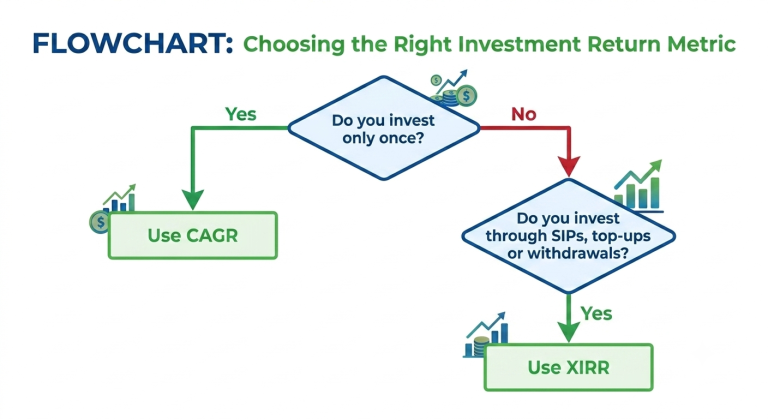
Different return calculation methods are suitable for different investment styles. For example, lump-sum investments generally use CAGR, while SIPs and irregular investments are better measured using XIRR.
Table of Contents
- What Are Mutual Fund Returns?
- Why Should You Calculate Mutual Fund Returns?
- What Is Absolute Return in Mutual Funds?
- How CAGR and XIRR Work
- What Are CAGR and XIRR in Mutual Funds? 5.1 What Is CAGR? 5.2 What Is XIRR?
- How to Calculate Mutual Fund Returns in Excel
- Mutual Fund Return Calculation Examples
- Key Features of CAGR and XIRR
- Benefits of Using CAGR and XIRR
- Limitations of CAGR and XIRR
- Tips to Track Mutual Fund Returns Accurately
- XIRR vs CAGR: Key Differences
- Common Mistakes When Calculating Mutual Fund Returns
- When Should You Use CAGR or XIRR?
- Conclusion: CAGR vs XIRR for Mutual Fund Investors
- Frequently Asked Questions
What Is Absolute Return in Mutual Funds?
Absolute return measures the total percentage gain or loss on your investment without considering how long you stayed invested.
Formula
Absolute Return = ((Current Value − Invested Amount) ÷ Invested Amount) × 100
Example
- Invested Amount: ₹1,00,000
- Current Value: ₹1,20,000
Absolute Return = ((1,20,000 − 1,00,000) ÷ 1,00,000) × 100 = 20%
Absolute return is useful for investments held for less than one year. However, it does not account for the investment period, making CAGR or XIRR more suitable for long-term mutual fund performance evaluation.

How CAGR and XIRR Work
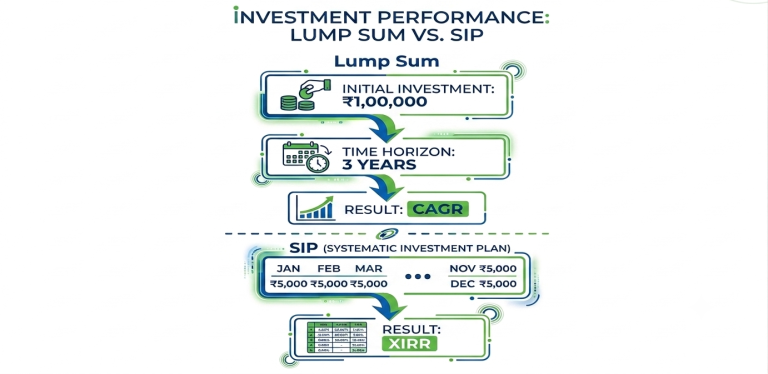
Both CAGR and XIRR calculate annualised returns, but they differ in how they treat investment timing.
- CAGR assumes a single investment made at the beginning and redeemed at the end.
- XIRR considers every investment date separately, making it suitable for SIPs, additional investments, withdrawals, or irregular cash flows.
Choosing the correct method ensures that your portfolio performance is measured accurately.
What Are CAGR and XIRR in Mutual Funds?
To understand how your wealth grows, you must look past basic absolute returns, which simply measure the simple difference between your invested amount and current value without considering the time elapsed. Instead, investors usually use two primary concepts: CAGR and XIRR.
What Is CAGR?
Compound Annual Growth Rate (CAGR) represents the smoothed annual rate at which an investment grows if it grew at a steady, compounding rate over a specific period. The stock market is highly volatile, with yearly ups and downs. CAGR smooths out market fluctuations to show you the geometric mean of your returns, providing a clear annualised baseline.
However, if your investments happen on multiple dates through SIPs or additional purchases, CAGR alone cannot provide an accurate picture.
What Is XIRR?
Extended Internal Rate of Return (XIRR) is a more financial measure used to calculate the annualised return of a series of cash flows occurring at irregular intervals. When you invest via a Systematic Investment Plan (SIP), you buy mutual fund units on different dates at different Net Asset Values (NAVs). Your first month’s instalment has 12 months to grow, while your tenth month’s instalment only has 2 months. XIRR assigns a specific time-weight to every individual transaction, combining them into one accurate annualised return percentage.
Since XIRR involves multiple cash flows, most investors calculate it using spreadsheet tools like Microsoft Excel or Google Sheets.
Let’s understand each of these return calculation methods in more detail and see when they should be used.
How to Calculate Mutual Fund Returns in Excel
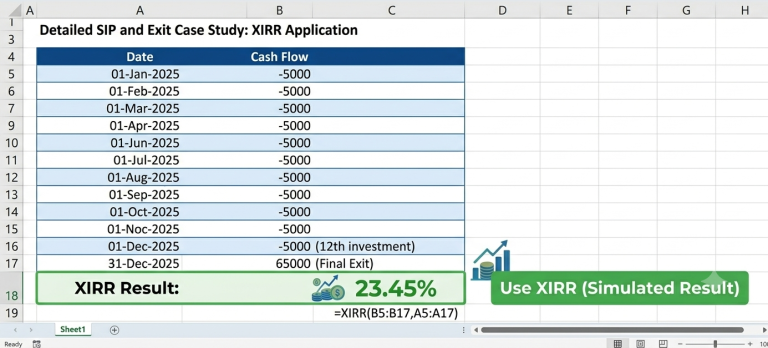
While CAGR can be derived using a standard algebraic formula, tracking modern portfolios with multiple cash flows requires software. Microsoft Excel and Google Sheets feature a native =XIRR() formula designed specifically to handle multi-date investments.
To perform a manual mutual fund return calculation via a spreadsheet without causing calculation errors, you must follow this exact sequence:
- List your dates chronologically (Column A Setup): In Column A, enter the exact dates on which your SIP instalments or lump-sum allocations occurred. Ensure these cells are formatted strictly as regular Date types (e.g., DD-MM-YYYY).
- Input cash flows with negative signs (Column B Setup): In Column B, list the corresponding investment amounts. Every time money leaves your bank account to purchase mutual fund units, it must be entered as a negative number (e.g., -5000).
- Add your final portfolio valuation (The Final Row Entry): On the very last row of your list, input the current date in Column A. Directly next to it in Column B, enter your current total portfolio market value as a positive number. This represents the current portfolio value.
- Deploy the XIRR formula string (Formula Execution): In an empty cell, type =XIRR(B2:B14, A2:A14), mapping your exact cell ranges for values and dates. Hit Enter, convert the cell format to a percentage, and the sheet will display your true annualised rate of return.
Mutual Fund Return Calculation Examples
Let us look at an example to see how these calculations function in practice.
The Lump Sum Scenario (CAGR)
Suppose you invest a single lump sum of ₹1,00,000 into an equity mutual fund. After exactly 3 years, you redeem your entire investment at a final valuation of ₹1,45,000.
To determine how to calculate CAGR in mutual funds, we apply the compounding formula:
CAGR = (Final Value / Initial Value)^(1/n) − 1
- Divide Final Value by Initial Value: 1,45,000 / 1,00,000 = 1.45
- Raise the result to the power of 1/3 (representing 3 years): 1.45^0.3333 = 1.1318
- Subtract 1 to get the rate: 1.1318 − 1 = 0.1318 or 13.18%
The SIP Scenario (XIRR)
Now, suppose instead of a lump sum, you invest ₹1,00,000 spread across 10 monthly SIP instalments of ₹10,000 each.
Because the market fluctuates month-to-month, you buy different amounts of units. If your final portfolio value at the end of the year is ₹1,10,000, a basic CAGR calculation would yield an incorrect result because it assumes the full ₹1,00,000 was working for you since day one. Running these monthly dates and negative values through the Excel XIRR function adjusts for the timeline, revealing a true annualised performance of roughly 18.5%.
Key Features of CAGR and XIRR
- Time-Adjusted Framework: Both metrics incorporate time, preventing the distortion common with basic absolute returns.
- Point-to-Point Focus: CAGR acts as a point-to-point return measure, looking only at the very first and very last valuation marks.
- Cash-Flow Sensitivity: XIRR considers all transactions, accounting for the exact calendar date of deposits, dividends, and withdrawals.
- Annualised Standardisation: Both metrics convert investment timelines into a standardised 12-month format, allowing you to easily compare mutual funds against fixed deposits or stock indices.
Benefits of Using CAGR and XIRR
Using these advanced metrics helps you avoid emotional decision-making. Calculating your returns accurately ensures you evaluate whether a specific fund manager is truly delivering alpha (beating the benchmark index) over long horizons. Furthermore, understanding your actual XIRR helps you build highly accurate compounding projections for financial goals like housing, education, or retirement.
Limitations of CAGR and XIRR
While highly reliable, these metrics have limitations you must keep in mind:
- Volatility Smoothing: CAGR entirely hides interim market corrections. A fund could drop 40% in year two and skyrocket in year three, but the CAGR will show a smooth annual growth rate.
- Reinvestment Presumption: XIRR operates on the mathematical assumption that any intermediate cash outflows (like systematic withdrawal plans or dividend payouts) are immediately reinvested back into an asset earning that same high rate of return, which is rarely achievable in a volatile market.
Tips to Track Mutual Fund Returns Accurately
When analysing your portfolio performance, always prioritise XIRR if you have an active monthly SIP running. Do not panic if your absolute return looks massive while your XIRR looks lower; remember that absolute return ignores how long your money sat in the fund.
Lastly, maintain clean records or use aggregated central platforms to download your consolidated account statements (CAS), which provide accurate transaction dates required for spreadsheet tracking.
XIRR vs CAGR: Key Differences
To determine whether CAGR vs XIRR is better for your specific analysis, refer to this structural breakdown:
Evaluation Attribute | CAGR (Compound Annual Growth Rate) | XIRR (Extended Internal Rate of Return) |
Primary Use Case | One-time, lump-sum investments | SIPs, irregular top-ups, SWPs, or partial redemptions |
Transaction Capacity | Accommodates exactly one entry and one exit value | Accommodates unlimited, scattered cash inflows and outflows |
Date Precision | Measures the broad, total fractional years elapsed | Matches the exact day, month, and year of each action |
Calculation Method | Easily calculated with a basic scientific formula | Requires computer spreadsheet logic or financial calculator software |
Common Mistakes When Calculating Mutual Fund Returns
The single most frequent error when setting up a manual mutual fund return calculator formula in Excel is entering all cash numbers as positive values. If you do not prefix your investment purchases with a minus sign (-), Excel’s algorithm cannot differentiate between money entering the fund and money leaving it, resulting in a broken #NUM! error code.
Another major mistake is utilising CAGR to measure an entire SIP portfolio, which leads to completely skewed performance tracking.
When Should You Use CAGR or XIRR?
CAGR is ideal for long-term, passive investors who deposit a lump sum into a fund and leave it untouched for years. On the other hand, XIRR is an essential tool for investors who regularly invest through SIPs (monthly systematic investment plans), equity-linked savings schemes (ELSS), or tactical partial profit-booking strategies.
Conclusion: CAGR vs XIRR for Mutual Fund Investors
Evaluating your investments correctly requires using the proper tools for the job. Absolute return is helpful for short-term trades under 12 months, but long-term wealth creation demands annualised metrics.
Always align your calculation method with your actual investing behaviour: deploy CAGR to check the performance of your long-term lump sums, and rely on XIRR to monitor the actual efficiency of your recurring SIPs. Mastering these distinct calculation methods ensures you maintain a clearer understanding of your investments.
Frequently Asked Questions
Scheme XIRR: The fund’s overall performance over a fixed period. My XIRR: Your actual personal return. It factors in your specific transaction dates, any missed SIPs, or extra lump sums. Always trust My XIRR for your actual wealth growth.
No. These metrics calculate gross returns based purely on the fund’s NAV. They do not deduct capital gains tax (STCG/LTCG) or exit loads upon withdrawal. However, they do include the fund’s internal expense ratio.
No. XIRR is built specifically to handle irregular timelines. If you pause or miss a month, simply skip that row in your spreadsheet and only log the dates and amounts where money actually changed hands.
When a portfolio is highly volatile, Excel’s math engine can get stuck in a calculation loop. Fix it by adding a “guess” baseline (like 10% or 0.1) to the end of your formula: =XIRR(values, dates, 0.1)
Neither. Annualising short-term returns distorts the numbers (e.g., a 2% gain in one week looks like an impossible 180% annualised return). For any investment under 12 months old, use Absolute Return instead.

Blog by Aliceblue News Desk


