
CIBIL Score Range Explained: What 300, 500, 650, 750, and 900 Mean for Loans
Blog by Aliceblue News Desk
08 April 2026
9 minutes
You’ve finally found the perfect flat for your growing family, or your parents need urgent medical treatment, or your daughter’s wedding is just months away. You apply for a personal loan only to get rejected in seconds because of your “CIBIL score”.
The anxiety that hits when banks say “no” even though your salary is decent? Millions of Indians face this every single month.
Your CIBIL score is the silent gatekeeper that decides whether lenders trust you with money. In 2026, the majority of loans in India are approved for borrowers with a CIBIL score above 750.
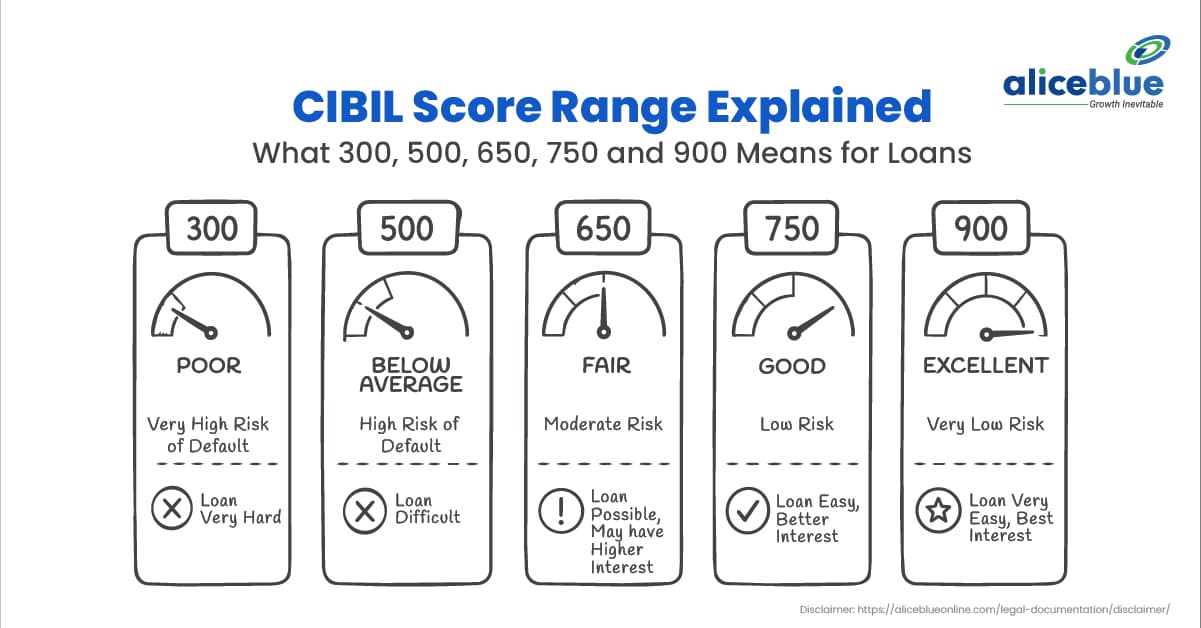
In this guide, we break down exactly what CIBIL scores of 300, 500, 650, 750, and 900 mean for your loans in simple, practical terms. You’ll learn how to check your score for free and proven ways to improve it fast.
What is a CIBIL Score?
A CIBIL score is a three-digit number between 300 and 900 that measures your creditworthiness. It is generated by TransUnion CIBIL (India’s leading credit bureau) based on your entire credit history, such as loans, credit cards, repayments, and enquiries.
Lenders use it to predict how likely you are to repay on time. A high score tells them you’re low-risk. A low score signals “higher risk”.
Unlike your salary slip or job stability, the CIBIL score is the first thing almost every bank or NBFC (Non-Banking Financial Company) checks before approving a personal loan, home loan, car loan, or credit card. It’s updated every week since April 1, 2026, after RBI’s new major reform and stays with you for life.
How to Check Your CIBIL Score for Free in 2026 (Step-by-Step)
Checking your own score is considered a soft enquiry and does not affect your score.
Official Free Method (Recommended):
- Visit the official website: www.cibil.com or go directly to myCIBIL.
- Click on “Get your Free CIBIL Score & Report”.
- Create an account or log in (verify with PAN, Aadhaar, and mobile OTP).
- You get one free score + full credit report per calendar year (as of 2026 rules).
Tip: Check your score at least once every 3 to 4 months to catch errors early.
Other Methods:
- Many Indian fintech apps (like Google Pay, OneScore, or Amazon Pay) now offer free monthly or even weekly refreshes because they have commercial tie-ups with the bureaus.
Major RBI Reform: Changes to CIBIL Score Reporting Since April 1, 2026
On April 1, 2026, the Reserve Bank of India (RBI) introduced a major reform in how lenders report credit data to bureaus like TransUnion CIBIL. This is the most significant update to the CIBIL system in recent years.
Old vs New Reporting Systems:
Aspect | Old System (Before April 1, 2026) | New System (From April 1, 2026) |
Reporting Frequency | Fortnightly (every 15 days) | Weekly (every 7 days) |
Score Update Speed | Changes reflected in 15-30 days | Changes reflected in ~7 days |
Data Submission Dates | Twice a month | Multiple fixed dates (e.g., 7th/9th, 14th/16th, 21st/23rd, 28th/last day of month) |
Overall Impact | Slower feedback loop | Near real-time reflection of your payment behaviour |
Key Impacts of This Reform:
- Faster score improvements: If you make on-time EMI or credit card payments, your CIBIL score can now rise more quickly, sometimes within a week instead of waiting 15+ days.
- Quicker penalties for misses: Late payments or defaults will also show up faster, so timely repayment has become even more important.
- More accurate lending decisions: Lenders now see a much fresher picture of your credit behaviour instead of data that could be weeks old.
- Better for responsible borrowers: Good habits (on-time payments and low utilisation) get rewarded faster.
- No change to score range or calculation: The 300-900 scale, risk categories, and the five main factors (repayment history, credit utilisation, etc.) remain the same; only the speed of updates has changed.
- Phased rollout note: While the framework started on April 1, full weekly reporting across all lenders is being implemented progressively through mid-2026.
This reform makes your CIBIL score more dynamic and responsive, encouraging better financial discipline.
CIBIL Score Range in India: Complete Breakdown (2026)
Here’s the latest, widely accepted classification used by most banks and NBFCs in 2026:
Score Range | Category | Risk Level | What It Means for You |
300-549 | Poor | Very High | Almost certain rejection or extremely high rates |
550-649 | Fair | High | Possible approval, but expensive terms |
650-749 | Good | Moderate | Decent approval chances + reasonable rates |
750-900 | Excellent | Very Low | Fast approvals, lowest interest rates, and higher loan amounts |
“NA/NH” Exception: If you check your score today and see “NA” or “NH” (No History), it doesn’t mean you’re in the “Poor” category. It simply means you haven’t used credit in the last 2 years.
What Your Specific CIBIL Score Actually Means
1. CIBIL Score of 300 (lowest possible score):
Usually means serious defaults, multiple late payments, or no credit history at all.
Loan Reality:
- Almost every bank rejects your application outright.
- Even NBFCs will demand heavy collateral or guarantors.
- Interest rates (if approved) can be 20-30%+ higher.
- Real example: A ₹5 lakh personal loan at 300 score – rejection or 24-36% interest.
2. CIBIL Score of 500 (still in the danger zone):
Considered the “Fair/Poor” category. Lenders see it as a red flag, maybe because of a few missed EMIs or high credit card usage.
Loan Reality:
- Approval is possible only with some NBFCs.
- Expect interest rates to be 4-8% higher than average.
- Smaller loan amounts and shorter tenures.
- Good news: This is fixable in 3-6 months with disciplined payments.
3. CIBIL Score of 650 (the good range):
Most lenders will at least consider your application.
Loan Reality:
- Personal loans: Good chance (especially from NBFCs).
- Car loans: Usually approved.
- Home loans: Borderline: Some banks may ask for extra documents.
- You’ll get competitive but not the best interest rates. This is the score where many people start seeing “yes” instead of “no”.
4. CIBIL Score of 750 (the sweet spot):
The majority of loans in India are approved for borrowers with a CIBIL score above 750.
Loan Reality:
- Personal loans: Fast approval + lowest rates (10-14% range).
- Home loans: Almost guaranteed with the best terms.
- Car loans: Premium offers and zero extra paperwork.
- You can negotiate interest rates down further. Banks treat you like a VIP customer.
5. CIBIL Score of 900 (the perfect score):
Only the top 1-2% of borrowers reach this. It shows a flawless repayment history over many years.
Loan Reality:
- Instant approvals.
- Lowest possible interest rates (sometimes 1-2% below market).
- Highest loan amounts.
- Pre-approved offers land in your inbox regularly. Lenders literally compete to give you money.
How CIBIL Score Affects Different Loan Types (2026)
Loan Type | Minimum Preferred Score | Ideal Score | Interest Rate Impact |
Personal Loan | 700+ | 750+ | 10-14% vs 18-24% |
Home Loan | 725-750 | 750+ | 0.5-1.5% lower rate |
Car Loan | 650-700 | 750+ | Better terms & lower down payment |
Credit Card | 650+ | 750+ | Higher limits (5L+) & better rewards |
Factors Affecting Your CIBIL Score & Proven Ways to Improve It
Key Factors (in order of importance):
- Repayment history (on-time payments)
- Credit utilisation (keep below 30%)
- Credit mix (healthy balance of secured + unsecured loans)
- Number of loan/credit applications (too many hard enquiries hurt)
- Length of credit history
7 Proven Ways to Improve Your CIBIL Score Fast in 2026
- Pay every EMI and credit card bill on time.
- Keep credit card utilisation under 30% of your limit.
- Don’t apply for too many loans at once.
- Build a long credit history, and don’t close old accounts with a good history.
- Maintain a healthy mix of credit types.
- Dispute and correct any errors in your credit report immediately.
- Never settle loans through debt settlement (it stays on record for 7 years).
Most people who monitor their score regularly see improvement within 3-6 months.
5 Reasons a High CIBIL Score Makes Loans Easier
- Easy Availability: Lenders compete to give you loans.
- Quicker Approvals: Often same-day or 24-48 hours.
- Better Interest Rates: Save lakhs over the loan tenure.
- Higher Loan Amounts: Borrow more based on your score.
- Pre-Approved Offers: Banks send you ready offers without paperwork.
Common CIBIL Score Myths Debunked
- Myth 1: One late payment will destroy my score forever.
Truth: One or two late payments hurt, but consistent on-time payments fix it quickly.
- Myth 2: No credit history means a good score.
Truth: Zero history often shows as “No Score” or very low; lenders prefer proven behaviour.
- Myth 3: Closing old credit cards helps your score.
Truth: It can actually hurt your credit history.
- Myth 4: Checking my score lowers it.
Truth: Soft enquiries (your own checks) do not affect it.
Whether your CIBIL score is sitting at 300 or already at 750, every on-time payment and smart credit habit moves you closer to better loans, lower interest, and financial peace of mind.
Start today:
- Check your free CIBIL score on cibil.com
- Set up auto-debit for all EMIs
- Keep utilisation low
Frequently Asked Questions
Negative information, such as late payments or defaults, remains visible on your CIBIL report for 7 years from the date of the first missed payment. While the record stays for the full period, its impact on your score gradually decreases over time as you add more positive payment history. Under the new weekly updates since April 1, 2026, fresh positive behaviour can start improving your score faster than before.
- Not immediately. Becoming a guarantor triggers only a soft enquiry, and the guaranteed loan appears as a contingent liability on your report (which can slightly increase your overall credit utilisation). However, if the primary borrower misses payments or defaults, it will directly affect your repayment history and CIBIL score, just like your own loan.
If you stop using credit for 2+ years, your score may show as “NH” (No History) or drop significantly. Lenders view this as higher risk because they have no recent data to assess your repayment behaviour. Even with a previously good score, long inactivity can make approvals harder or result in higher interest rates.
All four RBI-licensed bureaus use the same 300-900 scale, but they may weigh factors slightly differently and pull data from different lenders. CIBIL is the most widely used by traditional banks. Lenders often check one or more bureaus, so it’s smart to monitor all of them. Your scores are usually similar but not identical.
Most positive changes (on-time EMI or credit-card payments) now reflect within 7 days instead of 15-30 days under the old system. However, the exact timing still depends on when your lender submits the data. Check your score weekly after big payments to track progress faster.

Blog by Aliceblue News Desk


