
Contango and Backwardation in Indian Futures Markets
Blog by Aliceblue News Desk
28 May 2026
8 minutes
On April 20, 2020, a trader holding a long position in MCX crude oil for April delivery had to pay ₹1 lakh per lot at expiry. Not receive money, pay money. The contract settled at negative ₹2,884 per barrel using the RBI reference rate of USD/INR 76.6335.
That is what happens when you trade futures without understanding contango and backwardation.
These are just two words for describing the shape of the futures price curve. But they tell you a lot about what the market is actually doing. If you trade MCX gold, silver, crude oil, or NCDEX soybean and chana, these concepts will affect your P&L directly.
What You Need to Know First
Three things come up every time you trade futures.
The spot price is what you pay for immediate delivery. If you go to a jeweller today and buy gold at the day’s rate, that is the spot price.
The futures price is what you agree to pay today for delivery later. On MCX, you can buy a gold contract for June, August, and October, each for a different month.
The basis is the difference between them.
Basis = Spot price minus futures price
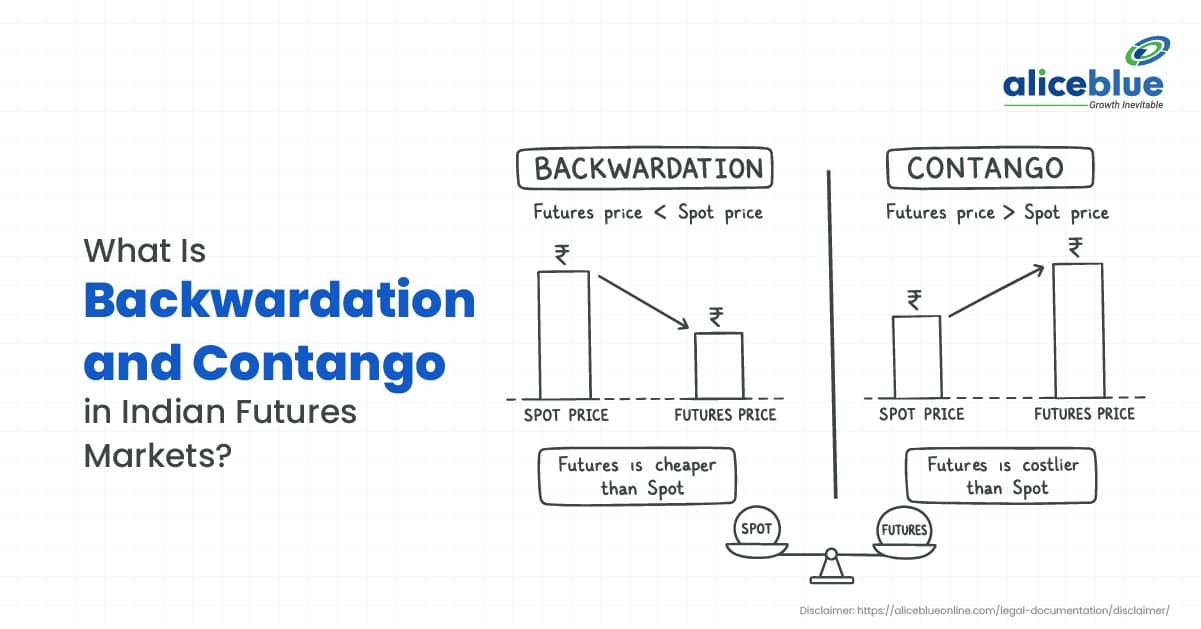
Negative basis means futures are more expensive. That is contango.
Positive basis means the spot is more expensive. That is backwardation.
Contango Explained Simply
Contango is when futures prices are higher than today’s spot price.
This happens because of storage. If you buy gold today and store it for three months, you pay for warehousing, insurance, and the interest on the money you locked up. Those costs get added to the futures price.
The formula is simple:
Futures price = Spot price + Cost of carry
If gold spot is ₹72,000 per 10 grams and carrying it for two months costs ₹400, the 2-month futures at ₹72,400 are just reflecting actual costs. No prediction about where the price is going.
On MCX, gold and silver are almost always in contango because they are easy to store and do not spoil.
Here is what MCX gold looks like in contango:
Contract Month | Price (per 10g) |
June | ₹72,400 |
August | ₹72,900 |
October | ₹73,500 |
Each month is higher. The upward slope is the cost of carry stacking up over time.
Backwardation Explained Simply
Backwardation is when the spot price is higher than the futures prices.
This happens when someone needs the commodity right now and is willing to pay extra for it. A flour mill in Rajasthan that needs wheat today to keep running will pay more for immediate delivery than for wheat arriving three months later.
That extra value for having something now is called convenience yield.
Backwardation shows up in Indian markets when:
- Monsoon fails, and soybean spot prices jump on NCDEX while October contracts stay lower
- Geopolitical tension causes crude oil spot to spike while futures stay calm
- Winter arrives, and natural gas spot prices on MCX rise while summer contracts stay lower
- Warehouse stocks drop, and buyers compete for whatever is available today
Here is what NCDEX soybean looks like in backwardation after a poor harvest:
Contract Month | Price (per quintal) |
June (spot) | ₹5,200 |
August | ₹4,950 |
October | ₹4,700 |
Each month is lower. Traders are pricing in the expectation that fresh supply will ease the shortage.
What Normal Backwardation Means
You will see two terms sometimes.
Backwardation means futures are below the current spot price.
Normal backwardation is a theory from economist John Maynard Keynes. It means futures are below the expected future spot price. Farmers sell futures at a discount to guarantee a sale today. Speculators take the other side and earn a return as prices rise toward the expected level.
In normal trading talk, when people say backwardation, they mean the first definition. Normal backwardation is mostly in research papers.
Super Contango — The April 2020 Example
Super contango is when the gap between spot and futures becomes extreme. Storage runs out. No one wants physical delivery.
In April 2020, COVID-19 lockdowns killed global fuel demand. Storage tanks were full. WTI crude oil May 2020 futures settled at negative USD 37.63 per barrel.
MCX settled its April crude contract at a negative ₹2,884 per barrel. Long positions on MCX paid about ₹1 lakh per lot.
This is rare but serious. Traders who did not know what was happening lost money fast.
Roll Yield — What Most Beginners Miss
You cannot hold a futures contract forever. It expires. To stay in the trade, you close the current month and open the next one. This is called rolling.
Roll yield is the gain or loss from that rollover.
Market Condition | Roll Yield for Long Position | Roll Yield for Short Position |
Contango | Negative (loss) | Positive (gain) |
Backwardation | Positive (gain) | Negative (loss) |
In contango, the next month is always more expensive. You sell the cheaper expiring contract and buy the more expensive new one. You lose money on every rollover.
In backwardation, the next month is always cheaper. You sell the more expensive expiring contract and buy the cheaper new one. You gain money on every rollover.
Roll yield can matter more than the price movement itself. If you are long gold in contango and keep rolling for a year, you can lose money even if gold goes up.
How This Affects ETF Investors
Gold ETFs in India are different.
ETF Type | Examples | Affected by Contango? |
Physical gold ETFs | Nippon India ETF Gold BeES, HDFC Gold ETF | No |
Futures-based commodity funds | Some oil and agri-commodity mutual funds | Yes |
Physical gold ETFs hold actual gold. They are not affected by contango or backwardation.
Futures-based commodity funds roll contracts. In contango, they lose on every roll. Over a year, they can underperform the actual commodity price even if prices are rising.
Check the product document before buying any commodity fund. See if it holds the physical asset or tracks futures. That one thing changes the return.
Contango vs Backwardation Side by Side
Feature | Contango | Backwardation |
Futures vs Spot | Futures above spot | Spot above futures |
Curve shape | Upward sloping | Downward sloping |
Main driver | Cost of carry | Convenience yield, supply shortage |
Roll yield for longs | Negative loss | Positive gain |
Roll yield for shorts | Positive gain | Negative loss |
ETF performance vs spot | Underperforms over time | Can outperform over time |
Hedging for producers | Attractive lock-in above spot | Less attractive lock-in below the spot |
Common Indian examples | MCX gold, silver, copper | NCDEX soybean, chana; MCX natural gas in winter |
How to Spot Contango or Backwardation
Open MCX crude oil or gold on your trading platform. Look at the contract list.
If you see:
June 72,400
August 72,900
October 73,500
Each month is higher. That is contango.
If you see:
June 5,200
August 4,950
October 4,700
Each month is lower. That is backwardation.
You do not need to calculate anything. The price column tells you the story.
Calendar Spreads
Experienced MCX traders sometimes run calendar spreads. You buy one month and sell another month of the same commodity at the same time.
Strategy | When to Use | Goal |
Sell near month, buy far month | Expect the spread to narrow | Profit from spread compression |
Buy near month, sell far month | Expect the spread to widen | Profit from spread expansion |
In contango, some traders sell the near month and buy the far month. They are betting on the spread between the two months, not on price direction.
If the MCX crude June-to-August spread is unusually wide and you expect it to narrow, you sell August and buy June. This is a common strategy when inventory is tight.
Mistakes Beginners Make
Mistake 1: Contango does not mean prices will rise. It just means futures reflect storage costs. Do not go long because futures are higher than spot.
Mistake 2: Equity futures are different. Nifty and Bank Nifty futures trade in contango because of interest rates and dividends, not storage. Do not mix the two frameworks.
Mistake 3: Roll yield is real P&L. If you hold a long position in MCX crude for six months in contango, you lose money on every rollover. Factor this into your position sizing.
Mistake 4: Check the roll strategy of commodity funds. Some roll the front month blindly. Some pick the cheapest month to roll into. The difference in one-year returns can be 10 percent or more.
Bottom Line
The next time you look at MCX gold or crude across expiry months, you will see whether the market is paying for storage or rushing for immediate supply.
Contango means comfortable supply. Time has a price.
Backwardation means an urgent need. Immediate possession has a premium.
Super contango means the system is broken. Near-month contracts are dangerous.
Roll yield connects all three to your account balance. Spot price alone does not tell the full story.
Frequently Asked Questions
The futures price is higher than the spot price. Happens because of storage, insurance, and financing costs. Gold and silver on MCX are usually in contango.
Spot price is higher than the futures price. Happens when buyers need the commodity now. Common in agri-commodities after poor harvests and in crude during supply disruptions.
Backwardation compares futures prices to today’s spot price. Normal backwardation compares futures to the expected future spot. Keynes theory. Most traders use the first definition.
MCX April crude settled at a negative ₹2,884 per barrel. Traders with long positions paid ₹1 lakh per lot. WTI crude settled at negative USD 37.63.
The gain or loss when you close one month and open the next. Negative in contango, positive in backwardation. Can affect returns more than the spot price.
Physical gold ETFs are unaffected. Futures-based funds lose on every roll in contango. Check if your fund holds physical or rolled futures.
Open the contract ladder. If each month is priced higher than the last, it is contango. If each month is lower, it is backwardation. No calculation needed.

Blog by Aliceblue News Desk


