
Corporate Demat Account in India: Rules, Documents & Opening Process
Blog by Aliceblue News Desk
06 May 2026
11 minutes
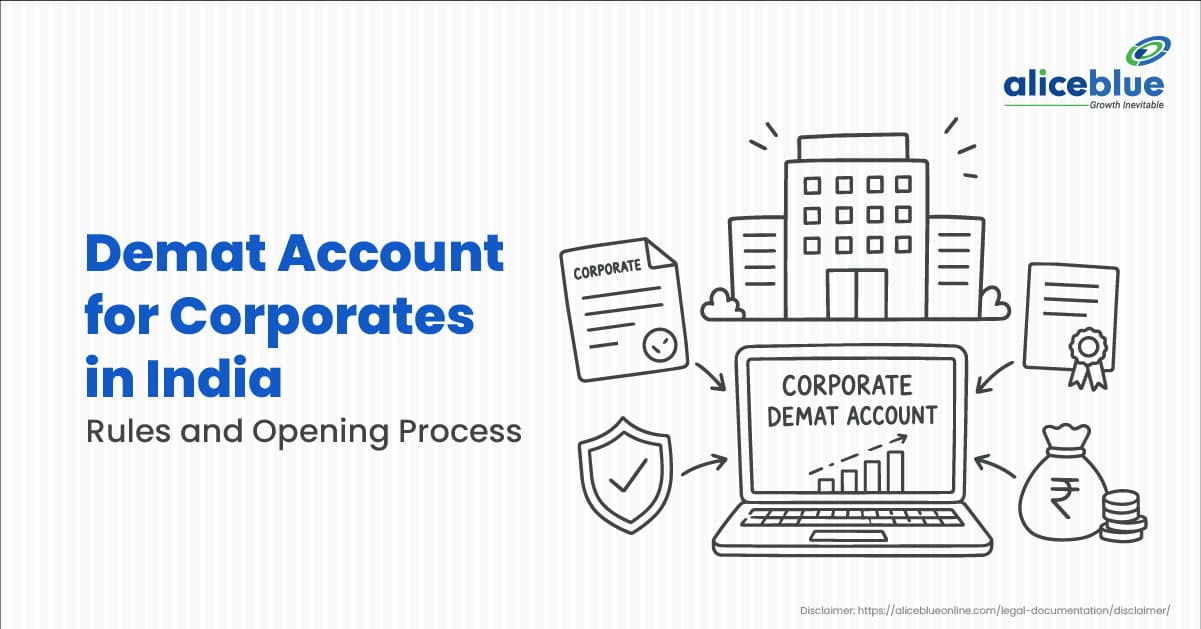
Can a company invest in stocks, ETFs, or IPOs in its own name? Yes, but only through a corporate demat account. Unlike individual accounts, corporate demat accounts involve stricter KYC, board approvals, and compliance checks.
In this guide, you’ll learn what a corporate demat account is, the key rules that apply, the usual documents needed, and a step-by-step opening process. You’ll also see a realistic example of how money moves from a company bank account into investments, and how dividends and sale proceeds flow back.
What is the Demat Account for Corporations in India: Rules and Opening Process?
A corporate demat account (often called a non-individual demat account) is a demat account opened in the name of a business entity, such as a Private Limited Company, Public Limited Company, LLP, partnership firm, trust, society, or other eligible entities to hold securities in electronic form.
Just as an individual demat account stores a person’s shares in electronic form, a corporate demat account holds securities digitally in the company or entity’s name. The key difference is how ownership and control are proved:
- Ownership is in the entity’s name.
- Operations are done by authorised signatories (people allowed to act on behalf of the entity).
- The Depository Participant (DP) must identify the people who ultimately control or own the entity (often through beneficial owner / UBO identification).
Also, corporates cannot open a demat account directly with NSDL or CDSL. They must go through a registered Depository Participant (DP) such as a broker, bank, or financial institution.
Rules for a Demat Account for Corporations in India
A corporate (non-individual) demat account follows most demat rules that apply to everyone, plus a few extra checks because the holder is a legal entity.
1) Account must be opened through a SEBI-registered DP (not directly with NSDL/CDSL)
Companies cannot open a demat account directly with the depository. They must open it through a registered Depository Participant (DP).
2) KYC is mandatory for the entity and key people
The DP will complete KYC for:
- The entity (PAN, registered address, constitutional documents), and
- The authorised signatories / controlling persons, based on the account type and internal structure.
3) Board Resolution / Authority document is required for “who can operate”
For companies, a Board Resolution is commonly required to:
- Appoint authorised signatories, and
- Define the mode of operation (single/joint signing rules).
4) Beneficial Owner / UBO identification rules apply
DPs must identify the people who ultimately own/control the entity (UBO/beneficial ownership) and may ask for declarations and supporting documents.
5) KYC validation status matters (restrictions if KYC is “on hold”)
If KYC is not validated by the KRA (often shown as “On Hold”), market transactions can be restricted until KYC is corrected and validated.
6) No minimum balance and no “account opening charges” (as per investor charter)
As per SEBI investor charter disclosures:
- No minimum balance is required in a demat account, and
- No charges are payable for opening a demat account.
DPs can still charge AMC/transaction fees as per their tariff schedule.
7) Standing instruction for automatic credit is optional (but useful)
You can give standing instructions so eligible credits (like corporate actions/transfers) come automatically to the demat account.
8) Power of Attorney (PoA) is optional, not mandatory
If a broker asks for PoA, the investor charter notes that PoA is not mandatory, and you can revoke authorisations. (Many corporates avoid PoA and use e-DIS/OTP-based approvals where possible.)
9) Multiple demat accounts are allowed
A corporate can open more than one demat account with the same DP or different DPs (useful for separation of portfolios).
10) Nomination: Non-individual accounts generally can’t add a nominee
Many DPs do not allow nomination for non-individual entities (companies, firms, trusts, societies, etc.). Operationally, transmission happens through entity/legal documentation instead.
Also, SEBI clarified that non-submission of nomination choice should not freeze demat accounts.
11) BSDA is for eligible individuals, not corporates
Basic Services Demat Account (BSDA) is a facility for eligible individuals (meant for retail inclusion), so corporates typically open a regular non-individual demat account.
How It Works: Corporate Demat Account Opening Process in India (Step by Step)
Step 1: Choose a Depository Participant (DP)
NSDL and CDSL are the two depositories in India, and your demat account will be opened through a DP connected to one of them. You can use the official DP search tools to verify and shortlist DPs.
Tip: Don’t pick only on brokerage. For corporates, it helps if the DP has strong support for documentation, signatory mapping, and ongoing compliance updates.
Step 2: Decide the account category (Company/LLP/Trust, etc.)
Your DP will give a non-individual account opening form and KYC pack based on entity type (company, LLP, partnership, trust, society, AOP, etc.). Many DPs use a standard “Non-Individual KYC” form format aligned to depository and SEBI requirements.
Step 3: Gather entity documents (proof of existence + address)
While the exact checklist varies by DP and entity type, corporate demat account document packs commonly include:
- Entity PAN
- Certificate of Incorporation / Registration
- Entity address proof
- Constitutional documents (MOA/AOA for companies, LLP deed for LLPs, partnership deed, trust deed, etc.)
- Bank proof (cancelled cheque/bank statement for the entity account)
Broker learning guides in India list similar corporate document requirements (PAN, incorporation papers, constitutional documents, bank proof, net worth proof in some cases).
Step 4: Submit Board Resolution / Authority Letter and signatory details
A corporate demat account must clearly show who is authorised to operate it.
- Companies typically submit a Board Resolution naming authorised signatories and the mode of operation.
- Other entities submit an equivalent authority letter/resolution.
Depository-related documents and audit manuals commonly refer to maintaining the mode of operation and signatures as per the Board Resolution for corporate clients.
Good practice: Keep the resolution wording aligned to your DP’s format to avoid back-and-forth.
Step 5: KYC of authorised persons + beneficial owner (UBO) identification
For a corporate account, KYC is not only about the entity. The DP may also collect KYC for:
- Directors/partners/trustees (as applicable)
- Authorised signatories
- People who control ownership (beneficial owners / UBO)
SEBI has issued guidelines on identifying beneficial ownership for KYC in the securities market, which DPs and intermediaries follow.
Step 6: In-person verification/verification checks (including KRA validation)
Account activation typically happens only after the DP receives the complete account opening form, KYC, and supporting documents.
Also, SEBI/KRA validation processes matter. If KYC is found not valid after validation, transactions can be restricted until KYC is validated, which is why accurate, complete documentation is important from day one.
Step 7: Account activation + linking trading account (if the company will trade)
A demat account is used to hold securities. If the company plans to buy/sell on exchanges, it also needs a trading account in the entity’s name (and bank mapping for fund transfers).
Example: How a Corporate Demat Account Is Used in Real Life
Let’s say BrightTools Private Limited has ₹10,00,000 as surplus working capital for 6-12 months and decides to invest part of it.
- The company opens a corporate demat account and a corporate trading account with a DP/broker.
- The Board passes a resolution authorising the CFO and one director as signatories for the account.
- The company transfers ₹5,00,000 from its current account to the trading account.
- Using the corporate trading account, it buys:
- ₹3,00,000 worth of a Nifty 50 ETF
- ₹2,00,000 worth of listed bonds (or another permitted instrument)
- After settlement, these holdings appear in BrightTools’ corporate demat account.
- Any dividend from the ETF (if declared) is credited to the company’s mapped bank account.
- After 8 months, the company sells the ETF units for ₹3,30,000.
- Sale proceeds come back through the trading settlement cycle and finally into the company’s bank account.
This is the practical value: the investment is owned by the company, recorded cleanly in the company’s books, and controlled through documented authorisations.
Key Features of a Corporate Demat Account
- Entity as the Beneficial Owner: Securities are held in the company/LLP/trust name, not in a director’s personal name.
- Operated via authorised signatories: Account operations follow the approved signatory list and mode of operation.
- Works through a DP (not directly with NSDL/CDSL): Account opening and servicing happen via the DP.
- No minimum balance requirement: Demat accounts generally do not require a minimum balance.
- Account opening charges: Investor charter documents state no charges are payable for opening a demat account (DPs may still have AMC/transaction charges depending on tariff).
- Ongoing compliance updates: KYC status and periodic updates can impact account operations.
Advantages of a Corporate Demat Account
A Demat Account for Corporations in India is helpful when:
- Treasury investing: Companies want to invest surplus cash in ETFs, bonds, or other market instruments (as permitted by their internal policies).
- Cleaner accounting and audits: Holdings remain in the entity’s name, supporting clear audit trails.
- Separation from personal finances: Avoids mixing director/partner personal investments with company investments.
- Corporate actions flow correctly: Dividends, interest, and other benefits map cleanly to the entity’s bank account.
- Better governance: Documented approvals (like board resolutions) reduce ambiguity on who can act.
Risks or Limitations
Corporate demat accounts are useful, but they come with extra responsibility:
- Heavier documentation and checks: Entity proofs + authorised persons’ KYC + beneficial owner identification are common requirements.
- KYC validation issues can restrict transactions: If KYC is not validated or becomes non-compliant, transactions can be restricted until fixed.
- Signatory change updates are mandatory: Director/partner changes should be updated quickly to avoid operational issues.
- DP tariffs vary: Even if “opening charges” are not payable as per the investor charter, DPs may charge AMC, transaction fees, and service charges as per their schedule.
- Internal control risk: If authorisation is drafted loosely, it can create a risk of misuse by a signatory.
Corporate Demat Account vs Individual Demat Account
Before choosing the right setup, it helps to see the differences clearly.
Point | Corporate Demat Account | Individual Demat Account |
Account holder | Legal entity (company/LLP/trust, etc.) | Person (resident/NRI, etc.) |
Who operates it | Authorised signatories as per the resolution | Account holder(s) |
Documents | Entity proofs + signatory KYC + ownership/control proofs | Personal KYC + bank proof |
Main use | Corporate investing, treasury, strategic holdings | Personal investing/trading |
Governance | Board/authority documentation is part of the process | Not needed |
Note: In both cases, accounts are opened through a DP and not directly with NSDL/CDSL
Common Mistakes and How to Avoid Them
- Submitting a generic Board Resolution
Fix: Use your DP’s suggested format and clearly mention signatories and mode of operation.
- Using the wrong bank account
Fix: Map the entity’s bank account (not a director’s personal account).
- Not disclosing beneficial ownership properly
Fix: Provide correct ownership/control details and UBO declarations when asked.
- Ignoring KYC/KRA validation messages
Fix: Treat KYC updates as a priority to avoid restrictions.
- Not updating changes in directors/partners/signatories
Fix: Update the DP quickly when there is a ROC change, partner change, or signatory update
Conclusion
A Demat Account for Corporations in India lets companies and other entities hold shares and other securities in electronic form, with control managed through authorised signatories and documented approvals. The opening process is more document-heavy than an individual account because the DP must verify the entity, the people operating the account, and the ownership/control structure.
If you get the paperwork and governance right at the start, especially the resolution and KYC, corporate investing and reporting become much cleaner.
If you’re planning to start investing, you can open a demat account with Alice Blue and get started.
Frequently Asked Questions
Yes. A private limited company can open a corporate (non-individual) demat account through a SEBI-registered DP. The account is held in the company’s name and operated by authorised signatories as per the Board Resolution.
Most DPs ask for entity PAN, incorporation/registration proof, registered address proof, constitutional documents (MOA/AOA or LLP deed/trust deed/partnership deed), and bank proof of the entity account. They also collect KYC for authorised signatories and may ask for beneficial ownership (UBO) declarations depending on the structure.
For companies, a Board Resolution is commonly required to confirm who can operate the demat account and how signing will work (single/joint). If it’s not a company (example: partnership/trust), the DP usually asks for an equivalent authority letter/resolution as applicable.
A demat account is used to hold securities. To buy/sell on exchanges, the company also needs a corporate trading account, bank mapping, and the broker’s segment approvals. For derivatives, brokers may ask for extra declarations and risk-related documentation based on internal policies and exchange rules.
Yes, if the Board Resolution/authority document names multiple authorised signatories and clearly states the mode of operation. The DP will allow operations based on that mode (example: “any one signatory” or “jointly by two signatories”).
Yes. If the KYC record is not validated by the KRA (often shown as “On Hold”), transactions can be restricted until KYC is corrected and validated. This is why getting UBO/signatory details right at the start matters.
No. A demat account is opened through a Depository Participant (DP) connected to NSDL or CDSL, not directly with the depositories.

Blog by Aliceblue News Desk


