
Crude Oil Directional Breakout Strategy: How It Works and Who Should Use It
Blog by Aliceblue News Desk
25 September 2026
13 minutes

The Crude Oil Directional Breakout Strategy is an intraday options approach on MCX Crude Oil. It waits for the price to close past a defined range, with rising volume and Open Interest confirming the move, then buys an at-the-money Call or Put option in that direction. The stop loss and target are both set as a fixed percentage of the premium paid, so the maximum loss is known before the trade is placed.
Table of Contents
- What Is the Crude Oil Directional Breakout Strategy?
- How the Strategy Works, Step by Step
- Best Time to Trade Crude Oil Breakouts
- A Worked Example With Real Numbers
- Key Features
- Advantages
- Risks and Limitations
- Tips for Beginners
- Options Breakout vs Futures Breakout vs Range Trading
- Common Mistakes to Avoid
- Who Should Use This Strategy?
- Conclusion
- Frequently Asked Questions
Crude oil sits still for an hour, then suddenly runs hard in one direction. Anyone watching a live MCX chart has seen this happen more than once. The Crude Oil Directional Breakout Strategy is built around that exact moment. It waits for price to close past a known range, checks that volume and Open Interest back the move, then buys a Call or Put option instead of guessing which way things go next. Below is the full mechanism, a worked example with current premium numbers, and where this fits if you are new to options.
What Is the Crude Oil Directional Breakout Strategy?
It is an intraday options method built on fixed rules. A trader marks a price range on MCX Crude Oil, waits for the price to close beyond that range with volume and Open Interest confirming the move, and then buys an at-the-money option in the breakout direction.
Here is the plain version. Crude oil trades sideways for stretches of time. Traders call this a range. At some point, buyers or sellers push hard enough to break it open. Instead of trading the underlying futures contract directly, this strategy buys a Call option when price breaks upward, or a Put option when it breaks downward. Buying an option instead of trading futures caps the maximum loss at the premium paid, which matters a lot for someone still learning how crude oil moves.
This is a form of price action trading with options layered on top. Decisions come from the chart itself, not a screen full of indicators. Before trying this, it helps to understand the basics of MCX crude oil contracts, including lot size, strike intervals, and expiry, since options behave differently from a straight futures trade.
How the Strategy Works, Step by Step
- Mark the range. On a 5 minute or 15-minute chart, note the high and low where crude oil has been stuck during the session.
- Wait for the candle to close beyond the range. A wick that pokes past resistance and pulls back before the candle closes is not a breakout. It is a trap.
- Confirm with volume and Open Interest, also called OI. Volume tells you more people are trading. OI tells you whether those trades are new positions or just existing ones being closed. Open Interest is simply the number of option contracts still open in the market. Rising OI alongside rising price usually means fresh money is entering the trade, which is a stronger signal than price movement alone.
- Pick the at-the-money option, also called ATM. ATM means the strike price closest to the current market price. Buy a Call if the breakout is upward; buy a Put if it is downward.
- Buy the option at the current premium. This is the price you pay for the option. It is also your maximum possible loss on the trade.
- Set the stop loss as a percentage drop in premium. A common rule is to exit if the premium falls by around 30 percent from your entry price. If the breakout fails, the premium usually drops fast.
- Set the target as a larger percentage rise in premium. Aiming for a 60 percent rise gives roughly a 1 to 2 risk-to-reward setup. Risking 30 percent to make 60 percent keeps the maths consistent across trades.
- Respect time decay. Options lose value every day just from time passing, even without any price movement. This is called theta decay. Since this is an intraday strategy, exit by the end of the session regardless of whether the stop or target has been hit.
- Take a fresh setup if one forms again in the same session. A new range and a new confirmed breakout later in the day can be traded using the same steps.
Best Time to Trade Crude Oil Breakouts
MCX Crude Oil trades from 9:00 AM to around 11:30 PM IST on most days, extending to 11:55 PM during the period when the US follows daylight saving time. Trading volume tends to build slowly through the day and picks up sharply from around 5:00 PM onward, once European and US markets open and overlap with Indian hours. That evening window is generally when the most reliable breakouts form, since it carries the heaviest volume and Open Interest activity. Be careful around US crude inventory data or OPEC announcements, since implied volatility, a measure of expected price swings that is priced into the premium, can jump sharply during these events even when the underlying price barely moves.
A Worked Example With Real Numbers
Crude oil futures on MCX were trading close to 8,150 rupees per barrel in the week these figures were checked, with the front month contract seeing an implied volatility of roughly 53 percent. Assume crude oil has been consolidating between 8,100 and 8,150 rupees per barrel for an hour. A candle closes at 8,165 on rising volume, and Call option Open Interest is climbing too, both pointing to a genuine breakout above 8,150.
The ATM Call option, with a strike of 8,200, is trading at a premium of around 430 rupees per barrel. On the Crude Oil Mini options contract, which has a lot size of 10 barrels, that is a total cost of 4,300 rupees for one lot.
Parameter | Value |
Strike, ATM Call | 8,200 |
Entry premium | 430 rupees per barrel |
Lot size, Mini contract | 10 barrels |
Premium cost per lot | 430 multiplied by 10 equals 4,300 rupees |
Stop loss, 30 percent premium drop | Exit near 301, a loss of 129 multiplied by 10 equals 1,290 rupees |
Target, 60 percent premium rise | Exit near 688, a gain of 258 multiplied by 10 equals 2,580 rupees |
If the target is hit, the gain is 2,580 rupees on a risk of 1,290 rupees, close to a 1 to 2 outcome. If the stop is hit, the loss is capped at 1,290 rupees, and it can never go beyond the 4,300 rupees paid as premium, no matter how sharply the breakout fails.
For traders who want the same setup at a larger size, the standard Crude Oil options contract uses a lot size of 100 barrels. The identical trade would cost 43,000 rupees in premium, with a stop loss near 12,900 rupees and a target near 25,800 rupees, ten times the size of the Mini contract example.
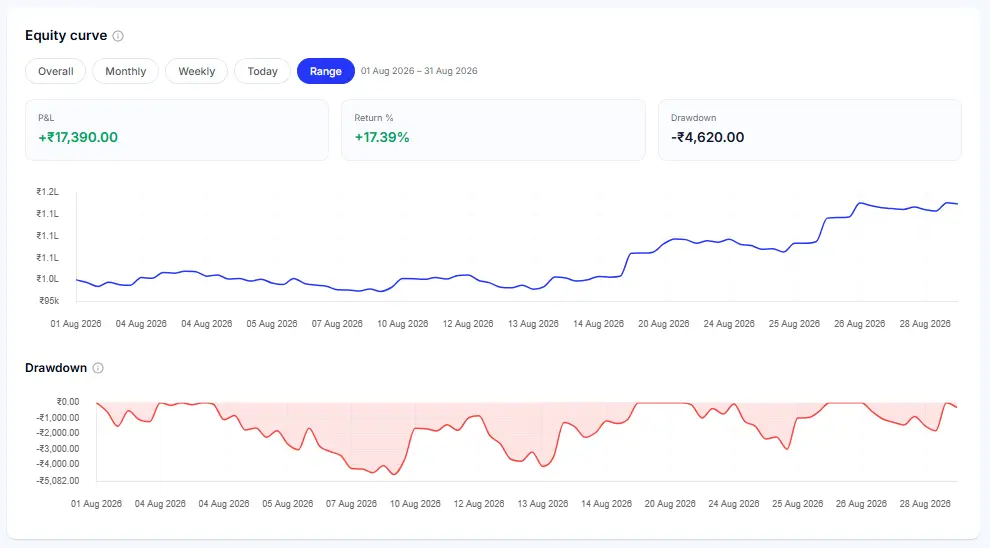
A strategy following this exact structure was tracked on the Alice Blue Algo Trading Marketplace through August, returning 17.39 percent on a capital base of 1,00,000 rupees, around 17,390 rupees in gains, built on breakout confirmed entries with defined risk on every trade. Over its full backtest window of one year, three months, and fourteen days, it held a win rate of 59.51 percent and a net profit of 2,04,800 rupees. These are historical backtest figures, not a guarantee of future performance, and live trading results can differ due to slippage and premium quotes changing between order placement and execution.
Key Features
- Entries need volume and OI confirmation together. Price alone is not enough. Both need to agree before a trade is placed.
- Maximum loss is capped at the premium paid. Unlike a futures position, there is no risk of losing more than what you put into the trade.
- Stop loss and target are both set in premium terms. A fixed percentage drop or rise, decided before entry, not adjusted mid trade.
- Time decay works against the buyer. Every intraday options buying trade needs to respect that the premium erodes with time, so the trade does not get held past the session.
- More than one setup can be traded per session. Fresh ranges and fresh breakouts later in the day follow the same process.
- Strike selection matters. ATM strikes move more closely with the underlying than far out of the money strikes, which is why this strategy sticks to ATM.
Advantages
- The biggest advantage of buying options instead of trading futures directly is that the loss is capped at the premium paid. There is no margin call, and no risk of losing more than what went into the trade. That alone makes this approach more forgiving for someone still learning how crude oil reacts to news and range breaks.
- Crude oil reacts sharply to OPEC decisions and US inventory data, and that reaction usually shows up as the kind of range to breakout move this strategy looks for. Trading the Mini contract keeps the premium and margin outlay small, so a beginner can take the same setup with a fraction of the capital needed on the standard contract.
Risks and Limitations
- False breakouts remain the core risk. Price can close past a range and reverse within minutes, and even volume and OI together will not catch every case. A losing trade here means losing part or all of the premium paid.
- Time decay works against the option buyer constantly. Even if the breakout direction turns out to be correct, holding the position too long can eat into gains as the premium erodes with each passing hour, particularly close to expiry.
- Implied volatility adds another layer. A premium can fall even when the underlying price moves in your favour, if implied volatility drops sharply right after a news event. This is sometimes called an IV crush, and it catches beginners off guard because the direction call was right but the premium still lost value.
- There is a behavioural risk too. After a couple of losing trades, the temptation to skip the OI check or hold past the planned exit just to see grows fast, and that is usually where a rule-based approach breaks down, not because the rules failed but because they were not followed. Wide bid-ask spreads on less liquid strikes can also make entry and exit prices worse than expected.
Tips for Beginners
- Stick to ATM strikes only. Far out of the money options are cheaper but move far less for the same underlying price change.
- Check both volume and OI before entering. A close beyond the range without OI support is a weaker signal.
- Decide the stop loss and target in premium percentage terms before entering, and do not shift them once the trade is live.
- Respect the intraday nature of the trade. Exit by the end of the session regardless of where the premium stands.
- Start with the Mini contract to keep the premium outlay small while you learn how fast crude oil premiums move.
- Avoid taking fresh breakout trades in the last 30 to 45 minutes of the session, since time decay accelerates and exits get harder to manage.
- Keep a log of every trade, including strike, premium paid, and exit reason, so you can see over time whether losses are coming from bad setups or from not following the rules.
Options Breakout vs Futures Breakout vs Range Trading
Parameter | Options Breakout | Futures Breakout | Range Trading |
Entry point | ATM Call or Put on confirmed breakout | Direct futures position on breakout | Inside the range, near support or resistance |
Maximum loss | Capped at premium paid | Can exceed initial margin if unmanaged | Depends on stop loss placement |
Time decay risk | Yes, premium erodes with time | No | No |
Capital required | Lower, especially with Mini contracts | Higher, based on margin | Similar to futures |
Confirmation needed | Candle close, volume, and OI | Candle close and volume | Support or resistance bounce |
Best suited for | Traders wanting capped risk with defined risk entries | Traders comfortable with margin and open ended downside if unmanaged | Traders comfortable with frequent, smaller moves |
Common Mistakes to Avoid
- Buying far out of the money options because they are cheap. They move less per rupee of underlying price change, so a correct breakout call can still lose money.
- Ignoring Open Interest. A price close beyond the range without rising OI is a weaker signal and fails more often.
- Holding past the session to let it play out. Time decay keeps working against the position, and this strategy is meant to be closed the same day.
- Widening the stop loss after entry. Once the planned exit percentage is ignored, a capped risk trade turns into an open ended one in practice.
- Trading every small range. Not every sideways stretch is a genuine setup. Chasing all of them adds up small, avoidable premium losses.
- Skipping the implied volatility check around news events. A right direction call can still lose money if implied volatility drops sharply right after the event.
Who Should Use This Strategy?
This fits intraday traders who want exposure to crude oil price swings but prefer a capped, known maximum loss over the open ended risk of a futures position. It suits people comfortable reading price charts directly, checking volume and OI together, and following fixed rules rather than discretionary calls.
It is not built for long term investors, since there is no holding period involved. Positions close the same day. It is also not ideal for someone who is not comfortable with how option premiums behave, since a right call on direction can still lose money if time decay or a drop in implied volatility works against the position. Spending time on a demat and trading account with small size practice trades, and understanding basic options behaviour first, is a reasonable step before trading this with meaningful capital.
Conclusion
The Crude Oil Directional Breakout Strategy gives a beginner a fixed, rule-based way to trade MCX crude oil options. Wait for a breakout confirmed by both volume and Open Interest, buy an ATM Call or Put, and manage the exit through a fixed percentage of the premium. The August numbers above show what disciplined execution can look like, but they describe the past, not a promise about what comes next.
What makes this approach usable is not the strategy on paper. It is whether the confirmation steps are followed every time, the stop loss percentage is respected without exception, and the position is closed before time decay eats into it. Capped risk only stays capped if the rules are actually followed.
Frequently Asked Questions
Yes, mainly because buying options caps the maximum loss at the premium paid, unlike a futures position. Start with the Mini contract and small premium amounts while you learn how fast crude oil premiums move.
It is when price closes clearly past a recent trading range, backed by rising volume and rising Open Interest. That combination signals fresh buying or selling pressure, not just existing positions closing out.
On the Crude Oil Mini options contract, an ATM premium around 430 rupees per barrel costs roughly 4,300 rupees for one lot of 10 barrels. The standard contract, at ten times the size, brings that up to around 43,000 rupees per lot.
MCX Crude Oil trades from 9:00 AM to around 11:30 PM IST, but trading volume builds sharply from around 5:00 PM onward once European and US markets overlap with Indian hours. That evening window usually carries the more reliable breakouts, though premiums can swing sharply around inventory data or OPEC news.
Open Interest is the number of option contracts still open in the market. Rising OI along with rising price suggests new money is entering the trade, which makes a breakout signal more reliable than price movement alone.
Yes. This can happen if implied volatility drops sharply after a news event, sometimes called an IV crush, or if too much time passes and decay eats into the premium. Both are real risks specific to buying options rather than trading futures.
Yes. Since the entry conditions, stop loss percentage, and target percentage are all fixed rules, this kind of setup is well suited to algo trading platforms that can apply the logic without manual monitoring throughout the session.

Blog by Aliceblue News Desk


