
Crude Oil Crosses $90: How the Strait of Hormuz Crisis Could Impact India and Stock Markets
Blog by Aliceblue News Desk
17 September 2026
9 minutes
Crude oil prices are back above the $90 mark, and this time the move is being driven by more than routine market volatility.
Renewed military tensions between the United States and Iran have intensified concerns over global oil supplies, while shipping activity through the Strait of Hormuz remains severely restricted. Brent crude climbed to around $91.54 per barrel on September 1, 2026, while US West Texas Intermediate (WTI) rose to approximately $87.03 per barrel. The move followed a sharp rally in the previous session, when Brent gained 2.7% to settle at $90.49 and WTI rose 2.8% to $85.76.
For global markets, the concern is not simply that crude oil has crossed $90. The bigger question is how long supply disruptions continue and whether higher energy prices begin feeding into inflation, interest rates, currencies and corporate earnings.
For India, the issue becomes even more important because crude oil has a direct connection with the country’s import bill, inflation outlook and several major industries.
Why Is Crude Oil Rising Above $90?
The latest oil rally has been triggered by renewed US-Iran military tensions and the growing risk that the conflict could further disrupt energy supplies from the Middle East.
The Strait of Hormuz is at the centre of the problem. The waterway connects the Persian Gulf with the Gulf of Oman and Arabian Sea and is one of the world’s most important energy shipping routes. Before the current conflict, roughly one-fifth of global oil supplies moved through the strait.
That makes any prolonged disruption a major concern for oil markets.
Shipping data shows just how significant the disruption has become. On Monday, only five vessels transited the Strait of Hormuz, compared with a 10-day average of around 14 vessels. More importantly, none of those five vessels were liquid tankers, highlighting the continuing weakness in oil-related traffic.
The market is therefore pricing in a supply-risk premium. Traders are not necessarily assuming that global oil supplies will immediately disappear. Instead, they are reacting to the possibility that transportation constraints could make it more difficult and expensive to move crude and refined petroleum products through the region.
That uncertainty is enough to move prices sharply.
Strait of Hormuz: Why One Waterway Matters So Much
The Strait of Hormuz has become one of the most closely watched locations in global financial markets.
Its importance comes down to geography. A large amount of crude produced in countries around the Persian Gulf must pass through this relatively narrow waterway before reaching international buyers.
When shipping operates normally, oil can move relatively efficiently from producers to refineries around the world. When the route becomes difficult or unsafe, the market immediately starts considering alternative routes, higher freight costs, delays and reduced supply availability.
The current situation is particularly sensitive because diplomatic efforts to reopen the waterway have not yet produced a meaningful breakthrough. A tanker also reported being struck by three projectiles while sailing out of the strait, although there were no reported casualties or environmental damage.
This creates a difficult environment for oil traders. Even if physical oil production continues, transportation disruption can still tighten the market.
What Does Higher Crude Oil Mean for India?
For India, higher crude oil prices are an important macroeconomic risk.
India imports a large share of its crude oil requirement, which means a sustained increase in international oil prices can raise the country’s import bill. If crude remains elevated for an extended period, it can also put pressure on the rupee and increase the cost of several petroleum-linked products.
The impact does not stop at petrol and diesel.
Crude oil is an important input across the wider economy. Transportation, aviation, chemicals, paints, tyres, logistics and several manufacturing activities can be affected by changes in energy and petroleum costs.
This is why investors often look at crude oil as an important indicator when assessing India’s inflation and corporate earnings outlook.
Alice Blue has previously covered how geopolitical developments around the Strait of Hormuz can affect India’s stock market through crude oil, inflation and the rupee. Investors looking for a deeper understanding can also read US-Iran War: Impact on India, Strait of Hormuz and Stock Market.
The Inflation Connection Could Become Important
One of the biggest risks from sustained high crude prices is inflation.
When energy becomes more expensive, businesses can face higher transportation and input costs. Depending on how long the increase lasts, some companies may pass those costs on to customers, while others may absorb them and accept lower margins.
That creates two possible outcomes for investors.
Companies with strong pricing power may be able to protect their profitability. Businesses operating with thin margins and high fuel exposure may have a more difficult time.
The macroeconomic impact can also become more complicated if higher oil prices influence central-bank expectations.
A prolonged rise in energy prices could make inflation harder to control, potentially affecting expectations around interest rates. Global bond markets have already been reacting to renewed inflation concerns, with Japan’s 10-year government bond yield touching 3% on September 1.
For Indian investors, this means crude oil is not an isolated commodity story. It can influence the broader interest-rate, currency and equity-market environment.
Which Indian Sectors Could Feel the Impact?
The effect of higher crude prices will not be the same across the stock market.
Aviation and transportation: Airlines and transport companies can face higher fuel and operating costs. If companies cannot fully pass these costs to customers, margins may come under pressure.
Paints and chemicals: Many chemical and industrial businesses use petroleum-linked inputs. Higher raw material prices can affect margins, especially when demand is weak.
Tyres and auto-related businesses: Synthetic rubber and other petroleum-linked inputs can become more expensive when crude prices rise.
Consumer businesses: Higher transportation and packaging costs can increase operating expenses for consumer companies. The impact depends on pricing power and demand conditions.
Oil and gas companies: The relationship is more complicated. Upstream producers can benefit from higher crude prices, while refiners and fuel marketers may experience different effects depending on crude costs, refining margins and government pricing policies.
Investors interested in this segment can explore Alice Blue’s guide to Oil and Gas Stocks in India to understand the sector and the companies that operate across different parts of the energy value chain.
Could Higher Oil Prices Pressure the Indian Stock Market?
Not necessarily in a straight line.
The stock market reacts to expectations, not just the current crude price.
If Brent rises sharply for a few sessions but the Strait of Hormuz reopens and supply concerns ease, the market could quickly reverse some of the risk premium.
However, if crude remains above $90 for weeks and moves substantially higher, the impact could become more meaningful.
Investors could start reassessing corporate earnings, inflation expectations and interest-rate assumptions. Import-dependent economies could also face pressure through their current-account and currency positions.
This is why a crude oil rally can sometimes coincide with a risk-off mood in equity markets.
But there can also be relative winners.
Energy producers, selected oil and gas companies and businesses with lower fuel sensitivity may perform differently from airlines, logistics companies or fuel-intensive manufacturers.
The important point is to avoid treating the entire market as one trade.
Crude Oil and the Rupee: Another Channel to Watch
There is another link Indian investors should monitor: the rupee.
When international crude prices rise, India’s oil import bill can increase. All else being equal, greater demand for dollars to pay for imports can add pressure to the rupee.
A weaker rupee can then create another layer of complexity for Indian companies.
Import-heavy businesses may face higher costs, while exporters can potentially benefit from currency movements. However, the actual impact depends on each company’s revenue mix, costs, hedging practices and exposure to foreign currencies.
This is why crude oil, the rupee and Indian equities often need to be viewed together rather than separately.
What About the US Strategic Petroleum Reserve?
The supply picture is also being complicated by the condition of the US Strategic Petroleum Reserve (SPR).
US crude inventories in the reserve fell by about 3.1 million barrels to 286.6 million barrels, leaving the stockpile near a multi-decade low.
The reserve is designed to act as a buffer during significant supply disruptions. A lower stockpile therefore reduces the amount of emergency supply available compared with periods when inventories were higher.
At the same time, the US is looking at Venezuela as a potential source of additional oil supply. President Donald Trump has announced a deal involving Venezuelan oil reserves, with the stated objective of helping replenish the US Strategic Petroleum Reserve. Several energy companies, including ONGC, Chevron, Eni and others, are also pursuing energy-related agreements in Venezuela.
However, additional production cannot immediately compensate for a shipping disruption in the Strait of Hormuz. Bringing new projects online, increasing output and establishing reliable logistics all take time.
Can Crude Oil Prices Move Towards $100?
The possibility of crude moving towards $100 is once again being discussed, but the path is highly dependent on what happens next in the Middle East.
If tensions ease and shipping through the Strait of Hormuz begins to normalise, the risk premium in crude could decline quickly.
On the other hand, a prolonged closure, further attacks on energy infrastructure or a wider regional escalation could tighten the physical oil market further.
That makes the next phase of the conflict particularly important for traders and long-term investors.
Analysts polled by Reuters in August expected oil prices to remain above $80 per barrel during 2026 if shipping disruptions persist.
The $90 level therefore matters psychologically, but the duration of the disruption matters economically.
How Should Investors Approach the Current Oil Rally?
For investors, the key is to avoid reacting only to the day’s crude oil price.
Instead, watch a combination of indicators: Brent crude, Strait of Hormuz shipping activity, the rupee, inflation expectations, bond yields and sector-specific earnings sensitivity.
Investors tracking commodities can also learn more about the mechanics through Alice Blue’s guide on How to Start Commodity Trading and its explainer on Commodity Derivatives.
For traders, crude oil can offer opportunities when volatility rises, but higher volatility also means greater risk. Understanding futures, margins, contract specifications and position sizing becomes particularly important during geopolitical events.
The objective should not be to predict every headline.
It should be to understand how a headline can affect supply, prices, sectors and ultimately earnings.
The Bigger Picture: Oil Is Becoming a Market-Wide Story
The latest crude oil rally is a reminder of how quickly geopolitical events can move from a regional conflict to a global financial-market issue.
The sequence is relatively simple:
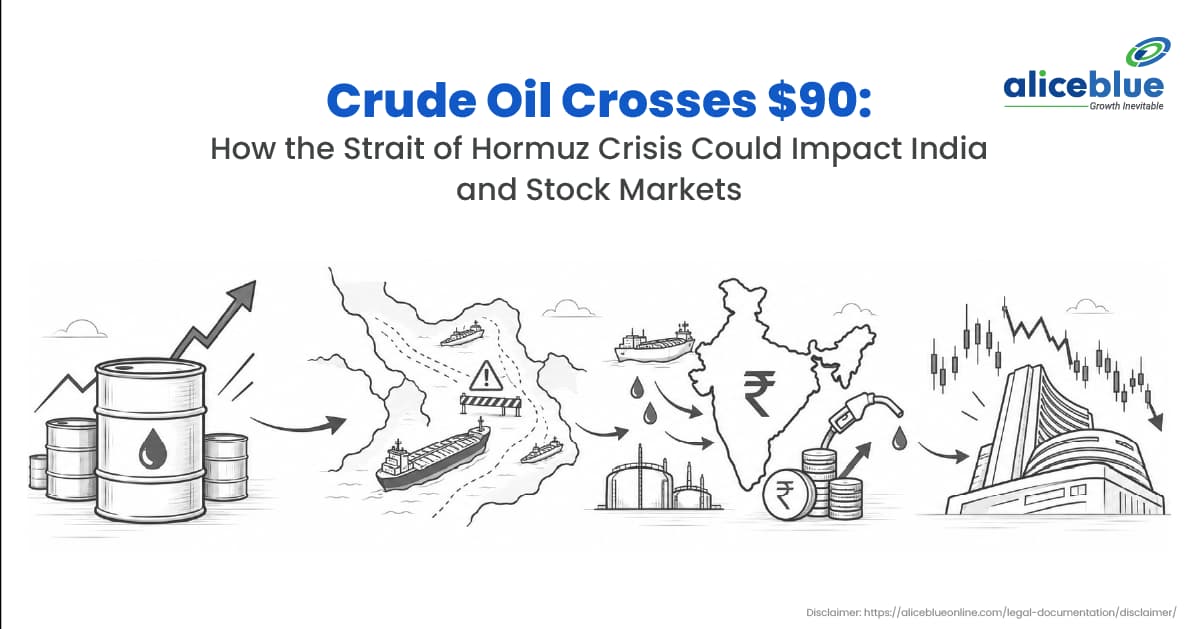
Middle East tensions → Strait of Hormuz disruption → supply concerns → higher crude prices → inflation pressure → interest-rate uncertainty → changes in sector performance.
For India, the implications are particularly important because crude affects the import bill, currency, inflation and a wide range of businesses.
Brent crude above $90 is therefore more than a commodity-market headline. It is a signal for investors to reassess where costs could rise, where margins could come under pressure and which sectors could remain relatively resilient.
For now, the market’s biggest variable is not simply whether crude stays above $90.
It is whether the Strait of Hormuz remains disrupted long enough to turn a geopolitical risk premium into a broader economic shock.
And that is the number investors should be watching—not just the number flashing next to the crude oil price.

Blog by Aliceblue News Desk


