Demat Account Growth in India: Trends and Analysis 2026
Blog by Aliceblue News Desk
05 May 2026
8 minutes
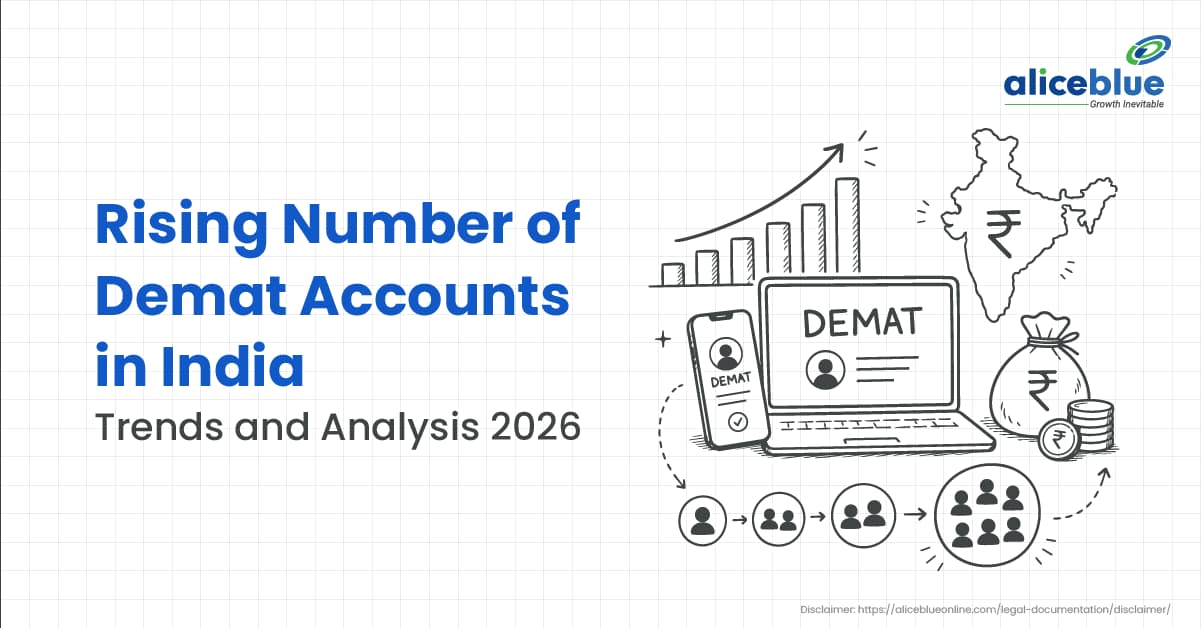
India ended FY26 with 22.5 crore (225 million) demat accounts. That is up from 9 crore in FY22. But FY26 also recorded the steepest fall in new account additions in six years, a 22% drop compared to FY25. If you want to understand what these numbers actually tell you about India’s retail investing story, this article covers the full picture.
What Is a Demat Account
A demat account holds your financial securities in electronic form. When you buy shares of a listed company, those shares are not printed on paper. They are stored digitally in your demat account, just as money sits in a bank account rather than as physical notes in a drawer.
In India, demat accounts are maintained by two depositories:
- CDSL (Central Depository Services Limited)
- NSDL (National Securities Depository Limited)
Your broker, called a Depository Participant (DP), is registered with one of these two and serves as the link between you and the depository. Every investor who wants to buy or hold shares listed on NSE or BSE needs a demat account.
Three Types of Demat Accounts in India
Most first-time investors do not know there are three distinct types. Picking the wrong one can cost you money in unnecessary charges.
Type | Who It Is For | Key Feature |
Regular Demat Account | Indian residents | Standard account for all securities |
Repatriable Demat Account | NRIs (linked to NRE bank account) | Allows transfer of funds back abroad |
Basic Services Demat Account (BSDA) | Small investors with holdings below Rs 10 lakh | Reduced or zero AMC based on holding value |
BSDA charge structure (SEBI revised September 2024):
- Holdings up to Rs 4 lakh: Zero AMC
- Holdings from Rs 4,00,001 to Rs 10 lakh: AMC capped at Rs 100 per year
If you are starting with a small amount of capital, ask your broker about BSDA before opening a regular account. The savings are real.
How a Demat Account Works
Once your account is activated through e-KYC using PAN and Aadhaar, every transaction follows this path:
- You place a buy order through your linked trading account
- The exchange executes the trade and debits the purchase amount from your bank
- Shares are credited to your demat account on T+1 (next trading day)
- When you sell shares, they are debited from your demat account, and the proceeds reach your bank within one working day
Your demat account can hold stocks, bonds, ETFs, Sovereign Gold Bonds, and mutual fund units, all in one place.
The Growth Data: FY21 to FY26
Financial Year | Total Demat Accounts | New Accounts Added |
FY21 | 5.5 crore | 1.4 crore |
FY22 | 9 crore | 3.5 crore |
FY23 | 11.4 crore | 2.5 crore |
FY24 | 15.14 crore | 3.7 crore |
FY25 | 19.2 crore | 4.1 crore |
FY26 (full year) | 22.5 crore | 3.2 crore |
FY25 held the record for new additions — 4.1 crore in a single year. FY26 closed at 22.5 crore total accounts, but new additions fell to 3.2 crore, a 22% decline year on year.
Why FY26 Saw the Sharpest Slowdown in Six Years
Three factors drove the drop in new account openings:
- Equity markets underperformed
The Nifty 50 fell 5.1%, and the Sensex declined 7.1% in FY26 — both indices posting their worst annual performance in six years. When returns disappear, so does the enthusiasm for opening new accounts. - IPO listing gains collapsed
In FY24 and FY25, strong IPO listing premiums — sometimes 30% or more on listing day — pulled in large numbers of first-time investors. In FY26, average listing gains dropped to approximately 8%. Many accounts opened exclusively for IPO gains went inactive. - SEBI tightened F&O rules
SEBI introduced stricter norms for Futures and Options trading in late 2024 and through 2025, including higher contract sizes and mandatory upfront margins. Retail traders who had opened accounts primarily for F&O found the new rules significantly more restrictive.
SIP Growth: The Supporting Trend
Demat account growth has run alongside a significant rise in SIP investing. Monthly SIP inflows jumped sevenfold from under Rs 4,000 crore in FY17 to over Rs 28,000 crore per month in FY26 (April to November average). Total SIP contributions in calendar year 2025 hit an all-time high of Rs 3.34 lakh crore, up from Rs 2.68 lakh crore in 2024. Monthly SIP inflows peaked at Rs 31,000 crore in December 2025.
This parallel growth matters because SIP investing has been the entry point for millions of Indians who later moved to direct stock investing and opened demat accounts.
Risks You Need to Know Before Opening
- Most accounts are dormant
Of the 22.5 crore total accounts, only a fraction are actively used. Activity data from January 2026 shows that just 33% of accounts had any trading activity — meaning over 14 crore accounts are sitting unused, some quietly accumulating annual maintenance charges. - The total count overstates unique investors
Many investors hold two or three demat accounts across different brokers. SEBI’s registered unique investor count of 13.6 crore against 22.5 crore total accounts confirms this duplication. - F&O losses are well documented
SEBI data consistently shows that over 90% of individual F&O traders lose money year after year. Easy account access has not changed this outcome for retail traders who enter F&O without preparation. - AMC charges on dormant accounts
If you open a regular demat account and stop using it, annual maintenance charges still apply. A BSDA removes this problem for small investors, but only if you actively choose it. - Fraud and phishing
Fake broker apps, phishing links, and OTP fraud targeting demat account holders are increasing. Always use the official app, never share OTPs, and enable two-factor authentication.
Demat Account vs Trading Account
Feature | Demat Account | Trading Account |
Purpose | Stores your securities | Places buy and sell orders |
Managed by | CDSL or NSDL | Your broker |
Needed to hold shares | Yes | No |
Needed to trade | No | Yes |
Linked to | Trading account and bank | Demat account and bank |
Both accounts are needed together. Most brokers open them simultaneously during onboarding.
Common Mistakes to Avoid
- Opening an account during a rally and abandoning it during a correction
Most dormant accounts in India were opened in 2021 or early 2024 when markets were rising sharply. When returns reversed, activity stopped. Investing is not a market-timing decision. - Not choosing BSDA when eligible
First-time investors with small portfolios automatically get a regular demat account if they do not ask. A BSDA with the same broker costs nothing for holdings under Rs 4 lakh. - No nominee registered
A large proportion of India’s demat accounts have no nominee on record. Without one, transferring securities to legal heirs after the account holder’s death requires significant legal effort. - Overtrading based on tips
A demat account is a holding facility. Many new investors treat it like a speculative tool, buying and selling based on social media tips, which leads to avoidable losses.
Conclusion
India’s demat account base grew from 9 crore in FY22 to 22.5 crore in FY26, a 150% increase in four years. FY26 also brought a reality check: 22% fewer new accounts than the record year before, driven by weak equity returns, shrinking IPO premiums, and tighter F&O regulations.
The total count is a headline number. The more useful measure is the 33% active rate, meaning a large majority of account holders are not investing at all. Opening an account is the administrative step. Investing consistently, understanding what you hold, and staying through market corrections is everything that follows.
If you’re planning to start investing, you can open a demat account with Alice Blue and get started.
Frequently Asked Questions
India crossed 22.5 crore (225 million) demat accounts at the end of FY26, with CDSL and NSDL together recording approximately 3.2 crore new additions during the year.
New additions fell 22% in FY26. The Nifty 50 dropped 5.1%, and Sensex fell 7.1% — the worst annual performance in six years. IPO listing gains fell sharply, and SEBI’s F&O rule changes reduced speculative account openings.
A BSDA is for investors with small portfolios. Holdings up to Rs 4 lakh attract zero AMC. Holdings between Rs 4 lakh and Rs 10 lakh are capped at Rs 100 AMC per year. SEBI revised these thresholds in September 2024.
As of December 2025, Groww held the largest active client base with 1.21 crore active accounts, ahead of Zerodha at 68.5 lakh and Angel One at 67.6 lakh.
As of January 2026, approximately 33% of total accounts showed any trading activity — meaning roughly 7 crore out of 22 crore were actively used.
Yes. NRIs can open a Repatriable Demat Account linked to an NRE bank account, which allows repatriation of funds. A Non-Repatriable account linked to an NRO account is also available for NRIs who do not need to move funds abroad.

Blog by Aliceblue News Desk


