
Demat Account KYC Re-Verification 2026: SEBI’s New Mandate Explained
Blog by Aliceblue News Desk
15 April 2026
12 minutes
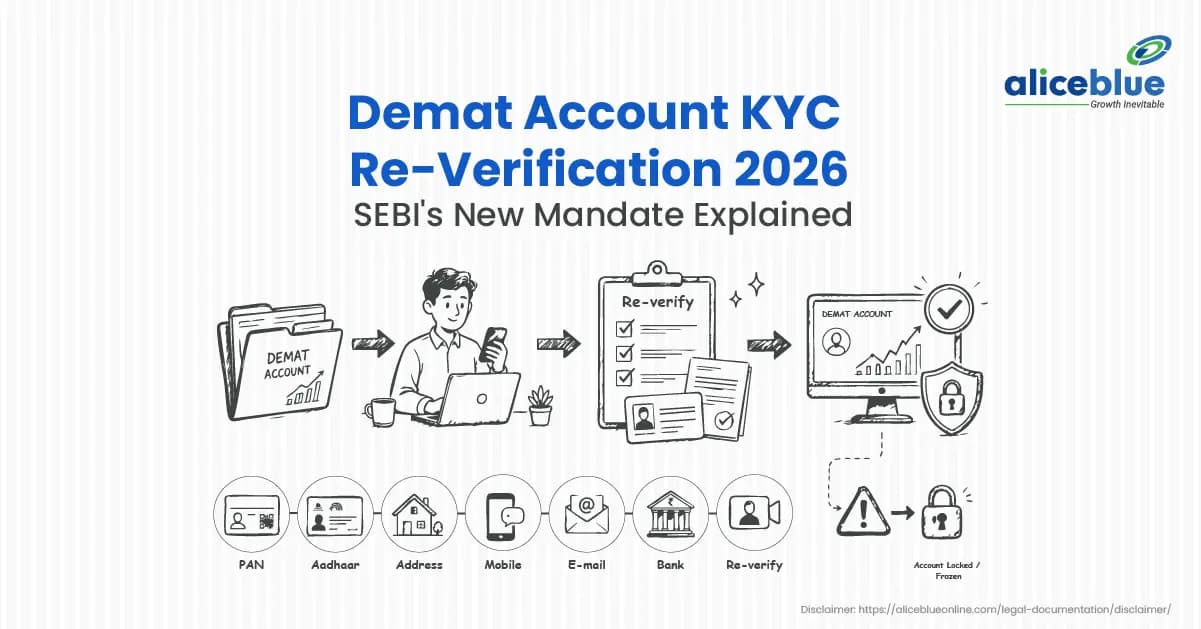
NSDL suspended thousands of demat accounts on January 31, 2026. The second batch followed on March 7, 2026. Investors who tried to log in and sell shares that week got a single error message saying their account was restricted. No fraud. No suspicious transactions. Just a mobile number that was never updated, an income range left blank since account opening, or a PAN card sitting unlinked to Aadhaar for years.
This guide covers the full picture: what SEBI’s KYC re-verification mandate says, what six attributes get checked, what each KYC status means, and exactly what you need to do if your account has been flagged or frozen.
What KYC Re-Verification Means
When you opened your demat account, you submitted your PAN, Aadhaar, a photograph, and address proof. That was your initial KYC. It confirmed your identity and let you start investing.
KYC re-verification is a follow-up check. SEBI requires that the information already on file still matches your current identity, address, contact details, and income. If it does not, your account gets flagged by the KYC Registration Agency (KRA), and your broker is directed to suspend the account until you update and revalidate your records.
The legal base for this process is SEBI circular SEBI/HO/MIRSD/DoP/P/CIR/2022/46, dated April 6, 2022, which mandated KYC validation for all demat account holders through KRAs. On January 16, 2026, SEBI followed this with a consultation paper proposing that all KYC records maintained by KRAs be reviewed at least once every five years from the date of account creation or last update.
The 6 KYC Attributes SEBI Checks
As per NSDL’s advisory and CDSL’s circular DP-304, six attributes are mandatory for every demat account. Your account can be frozen if any one of these is missing, expired, or mismatched.
The six attributes are the following:
- Name as it appears on your PAN card and Aadhaar
- PAN, which must be active and linked to Aadhaar in the Income Tax Department database
- Address with a valid PIN code, supported by a current Officially Valid Document
- Mobile number, which must be active and registered with your broker
- Email ID, which must be active and accessible since KRAs send validation links here
- The income range which must be declared and the current
The income range options for individual investors are below Rs 1 lakh, Rs 1 lakh to Rs 5 lakh, Rs 5 lakh to Rs 10 lakh, Rs 10 lakh to Rs 25 lakh, and more than Rs 25 lakh.
The income range field is the one that catches the most investors off guard. Most people associate KYC with identity documents and overlook this field entirely. But NSDL’s circulars from 2021 onwards explicitly list income range as a mandatory attribute, and accounts where this field has not been reviewed get flagged during KRA validation.
What Your KYC Status Actually Means
When you check your KYC section on your broker’s platform, you will see one of three statuses. Most investors do not know what these mean or what action each one requires.
Status | What It Means | Action Required |
Validated | All six attributes passed cross-verification with PAN database and Aadhaar records | No action needed if details are current |
Registered | KYC was accepted at account opening, but not yet cross-validated against government databases | Initiate re-verification through your broker |
On Hold | One or more attributes failed validation | Act immediately as account suspension follows |
Accounts with “Registered” status are not automatically safe. Many accounts opened between 2019 and 2022 carry this status because the KRA cross-validation system was not fully operational at that time. These accounts are now in the re-verification queue under NSDL’s current suspension cycle.
What Triggers a Re-Verification Notice
The KRA identifies specific conditions that push an account into the re-verification queue:
- KYC documents were last submitted more than five years ago
- Your registered mobile number is inactive or not Aadhaar-linked
- The income range has not been reviewed since account opening
- The address proof submitted at account opening has expired
- PAN is inoperative due to no Aadhaar linkage
- The account was opened as a minor account, and you have since turned 18
- No transactions have been made in 12 months or more (dormant classification)
- The names on PAN and Aadhaar have a mismatch, even a spelling difference
Once the KRA detects any of the above, it flags the record and notifies your depository participant. Your broker then sends you an alert by email, SMS, or through the app. If you do not act within the given window, NSDL or CDSL suspends the account for both debit and credit.
What Happens When Your Account Is Frozen
NSDL’s circular NSDL/POLICY/2026/0010 dated January 21, 2026, formally describes the suspension as “frozen for debit and credit”. Both directions are blocked. You cannot sell shares. You cannot receive shares. Bonus issues, dividend credits in the form of shares, and transfers from other accounts all stop until re-verification is complete.
Reactivation after a freeze takes one to three working days after you submit your documents and the KRA validates the records. In a volatile market, that window matters. There is also a second consequence that investors often miss: a frozen demat account can block your linked trading account from completing pending settlements, which can result in short delivery penalties depending on your broker’s policy.
NSDL ran a second suspension cycle where accounts with KYC records found invalid during January 2026 were frozen on March 7, 2026. These cycles run every month.
A Realistic Scenario
Arjun opened his demat account in 2020 during the COVID lockdown. He used his paying guest address in Bengaluru, declared an income of Rs 1 to 5 lakh, and linked a college SIM he was using at the time.
By 2026, Arjun works in Gurugram, earns over Rs 15 lakh, and has not used that SIM in three years. His income range in the account still shows Rs 1 to 5 lakh. His registered mobile number is dead.
In February 2026, his broker sent a re-KYC compliance notice to his email. He saw it but assumed it was a promotional message. Three weeks later, he tried to sell his holdings after the stock hit his target price. His screen showed: “Account restricted. Contact your broker.”
He reached out for support, was told his account had been suspended in the January 31 batch, submitted new address proof from Gurugram, updated his income range, and completed Aadhaar OTP verification through a secondary number he had updated on Aadhaar. His account was restored in two working days. The stock had already corrected by then.
How to Complete KYC Re-Verification: Step by Step
Before starting, confirm four things:
- Your PAN is active and linked to Aadhaar. Check this on incometax.gov.in before anything else.
- Your Aadhaar has a currently active mobile number linked to it. OTPs go to this number.
- You have a recent address proof not older than three months, such as a bank statement or electricity bill.
- You know which income range category reflects your current annual income.
Step 1: Log in to your Alice Blue account and check your profile or compliance section. If your KYC status shows Validated and you have received no compliance notice, you are in good standing. If it shows Registered or On Hold, proceed.
Step 2: Use the re-KYC link sent in the compliance notice from Alice Blue, or find the re-KYC option inside your profile settings. Do not navigate directly to a KRA portal without going through your broker’s verified link.
Step 3: Enter the OTP sent to your Aadhaar-linked mobile number. This step confirms your number is active and belongs to you. If the OTP fails to arrive, your number may have changed. Update your Aadhaar-linked mobile at a UIDAI centre or via the mAadhaar app first.
Step 4: Update your income range in the dropdown. Select the bracket that matches your current annual income. Do not skip this field.
Step 5: Upload your current address proof if you have moved since account opening. The document must be dated within the last three months.
Step 6: If your account has had no transactions for more than 24 months, you will be prompted to complete a video IPV. This is a short video where you hold your PAN card, face the camera, and state your name. This can be completed through the Alice Blue app from home.
Step 7: Submit and wait for KRA confirmation. Alice Blue will notify you once the KRA has validated your updated records. This typically takes one to two working days.
The Income Range Field: Why It Matters More Than You Think
The income range is not just an administrative box to tick. SEBI and NSDL treat it as an active compliance attribute. Per NSDL’s investor advisory, the income range is one of the six mandatory KYC attributes that must be present and current in your demat account records.
Accounts where this field shows a bracket significantly lower than the investor’s actual trading activity can also trigger a review from a risk management standpoint. When completing re-KYC, update this field honestly. The brackets are below Rs 1 lakh, Rs 1 lakh to Rs 5 lakh, Rs 5 lakh to Rs 10 lakh, Rs 10 lakh to Rs 25 lakh, and more than Rs 25 lakh for individual investors.
NRI Investors: No Travel Required
NRI investors previously had to arrange an in-person verification for any KYC update, which was impractical for someone living outside India. In December 2025, SEBI relaxed this requirement. NRIs can now complete the full re-KYC process digitally from outside India through your broker’s authorised app, using geo-tagged and time-stamped verification. Alice Blue’s NRI digital verification option covers this.
Common Mistakes That Delay or Block Re-Verification
- Starting re-KYC before fixing PAN and Aadhaar linkage
If your PAN is inoperative, the KRA validation fails at the first check. Confirm that your PAN and Aadhaar are linked on incometax.gov.in before starting. - Name mismatch between PAN and Aadhaar
A minor spelling difference counts as a mismatch in the validation system. Get the incorrect record corrected with NSDL (for PAN errors) or UIDAI (for Aadhaar errors) before you attempt re-verification. - Aadhaar linked to a dead SIM card
The OTP in Step 3 goes only to the number linked to Aadhaar. If that number has been deactivated, re-verification stalls. Visit a UIDAI centre or use the mAadhaar app to update your Aadhaar-linked mobile first. - Submitting documents older than three months
A bank statement from six months ago will not pass as address proof. Use your latest available statement or the most recent utility bill. - Ignoring the compliance email
NSDL’s suspension notices are issued in monthly batches. If you receive a notice and ignore it, the next batch date becomes your deadline. Accounts in the February 2026 data were frozen on March 7, 2026, with no further grace period.
Who Needs to Act Now
You need to complete re-verification today if:
- Your demat account was opened before 2022, and you have not updated any details since
- Your broker, NSDL, or CDSL has sent you a compliance notice
- Your KYC status shows ‘Registered’ or ‘On Hold’ in your broker platform
- Your income range still shows the bracket you declared at account opening
- Your registered mobile number has changed since you opened the account
- Your PAN shows as inoperative on the Income Tax portal
If your KYC status is validated, your income range is current, and your mobile is active, you are likely clear. Log in once and verify.
SEBI’s KYC re-verification mandate is not new in concept, but the 2026 enforcement is stricter and more systematic than anything before it. NSDL is running monthly suspension cycles. Accounts frozen in January 2026 had KYC records flagged in December 2025. Accounts frozen in March 2026 had records flagged in January 2026. This cycle continues.
The investors who faced the most disruption were not those who refused to comply. They were the ones who never opened the email. Log in to your Alice Blue account, check your KYC status, confirm your income range is current, and make sure the mobile number registered with your broker is the same one linked to your Aadhaar. Do this today, before the next suspension batch runs.
If you’re planning to start investing, you can open a demat account with Alice Blue and get started.
Frequently Asked Questions
Yes. ‘Registered’ means your KYC was accepted at account opening but has not been cross-validated against PAN and Aadhaar databases. NSDL’s suspension cycles in 2026 are targeting accounts with this status. Initiate re-verification through Alice Blue immediately.
Log in to Alice Blue, go to your compliance or KYC section, and initiate the re-verification process. Submit your current address proof, complete Aadhaar OTP verification, and update your income range. Alice Blue restores access within one to two working days after the KRA validates your records.
As per NSDL’s investor advisory, the six mandatory attributes are: Name, PAN, Address (with PIN code), Mobile Number, email ID, and Income Range. All six must be present and validated for your account to hold ‘validated’ status.
You need an active PAN linked to Aadhaar, your Aadhaar-linked mobile number for OTP, and recent address proof dated within the last three months if your address has changed. If none of your details has changed, a self-declaration may be accepted by your broker.
Yes. Aadhaar OTP verification, document upload, income range update, and KRA validation are all online through Alice Blue’s platform. Accounts dormant for more than 24 months need a video IPV, which can also be completed through the app.
Yes. The income range is one of the six mandatory KYC attributes mandated by NSDL and CDSL. If this field is blank or has not been reviewed, your account can be flagged during KRA validation. Update it to your current annual income bracket when completing re-verification.
No. SEBI relaxed NRI re-KYC requirements in December 2025. NRIs can complete digital re-verification from outside India through Alice Blue’s authorised verification app using geo-tagged and time-stamped identification.

Blog by Aliceblue News Desk


