
Demat Account Rules in India (2026): SEBI Regulations Every Investor Must Know
Blog by Aliceblue News Desk
22 April 2026
26 minutes
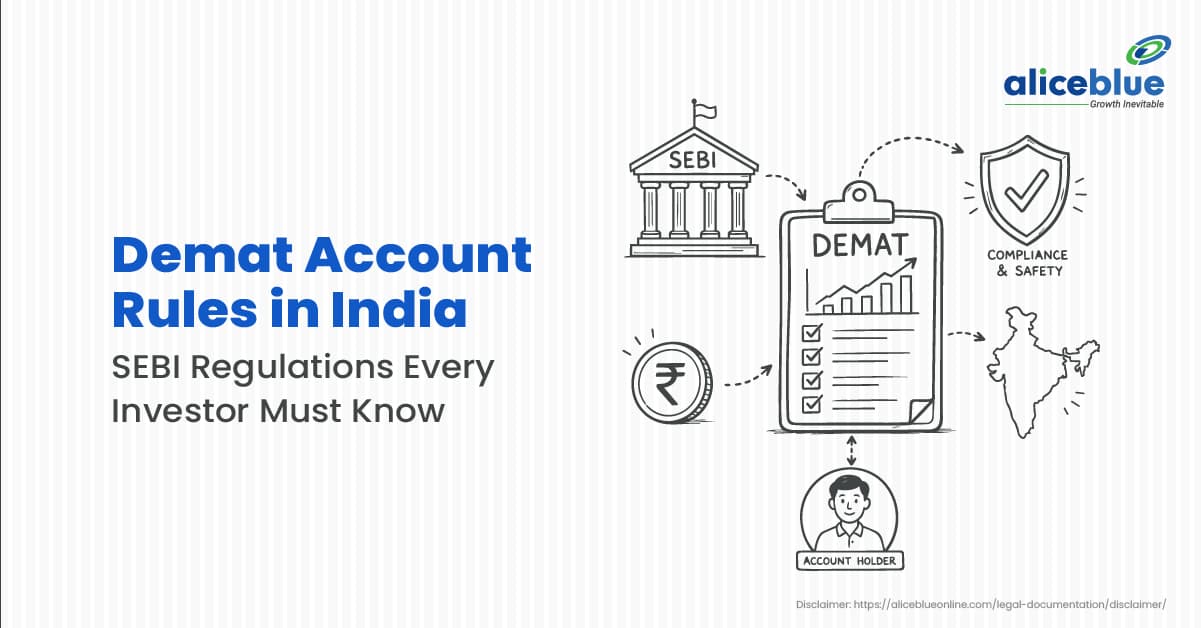
Opening a demat account takes ten minutes. Understanding the rules that govern it takes longer, and matters more.
SEBI sets a detailed framework covering every part of how a demat account works. It decides how your securities reach you, how nominees are registered, what your broker may charge, and what happens when something goes wrong. Four changes have come into force during 2026, and the most recent one started on 1 September.
This guide covers the active demat account rules in India as of today, with every 2025 and 2026 update checked against the source circulars.
What Is a Demat Account?
A demat account holds your securities in electronic form. It can hold shares, bonds, exchange-traded funds, sovereign gold bonds and mutual fund units.
Before 1996, physical share certificates could be forged, lost or damaged in transit. NSDL, the National Securities Depository Limited, was set up in 1996 to remove that problem. CDSL, the Central Depository Services Limited, followed in 1999. Every listed security in India is now held in dematerialised form, which simply means electronic form.
You reach your demat account through a Depository Participant, or DP. This is usually your stockbroker. The DP connects you to the depository. If the basics are new to you, start with what is a demat account.
How SEBI Oversees Demat Accounts
SEBI does not operate individual demat accounts. It writes the rules that depositories, DPs and listed companies must follow.
Its authority comes from the Depositories Act, 1996 and the SEBI (Depositories and Participants) Regulations, 2018. Both NSDL and CDSL work under SEBI supervision. Every DP must hold a valid SEBI registration before it can offer demat services. Checking that registration is the simplest safety check you can run before you sign up.
SEBI updates these rules through circulars issued throughout the year. Enforcement action, including cancellation of registration, is available against intermediaries that break them.
Key SEBI Demat Account Rules in India
1. KYC Is Mandatory Before Account Activation
No demat account can be activated until Know Your Customer verification is complete. KYC is the identity check every regulated intermediary must run before it takes you on as a client.
What you need:
- PAN card, mandatory for every investor
- Aadhaar card for identity and address verification
- Address proof such as a passport, utility bill or recent bank statement
- A recent passport-size photograph
- Bank account proof for trade settlement
- Income proof, but only if you want access to Futures and Options
In-person verification, or IPV, is compulsory. Most DPs complete it over a video call. You must also register your mobile number and email address. Until both are on record, some transaction permissions stay restricted.
2. PAN Aadhaar Linking
If your PAN is not linked with Aadhaar, your demat account gets frozen. You cannot buy or sell until the linking is done.
SEBI wants this in place to remove duplicate investor identities from the system. Periodic KYC review cycles flag unlinked accounts automatically. Check your status on the Income Tax portal and fix it before you next plan to trade.
3. Client Segregation and the Unique Client Code
SEBI requires brokers to keep client money and client securities separate from their own assets. This is called client segregation, and it exists so that client assets cannot be used for the broker’s own purposes.
Every investor also gets a Unique Client Code, or UCC. This is an alphanumeric code assigned by the broker or DP. It acts as your primary identifier for transactions and links your trading activity to your PAN and demat account.
4. Basic Services Demat Account Rules: How a Zero AMC Demat Account Works
SEBI created the Basic Services Demat Account, or BSDA, for small investors who do not want to pay a full Annual Maintenance Charge. This is the regulatory mechanism behind what most investors search for as a zero AMC demat account. It is not a product any single broker invents. It is a SEBI category that every registered DP must honour.
The current charge structure:
Holdings value | Annual Maintenance Charge |
Up to ₹4 lakh | Nil |
Above ₹4 lakh up to ₹10 lakh | Maximum ₹100 a year |
Above ₹10 lakh | Not eligible; converts to a regular account at standard charges |
Eligibility conditions:
- One BSDA per PAN across all DPs
- You must be the sole or first holder
- Accounts held jointly are not eligible for BSDA
- Electronic statements are free; a charge of up to ₹25 may apply to a physical statement
SEBI revised this framework with effect from 31 March 2026, and the changes work in your favour:
- Zero Coupon Zero Principal bonds, delisted securities and suspended securities are now left out of the valuation used to test BSDA eligibility. These instruments are not tradable, so counting them was pushing investors out of the category on paper only.
- Securities that are illiquid are valued at the last closing price.
- DPs must reassess BSDA eligibility every quarter, not occasionally.
- Eligible accounts must be converted to BSDA by default. The only way to stay on a regular account is to give explicit consent through a channel your DP can verify.
The practical effect is that BSDA is now the default for eligible retail investors rather than something you have to ask for. It is worth checking which category your account sits in. Full details here: Basic Services Demat Account.
5. Demat Account Charges SEBI Permits
SEBI caps charges only where it has said so, and the BSDA is the main place it has. Everywhere else, the DP sets its own tariff. What SEBI does require is that every applicable charge is disclosed in your client agreement before activation. Read the Schedule of Charges in full before you sign up.
Charge type | SEBI position |
Account opening fee | Permitted; set by the DP, and some DPs charge nil |
AMC, BSDA up to ₹4 lakh | Nil |
AMC, BSDA ₹4 lakh to ₹10 lakh | Maximum ₹100 a year |
AMC, regular account | Not capped by SEBI; set by the DP and disclosed upfront |
Transaction charges on debit | Charged per debit instruction; set by the DP |
Dematerialisation charges | Per certificate submitted; set by the DP |
Rematerialisation charges | Per 100 securities or part thereof; set by the DP |
Custodian fees | A small amount per ISIN, charged by the depository and usually passed on |
Physical account statement | Up to ₹25; electronic statements are free |
Account closure | No closure fee on a Beneficial Owner account |
Two points people get wrong. There is no SEBI rule banning account opening charges, so a DP may levy them, and rates differ widely. And GST applies on top of these charges, including on the ₹100 BSDA band.
One related change from the same December 2025 review: the value threshold for the simplified documentation route on duplicate securities was doubled from ₹5 lakh to ₹10 lakh. If your holding is worth up to ₹10 lakh, you submit fewer documents when claiming a duplicate certificate. For how AMC actually works out in practice, see demat AMC charges explained.
6. Nomination Rules for Demat Accounts
SEBI issued circular SEBI/HO/OIAE/OIAE_IAD-3/P/CIR/2026/12676 on 29 May 2026. It came into force recently, and it replaces 18 earlier circulars going back to 2002. There is now a single reference document for nomination across demat accounts and mutual fund folios. You can read the SEBI circular on nomination norms directly.
A nominee is the person you name to receive your securities after your death.
For new accounts held in a single name. Nomination is now mandatory. If you open a demat account in one name now, you must either name a nominee or formally declare that you are opting out. Leaving the field blank is no longer an option, and account opening cannot be completed without one of the two.
For accounts held jointly. Nomination stays optional. Any addition, change or cancellation needs the consent of all joint holders. That applies even where the account operates on an either-or survivor basis.
Number of nominees. Up to three. You can change or cancel a nomination any number of times.
What details are mandatory? Only the nominee’s name and their relationship to you. If the nominee is a minor, their date of birth is also required. Mobile number, email, percentage share, KYC identifier and guardian details are all optional now. This is a large reduction from the earlier requirement, which asked for full identification details for every nominee.
If you do not set percentages. Holdings are split equally among your nominees. Any odd lot that cannot be divided goes to the first nominee named.
Witnesses. No longer needed on a physical form signed with a normal signature. Two witnesses are required only where the investor uses a thumb impression instead.
Ways to submit. Online through a Digital Signature Certificate, through Aadhaar-based e-sign or another e-sign recognised under the Information Technology Act, 2000, or through two-factor authentication where one factor is an OTP sent to your registered mobile and email. Offline, on the standard form, with a signature.
If you want to opt out. You must complete the standard declaration. Online, your DP has to show you the full declaration text, and you have to actively agree to it. Skipping the field passively does not count as opting out.
Reminders. For accounts without a nominee, your DP must send reminders twice a year by email and SMS, and show a prompt on your first login of each day. Investors who have named a nominee are excluded from both.
One point worth correcting. Some coverage has suggested that existing accounts without a nominee will be frozen or blocked from trading after the September deadline. That is not what the circular says.
The confusion comes from an older rule. SEBI once did require existing holders to submit a choice of nomination by 30 June 2024 or face a freeze on debits. It then removed that freeze through a circular dated 10 June 2024. It applies to existing accounts for the purpose of forms and reminders, and it imposes no freeze and no restriction on them.
Part of the reason the old warning keeps circulating is that SEBI’s own investor education website has been slow to update it. Treat the circular as the position, not the education page. The mandatory requirement applies to new accounts held in a single name. Existing nominations stay valid, including older ones signed in front of a witness.
Nomination still matters even though nothing forces you. Without a nominee on record, your legal heirs typically need court-issued documents such as a succession certificate to claim your holdings. That process runs into months. If nobody claims the holdings for a long period, they can be treated as unclaimed and transferred to the Investor Education and Protection Fund.
7. Demat Accounts for Minors and for Associations of Persons
For minors. A demat account can be opened for a child under 18. A parent or a guardian appointed by a court operates it until the child turns 18. KYC is needed for both the minor and the guardian, along with proof of the relationship.
The restrictions are real:
- It must be held in a single name. A minor cannot be a joint holder.
- Only delivery trades are allowed. Intraday, futures and options, currency and commodity segments cannot be activated.
- On the child’s 18th birthday, fresh KYC must be completed and the account converted into a regular individual account before any further transaction is processed.
For Associations of Persons. An Association of Persons, which includes some family trusts and similar structures, can open a demat account in India. It cannot hold equity shares in that account. It can hold bonds, debt instruments and other eligible securities. Confirm with your DP which securities your account type permits before you buy anything.
8. Direct Payout of Securities
Until late 2024, shares you bought passed through your broker’s pool account before reaching you. That created an overnight window where your securities sat with the broker rather than with you.
SEBI made direct payout mandatory through a circular of 5 June 2024 and closed the gap in two phases. The first was due to start on 14 October 2024. It was pushed back to 11 November 2024 at the request of the brokers’ industry forum, and ran to 13 January 2025. It covered the equity cash segment and physical delivery settlements. The second phase began on 14 January 2025 and extended direct payout to Securities Lending and Borrowing, Offer for Sale and the remaining segments. Purchases under the Margin Trading Facility followed from 24 February 2025.
Securities you buy now are credited straight to your demat account. Broker pool accounts are no longer part of settlement.
9. Unpaid Securities and the CUSPA Framework
SEBI revised this on 3 July 2026 through circular HO/38/11/(9)2026-MIRSD-POD/I/15382/2026, which amends the Master Circular for Stock Brokers.
Say you buy shares and do not pay for them in full, and the purchase is not under the Margin Trading Facility. The shares are still credited to your demat account first. They are then automatically pledged in favour of your broker’s Client Unpaid Securities Pledgee Account, known as CUSPA.
What this means for you:
- The securities sit in your account, not the broker’s, with a pledge marked against them.
- Your broker must notify you by email or SMS about the money you owe and its right to sell.
- You have up to five trading days from payout to pay.
- If the pledge is neither invoked nor released, it is automatically released on the sixth trading day. Limited extensions of up to a week apply where market conditions make a sale impossible.
- Your broker cannot pledge those securities onward to a bank or a non-banking finance company to raise its own funding.
The circular is being brought in over a phased timeline through the exchanges’ operational guidelines, so ask your broker where it stands on implementation.
10. Pledge Rules for Margin Trading
SEBI’s 2020 pledge framework changed how brokers may use client securities as collateral. Before it, brokers could use your shares for margin without asking you. That is no longer allowed. The current position:
- You must authorise every pledge yourself, through consent verified by OTP.
- Pledged shares stay in your demat account with a lien marked on the specific securities you authorised.
- You can revoke a pledge at any time by instructing your DP.
- Transferring shares into a broker’s own account for margin purposes is not permitted.
SEBI automated parts of this through a circular of 3 June 2025, which introduced a single instruction to release a pledge and set up the pay-in block when you sell, along with an automatic mechanism for invoking margin pledged securities. Implementation was extended to 10 October 2025.
A new right from April 2026. Circular HO/47/14/12(1)2026-MRD-POD2/I/4229/2026 dated 5 February 2026 took effect on 6 April 2026, and it matters if a pledge ever goes wrong. The pledgee, meaning whoever holds your shares as security, must now give you reasonable notice before invoking the pledge and selling. This is written into the Pledge Request Form as an undertaking, and it aligns the depository process with Sections 176 and 177 of the Indian Contract Act, 1872. On invocation, the depository must notify both you and the pledgee that the pledge has been enforced and that the pledgee is now recorded as the beneficial owner. Before this, the legal duty to give notice existed in general law but was not built into the depository paperwork.
If a broker asks you to transfer shares rather than pledge them, that is a regulatory breach. Report it on SEBI’s SCORES portal.
11. Account Freeze and How to Unfreeze
Why a demat account gets frozen:
- PAN not linked with Aadhaar
- KYC documents expired or not updated during a periodic review
- Transaction patterns the DP flags as unusual
- A court order or regulatory direction against the account holder
- Income proof not submitted for an account enabled for Futures and Options
How to get it unfrozen:
- Contact your DP. It must tell you in writing why the account was frozen.
- Submit the documents or complete the pending action, such as PAN-Aadhaar linking or a KYC update.
- Your DP forwards the cleared request to the depository.
- The freeze is lifted, usually within 2 to 7 working days.
You can also freeze your own account as a security measure if you are not trading. Ask your DP in writing for a freeze on debits only. Incoming credits keep working, and outgoing transfers are blocked until you lift it yourself.
A related facility now exists on the mutual fund side. Following SEBI’s circular of 6 March 2026, investors have been able to lock their mutual fund folios since 30 April 2026. While a folio is locked, no units can be redeemed, switched or transferred until you unlock it. It covers folios held in demat form and folios held as a statement of account. The facility runs through MF Central. It is open to investors whose KYC is current and who have a registered mobile number and email. AMFI sets the detailed process. Instructions you had already registered, such as an SIP, generally continue.
12. Dormant and Inactive Accounts
A demat account is generally treated as dormant or inactive if no transaction takes place in it for 12 continuous months.
A dormant account is not closed automatically. It stays open, though some operations can be restricted until you complete any pending compliance step. If you have stopped using an account for good, closing it is better than leaving it dormant, because charges can keep accruing.
One related rule concerns money rather than securities, and applies to your trading account. If you have a credit balance and have not traded for 30 calendar days, your broker must return the money to you. Until January 2025, that had to happen within three working days. Under SEBI circular SEBI/HO/MIRSD/MIRSD-PoD1/P/CIR/2025/1 dated 6 January 2025, it now happens on the next date in the monthly running account settlement cycle notified by the exchanges. If you resume trading before that date, your usual monthly or quarterly settlement preference applies instead.
13. Statements and Account Monitoring
You receive a Consolidated Account Statement showing your holdings across depositories. SEBI encourages investors to use the electronic version, e-CAS, and to review statements regularly for anything that looks wrong.
Under the new nomination framework, your holding statement must also show either the names of your nominees or a simple yes or no on whether a nomination exists. You choose which of the two appears, on the nomination form itself.
14. Dematerialisation of Physical Shares
SEBI no longer permits the transfer of physical share certificates. If you hold paper certificates, dematerialise them before you try to sell or transfer.
The process:
- Fill in a Dematerialisation Request Form, available from your DP.
- Submit it with the original certificates marked “Surrendered for Dematerialisation”.
- Your DP forwards the request to the company’s Registrar and Transfer Agent, or RTA.
- The RTA verifies the certificates and confirms with the depository.
- Securities are credited to your demat account, typically within 15 to 30 days.
The special window for older certificates. SEBI circular HO/38/13/11(2)2026-MIRSD-POD/I/3750/2026 dated 30 January 2026 opened a window running from 5 February 2026 to 4 February 2027. It covers physical shares bought or sold before 1 April 2019, including transfer requests that were submitted earlier but rejected, returned or left unattended because of problems with the documents.
Two conditions matter. Shares transferred through this window are credited only in demat form. They also carry a lock-in of one year from the date the transfer is registered, and during that year they cannot be sold, pledged or lien marked. Transfers must be completed within 70 days of the RTA receiving complete documents.
15. Letter of Confirmation Removed From Investor Service Requests
SEBI circular HO/38/13/(3)2026-MIRSD-POD/I/3763/2026, also dated 30 January 2026, came into force on 2 April 2026.
Until then, investors asking for a duplicate certificate, a transmission or a transposition received a Letter of Confirmation, or LOC. They then had to take it to their DP. SEBI has removed that step. RTAs and listed companies now credit the securities directly into your demat account after their own due diligence.
What changed in practice:
- No LOC. It is no longer issued. Any LOC issued before 2 April 2026 can still be used, as long as it is submitted within 120 days of issue.
- Direct credit. Securities from duplicate certificate issuance, transmission, transposition, claims from the unclaimed suspense account and certain corporate actions go straight to your demat account.
- What you submit. Form ISR-4, together with a copy of your Client Master List, or CML, not older than two months and attested by your DP. Your CML is the record of your demat account details held by your DP.
- Timeline. RTAs and listed companies must process the request and credit the securities within 30 days of receiving complete documents. SEBI expects this to cut the turnaround from roughly 150 days to about 30.
16. NRI Demat Account Rules
NRIs investing in listed Indian equities follow rules set by both SEBI and the RBI under the Foreign Exchange Management Act, 1999, known as FEMA.
Investment limits changed in June 2026. The Ministry of Finance notified the Foreign Exchange Management (Non-Debt Instruments) (Third Amendment) Rules, 2026 on 12 June 2026, giving effect to a Budget 2026 announcement. Two things changed.
First, the route is no longer limited to NRIs and OCI cardholders. It is now open to any individual resident outside India, a category that FEMA calls a PROI.
Second, the limits doubled. An individual holding must stay below 10 per cent of a listed company’s paid-up equity capital on a fully diluted basis, against 5 per cent before. The combined holding of all such investors in one company can go up to 24 per cent, against 10 per cent before. There is a consequence for breaching the individual threshold. The excess has to be sold within five trading days of the settlement date of the trade that caused it. If it is not, the investment is treated as foreign direct investment.
Portfolio Investment Scheme. An NRI investing in Indian equities on a repatriable basis needs PIS permission from the RBI through a designated bank. Under PIS, transactions flow through a single designated bank account, tax is deducted at source on gains, the designated bank reports every transaction to the RBI, and the permission can be held with only one bank at a time.
The non-PIS route. This uses an NRO account directly, needs no PIS letter and costs less to set up. Repatriation under this route is capped at USD 1 million per financial year across all Indian income sources.
What NRIs can and cannot trade. Only delivery trades are permitted in equity. Intraday trading and short selling are not allowed. Exchange-traded derivatives are allowed, and this is where an older restriction has been removed. Through a circular dated 29 July 2025, SEBI removed the requirement for NRIs to notify a clearing member and obtain a Custodial Participant code before trading derivatives. Position limits are now monitored at the client level, the same way they are for resident clients, and existing clients were given a window to exit the CP code framework by email.
Other NRI account rules.
- Separate demat accounts must be kept for repatriable holdings, linked to an NRE account, and non-repatriable holdings, linked to an NRO account.
- A resident demat account cannot be used once you become an NRI. Continuing to use one is a FEMA breach, not a paperwork detail.
- KYC must include PAN, overseas address proof, a passport copy and a FATCA declaration. Investors from the USA, UK, Canada, Australia and other CRS member countries must file FATCA declarations at account opening and update them whenever residential status changes.
17. Closing a Demat Account
SEBI does not prescribe a single closure procedure, but the process is consistent across DPs:
- Submit a written closure request to your DP.
- Move your holdings to another demat account, or sell them and take the proceeds into your bank account.
- Clear any dues payable to the DP.
- The DP verifies the request electronically and closes the account.
No closure fee is charged for closing a Beneficial Owner account.
18. Grievance Redressal and SCORES
SCORES is SEBI’s online complaint system for investors, and it covers brokers, DPs, depositories, RTAs and listed companies. Try to resolve the issue directly with the entity concerned first.
The current version, SCORES 2.0, went live in April 2024. Complaints are routed automatically to the entity concerned. It must resolve the complaint and upload an Action Taken Report within 21 calendar days, down from 30 under the older system. If you are not satisfied with that report, you can ask for a review within 15 calendar days. If the entity misses the 21-day deadline, the complaint escalates on its own. Unresolved disputes can then go to the Online Dispute Resolution platform for conciliation and arbitration, at no cost for most retail disputes.
NSDL vs CDSL: Key Differences
Feature | NSDL | CDSL |
Established | 1996 | 1999 |
Primary exchange association | NSE | BSE |
Account number format | IN followed by 14 digits | 16-digit numeric code |
Investor portal | IDeAS | Myeasi |
Share of active accounts | Smaller | Larger |
Both operate under identical SEBI regulations. Your broker decides which depository your account sits with. The choice has no effect on how your investments perform.
Common Demat Account Mistakes That Can Get Your Account Frozen
- Skipping PAN-Aadhaar linking. The most common cause of frozen demat accounts in India. Ten minutes on the Income Tax portal prevents weeks of not being able to trade.
- Leaving nomination blank. Your existing account will not be frozen for it, but transmission without a nominee means your heirs need court-issued succession documents. Six months is a realistic minimum.
- Ignoring KYC update notices. Accounts move from partial restriction to a full freeze as deadlines pass. Act on DP notices within the stated deadline.
- Transferring shares to a broker for margin. Not permitted. The correct route is a pledge authorised by OTP, with the shares staying in your account.
- Holding more than one BSDA. Only one is permitted per PAN across all DPs. A second one does not get you two zero AMC accounts. It defaults to a regular account with full AMC, whatever your portfolio is worth.
- Assuming you are not eligible for BSDA. Since 31 March 2026, eligible accounts are meant to be converted by default and reviewed every quarter. Check which category yours sits in rather than assuming.
- Trying to sell physical shares without dematerialising. The transaction will fail. Submit for dematerialisation first.
- Continuing on a resident account after becoming an NRI. Once your status changes, the account must be converted. Continued use is a FEMA breach.
Real Example: A Trade from Start to Settlement
You hold a demat account with Alice Blue, linked to CDSL. You buy 50 shares of a listed company at ₹4,000 each.
You place the order on NSE during market hours. It executes, and T+1 settlement begins, meaning settlement completes on the next trading day. On that day, ₹2,00,000 is debited from your linked bank account. At the same time, 50 shares are credited straight into your CDSL demat account under your 16-digit account number. No broker pool account is involved.
You then decide to use those shares as collateral for margin. You select them on the platform and authorise a pledge through OTP consent. Margin is activated. The 50 shares stay in your demat account with a lien marked against them.
What Changed in 2026, in Order
Date | Change | Status |
31 March 2026 | Revised BSDA framework: ZCZP bonds, delisted and suspended securities excluded from valuation; quarterly review; conversion by default | In force |
2 April 2026 | Letter of Confirmation removed; direct credit of securities; Form ISR-4 and CML required; 30-day processing | In force |
6 April 2026 | Pledgee must give reasonable notice before invoking a pledge; depository must notify both parties on invocation | In force |
30 April 2026 | Voluntary lock and debit freeze for mutual fund folios through MF Central | In force |
5 February 2026 to 4 February 2027 | Special window to re-lodge and dematerialise physical shares from before April 2019 | Open |
12 June 2026 | FEMA rules widened to all individuals resident outside India; limits raised to below 10 per cent individually and 24 per cent in aggregate | In force |
3 July 2026 | Revised handling of unpaid securities through CUSPA | Phased |
1 September 2026 | New nomination framework; mandatory for new accounts in a single name; up to three nominees; witness requirement removed | In force |
Conclusion
SEBI has restructured demat account rules steadily over the last three years, and 2026 has been the busiest year of the three. The nomination overhaul that started on 1 September is the change most investors will actually notice, because it affects every new account opened from now on.
For most investors, staying compliant comes down to three things. Keep your KYC current. Keep a valid nominee on record. Keep PAN-Aadhaar linking active. Those three prevent most of the account freezes investors run into.
One more thing worth doing today: check whether your holdings qualify for BSDA. Since March 2026, that check is your DP’s job every quarter, but it is your money either way.
You can open a demat and trading account with Alice Blue, a SEBI-registered broker.
Frequently Asked Questions
PAN card, Aadhaar card, address proof, a recent photograph and bank account proof. You also need to register your mobile number and email. Income proof is required only if you want access to Futures and Options.
For a new account held in a single name and opened on or after 1 September 2026, yes. You must either name a nominee or formally declare that you are opting out, because the field cannot be left blank. Nomination remains optional for accounts held jointly.
No. The 29 May 2026 circular imposes no freeze and no restriction on existing accounts. Your DP will send you reminders twice a year and show a prompt on your first login of each day until you add a nominee.
Up to three. Only the name and the relationship are mandatory, plus date of birth if the nominee is a minor. If you do not specify percentages, the holdings are split equally, and any odd lot goes to the first nominee named.
Your demat account gets frozen, and all buying and selling is blocked. Complete the linking on the Income Tax portal and notify your DP.
Account opening is free under SEBI rules. For nil AMC, your holdings need to qualify as a BSDA, which means a value at or below ₹4 lakh. Between ₹4 lakh and ₹10 lakh, AMC is capped at ₹100 a year. Above ₹10 lakh, and on regular accounts, AMC varies by DP and must be disclosed in your client agreement.
Yes. A parent or a guardian appointed by a court operates it until the child turns 18. Only delivery trades are allowed, and the account must be held in a single name. Fresh KYC and conversion to a regular account are required once the child turns 18.
Yes, once you have transferred or sold the securities in it and cleared any dues. No closure charge applies to a Beneficial Owner account.
Every pledge must be authorised through consent verified by OTP. Pledged shares stay in your demat account with a lien marked on them. Transferring shares into a broker’s own account for margin is not permitted.
Yes, in exchange-traded derivatives. Since SEBI’s circular of 29 July 2025, no Custodial Participant code is needed, and position limits are monitored at the client level. Intraday trading and short selling in equity remain off-limits.
They are credited to your demat account and then pledged automatically to your broker’s CUSPA account. You have up to five trading days from payout to pay. If you do not, the broker can invoke the pledge and sell them after giving you notice.

Blog by Aliceblue News Desk


