
Demat Account vs Bank Account (2026): Key Differences, How They Work & Which You Need
Blog by Aliceblue News Desk
20 May 2026
8 minutes
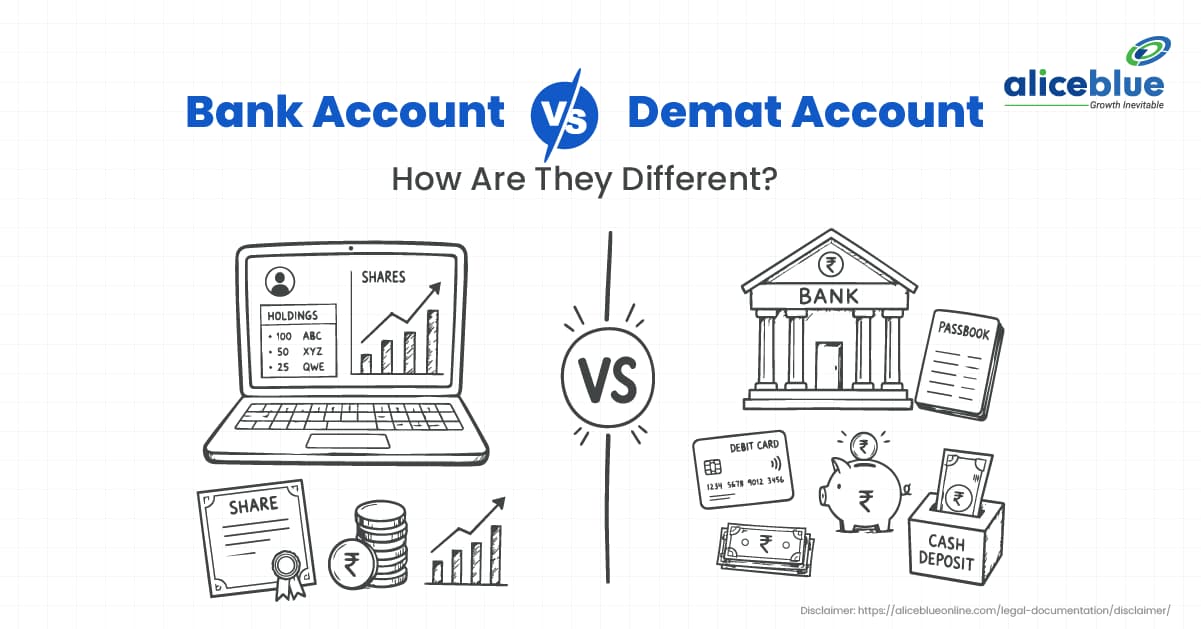
If you’re starting your investment journey in India, one question comes up quickly: Do you need both a bank account and a Demat account?
While both help manage money, they serve completely different purposes. A bank account stores cash, while a Demat account stores investments like shares, ETFs, and bonds.
In this guide, we’ll explain:
- The difference between a Demat account and a bank account,
- how they work together,
- whether you need both,
- account opening requirements,
- and the latest SEBI-related rules investors should know.
Demat Account vs Bank Account: What’s the Real Difference?
At its simplest level, the difference lies in the type of asset being stored.
- Bank Account: This is your repository for Liquidity (Cash). It is governed by the RBI and is designed for transactions, interest-earning, and immediate withdrawals.
- Demat Account: Short for “Dematerialized,” this is your repository for Ownership (Securities). It is governed by SEBI and holds your stocks, mutual funds, bonds, and ETFs in digital form.
What is a Bank Account? (Meaning, Uses & Features)
A bank account (usually a savings or current account) is where you store, manage, and grow your cash (rupees).
- Purpose: Daily transactions, salary credits, bill payments, UPI transfers, loans, and earning interest.
- What it holds: Only money (₹)
- Who operates it: Banks regulated by the RBI (SBI, HDFC, ICICI, Axis, Kotak, etc.).
- Key features:
- Interest: Typically 2.5%-4% p.a. for major banks (higher slab rates up to 7% in small finance banks).
- Instant transfers via UPI, IMPS, NEFT, RTGS.
- Debit cards, cheques, and overdraft facilities.
- DICGC insurance up to ₹5 lakh per depositor per bank.
- Minimum balance: Varies, as many digital banks now offer zero-balance accounts.
- Everyday use: This is your financial “home base”.
Note: SEBI regulations and limits (such as BSDA eligibility and nomination rules) may be updated periodically. Always check the latest circulars or your broker’s website for current details.
What is a Demat Account? How It Works in India
A Demat (Dematerialised) account is an electronic vault that holds your securities, including shares, bonds, ETFs, mutual fund units (in some cases), and government securities, all in digital form.
- Purpose: To buy, sell, and safely store investments in the stock market without physical share certificates. Before Demat accounts became common, investors had to manage paper certificates, which created risks like theft, forgery, transfer delays, and physical damage.
- What it holds: Only securities (not cash). (Cash for trading is held in the linked trading account or broker ledger, not inside the Demat account itself.)
- Who operates it: Depository Participants (DPs) like brokers (Zerodha, Groww, Upstox) or banks, linked to either NSDL or CDSL (India’s two depositories, regulated by SEBI).
- Why it exists: SEBI made dematerialisation mandatory in 1999 to eliminate risks of lost, forged, or damaged paper certificates. Today, the system is almost entirely electronic, though legacy physical share certificates may still exist in rare cases and can be converted to Demat form.
- Key features:
- No interest earned on holdings.
- Electronic transfer of shares typically on T+1 settlement, with T+0 settlement currently in pilot rollout for select stocks.
- Full visibility via apps and Consolidated Account Statements (CAS).
- Latest SEBI updates: Default Basic Services Demat Account (BSDA) for holdings up to ₹10 lakh (zero or very low AMC), simplified nomination (only name + relationship mandatory, max 4 nominees), and easier KYC.
Do You Need Both a Demat Account and a Bank Account?
Yes, if you want to invest in stocks in India, you typically need:
- a bank account to transfer money,
- a trading account to place buy/sell orders,
- and a Demat account to hold the securities digitally.
These three accounts work together during every stock market transaction.
Difference Between Demat Account and Bank Account (Quick Comparison Table)
Feature | Bank Account | Demat Account |
Asset Stored | Liquid Cash (Fiat Currency) | Digital Securities (Shares, Bonds, SGBs) |
Primary Regulator | RBI (Reserve Bank of India) | SEBI (Securities & Exchange Board) |
Earnings | Fixed Interest (usually 2.7% – 7%) | Market-linked Capital Gains & Dividends |
Settlement Speed | Instant (UPI / IMPS) | T+1 (Standard) / T+0 (Select Stocks) |
Nomination | Optional but encouraged | Mandatory for new accounts (SEBI rule) |
Mandatory For | Daily life, Salary, Bill payments | Trading or holding stocks/mutual funds |
How a Demat Account and Bank Account Work Together
Real-Life Example: Buying 100 Shares of a stock:
- The Bank Link: Your money stays in your existing bank account (HDFC, SBI, ICICI, etc.).
- The UPI Block (SEBI-enabled mechanism): When you place an order through your broker’s trading platform, the funds are “blocked” in your bank account via UPI. You still earn interest on that money until the trade is executed! This mechanism is part of SEBI’s ASBA-like UPI system for retail investors, ensuring funds remain in your bank account until the trade is confirmed.
- The Trade: You click “Buy” on the brokerage app. The trading account executes the order.
- The Storage: Typically, by the next trading day (T+1 settlement), though T+0 is being piloted for select stocks, the shares are safely stored in your Brokerage Demat Account.
- The Profit: When you sell, the shares leave the Demat, and the money is unblocked or transferred back to your linked bank account automatically.
Transaction Flow Example:
Bank Account → Trading Account → Stock Exchange → Demat Account
- Money moves from your bank account.
- The trading account places the order.
- Shares are credited to your Demat account after settlement.
How to Open a Bank Account vs. a Demat Account (Step-by-Step Guide)
Documents required (same for both in most cases):
- PAN card (mandatory)
- Aadhaar (for e-KYC)
- Cancelled cheque/bank statement (for bank linkage)
- Proof of address (if Aadhaar is not sufficient)
- Passport-size photo (rarely needed now)
Bank Account Opening:
- Download the bank app or visit a branch.
- Aadhaar + PAN e-KYC.
- Instant account number in minutes.
Demat Account Opening (fully digital for years):
- Choose DP (Alice Blue or any of your choice).
- Fill online form + upload docs.
- Video KYC / Aadhaar e-sign.
- Account activated in 1-2 working days (often same day).
Pros and Cons of a Demat Account vs. a Bank Account
Bank Account:
- Pros: Earns interest, has daily utility, is highly liquid, and insured.
- Cons: Lower returns than stocks; inflation can erode value.
Demat Account:
- Pros: Safe electronic holding, easy trading, corporate actions (dividends, bonuses) auto-credited, portfolio diversification.
- Cons: No interest, annual maintenance charges (unless BSDA), market risk on investments.
Which One Should You Choose: Demat or Bank Account?
- You need a Bank Account if: You want to receive your salary, pay via UPI at a grocery store, or keep an emergency fund that is 100% liquid.
- You need a Demat Account if: You want to invest in market-linked assets like stocks, ETFs, or bonds. A Demat account is required for holding listed securities electronically in India. In 2026, Sovereign Gold Bonds are typically held in Demat form, while mutual funds can be held either via Demat or directly with AMCs; many investors prefer direct (non-Demat) plans for flexibility and lower costs.
Conclusion
The difference between a Bank Account and a Demat Account is the difference between saving and investing. One keeps you from losing money to daily expenses; the other helps you beat inflation and grow your net worth.
To get started, you can link your existing bank account to any SEBI-registered broker’s Demat account and begin investing within minutes.
Note: SEBI regulations, BSDA eligibility limits, brokerage charges, and settlement mechanisms may change over time. Always verify the latest details with your broker or official SEBI circulars.
If you’re planning to start investing, you can open a demat account with Alice Blue and get started.
Frequently Asked Questions
A trading account is your “order placement window”, the platform where you actually click “Buy” or “Sell” for stocks, ETFs, or bonds. It doesn’t hold cash or shares; it only routes your instructions.
Account opening is free with almost every broker and bank. The only recurring cost is the Annual Maintenance Charge (AMC). Most discount brokers now offer ₹0 AMC, while full-service ones charge ₹300-₹750 + GST per year. If your total holdings are under ₹10 lakh, the SEBI-mandated Basic Services Demat Account (BSDA) automatically gives you zero or very low AMC.
BSDA is a simplified, low-cost version of a regular Demat account created by SEBI for small and first-time investors. It comes with fewer statements, simpler nomination rules, and almost zero maintenance fees as long as your holdings stay within the limit (currently up to ₹10 lakh portfolio value).
Your shares and securities are not held by the broker; they are held directly by NSDL or CDSL (the two government-regulated depositories). Even if the broker goes bankrupt or faces issues, your holdings stay completely safe and can be transferred to any other broker within a few days.
Yes, the process is simple and still available. You submit the physical certificates along with a Demat Request Form (DRF) to your broker or bank DP. Once processed, the shares are credited to your electronic Demat account, and you can trade them instantly. This is the last step for anyone still holding paper shares from before 1999.

Blog by Aliceblue News Desk


