
Demat Account vs Crypto Wallet: What’s the Difference?
Blog by Aliceblue News Desk
19 March 2026
8 minutes
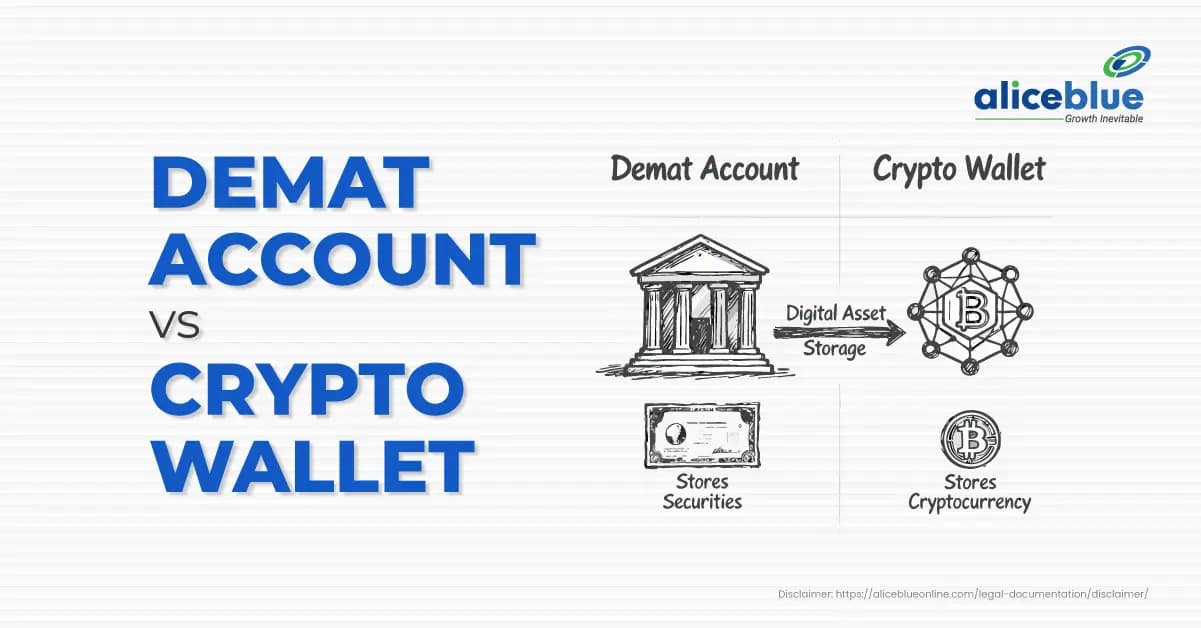
You buy TCS shares and Bitcoin on the same day, and both show up in apps as “holdings.” Looks similar, right? The confusion starts when you try to understand what you actually own and where it’s stored because stocks and crypto don’t sit in the same type of system.
That’s where most beginners get stuck: Demat accounts and crypto wallets may look like digital containers, but they work very differently. Demat is built for regulated securities held through India’s depository setup, while crypto wallets work through private keys that control assets on a blockchain.
In this blog, we’ll break down the Demat account vs crypto wallet – what are their key features, how they work, what the charges are, before putting money into either.
What is a Demat account?
A Demat account holds securities like shares, ETFs, bonds, and mutual fund units in electronic form. You open it with a Depository Participant (DP) (usually a broker or bank), and it is linked to a depository system like NSDL or CDSL.
In India, two depositories manage all dematerialised securities:
- NSDL (National Securities Depository Limited) – Set up in 1996, currently holds over 3.5 crore Demat accounts with 278 registered Depository Participants
- CDSL (Central Depository Services Limited) – Set up in 1999, currently holds over 15 crore Demat accounts with 599 registered Depository Participants
SEBI regulates both. Together, they maintain electronic records of most dematerialised securities owned by investors in India.
Key features of a Demat Account:
- Holds multiple securities in one place: Shares, ETFs, and other demat-held products sit in a single electronic account.
- Works well if you invest beyond mutual funds: Useful when you buy stocks/ETFs and also hold mutual funds in demat mode.
- Held through the depository system: Your holdings are maintained through your DP and the depository.
- Easier single-view tracking: You can see most of your market holdings in one account view, which helps while monitoring your portfolio and downloading statements.
What Is a Crypto Wallet?
A crypto wallet is a digital tool that helps you manage cryptocurrencies like Bitcoin or Ethereum. A wallet does not store coins inside the app or device. Instead, it stores the private keys or seed phrase that proves control over crypto linked to your wallet address.
There are 2 types of Crypto wallets:
- Hot wallet (online): Mobile apps, desktop apps, browser wallets. Easy to use, but higher exposure to phishing and malware.
- Cold wallet (offline): Hardware wallets. Better for long-term holding, but you still must protect the seed phrase carefully.
Custodial vs non-custodial
Crypto wallets come in two styles, and the difference is simple: convenience vs control.
- Custodial wallet (exchange wallet): The exchange controls the private keys. You access crypto using login/OTP.
- Non-custodial wallet (self-custody): You control the keys. If you lose the seed phrase, recovery is usually not possible.
Key Features of Crypto Wallet:
- Stores private keys that grant access to cryptocurrencies
- Supports sending and receiving digital currencies
- Not regulated by any central authority in India as of now
- Requires secure handling of private keys to prevent theft or loss
- Can be software-based (mobile or desktop apps) or hardware devices
Key Differences Between a Demat Account and a Crypto Wallet
Let’s break this down in a way that actually matters when you’re investing:
Aspect | Demat Account | Crypto Wallet |
Asset Type | Stocks, bonds, mutual funds, ETFs | Cryptocurrencies like Bitcoin, Ethereum |
Regulation | Regulated by SEBI and stock exchanges | No specific regulatory framework in India |
Ownership Proof | Electronic record maintained by a depository | Ownership through private keys |
Transaction Methods | Linked with trading accounts; settled via exchanges | Peer-to-peer transfers via blockchain |
Security | Secured by regulated custodians and brokers | Depends on wallet type and private key security |
Accessibility | Accessible via brokers or depository websites | Accessible via wallet software or hardware |
Transfer Process | Instantaneous within trading hours | Network-dependent, can take minutes to hours |
Risk Factors | Market risk and fraud risk are mitigated by regulations | Hacking, loss of private keys, and unregulated exchanges |
How to Use a Demat Account?
Step 1: Open your Demat account with a registered broker/DP
Step 2: Understand your Demat ID format (NSDL vs CDSL)
Your Demat account details usually appear in one of these formats:
- NSDL format: DP ID + Client ID
- DP ID often starts with “IN” (example: INxxxxxx)
- DP ID often starts with “IN” (example: INxxxxxx)
- CDSL format: a 16-digit BO ID (Beneficial Owner ID)
This is useful when you’re transferring shares or checking official statements.
Step 3: Link Demat + trading + bank account
Once linked, your buying and selling become smooth.
Step 4: Buy shares (credit happens after settlement)
When you buy stocks:
- You place a buy order in your trading app
- The trade executes on the exchange
- After settlement, shares are credited to your Demat holdings
So you may not see shares “instantly” in Demat after purchase, but they will be reflected once the settlement process is completed.
Step 5: Sell shares (debit shares, credit money)
When you sell:
Shares are debited from your Demat holdings
- Sale proceeds are credited to your trading account
Step 6: Track holdings and statements
You can track your portfolio through:
- Broker app/web platform (most common)
- NSDL/CDSL statements/portals (useful for independent verification)
How to Use a Crypto Wallet?
Step 1: Choose your wallet type
Start by deciding if you want:
- Custodial (exchange wallet): simpler, but you don’t control keys
- Non-custodial (self-custody): you control keys, but you carry full responsibility
Beginners often start with custodial, then move to self-custody once they understand the basics of security.
Step 2: Install wallet safely (avoid fake apps)
- Download only from the official website or official app store listing
- Double-check spelling, developer name, and reviews
Step 3: Create a wallet and back up the seed phrase
Rules that matter:
- Write it down offline (paper/metal backup)
- Do not store it in email/Drive/WhatsApp/notes
- Do not share it with anyone, even if they claim to be a supporter
Step 4: Receive crypto (use your public address)
To receive crypto:
- Copy your wallet’s public address
- Share it with the sender
- Confirm the correct network (example: sending on the wrong chain can cause loss)
Step 5: Send crypto (always test with a small amount first)
For a safe first transfer:
- Send a very small test amount
- Confirm it reached the correct address
- Then send the full amount
Crypto transfers can’t usually be reversed if you send to the wrong address.
Step 6: Keep your wallet secure over time
- Update the wallet app when updates are released
- Use phone security (PIN/biometrics)
- Avoid clicking on unknown links
- Consider hardware wallets for long-term holdings
Examples: Demat and Crypto Wallet
Example 1: Using a Demat account
Rohan opened a Demat account through a SEBI-registered broker. His account details showed his depository format (NSDL-style DP + Client ID, where the DP ID often starts with IN).
He bought 50 shares of TCS at ₹4,000 each.
- Total value = 50 × 4,000 = ₹2,00,000 (excluding charges)
- After the settlement, the shares reflected in his Demat holdings
He added his wife as a nominee, so in case of an emergency, the claim process becomes smoother and usually needs fewer formal steps compared to a non-nominated account
Example 2: Using a crypto wallet safely
Priya bought crypto on an exchange. She wanted to move it to her own wallet for long-term holding.
- Installed a self-custody wallet from the official source
- Backed up the seed phrase offline
- Sent a small test transfer first
- Verified the network and address before sending the remaining amount
This routine reduced the biggest beginner risks: wrong address, wrong network, and seed phrase exposure.
Costs and Charges: What You Pay For
Common Demat-related charges (varies by broker/DP)
- Account maintenance charges (AMC) in some plans
- Brokerage when trading
- DP charges on sell transactions (often per scrip)
- Other charges depending on transaction type
Common crypto costs:
- Exchange trading fees (if using an exchange)
- Network fees for withdrawing or sending crypto on-chain
- Spread/slippage in fast markets
- Hardware wallet cost (if you buy one)
A Demat account and a crypto wallet may both feel like “digital storage,” but they work very differently. Demat holdings move through a structured securities system with defined processes, while crypto ownership depends on how safely you protect your keys and verify every transfer. The right approach is to use the correct tool for the asset you’re buying, keep records of all transactions, and focus on basic security habits before putting larger amounts at risk.
Also Read: Open Demat Account Page
No. A Demat account is used to hold regulated securities like shares, ETFs, and bonds in electronic form through India’s depository system.
A crypto wallet is used to manage cryptocurrencies by storing the private keys/seed phrase needed to access and transfer crypto on a blockchain.
No. A Demat account can only hold assets that are supported by the securities market infrastructure, such as shares and ETFs.
Bitcoin, Ethereum, and other cryptocurrencies exist on blockchains, so they are held through an exchange account (custodial) or a crypto wallet (self-custody), not in Demat form.
No. Shares are issued and maintained through stock market systems and depositories, so they appear in a Demat account not a crypto wallet.
A crypto wallet can only hold blockchain-based assets, meaning tokens that exist on networks like Bitcoin or Ethereum (or other chains).
For most beginners, a Demat account is generally safer because it operates within a structured setup and you usually have support channels if something goes wrong.
Crypto wallets can also be safe, but security depends heavily on you—protecting your seed phrase, avoiding phishing, and verifying addresses before every transfer.
If you’re using a non-custodial (self-custody) wallet, losing the seed phrase usually means you lose access permanently, because there’s no “forgot password” option.
That’s why storing the seed phrase offline (and safely) is considered the most important step when using a crypto wallet.

Blog by Aliceblue News Desk


