What Is a Diagonal Spread in Options? How to Set It Up in India
Blog by Aliceblue News Desk
28 May 2026
16 minutes
You’re watching Nifty sit at 24,500. You think it’ll inch up over the next few weeks, maybe 200-300 points. Nothing dramatic. Buying a plain call option feels expensive because time decay will eat your premium whether Nifty moves or not. Selling a covered call means owning the underlying, which locks up a lot of capital.
This is where experienced traders use a diagonal spread in options.
A diagonal spread, also called a diagonal call spread or diagonal put spread, depending on the setup, lets you profit from a mild directional move while collecting premium from a short-term option that works against time decay for you. In this guide, you’ll understand exactly what it is, how theta decay plays into the strategy, how to set one up in India with Nifty and Reliance examples, and the mistakes that actually cost money.
What Is a Diagonal Spread in Options?
A diagonal spread is an options strategy where you buy and sell options of the same type — both calls or both puts — on the same underlying asset, but with different strike prices and different expiration dates.
Here’s why it’s called “diagonal”: In an options chain, strikes run vertically (24,000, 24,100, 24,200) and expiry dates run horizontally (weekly, monthly, next-month). When you pick two options with different strikes AND different expiries, you move diagonally across the chain grid. That’s the origin of the name.
There are four types of diagonal spreads:
- Long Call Diagonal Spread — Bullish view, debit spread
- Short Call Diagonal Spread — Bearish view, credit spread
- Long Put Diagonal Spread — Bearish view, debit spread
- Short Put Diagonal Spread — Bullish view, credit spread
The most common in India is the long call diagonal spread (also called a Poor Man’s Covered Call), which we’ll cover with a detailed example below.
Why This Strategy Exists
Vertical spreads (same expiry, different strikes) give directional exposure but no time decay benefit.
Calendar spreads (same strike, different expiries) benefit from time decay but have no directional view.
Diagonal spreads give you both a directional bet AND the ability to collect premium from faster-decaying short options. That’s the entire logic behind the strategy.
How a Diagonal Spread Works
A diagonal spread has two legs. Here’s how each one functions:
Leg 1: Buy the Long Option (Farther Expiry)
You buy an option with more time to expiry. This is your directional bet.
- Bullish view: Buy a longer-dated call (long call diagonal)
- Bearish view: Buy a longer-dated put (long put diagonal)
You pay more for this option because it has more time value, but it also decays slowly compared to short-term options.
Leg 2: Sell the Short Option (Near-Term Expiry)
You sell an option with less time to expiry and a different strike. This leg generates income.
- Bullish diagonal: Sell a near-term call at a higher strike than your long call
- Bearish diagonal: Sell a near-term put at a lower strike than your long put
The short option decays fast. As expiry approaches, theta accelerates on near-term options, which works in your favor as the seller.
What Happens at Expiry
Most traders close the trade when the short-term option expires:
- If the short option expires worthless, you keep the full premium and still hold the long option
- Many traders “roll” the short leg forward, selling another near-term option with the same or similar strike at the next expiry while still holding the long leg
- This rolling technique creates a recurring income stream
Understanding Theta Decay in Diagonal Spreads
Theta measures how much value an option loses per day just from the passage of time. It’s the single biggest reason diagonal spreads work.
Here’s what most beginners miss: theta decay is not linear. It accelerates sharply in the final 2-3 weeks before expiry.
Leg | Time to Expiry | Daily Theta Decay | Who Benefits? |
Short leg (near expiry) | 3-10 days | ₹8-₹15/day (fast) | You (collector) |
Long leg (far expiry) | 25-45 days | ₹2-₹5/day (slow) | You (holder) |
Net Theta Effect | — | +₹5 to +₹12/day | Works in your favor |
Example:
- Your May 30 short call lost ₹10 per day in the last week
- Your June 27 long call loses ₹3 per day during the same period
- Net benefit: ₹7 per day just from time passing
This is why diagonal spreads work even when the market stays flat. You’re essentially paid to wait for your directional view to play out.
Important: Theta decay is your friend on the short leg and works against you on the long leg. The net effect is positive only if the short leg decays faster — which it always does when the expiry gap is 3+ weeks.
If you want to understand theta more deeply, our blog on Theta in Options Trading: Time Decay Explained breaks down the math and gives practical examples for Indian markets.
Example 1: Long Call Diagonal Spread on Nifty
Nifty is trading at 24,500 on May 27, 2026. You expect a mild rise to 24,700-24,800 by late June.
Trade Setup
Action | Option | Expiry | Strike | Premium (₹) |
Sell | Call Option | May 30, 2026 (weekly) | 24,600 (OTM) | 85 (collected) |
Buy | Call Option | June 27, 2026 (monthly) | 24,400 (ITM) | 210 (paid) |
Net Premium Paid: ₹210 − ₹85 = ₹125 (debit spread)
Lot Size: 50
Total Capital Required: ₹125 × 50 = ₹6,250
Breakeven Calculation
Breakeven = Long Strike + Net Premium Paid
Breakeven = 24,400 + 125 = ₹24,525
Nifty needs to be above ₹24,525 at the June 27 expiry for the trade to be profitable.
Profit and Loss Scenarios
Nifty at Expiry | What Happens | Profit / Loss |
Below 24,400 | Both options expire worthless | −₹6,250 (max loss) |
At 24,525 | Breakeven | ₹0 |
At 24,600 | Short call expires worthless, long call worth ₹200 | +₹3,750 (near max profit) |
Above 24,700 | Both profitable | Reduced due to short call obligation |
Maximum Profit:
Occurs when Nifty closes at or just around the short strike (24,600) on May 30 expiry.
Max Profit = (24,600 − 24,400 − 125) × 50 = ₹3,750
Maximum Loss:
Occurs if Nifty falls below 24,400 at the June 27 expiry. Both options expire worthless.
Max Loss = ₹125 × 50 = ₹6,250
Risk-to-Reward Ratio: 1:0.6 (risk ₹6,250 to potentially make ₹3,750)
Rolling the Short Leg
After May 30 expiry, if Nifty is near 24,600:
Step 1: Buy back the May 30 short call (buy to close)
Step 2: Sell a June 6 or June 13 24,600 call (sell to open)
This collects another ₹60-80 in fresh premium. Your long June 27 call still has time value. You’ve now collected premium twice on one long position. This is the core income mechanic of diagonal spreads.
Example 2: Bear Call Diagonal (Credit Spread)
Nifty is at 24,500. You expect it to stay flat or drop slightly over the next few weeks.
Trade Setup
Action | Option | Expiry | Strike | Premium (₹) |
Sell | Call Option | May 30, 2026 | 24,500 (ATM) | 140 (collected) |
Buy | Call Option | June 27, 2026 | 24,700 (OTM) | 75 (paid) |
Net Premium Received: ₹140 − ₹75 = ₹65 (credit spread)
Total Credit: ₹65 × 50 = ₹3,250
Breakeven Point: Short Strike + Net Credit = 24,500 + 65 = ₹24,565
Maximum Profit: ₹3,250 (if Nifty stays below 24,500 by May 30 expiry)
Maximum Loss:
Occurs if Nifty surges above 24,700 by June 27 expiry.
Max Loss = (24,700 − 24,500 − 65) × 50 = ₹6,750
Example 3: Diagonal Spread on Reliance Stock
Many traders in India want to trade stock options, not just indices. Here’s how a diagonal spread works on Reliance Industries.
Reliance is trading at ₹2,950 on May 27, 2026. You expect a mild rise to ₹3,050-₹3,100 by late June.
Trade Setup
Action | Option | Expiry | Strike | Premium (₹) |
Sell | Call Option | May 30, 2026 | 3,000 (OTM) | 45 (collected) |
Buy | Call Option | June 27, 2026 | 2,900 (ITM) | 125 (paid) |
Net Premium Paid: ₹125 − ₹45 = ₹80
Lot Size: 250 (Reliance standard lot)
Total Capital Required: ₹80 × 250 = ₹20,000
Breakeven: 2,900 + 80 = ₹2,980
Maximum Profit: (3,000 − 2,900 − 80) × 250 = ₹5,000
Maximum Loss: ₹80 × 250 = ₹20,000
⚠️ Important for Stock Options: Stock options in India are American-style and physically settled. If your short call expires in the money, you may be obligated to deliver shares. Always check your broker’s settlement rules before trading stock diagonals. This risk does NOT apply to Nifty and Bank Nifty index options.
Margin Requirements in India
Beginners often underestimate margin needs. Here’s what to expect:
Example: Nifty Diagonal Spread Margin (Approximate)
Scenario | Approx. Margin |
Naked short 24,600 call | ₹80,000 – ₹1,00,000 |
Diagonal spread (with long hedge) | ₹30,000 – ₹45,000 |
Capital Saved | 40-55% lower |
The long leg acts as a hedge, so brokers reduce your margin obligation significantly.
How to Calculate Exact Margin:
- Go to your broker’s margin calculator (Alice Blue, Zerodha, 5paisa all have one)
- Enter both legs, the short call and the long call
- Select “spread order” or enter both legs together
- The system shows the hedged margin amount
Always keep a 20% buffer above the required margin. Market gaps can spike margin requirements overnight.
How to Set Up a Diagonal Spread on Alice Blue
Step 1: Log in to your Alice Blue trading account
Step 2: Open the NSE F&O section and find the Nifty option chain
Step 3: Identify two expiries, current week (May 30) and next month (June 27)
Step 4: Place both legs:
- Click BUY on June 27, 24,400 Call
- Click SELL on May 30, 24,600 Call
Step 5: Use a basket order if available, or place both legs within 30 seconds to avoid price slippage between legs
Step 6: Verify in your order book that both legs show “Filled” at your expected premiums
Step 7: Monitor the position screen for your combined P&L as expiry approaches
If you’re new to options trading altogether, our guide on How to Trade Options in India: Step-by-Step Guide for Beginners 2026 covers the basics before you try spread strategies.
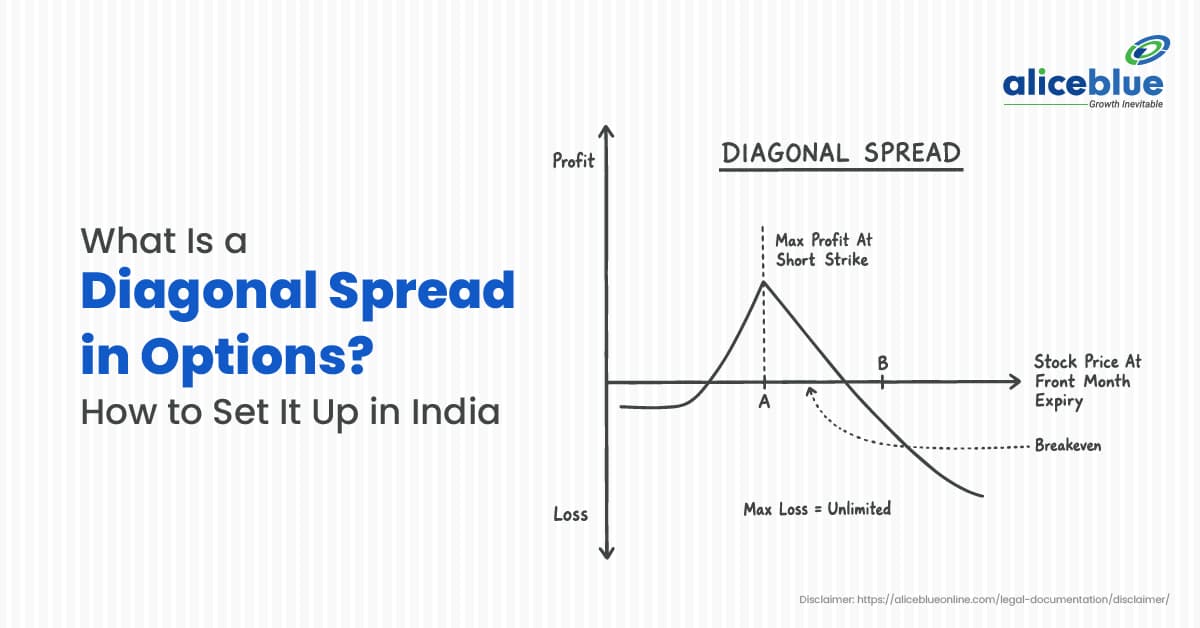
What the Payoff Diagram Looks Like
If you plot this on Sensibull or OptionStrat (free tools available in India), the payoff curve at short expiry looks like a truncated mountain:
- Far left (below 24,400): Flat line at max loss (₹6,250)
- Rising slope (24,400 to 24,600): Profit increases as Nifty rises toward the short strike
- Peak (around 24,600): Maximum profit zone
- Slight decline (above 24,600): Short call obligation reduces profit
- Far right (above 24,700+): Profit stabilizes (long call caps your loss on the short side)
After rolling the short leg forward, the peak shifts slightly, and the overall curve flattens at higher Nifty levels.
Double Diagonal Spread (For Neutral Markets)
A double diagonal spread is a 4-legged strategy combining a bull call diagonal AND a bear put diagonal. Use this when you expect Nifty to stay in a range.
Setup Example
Action | Option | Expiry | Strike |
Sell Call | May 30, 2026 (weekly) | 24,700 (OTM) | |
Buy Call | June 27, 2026 (monthly) | 24,900 (OTM) | |
Sell Put | May 30, 2026 (weekly) | 24,300 (OTM) | |
Buy Put | June 27, 2026 (monthly) | 24,100 (OTM) |
You collect premiums from both short legs. Max profit occurs if Nifty stays between 24,300 and 24,700 at the May 30 expiry. The long legs on both sides protect you from large moves in either direction.
This is popular during low-volatility phases in Indian markets — especially after major events when Nifty settles into a range.
Poor Man's Covered Call (Long Call Diagonal)
A Poor Man’s Covered Call (PMCC) is a specific version of a long call diagonal spread. Instead of buying 100 shares of stock (expensive), you buy a deep ITM call with far expiry and repeatedly sell short-term OTM calls against it.
Why It’s Called “Poor Man’s”:
A traditional covered call on Reliance at ₹2,950 requires buying 250 shares = ₹7,37,500 capital.
A PMCC on Reliance buys a deep ITM June 27 call (delta ~0.80) for ₹125 × 250 = ₹31,250 instead.
You get 80% of the directional exposure at 4% of the capital cost.
How PMCC Works:
- Buy a deep ITM long-dated call (delta 0.70-0.85, 45-90 days to expiry)
- Sell an OTM short-term call every week or month
- Repeat until the long call expires
Each short call you sell reduces your net cost basis. If Nifty stays below your short strike repeatedly, you can potentially collect enough premium to recover your entire long call cost, making the remaining upside “free.”
Key Features of Diagonal Spreads
Feature | What It Means |
Two Legs | One long option (far expiry) + one short option (near expiry) |
Same Option Type | Both calls OR both puts, never mixed |
Different Strikes | Strikes differ (unlike calendar spreads) |
Different Expiries | One near-term, one longer-term |
Directional Bias | Bullish or bearish, depending on the setup |
Defined Risk | Max loss capped at net premium paid (debit) |
Positive Theta | Net theta is often positive; time passing helps you |
Rollable | Short leg can be rolled forward multiple times |
Advantages
1. Cheaper Than Buying Naked Options
Selling the near-term leg collects a premium that cuts your net cost by 30-50% versus buying the long call alone.
2. Profit Even When Market Stays Flat
If the market doesn’t move, the short option decays toward zero. You keep that premium. Your long option retains most of its value.
3. Risk Is Always Defined
You can never lose more than the net premium paid (in a debit diagonal). There’s no overnight surprise that wipes your account.
4. Works for Mild Directional Views
You don’t need a 10% move. A 2-4% move over 3-6 weeks is enough to profit. This is far more achievable and realistic.
5. Multiple Income Streams via Rolling
Skilled traders roll the short leg 3-5 times on a single long option position. Each roll collects fresh premium, progressively lowering the cost basis of the long option.
6. Lower Margin Than Naked Short
Since the long leg hedges the short, brokers charge 40-55% less margin than a naked short option.
Risks and Limitations
1. Capped Profit
Unlike naked calls, where profit is unlimited, diagonal spreads cap your upside. If Nifty moves 1,000 points in your favor, you still hit your ceiling.
2. More Moving Parts Than Basic Strategies
You need to track two legs, manage rolling decisions, and monitor theta curves. If you’re new to options, start with long calls/puts or vertical spreads first.
3. Volatility Drop (Vega Risk)
If implied volatility collapses after you enter, your long option loses value faster than expected. This can turn a winning trade into a loser even if the market moves your way.
Before entering any options strategy, it helps to understand how India VIX affects your premiums. Our blog on Implied Volatility in Options Explained explains IV rank and IV crush in simple terms.
4. Early Assignment Risk on Stock Options
For physically settled stock options in India, your short-term short call can be exercised early if it goes deep ITM near expiry. This forces you to deliver shares or buy back the call urgently. Index options (Nifty, Bank Nifty) don’t have this risk — they’re European-style.
5. Transaction Costs Add Up
Two legs mean double the brokerage, STT, exchange fees, and GST. If you roll frequently, costs stack up. Always calculate net cost before entering, including all charges.
When NOT to Use Diagonal Spreads
Situation | Why to Avoid |
Before earnings announcements | Volatility spike can hurt long options more than short options help |
During a market crash or a strong trend | The move is too fast; a naked directional option performs better |
IV above 80th percentile | The long option is overpriced; the premium ratios become unfavorable |
You want unlimited profit | Buy a naked call instead |
You can’t monitor daily | This needs active management; calendar spreads are better for passive traders |
Illiquid stocks | Wide bid-ask spreads eat profitability; stick to Nifty, Bank Nifty |
Diagonal Spread vs Vertical Spread vs Calendar Spread
Feature | Diagonal Spread | Vertical Spread | Calendar Spread |
Strikes | Different | Different | Same |
Expiries | Different | Same | Different |
Direction | Bullish or bearish | Bullish or bearish | Neutral |
Theta Benefit | Yes (net positive) | No | Yes |
Max Profit | Capped | Capped | Capped |
Risk | Defined | Defined | Defined |
Capital Needed | Medium | Low-Medium | Medium |
Complexity | Medium-High | Low-Medium | Medium |
Best Market | Mild directional move | Strong directional move | Flat, range-bound |
Rollable | Yes | No | Yes (both legs) |
Vertical spreads are simpler and work better for strong moves. If you want to understand the difference between futures and options before trying spreads, our guide on Difference Between Futures And Options explains when each instrument works best.
Common Mistakes Beginners Make
1. Strikes Too Far Apart
If the gap between long and short strike is too large (500+ points for Nifty), the short option collects very little premium. The trade barely helps your cost reduction. Keep it 100-200 points for Nifty, 50-100 for Bank Nifty.
2. Expiries Too Close Together
If both legs expire within the same week, the theta advantage disappears. You need at least 3-4 weeks between the short and long expiry for the strategy to work correctly.
3. Skipping Breakeven Calculation
Many traders enter without calculating breakeven. If your breakeven is 500 points away from the current price, the trade doesn’t make sense. Always calculate before entering.
4. Ignoring Bid-Ask Spread
Near-month Nifty options are liquid. But mid-month or illiquid stock options may have a ₹5-15 bid-ask spread. On a ₹125 net debit trade, a ₹10 spread is an 8% hidden cost. Check liquidity before placing.
5. No Exit Plan on Stock Options
If your short stock option expires ITM, you face physical settlement. Always have a plan to either close or roll before expiry, not on the day of expiry.
6. Overtrading
This is not a daily trading strategy. Transaction costs from frequent entry and exit will destroy your P&L. Execute 1-2 diagonal spreads per month, not per week.
Who Should Use This Strategy?
Best For:
Trader Type | Why It Fits |
Intermediate options traders | You know basic options and want to add income generation |
Mildly bullish/bearish traders | You expect a 2-4% move, not a sharp rally or crash |
Income-seeking traders | You want to roll the short leg repeatedly for cash flow |
Capital-conscious traders | You want a cheaper cost than buying naked long options |
Not Suitable For:
Trader Type | Why It Doesn’t Fit |
Absolute beginners | Start with long calls/puts or vertical spreads first |
Traders who want unlimited upside | This strategy has a capped profit |
Passive, set-and-forget investors | Requires active monitoring and rolling |
High volatility traders | This underperforms when IV is very high at entry |
Conclusion
A diagonal spread in options sits in a sweet spot between a vertical spread and a calendar spread. It lets you take a mild directional view while also collecting premium from faster-decaying short-term options.
Key takeaways:
- Buy a longer-dated option, sell a shorter-dated option with a different strike
- Can be bullish (diagonal call spread) or bearish (diagonal put spread)
- Theta works in your favor, the short leg decays faster than the long leg
- Risk is defined, and the strategy can be rolled for multiple income cycles
- Works best in low-to-moderate volatility with a gradual directional move
Before jumping in: If you’re new to options, get comfortable with long calls/puts and vertical spreads first. Then test diagonal spreads with one Nifty lot, calculate your breakeven, and keep strike spacing at 100-200 points.
Understanding diagonal spreads builds on the basics of options trading. If you’ve read our earlier posts on theta decay and options pricing, you already have the foundation needed to make this strategy work for you.
Frequently Asked Questions
A diagonal spread is an options strategy where you buy and sell options of the same type (both calls or both puts) with different strike prices AND different expiration dates. You pay less for the trade because the short option’s premium offsets part of your long option’s cost.
A calendar spread uses the same strike price but different expiries. A diagonal spread uses different strikes AND different expiries. This gives diagonal spreads directional bias, while calendar spreads are neutral and work best when the market stays flat.
Yes, diagonal spreads can work well in India for Nifty and Bank Nifty options, where liquidity is high. Profitability depends on your directional view, the strike and expiry you choose, and whether you actively manage or roll the position.
100-200 points between the long and short strike works well for Nifty. For Bank Nifty, 50-100 points is more appropriate. The gap should be wide enough to give the short option premium value but not so wide that the short option collects too little.
A Poor Man’s Covered Call (PMCC) is a long call diagonal spread. Instead of owning shares, you buy a deep ITM long-dated call and sell OTM short-term calls against it. This strategy generates monthly income with far less capital than a traditional covered call.
Since the long leg hedges the short leg, the margin is 40-55% lower than a naked short option. For a Nifty diagonal, expect ₹30,000-₹45,000 versus ₹80,000-₹1,00,000 for a naked short call. Use your broker’s margin calculator with both legs entered as a spread for an exact figure.
Yes. Bank Nifty is highly liquid and has a good premium on weekly options. Use 50-100 point strike spacing. Bank Nifty’s higher volatility means larger premiums, but also larger potential losses if the market moves against you sharply.

Blog by Aliceblue News Desk


