Dividend Option vs Growth Option in Mutual Funds
Blog by Aliceblue News Desk
11 May 2026
8 minutes
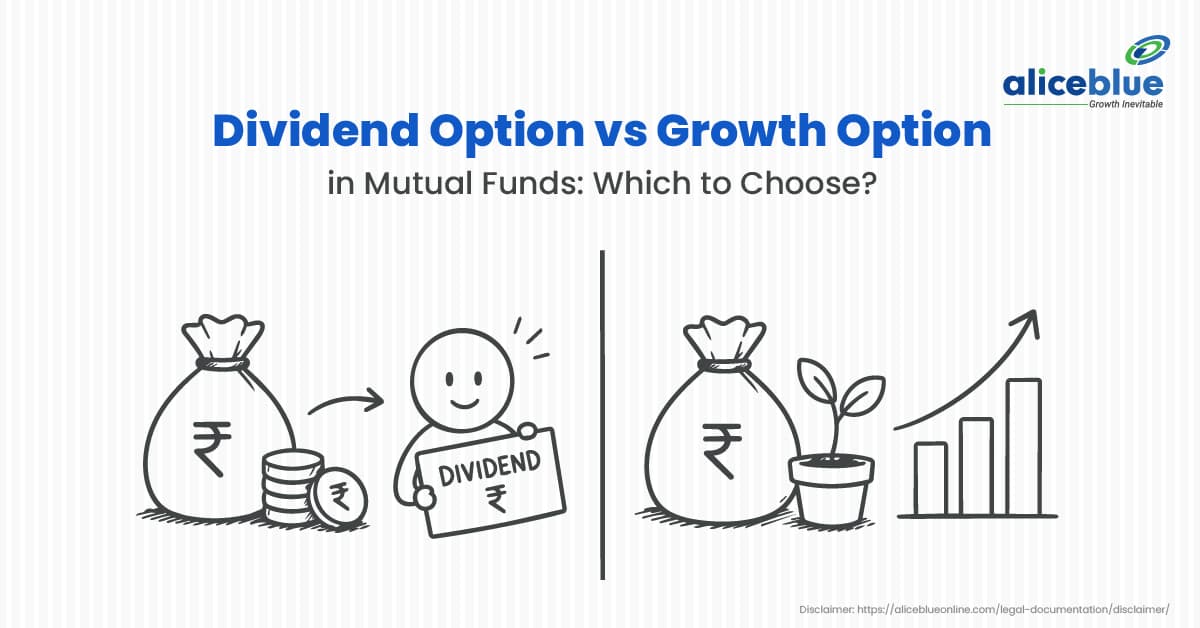
Most first-time mutual fund investors click “Growth” or “IDCW” on the application form without knowing what they are actually choosing. That single click decides how your money grows, how much tax you pay every year, and whether compounding works fully in your favour or keeps getting interrupted. This article explains how each option works, shows you verified numbers, and helps you decide which one fits your situation.
What Is the Growth Option?
In the growth option, the fund retains all profits inside the scheme. No payouts go to your bank account. Every rupee the fund earns stays invested and generates further returns. Your NAV rises steadily over time, and you receive money only when you choose to redeem your units.
What Is the IDCW Option?
IDCW stands for Income Distribution cum Capital Withdrawal. SEBI officially renamed it from “dividend option” effective April 1, 2021, via Circular No. SEBI/HO/IMD/DF3/CIR/P/2020/194, because many investors wrongly assumed payouts were extra income. In reality, distributions can include a portion of the investor’s own capital.
When the fund manager declares a payout, the amount is credited to your bank account. The NAV falls by exactly the payout amount on that same day. You are not receiving bonus money. You are getting part of your own invested money back.
SEBI mandates three sub-options under IDCW:
- IDCW Payout: Amount credited to your bank account
- IDCW Reinvestment: Amount used to purchase additional units in the same fund, still taxable as income in that financial year
- IDCW Sweep: Amount automatically transferred to a specified scheme
How the Two Options Work
- Growth Option
You invest ₹1,00,000 at a NAV of ₹100 and get 1,000 units. The fund earns 12% in Year 1. NAV moves to ₹112. No payout happens. Your portfolio value is ₹1,12,000. In Year 2, the 12% return is calculated on ₹1,12,000, not your original ₹1,00,000. Every year, your gains earn further gains.
- IDCW Payout Option
Same investment. Fund earns 12% in Year 1. NAV moves to ₹112. Fund manager declares a payout of ₹12 per unit. You receive ₹12,000 in your bank account. NAV falls back to ₹100. In Year 2, the 12% return is again calculated on ₹1,00,000. Your compounding base resets each time a payout is made.
The Numbers: Growth vs IDCW Over 10 Years
Assumptions: ₹1,00,000 invested, 12% annual return, entire annual gain distributed as IDCW each year, NAV resets to original cost price after each payout. Numbers are pre-tax.
Year | Growth NAV (₹) | Growth Portfolio Value (₹) | IDCW Payout Per Year (₹) | IDCW Cumulative Payouts (₹) | IDCW Portfolio Value (₹) | IDCW Total Wealth Pre-tax (₹) |
1 | 112 | 1,12,000 | 12,000 | 12,000 | 1,00,000 | 1,12,000 |
3 | 140 | 1,40,493 | 12,000 | 36,000 | 1,00,000 | 1,36,000 |
5 | 176 | 1,76,234 | 12,000 | 60,000 | 1,00,000 | 1,60,000 |
10 | 310 | 3,10,585 | 12,000 | 1,20,000 | 1,00,000 | 2,20,000 |
Growth NAV and portfolio values calculated using the standard compound interest formula: ₹1,00,000 x (1.12)^n.
At Year 10, the growth portfolio is worth ₹3,10,585. The IDCW investor received ₹1,20,000 in payouts over 10 years while the portfolio stayed at ₹1,00,000, giving a pre-tax total of ₹2,20,000.
After tax, the gap widens further. The IDCW investor in the 30% bracket pays ₹36,000 in tax on the ₹1,20,000 of payouts, bringing total IDCW wealth to approximately ₹1,84,000. The growth investor pays 12.5% LTCG only on gains above ₹1.25 lakh at redemption, paying roughly ₹23,198 in tax on ₹3,10,585 redeemed, retaining approximately ₹2,87,387.
Tax Treatment
Growth Option, tax applies only at redemption:
- Equity funds held over 12 months: LTCG taxed at 12.5% on gains above ₹1.25 lakh
- Equity funds held under 12 months: STCG taxed at 20%
- Debt funds (purchased after April 1, 2023): All gains are taxed at your income tax slab rate, regardless of holding period
IDCW Option, tax applies every time a payout is made:
- Every payout is added to your total annual income and taxed at your applicable slab rate (5%, 20%, or 30%)
- TDS of 10% is deducted at source if annual IDCW from a fund exceeds ₹10,000 in a financial year (updated threshold, Budget 2025)
- IDCW Reinvestment is also taxed as income in the year it is declared, even though no cash reaches your bank account
Why SWP Works Better Than IDCW for Regular Income
A Systematic Withdrawal Plan (SWP) lets you redeem a fixed amount from your growth option fund every month. Tax applies only to the capital gains portion of each withdrawal, not the entire amount withdrawn.
For equity funds held over 12 months, gains up to ₹1.25 lakh annually are tax-free, and gains above that are taxed at 12.5% LTCG. IDCW payouts, by contrast, are fully added to your income and taxed at your slab rate up to 30%.
For investors in the 20% or 30% tax bracket who need regular income, SWP from a growth option fund consistently results in a lower tax outgo than IDCW on the same cash flow amount.
Growth vs IDCW: Side by Side
Feature | Growth | IDCW Payout | IDCW Reinvestment |
Cash to the bank | Only at redemption | Yes, at each payout | No |
NAV movement | Rises steadily | Falls after each payout | Falls, adjusts with new units |
Compounding | Uninterrupted | Resets at each payout | Partial |
Tax event | At redemption only | Each payout | Each declaration |
Tax rate (equity funds) | STCG 20%, LTCG 12.5% | Slab rate up to 30% | Slab rate up to 30% |
TDS applicable | No | 10% above ₹10,000/year | 10% above ₹10,000/year |
IDCW Reinvestment triggers a slab-rate tax on every declared payout, while no cash reaches your account. You carry the full tax burden of IDCW with none of the liquidity benefit.
Common Mistakes That Cost Investors Money
Treating IDCW as bonus income
The payout is not extra money. On the declaration date, the NAV drops by exactly the payout amount per unit. You receive ₹10,000, your fund value falls by ₹10,000. Then you pay income tax on that ₹10,000.
Choosing IDCW for long-term goals
If your goal is 7 to 10 years away, every IDCW payout breaks your compounding base. The table above shows the direct cost of this reset over a decade.
Confusing IDCW Reinvestment with Growth
Both keep money inside the fund. But reinvestment is taxed as income the moment it is declared. Growth defers all taxes to redemption. The difference in tax outgo over 10 years can be substantial for anyone in the 20% or 30% bracket.
Choosing IDCW in ELSS funds
ELSS funds already have a 3-year lock-in period. Choosing IDCW in an ELSS creates a slab-rate tax event on every payout while your principal stays locked. There is no practical benefit. Growth is always the right choice for ELSS.
Who Should Choose Which Option
Growth option suits:
- Salaried investors building a corpus over 5 to 20 years through SIP
- Investors in the 20% or 30% income tax bracket
- Anyone saving for retirement, a child’s education, or a long-term financial goal
- All ELSS investors
IDCW Payout may work for:
- Retired investors in the nil or 5% tax slab with no other income source
- Investors who genuinely need periodic cash flow and cannot set up a SWP
- Short-term investors looking to book partial profits at intervals
IDCW Reinvestment suits almost no investor
It creates annual taxable income with no cash received, while growth achieves the same compounding effect with zero tax until redemption.
Conclusion
Growth and IDCW are the same fund, structured differently. Growth keeps every rupee of profit working inside the scheme and defers tax to redemption. IDCW pays out portions periodically, resets the NAV each time, and creates a tax liability at your slab rate on every payout.
For most investors building wealth in India over the long term, the growth option delivers better returns and a lower tax bill. If you need regular income from your investments, an SWP from a growth option fund provides the same cash flow with significantly lower taxes.
You can invest in direct growth option mutual funds through Alice Blue and manage your entire portfolio from a single platform.
Frequently Asked Questions
For long-term wealth creation, the growth option performs better in most situations. IDCW is useful only for investors in a low tax bracket who genuinely need periodic income and have no other source of cash flow.
Yes. All IDCW payouts are added to your total income and taxed at your applicable slab rate. TDS of 10% is deducted at source if your annual IDCW from a fund exceeds ₹10,000.
The payout is made from the scheme’s accumulated profits. When money leaves the fund, the total assets fall. The NAV per unit drops by exactly the payout amount on the declaration date.
Yes. The switch is treated as a redemption from IDCW and a fresh purchase in the growth option. Capital gains tax applies to the existing holding at the time of the switch, based on your holding period and fund type.
Only if you fall in the nil or 5% tax slab and have no other income source. For anyone in the 20% or 30% bracket, SWP from a growth option fund delivers the same periodic income with a much lower tax cost.
Growth, for most SIP investors. IDCW payouts reset the compounding base every time they are declared, which directly reduces the final corpus over long investment periods.
No payout is declared. IDCW is never guaranteed and depends entirely on the fund generating distributable profits. It cannot be relied on as a fixed or predictable income source.

Blog by Aliceblue News Desk