Documents Required for NRI Demat and Trading Account in India
Blog by Aliceblue News Desk
26 March 2026
6 minutes
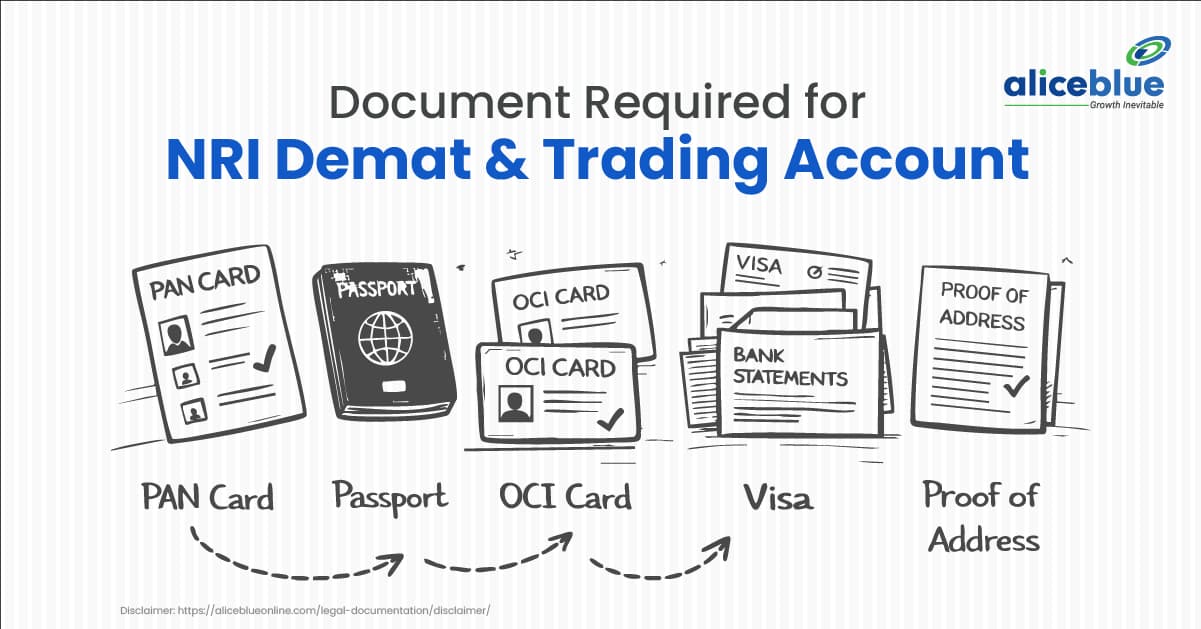
Getting rejected at account opening over one missing document is the most common problem NRIs face when trying to invest in India. The document list is longer than what a resident Indian submits, and most guides leave out three or four items that brokers actually ask for.This blog covers every document you need, with nothing left out.
Can NRIs Invest in Indian Stock Markets?
Yes. NRIs, OCIs (Overseas Citizens of India), and PIOs (Persons of Indian Origin) can invest in Indian stocks and mutual funds through the Portfolio Investment Scheme (PIS), regulated by RBI and FEMA.
To do this, you need two accounts:
- An NRI Demat account to hold securities in electronic form
- An NRI trading account to place buy and sell orders on NSE or BSE
Both accounts are opened together through a SEBI-registered broker like Alice Blue.
NRE vs NRO Account: Decide This First
Before you gather any document, decide which bank account you will link to your Demat account. This changes your document requirements and how your money can move.
Feature | NRE Account | NRO Account |
Source of funds | Money earned abroad | Income earned in India such as rent, pension, dividends |
PIS permission required | Yes, for equity trading | No |
Repatriation | Fully repatriable | Up to USD 1 million per financial year after tax |
Tax on interest | Tax-free in India | Taxable in India |
Most NRIs investing in equities use the NRE account with PIS. If your purpose is to manage income earned in India, use the NRO route.
Complete Document Checklist
Do not skip any item on this list. Applications with even one missing document are returned without processing.
1. Passport Copy Heading Text Here
Provide the photo page, address page, and the page carrying your current valid visa stamp. Both Indian and foreign passport holders must submit this.
2. Visa Copy (Separate Submission) our Heading Text Here
This is not the same as the passport copy. Submit a clear copy of your currently valid visa, whether it is a work permit, employment visa, student visa, or residence permit. An expired visa causes instant rejection.
3. PAN Card
Mandatory for every financial transaction in India. If you do not have one, apply before starting this process.
4. OCI or PIO Card
Required only if you hold a foreign passport and your place of birth is India. Submit this alongside your passport copy.
5. Overseas Address Proof
Must reflect your current foreign residential address and should not be older than 3 months. Accepted documents are an overseas driving licence, overseas bank statement, utility bill (electricity, water, gas, or telephone), or a foreign government-issued identity card.
6. Indian Address Proof
Required only if you have an Indian address to register. A utility bill not older than 3 months, Aadhaar card, Voter ID, or Indian bank statement is accepted.
7. NRE or NRO Bank Account Proof
Submit a cancelled personalised cheque from your NRE or NRO account along with a bank statement not older than 3 months.
8. PIS Permission Letter
Applicable only for NRE account holders investing in equities. You must obtain this letter from RBI through your designated bank before approaching a broker. Your bank opens a separate PIS bank account, routes the request to RBI, and issues you the permission letter. Without this, equity trading under the NRE route cannot begin.
9. Income Proof
This is the most frequently missed document. SEBI classifies NRI clients as Clients of Special Category (CSC), making income proof mandatory at the time of account opening. Submit any one of the following: last 6 months bank statement, latest salary slip, Income Tax Return acknowledgement, net worth certificate from a Chartered Accountant, or a recent Demat account holdings statement.
10. FATCA Declaration
This form confirms your country of tax residency and your Tax Identification Number (TIN). Errors in TIN details or country of residence are among the top reasons NRI account activations get delayed.
11. FEMA Declaration
A separate mandatory form where you declare that your investments comply with the Foreign Exchange Management Act. This is not the same as FATCA. Both forms must be submitted separately.
12. Immigration Copy
Required only if you are physically present in India when submitting your documents. Attach the latest arrival stamp page from your passport to confirm your current status.
13. Passport-Size Photographs
Standard requirement as specified by your Depository Participant.
Attestation Rules for Applications Submitted from Abroad
Self-attested copies are not accepted if you are applying from outside India. Every document must be attested by an Indian Embassy or Consulate in your country, an overseas Notary Public, or your overseas banker with a written certification that the copies have been verified against originals.
If you are in India at the time of application, self-attested copies along with the immigration copy are sufficient.
Existing Resident Demat Account? You Must Convert It
If you moved abroad and gained NRI status but still hold a resident Indian Demat account, using it is a violation of FEMA. You are required to inform your broker and Depository Participant, convert the account to an NRI Demat account, and link it to your NRE or NRO bank account. This is not optional.
Step-by-Step Account Opening Process
- Open an NRE or NRO savings bank account with a bank that offers PIS services
- Apply for PIS permission from RBI through your bank (for NRE equity trading)
- Collect all 13 documents listed above
- Get overseas attestation completed if you are applying from abroad
- Fill out the NRI Demat and trading account opening form with Alice Blue
- Complete In-Person Verification through video call if abroad, or in person at a branch if in India
- Submit all documents and wait for activation
Example: What This Looks Like in Practice
Arun works in Germany and wants to invest in Indian stocks through an NRE account.
He opens an NRE savings account with an RBI-authorised Indian bank that provides PIS services. The bank processes his PIS application and issues him the permission letter. He then approaches Alice Blue with all 13 documents listed above, gets them notarised by a German notary, and completes his IPV via video call. His account is active within 7 to 10 working days and he can now buy and hold Indian shares from Germany.
One thing he cannot do is intraday trading. NRIs are permitted only delivery-based equity transactions in India.
Account Opening Fees and AMC
Fees vary by broker. Here is what major brokers currently charge:
Broker | Account Opening Fee | AMC per Year |
Zerodha | ₹500 | ₹500 plus 18% GST |
ICICI Direct | ₹1,500 | ₹750 |
Kotak Securities | ₹1,000 | ₹750 |
Fyers | Free | Free |
SBI Securities | ₹1,000 plus GST (from May 2024) | Applicable separately |
Common Mistakes That Delay Account Opening
- Submitting an expired visa: The visa inside your passport must currently be valid. Many applicants miss this.
- Skipping the PIS letter before applying: The PIS step takes time. Apply for it before you approach a broker, not after.
- Treating FATCA and FEMA as the same form: Two different compliance forms with two different purposes. Both are required.
- No overseas attestation on documents: Applications submitted from abroad without Embassy, Consulate, or notary attestation are returned.
- Continuing to use a resident Demat account after becoming an NRI: This is a FEMA violation. Convert the account before you start investing.
If you’re planning to start investing, you can open a demat account with Alice Blue and get started.

Blog by Aliceblue News Desk