
When a Weight-Loss Pill Threatens Your “Safe” FMCG Stock
Blog by Aliceblue News Desk
07 August 2026
6 minutes
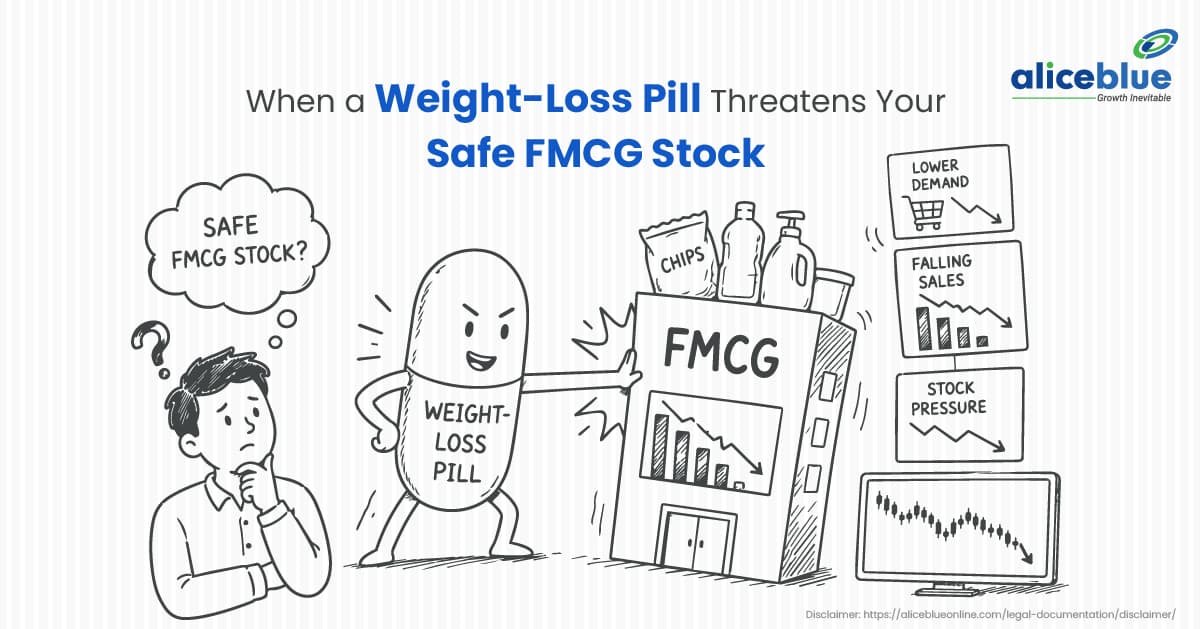
For decades, FMCG stocks sat in the safe corner of most Indian portfolios. Toothpaste, biscuits, snacks and soap were seen as businesses that survive almost any economic cycle. People buy them in good years and bad years alike. That belief is one reason FMCG stocks have traded at high price-to-earnings multiples compared to cyclical sectors like metals or capital goods.
A new global trend is quietly testing that belief. GLP-1 weight loss drugs, originally developed for diabetes, are now used by millions of people worldwide to cut their appetite and calorie intake. Global research shows GLP-1 users can reduce daily calorie intake by 24 to 40 per cent. Spending on salty snacks and desserts has dropped sharply in these households. This is not yet an India-specific story, since GLP-1 adoption here is still low compared to the United States. But the underlying lesson applies directly to how Indian investors think about FMCG and consumer stocks.
The Drug That's Rewriting Snack-Aisle Economics
GLP-1 drugs such as semaglutide and tirzepatide were approved for weight management starting in 2021. Adoption has grown fast since then. One industry estimate points to the food and beverage segment affected by these drugs. It could grow from under 5 billion dollars in 2025 to more than 25 billion dollars by 2034. Large global food companies including Nestle, Danone and Conagra are already redesigning products and portion sizes in response.
The impact on stock prices has been visible too. Global snack and beverage companies have seen their valuation multiples shrink even as near-term profits kept growing. Markets are pricing in future uncertainty rather than reacting to current earnings. A well-known Pennsylvania snack brand was acquired at a steep premium recently. Several major packaged food companies have also gone private through acquisitions. This suggests public markets and private buyers may disagree on how serious the long-term threat really is.
India Isn't Immune, Even If It's Behind the Curve
India differs from the US in the scale of GLP-1 adoption today. Affordability, prescription patterns and food habits mean India will likely see a slower and smaller shift. But the real lesson for Indian investors is not about weight loss drugs specifically. It is about a category of risk that is easy to miss when you only study a company’s past financial statements.
Every sector carries a quiet assumption baked into its valuation. For FMCG, the assumption has been that demand is stable and predictable. That is why investors are willing to pay a premium multiple for these stocks. When that assumption comes under threat, even from something entirely outside the industry, the market often prices the stock down before the sales numbers actually fall.
This points to a key difference between fundamental analysis and forward-looking risk analysis. A company’s past three years of revenue growth in its P&L statement tells you what has already happened. It does not tell you whether the demand assumption behind that growth is still intact today.
Chips vs. Chips: The Same Problem, Wearing Different Clothes
Interestingly, chipmakers face something close to the opposite problem. Demand for AI chips has exploded in the last two years. Yet companies like SK Hynix and Samsung still trade at fairly modest earnings multiples. The root cause is similar to the FMCG story. Markets struggle to price companies whose future demand is genuinely hard to forecast. It does not matter whether that uncertainty comes from a demand collapse or a demand boom that might not last. Both cases show that valuation multiples reflect confidence in future cash flows, not just current profit numbers.
For Indian retail investors, this comparison offers a useful mental model. A stock trading at a high price-to-earnings ratio is not automatically expensive or safe. The multiple reflects how confident the market is that today’s growth or stability will continue. Anything that introduces doubt about that continuity can compress the multiple. This holds whether the doubt comes from new technology, a policy change, a health trend or a new substitute product.
Five Ways to Stress-Test Your "Safe" Stocks
Look beyond the sector label. FMCG, IT services, banking and pharma are broad categories. Individual companies within each carry very different exposure to disruption. A biscuit and namkeen maker with a wellness-focused product line faces different risk than one built purely around traditional fried snacks. This is where fundamental analysis of Indian stocks becomes useful, since it forces you to read a company’s product mix rather than stopping at its sector tag. Two dairy or FMCG peers can also look identical on the surface but carry different risk once you compare them closely. This comparison of Dodla Dairy and Hatsun Agro shows the gap, and so does this one on KRBL versus LT Foods.
Track global consumer trends, not just Indian ones. Many Indian FMCG and food companies have export exposure or global promoter groups that watch international trends closely. A shift in US or European consumer behaviour often previews product strategy changes that eventually reach Indian shelves. Following global earnings calls of multinational parent companies can offer early signals.
Separate short-term numbers from long-term assumptions. When you study a company’s free cash flow or margin trends, also ask what demand assumption sits underneath the valuation. A fragile assumption can move the stock price well before sales numbers shift. This is one reason quarterly results alone rarely tell the full story, and why a proper stock analysis checklist always looks beyond the latest quarter.
Diversify across disruption exposure, not just across sectors. Two FMCG stocks can look similar on paper but carry very different exposure to a single disruptive trend. Building a portfolio from scratch means checking this kind of hidden correlation, not just relying on sector labels to signal diversification.
Watch corporate action as a signal. When several companies in a sector get acquired or delisted around the same time, it often means something. Insiders and private buyers may see value that public markets are pricing out of fear. This does not automatically mean the fear is wrong, but both sides deserve a fair look before you conclude.
Revisit your assumptions periodically. A stock that looked defensive five years ago may not carry the same profile today. Reviewing your portfolio’s underlying demand assumptions once or twice a year, rather than only when prices move sharply, helps catch these shifts earlier.
The Real Lesson Isn't About Weight Loss
The GLP-1 story is a reminder that no sector is immune to demand disruption, not even ones long considered defensive. For Indian investors, the practical lesson is to build the habit of asking what assumption is baked into a stock’s valuation. Then actively monitor whether that assumption still holds over time. Sector stability is a starting point for analysis. It is not a substitute for it.
This kind of ongoing tracking becomes far easier with the right tools. On the Alice Blue app, investors can set up watchlists across FMCG, pharma and technology stocks, and track live price and volume action in one place. Screeners let you compare companies side by side on margins, growth and valuation, which makes spotting a fragile assumption easier than digging through separate reports. The next disruption could come from a new drug, a new technology or a shift in consumer habits. Either way, a single platform to monitor a full portfolio makes it easier to stay ahead of these changes. That beats reacting only after the damage shows up in the numbers.

Blog by Aliceblue News Desk


