
How to Build a 3-Fund Portfolio Using Indian Mutual Funds?
Blog by Aliceblue News Desk
12 May 2026
10 minutes
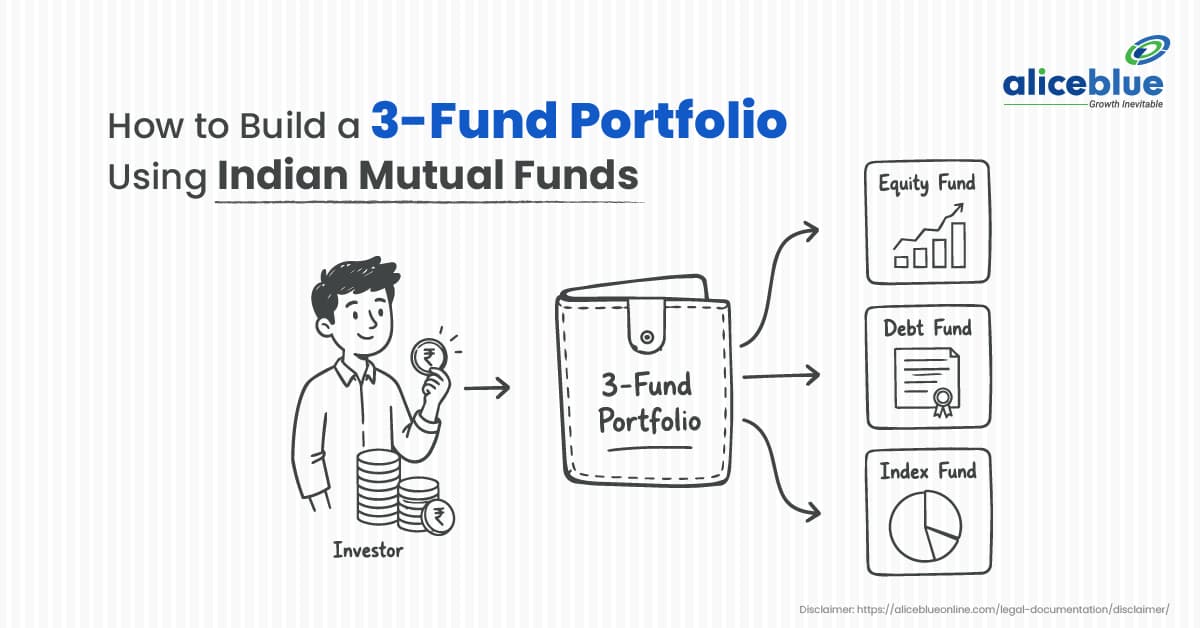
Many new investors in India start SIPs in several mutual funds because every scheme looks attractive at the time. After a few years, they may end up with 8-12 funds, repeated stock holdings, unclear risk, and no simple way to review the portfolio. This is where learning how to build a 3-fund portfolio using Indian mutual funds can help. A 3-fund portfolio keeps investing simple by using only three fund categories for growth, stability, and diversification.
In this article, you will learn what it means, how it works, how to create one, and what mistakes beginners should avoid.
What is a 3-Fund Portfolio Using Indian Mutual Funds?
A 3-fund portfolio is an investment approach where you build your mutual fund portfolio using only three funds or three fund categories. Each fund has a clear role in the portfolio.
For Indian investors, a simple 3-fund portfolio may include:
- One Indian equity fund for long-term growth
- One debt mutual fund for stability
- One gold fund or an international fund for diversification
The purpose is not to chase the top-performing fund every year. The purpose is to keep your portfolio clean, balanced, and easy to track.
For example, an investor may use a Nifty 50 index fund for Indian equity exposure, a short-duration debt fund for stability, and a gold fund for diversification. These are category examples, not recommendations.
Mutual funds are market-linked products. AMFI states that mutual fund schemes are not guaranteed or assured return products, and the value of a scheme can go up or down depending on the securities it holds.
How a 3-Fund Portfolio Works in Indian Mutual Funds
A 3-fund portfolio works by dividing your money across different asset classes. Each asset class behaves differently during market cycles.
1. Equity fund for growth
The equity fund acts as the growth engine of the portfolio. It invests mainly in shares of listed companies.
Indian investors can consider categories such as:
- Nifty 50 index fund
- Nifty Next 50 index fund
- Nifty 500 index fund
- Large-cap fund
- Flexi-cap fund
Equity funds can help build wealth over the long term, but they can also fall sharply during market corrections. This part is more suitable for goals that are several years away.
2. Debt fund for stability
The debt fund helps reduce overall portfolio movement. Debt mutual funds invest in instruments such as government securities, treasury bills, corporate bonds, and money market instruments.
Common debt categories include:
- Liquid funds
- Overnight funds
- Money market funds
- Short-duration funds
- Target maturity funds
- Gilt funds
Debt funds are usually less volatile than equity funds, but they are not risk-free. AMFI explains that debt securities can carry credit risk, interest rate risk, liquidity risk, and market risk.
3. Gold or an international fund for diversification
The third fund helps reduce dependence on only Indian equity and debt.
A gold fund may help when equity markets are weak or when inflation concerns rise. An international fund can give exposure to overseas companies, but Indian investors should check whether fresh investments are allowed in the chosen scheme.
For beginners, a gold fund is often easier to understand than an international fund.
4. Asset allocation decides the risk
The main strength of a 3-fund portfolio lies in its asset allocation. Asset allocation means deciding how much money will go into equity, debt, and the third fund.
Example allocations:
Investor Type | Equity Fund | Debt Fund | Gold or International Fund |
Conservative | 40% | 50% | 10% |
Moderate | 60% | 30% | 10% |
Aggressive | 75% | 15% | 10% |
A young investor with a 15-year goal may choose higher equity exposure. An investor who needs money in 3–5 years may keep more money in debt funds.
5. Rebalancing keeps the portfolio aligned
Over time, one part of the portfolio may grow faster than the others. Rebalancing means bringing the portfolio back to the planned allocation.
For example, if your target is 60% equity, 30% debt, and 10% gold, but equity rises to 70%, you can invest more fresh money into debt and gold until the balance is restored.
Example of a 3-Fund Portfolio Using Indian Mutual Funds
Let us take an example of Rohan, a 30-year-old salaried investor. He wants to invest ₹10,000 per month for long-term wealth creation. His investment period is 15 years, and he has a moderate risk appetite.
He chooses this structure:
Fund Role | Category Example | Monthly SIP |
Growth | Nifty 50 or Nifty 500 index fund | ₹6,000 |
Stability | Short-duration debt fund | ₹3,000 |
Diversification | Gold fund | ₹1,000 |
Total | ₹10,000 |
After one year, suppose equity markets perform well. His portfolio changes from 60:30:10 to 68:24:8.
Instead of adding another equity fund, Rohan directs his next few SIP instalments more toward debt and gold. This brings the portfolio closer to the original allocation.
This example shows why a 3-fund portfolio is useful. The investor does not need to track many funds. He only needs to check whether the portfolio still matches his planned allocation.
Add Your Heading Text Here
- Simple structure
The portfolio has only three funds or three fund categories. This makes it easier to track and review.
- Clear purpose for each fund
Each fund has a separate role. Equity is for growth, debt is for stability, and gold or international exposure is for diversification.
- Lower fund overlap
Many beginners buy several equity funds that hold similar large-cap stocks. A 3-fund structure can reduce unnecessary overlap.
- SIP-friendly approach
Investors can start with monthly SIPs and divide the amount across three funds. AMFI explains that SIP allows investors to invest a fixed amount periodically and can help with disciplined investing and rupee cost averaging.
- Easy to review
With only three funds, investors can easily check performance, risk level, fund objective, expense ratio, and asset allocation.
- Risk can be adjusted
You can change the equity and debt mix based on your age, income, time horizon, and financial goals.
Benefits of Building a 3-Fund Portfolio
- Reduces fund clutter
A 3-fund portfolio helps beginners avoid owning too many schemes. This makes portfolio tracking easier.
- Supports long-term investing
This approach works well for long-term goals such as retirement, child education, house planning, or wealth creation.
- Makes asset allocation clear
Instead of asking which fund gave the highest return last year, the investor focuses on the right mix of equity, debt, and diversification.
- Reduces emotional investing
When every fund has a role, investors are less likely to stop SIPs during market falls or chase every new fund category.
- Helps in regular review
The portfolio can be reviewed once or twice a year. Investors can check whether the allocation is still suitable for their goal and risk appetite.
- Easier for beginners to understand
A small portfolio is easier to learn from. New investors can understand how equity, debt, and gold behave in different market conditions.
Risks or Limitations of a 3-Fund Portfolio
- Equity risk
The equity fund can decline during market corrections. Investors should avoid using equity funds for money they need in the near term.
- Debt fund risk
Debt funds can face interest rate risk, credit risk, and liquidity risk. They are not the same as fixed deposits.
- Gold may underperform
Gold can help with diversification, but it may not always give high returns. It can remain flat for long periods.
- International fund limits
Some international funds may stop or restrict fresh inflows due to overseas investment limits. Investors should check the current status before choosing this category.
- Allocation may not suit everyone
A 60:30:10 portfolio may suit one investor but not another. The right mix depends on goals, income, risk appetite, and time horizon.
- Tax impact during rebalancing
Selling or switching mutual fund units may create capital gains tax. For equity-oriented mutual funds sold on or after 23 July 2024, AMFI states that short-term capital gains are taxed at 20%, while long-term capital gains above ₹1.25 lakh are taxed at 12.5%, subject to conditions.
3-Fund Portfolio vs Multi-Fund Portfolio vs Hybrid Fund
Point | 3-Fund Portfolio | Multi-Fund Portfolio | Hybrid Fund |
Number of funds | Usually 3 | Often 6–12 or more | Usually 1 |
Control over allocation | High | Medium to high | Limited |
Ease of tracking | Easy | Can become difficult | Easy |
Rebalancing | Done by the investor | Done by the investor | Managed by a fund manager |
Fund overlap risk | Lower if selected well | Higher | Lower within the fund |
Suitable for beginners | Yes, with a yearly review | Only if well managed | Yes, for hands-off investors |
Flexibility | High | High, but can become messy | Lower |
A 3-fund portfolio gives more control than a hybrid fund, but it needs some review. A hybrid fund may suit investors who do not want to manage allocation themselves. A multi-fund portfolio may suit experienced investors, but beginners may find it hard to track.
Common Mistakes Beginners Make
- Choosing three equity funds
A 3-fund portfolio should not mean one large-cap fund, one flexi-cap fund, and one small-cap fund. That is still mostly equity. A better structure usually includes equity, debt, and one diversifier.
- Ignoring asset allocation
The success of this approach depends more on allocation than on fund names. A poor allocation can make the portfolio too risky or too conservative.
- Selecting funds only by past returns
Past performance does not guarantee future returns. AMFI also states that past performance does not guarantee future performance of any mutual fund scheme.
- Not checking the riskometer
SEBI explains that the riskometer shows the risk level of a mutual fund scheme and that AMCs must display it as per SEBI guidelines.
- Using equity funds for short-term goals
If the money is needed within 1–3 years, equity exposure can be risky. Short-term goals need safer and more liquid options.
- Rebalancing too often
Frequent switching can create tax and exit-load issues. For many long-term investors, reviewing once or twice a year is enough.
- Forgetting emergency savings
A mutual fund portfolio should not replace an emergency fund. Keep emergency funds separate in liquid, low-risk options.
How to Build a 3-Fund Portfolio Using Indian Mutual Funds
Here is a simple step-by-step method:
- Define your goal
Decide whether the portfolio is for retirement, child education, house purchase, or long-term wealth creation.
- Choose your asset allocation
Select a mix based on your risk appetite. For example, a moderate investor may choose 60% equity, 30% debt, and 10% gold.
- Select one equity fund
Choose a broad Indian equity fund such as a Nifty 50 index fund, Nifty 500 index fund, large-cap fund, or flexi-cap fund.
- Select one debt fund
Choose a debt category based on your time horizon and risk comfort. Conservative investors may prefer liquid, money market, or short-duration funds.
- Select one diversification fund
Choose either a gold fund or an international fund. Beginners who want a simpler structure may prefer gold.
- Start SIPs
Divide your monthly SIP based on the chosen allocation. For example, a ₹10,000 SIP in a 60:30:10 portfolio can be split as ₹6,000, ₹3,000, and ₹1,000.
- Review once or twice a year
Check whether the portfolio has moved too far from the planned allocation.
- Rebalance carefully
Use fresh investments first. Switch or redeem only when needed, and check tax impact before making changes.
Conclusion
A 3-fund portfolio is a simple way to build a mutual fund portfolio without owning too many schemes. For Indian investors, it can include one equity fund for growth, one debt fund for stability, and one gold or international fund for diversification.
The main idea is to keep the portfolio clear, control risk through asset allocation, and review it regularly. Beginners do not need to chase every new fund category. A clear 3-fund structure, regular SIPs, and yearly rebalancing can help investors stay focused on long-term goals.
Frequently Asked Questions
A 3-fund portfolio in India is a mutual fund portfolio built using three funds or categories, usually equity, debt, and gold or international exposure.
Choose one equity fund, one debt fund, and one gold or international fund. Then decide your allocation, start SIPs, and review the portfolio once or twice a year.
A beginner may use a broad equity index fund, a short-duration or liquid debt fund, and a gold fund. These are category examples, not investment advice.
Yes, it can be useful for beginners because it reduces fund clutter and makes tracking easier. The allocation should match the investor’s risk appetite and time horizon.
There is no single best allocation. A moderate investor may consider 60% equity, 30% debt, and 10% gold or international exposure. Conservative investors may keep more in debt.

Blog by Aliceblue News Desk


