
How to Fill a Dematerialisation Request Form (DRF): Step-by-Step Guide
Blog by Aliceblue News Desk
25 March 2026
10 minutes
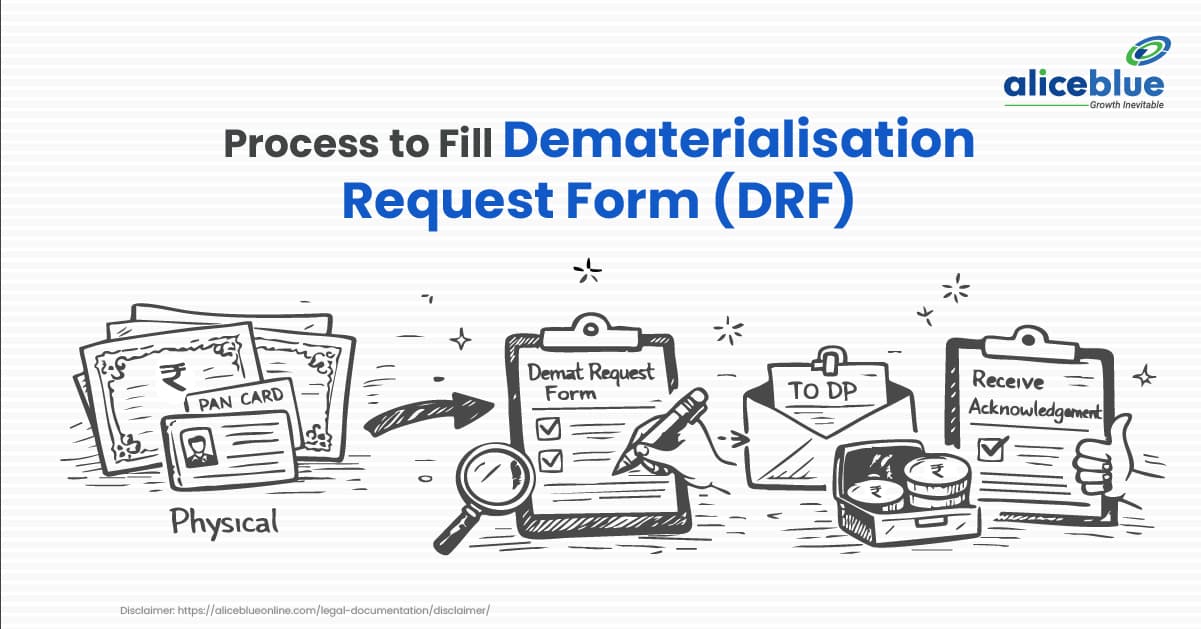
Inherited share certificates from a family member? Found old paper certificates from the early 2000s sitting in a file cabinet? Those certificates are legally valid but completely untradeable until they are converted into electronic form. SEBI does not allow physical shares to be sold or transferred on any stock exchange.
Converting them starts with one document: the Dematerialisation Request Form, called the DRF. Get it right the first time, and your shares will be in your demat account within 15 days of the RTA receiving your certificates.
What Is the Dematerialisation Request Form (DRF)?
The DRF is a formal instruction form you submit to your Depository Participant, which is your broker or bank. It asks the Depository Participant to convert your physical share certificates into electronic holdings in your demat account.
Your Depository Participant forwards the form and physical certificates to the company’s Registrar and Transfer Agent, known as the RTA. The RTA checks the certificate details against their records. Once verified, the shares are electronically credited to your demat account, and the original physical certificates are permanently cancelled.
Which Type of DRF Do You Need?
The form type depends on how your name appears on the physical certificate compared to your demat account.
Type of DRF | When to Use |
Normal DRF | Names on the certificate and demat account are identical and listed in the same order |
Transposition cum Dematerialisation | Same holders, but names appear in a different order on the certificate compared to the demat account |
Transmission cum Dematerialisation | A joint holder has passed away, and the surviving holder needs to remove the deceased person’s name before dematerialising |
Submitting the wrong form type is one of the most common reasons for rejection at the Depository Participant level itself, before the form even reaches the RTA.
What to Keep Ready Before You Begin
Keep these on the table before you start filling the form:
- Active demat account with your Depository Participant
- Original physical share certificates in hand
- Your 16-digit Client ID, which is your DP ID combined with your Client ID, found on your account statement or trading platform
- ISIN of the company. Search using the company name on nseindia.com or bseindia.com
- Folio number, certificate number, and distinctive numbers printed on the certificate
- Blue or black ink pen to write the mandatory text across each certificate before submission
One DRF covers only one company. If you hold three certificates belonging to the same company, list all three on one DRF. If you are dematerialising shares from two different companies, fill two separate DRFs.
How to Fill the DRF: Every Field Explained
Contact Number and Date
Write your active mobile number and today’s date. The Depository Participant uses this to contact you if anything needs clarification during processing.
Client ID
Enter your 16-digit demat account number. The first 8 digits identify your Depository Participant. The next 8 are your unique Client ID. If you cannot locate it, check your latest demat account statement or log into your trading platform.
Account Holder Names
Write the name or names exactly as they appear in your demat account. Same spelling, same order, no abbreviations. If the certificate says “Rajiv Kumar Sharma” but your demat account has “R. K. Sharma,” the RTA will reject the request. These must match character for character.
Face Value
The face value is the original printed value of the share, not its current market price. It is printed on the certificate. Common face values in India are Rs 1, Rs 2, Rs 5, and Rs 10.
Quantity of Shares
Enter the total number of shares you are submitting. This must match exactly what is printed on the certificate.
ISIN
The ISIN is a 12-character alphanumeric code that uniquely identifies the security. For example, Infosys Limited carries ISIN INE009A01021 on NSE. Verify this on the exchange website using the company name. Some companies have more than one ISIN for different share classes, such as fully paid and partly paid. Entering the wrong one causes an automatic mismatch at the RTA level.
Free or Locked In
Indicate whether the shares are freely tradeable or under a lock-in period. Also, mention the total number of physical certificates you are attaching to this form.
Folio Details
This section has multiple rows. For each certificate, fill in:
- Folio Number as printed on the certificate
- Certificate Number. If consecutive from 1001 to 1010, write the range. If scattered, list each number separately in its own row
- Distinctive Numbers, which is the range printed on the certificate identifying your specific shares
- Quantity covered by that certificate
Signature
Every account holder must sign in the same sequence as listed in the demat account. The signature is compared against what the RTA has in its records, which can be a record from several decades ago. If you suspect your signature looks different today, attach Form ISR 2 for banker-verified signature confirmation. Not attaching it when required is a preventable rejection.
Declaration
Sign and date the declaration confirming that all details are correct and the certificates are genuine.
Form ISR 2: When You Need It
Form ISR 2 is a banker-verified signature confirmation form. Some Depository Participants require it as a standard attachment. Others ask for it only when the signature on the DRF does not clearly match. It requires you to fill in the company name, security type, number of shares, and ISIN, and get it countersigned by your bank branch manager. Ask your Depository Participant before submitting whether they need this form.
Example: How Arjun Fills the DRF
Arjun holds 200 physical shares of a listed company. His certificate shows a face value of Rs 10, folio number 45678, and certificate number A1234.
He fills the DRF as follows:
- Client ID: His full 16-digit demat account number
- Account Holder Name: ARJUN MEHTA, written exactly as it appears in his demat account
- Face Value: Rs 10
- Quantity: 200
- ISIN: Verified on nseindia.com using the company name
- Folio Number: 45678
- Certificate Number: A1234
- Distinctive Numbers: Copied exactly from the certificate as printed
Before handing over the certificates, Arjun writes “Surrendered for Dematerialisation” across the face of each certificate in blue ink. He attaches a self-attested copy of his PAN card and submits everything to his Depository Participant.
Documents to Submit With the DRF
Submit all of the following together in one package:
- Filled and signed DRF form
- Original physical share certificates with “Surrendered for Dematerialisation” written across them
- Self-attested copy of PAN card
- Self-attested copy of Aadhaar card
- Form ISR 2 if your Depository Participant requires it
Alice Blue customers can download the DRF directly from the Alice Blue website or contact the Alice Blue support team for a physical copy.
DP Charges for Dematerialisation
Depository Participants charge a processing fee for handling dematerialisation requests. The charge structure varies by broker but is typically applied per certificate or per request. Some brokers charge a flat fee per company per DRF submission. Others charge per certificate submitted.
Check the fee schedule with your Depository Participant before submitting. Alice Blue customers can check the applicable charges directly on the Alice Blue website or by contacting support.
What Happens After You Submit the DRF
Once the form and certificates reach your Depository Participant:
- The Depository Participant checks the form for completeness and generates a Dematerialisation Request Number, called the DRN. Note this number down immediately. You will use it to track status.
- The Depository Participant enters the request into the depository system, either NSDL or CDSL, depending on where your account is held.
- The physical certificates are forwarded to the company’s RTA along with the DRF details.
- The RTA cross-checks the certificate numbers, folio number, distinctive numbers, ISIN, and signatures against their records.
- Once verified, the RTA confirms the request, and the shares are electronically credited to your demat account.
- The physical certificates are permanently cancelled by the RTA and removed from circulation.
According to CDSL’s official RTA Operating Instructions from March 2025, the RTA is required to complete the dematerialisation within 15 days of physically receiving the certificates. NSDL’s official FAQ states the same. If it is not done within this period, contact your Depository Participant with your DRN.
If the RTA does not receive the physical certificates within 30 days from the date the DRN was generated, the request is automatically cancelled.
SEBI Update: January 2026
SEBI issued a circular on January 30, 2026, changing part of this process from April 2, 2026, onwards. Previously, RTAs issued a Letter of Confirmation after processing a service request, and investors had 120 days to submit their demat request against it. Under the new rule, listed companies and RTAs must directly credit the securities into the investor’s demat account after verification. The Letter of Confirmation step has been removed entirely, which shortens the total process.
If you are submitting a DRF on or after April 2, 2026, the direct credit mechanism applies to your request.
Why DRF Requests Get Rejected
These are confirmed rejection causes from CDSL, NSDL, and SEBI documentation:
Signature mismatch: The signature on the DRF does not match what the RTA holds on record. Get Form ISR 2 with banker verification if this is a possible issue.
Wrong ISIN: A company may have multiple ISINs for different share classes. Always verify the exact ISIN on the exchange website before writing it on the form.
Name or order mismatch: If your certificate lists joint holders in a different order from your demat account, use the Transposition cum Dematerialisation form.
Incorrect folio or certificate number: A single-digit error means the RTA cannot match the certificate to their records, and the entire request is returned.
Overwriting or use of correction fluid: Do not attempt to correct errors on the form. Take a fresh form and fill it again.
Damaged or mutilated certificates: Certificates with torn sections, heavy stains, or missing text may be rejected. Check the physical condition before submitting.
Missing mandatory text on certificates: “Surrendered for Dematerialisation” must be written on each certificate. Certificates without this text may not be processed.
Wrong form type selected: Submitting a Normal DRF when a transposition or transmission form is required leads to immediate rejection.
When a DRF is rejected, the RTA issues a rejection memo with the specific reason. Certificates are returned to you through your Depository Participant. You address the specific issue and resubmit with a fresh DRF.
Who Needs the DRF Process?
This applies specifically to investors who:
- Hold physical share certificates issued before the demat system became standard in India, roughly before the late 1990s
- Inherited shares from a family member. In this case, the transmission process must be completed first to transfer ownership before filing a DRF
- Received shares through older Employee Stock Option Plans issued in physical certificate form
- Are NRIs holding legacy physical certificates in Indian companies
If your shares are already held in a demat account, you do not need a DRF.
Collect your certificates, note the folio number, certificate number, and ISIN, keep your demat Client ID ready, and download the DRF from Alice Blue before you start. The form itself takes 15 to 20 minutes to fill out correctly. Once submitted, the RTA has 15 days from receipt to credit the shares into your account.
The only thing that delays or stops this process is an error in the form. Verify the ISIN from the exchange website, write names exactly as they appear in your demat account, and match signatures carefully. Get those right, and the process runs on its own from there.
DRF stands for Dematerialisation Request Form. It is submitted to your Depository Participant to convert physical share certificates into electronic holdings in your demat account.
According to CDSL’s official operating instructions, the RTA must complete dematerialisation within 15 days of receiving the physical certificates. End-to-end, including transit and DP processing time, the total timeline is generally 15 to 30 days from the date of your submission.
No. Submit a separate DRF for each company. If you hold multiple certificates from the same company, list all of them on one DRF.
Once the RTA verifies and credits the shares electronically, the physical certificates are permanently cancelled. They are no longer valid documents.
The RTA issues a rejection memo stating the reason and returns the certificates to your Depository Participant. You correct the specific issue and resubmit with a fresh DRF.
Yes. Write “Surrendered for Dematerialisation” across the face of each certificate before submission. This is mandatory and prevents the certificates from being misused.
Transmission transfers ownership from a deceased holder to the surviving holder or nominee. Dematerialisation converts physical certificates to electronic form. If a joint holder has passed away, complete the transmission first. Then file the DRF to dematerialise the shares that now stand in the surviving holder’s name.

Blog by Aliceblue News Desk


