
How to Know Your Demat Account Number: Every Method That Actually Works
Blog by Aliceblue News Desk
20 March 2026
9 minutes
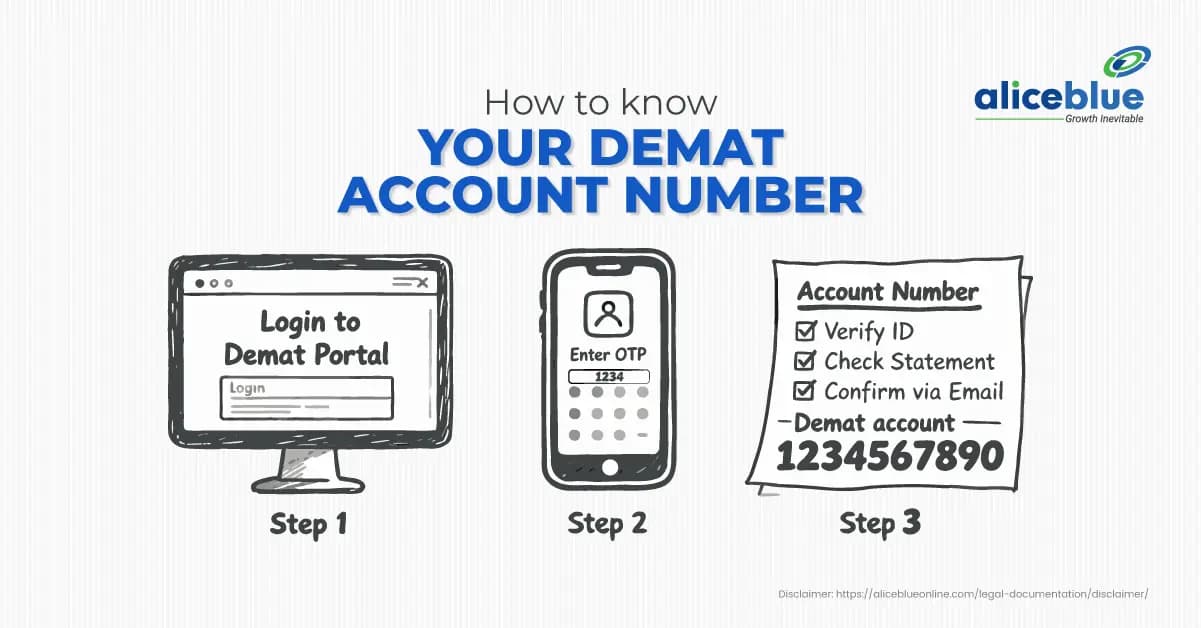
Your Demat account number isn’t something you need every day. But when you’re applying for an IPO, transferring shares, checking your holdings or completing a depository-related request, you may suddenly need it.
The good news is that you don’t need to memorise it. Your Demat account number is usually available through your broker, account statement or depository records.
This guide explains what the number means, where to find it and how CDSL and NSDL account numbers are structured.
Quick Definition
A Demat account number is the unique identification number assigned to your Demat account. Its format depends on whether your account is with CDSL or NSDL.
For a CDSL account, the Demat account number is a 16-digit BO ID. For an NSDL account, it is made up of an 8-character DP ID and an 8-digit Client ID.
Table of Content
- What Is a Demat Account Number?
- CDSL vs NSDL: What Does the Account Number Look Like?
- What About Alice Blue?
- How to Find Your Demat Account Number? 3
- Real Example: Understanding a CDSL Demat Account Number
- When Do You Need Your Demat Account Number?
- Common Mistakes to Avoid
- Can You Have More Than One Demat Account?
- Final Takeaway
- Frequently Asked Questions
What Is a Demat Account Number?
When you buy shares, ETFs, bonds or other securities in electronic form, they are held in your Demat account.
Your Demat account number is the identification number associated with that account.
You can think of it as an account identifier for your securities holdings. It is different from your trading account login or client code used by your broker.
India has two depositories:
- CDSL: Central Depository Services (India) Limited
- NSDL: National Securities Depository Limited
Your Depository Participant, or DP, maintains your Demat account with one of these depositories.
CDSL vs NSDL: What Your Account Number Looks Like
The format depends on your depository.
Feature | CDSL | NSDL |
Account number format | 16 digits | 8-character DP ID + 8-digit Client ID |
Example | 1208160012345678 | IN30002001234567 |
DP ID | First 8 digits | First 8 characters |
Client ID | Last 8 digits | Last 8 digits |
Common term | BO ID / Beneficiary Owner ID | DP ID + Client ID |
For CDSL, the first 8 digits identify the DP and the last 8 digits identify the client account. CDSL officially refers to this 16-digit number as the BO ID or Demat account number.
For NSDL, the DP ID is an 8-character code, and the Client ID is an 8-digit number. Together, they form the account number in the NSDL system.
What About Alice Blue?
How to Find Your Demat Account Number?
1. Check It on Your Broker's App
This is usually the easiest option.
Log in to your broker’s app or website and look under sections such as:
- Profile
- Account Details
- Demat Details
- My Account
- Holdings
The exact location varies between brokers.
For Alice Blue customers, you can start from the ANT platform or the account-related sections available through Alice Blue’s support and account services.
Look for terms such as Demat Account Number, BO ID, DP ID or Client ID.
On Alice Blue's ANT Platform:
- Log in at aliceblueonline.com or open the ANT app
- Tap the Profile icon at the top right corner
- Go to My Profile → Account Details
- Your 16-digit BO ID is listed under Demat Account Information
For other brokers, the path is slightly different but the logic is the same. Head to your profile or account settings and look for “Demat Account Number,” “BO ID,” or “Client ID.”
2. Check Your Account Statement:
Your Demat account statement contains details related to your securities account.
If you receive statements electronically, search your email for your broker or DP’s statement. You can also download available statements through your broker’s platform.
Look for the DP Details or account information section.
3. Check Your Client Master Report:
Your Client Master Report (CMR) contains important details related to your Demat account.
NSDL’s investor guide states that the DP provides the Client Master Report after the Demat account is opened.
If you need an official record of your account details, you can request the relevant document from your DP.
4. Check Your Welcome or Account-Opening Documents:
When your Demat account was opened, your broker or DP may have provided account-opening documents containing your Demat account details.
Search your email or saved documents for terms such as:
- Demat account
- BO ID
- Client ID
- DP ID
- Account opening
- Client Master Report
5. Check Your Depository Account:
If your account is with CDSL, you can use CDSL’s investor services to access your Demat-related information.
For example, CDSL’s Easi registration process uses the 16-digit BO ID as the Demat account number.
If you’re not sure about your BO ID, CDSL advises investors to approach their DP to obtain the Demat account number.
Real Example: Understanding a CDSL Demat Account Number
Suppose an investor has this CDSL BO ID:
1208530012345678
It can be understood as:
Part | Digits | Meaning |
DP ID | 12085300 | Identifies the Depository Participant |
Client ID | 12345678 | Identifies the client’s account |
Full BO ID | 1208530012345678 | Complete Demat account number |
For a CDSL account, the DP ID and Client ID together form the 16-digit BO ID.
When Do You Need Your Demat Account Number?
You may need your Demat account number for several situations, including:
- Applying for an IPO: Depending on the application process, you may need to provide Demat account details when applying for an IPO.
- Transferring Securities: Demat account details can be required when transferring securities between Demat accounts.
- Depository Services: Some depository services and requests may require your Demat account number or BO ID.
- Account Verification: You may need the number when verifying or updating certain Demat account details.
- Changing or Closing Accounts: Demat account details may be required when completing account-related requests with your broker or DP.
Common Mistakes to Avoid
- Confusing Your Client ID With Your Full Demat Account Number: For a CDSL account, the Client ID is only the last 8 digits of the 16-digit BO ID. If a form asks for the complete Demat account number, don’t enter only the Client ID.
- Confusing DP ID with Demat Account Number: The DP ID identifies the Depository Participant. It is only one part of the complete account number. For CDSL, the DP ID is the first 8 digits of the BO ID.
- Mixing Up CDSL and NSDL Formats: A CDSL BO ID and an NSDL account number don’t follow the same format. Check which depository your account is with before entering the details into a form.
- Using Outdated Account Information: If your broker or DP details have changed, don’t rely on an old document without checking the current account information. Use your latest statement or confirm the details with your DP.
- Sharing Your Account Details Carelessly: Your Demat account number may be required for legitimate transactions and account-related requests, but don’t share your login password, OTP or other authentication details with anyone.
Can You Have More Than One Demat Account?
Yes. An investor can have multiple Demat accounts with different Depository Participants, subject to applicable account-opening requirements.
Each Demat account will have its own account number.
If you have accounts with different DPs, keeping track of your latest statements and account documents can make it easier to identify each account when needed.
Conclusion
Your Demat account number is the unique identifier for your securities account, and finding it is usually straightforward.
For CDSL accounts, look for the 16-digit BO ID. For NSDL accounts, look for the DP ID and Client ID.
Your broker’s app, Demat statement, account documents or DP are usually the quickest places to check. If you still can’t find it, contacting your DP is the most reliable option.
Frequently Asked Questions
It depends on the depository.
A CDSL Demat account number is a 16-digit BO ID. An NSDL account number consists of an 8-character DP ID and an 8-digit Client ID.
Start with your broker’s app or website and look under Profile, Account Details or Demat Details.
You can also check your Demat statement or contact your DP if you cannot find it.
For CDSL, yes. CDSL describes the 16-digit BO ID as the Demat account number.
The DP ID identifies your Depository Participant, while the Client ID identifies your account with that DP.
For CDSL, the two together make up the 16-digit BO ID. For NSDL, the 8-character DP ID and 8-digit Client ID together form the account number.
Your PAN is used for KYC and account identification, but the exact process for retrieving a Demat account number depends on the depository and DP.
If you don’t know your account number, the safest option is to contact your DP and complete the required verification.
Check your welcome email first. If that’s gone, log into your broker’s app. If you’ve lost access to the app as well, the NSDL CAS portal will show every account linked to your PAN. If all else fails, call your broker with your PAN card handy.
First, check your broker’s app, account statement and account-opening documents.
If you still can’t find it, contact your broker or DP. CDSL also advises investors who don’t know their BO ID to approach their DP for the account number.
Yes. You can have multiple Demat accounts, subject to the applicable account-opening requirements. Each account will have its own Demat account number.

Blog by Aliceblue News Desk


