
How to Redeem ELSS Mutual Fund After the 3-Year Lock-In Period
Blog by Aliceblue News Desk
12 May 2026
10 minutes
Many investors choose ELSS mutual funds to save tax under Section 80C, but they often get confused after three years. Should they redeem the fund immediately, continue holding it, or withdraw only part of the amount? This question becomes more common when the investment was made through SIPs, because each SIP instalment has its own lock-in period. Learning how to redeem an ELSS mutual fund after the 3-year lock-in period helps investors avoid wrong withdrawals, tax confusion, and unnecessary exits.
In this article, you will learn how ELSS redemption works, when units become eligible, how tax applies, and what mistakes to avoid.
What is Redeeming an ELSS Mutual Fund After the 3-Year Lock-In Period?
Redeeming an ELSS mutual fund after the 3-year lock-in period means withdrawing eligible units from an Equity Linked Savings Scheme once the mandatory lock-in period is over.
ELSS is a type of equity mutual fund designed for tax-saving investments under Section 80C of the Income Tax Act. SEBI’s investor education page explains that ELSS invests mainly in equity and equity-related instruments and offers tax deduction benefits under Section 80C. It also states that ELSS has a three-year lock-in period, after which investors can redeem their units or continue holding them.
The lock-in period means you cannot withdraw the invested units for three years from the date of allotment. In simple terms, if your ELSS units were allotted on 10 April 2023, they usually become eligible for redemption after 10 April 2026.
Redemption does not mean you must withdraw the money as soon as the lock-in ends. It only means you have the option to withdraw. You may also continue holding the fund if it still matches your goal, risk appetite, and portfolio plan.
How ELSS Redemption Works After the 3-Year Lock-In
ELSS redemption works differently depending on whether you invested through a lump sum or SIP. The most important point is that the lock-in applies to the units, not just the scheme.
1. Check the investment date and allotment date
The lock-in period is counted from the date of unit allotment. The purchase date and allotment date are usually close, but they may differ due to holidays, cut-off timings, or processing rules.
For example, if you made a payment on Friday evening, the units may be allotted on the next business day. The lock-in period will be counted from the allotment date.
2. Understand lump sum redemption
If you invested a lump sum amount in ELSS on one date, the units are usually locked for three years from that date of allotment. After three years, all those units become eligible for redemption together.
For example, if you invested ₹1,00,000 in ELSS on 5 March 2023 and units were allotted on 6 March 2023, those units may become redeemable after 6 March 2026.
3. Understand SIP redemption
For SIPs, each instalment gets a separate three-year lock-in. This is where many beginners make mistakes.
If you started a monthly ELSS SIP in January 2023, your January 2023 instalment becomes eligible in January 2026, your February 2023 instalment becomes eligible in February 2026, and so on.
This means completing three years from the first SIP date does not make the entire SIP investment redeemable.
4. Decide whether to redeem or continue
Once units become eligible, you can redeem them fully, redeem partially, or continue holding. If the fund is performing well and your financial goal is still far away, you may not need to redeem immediately.
5. Place the redemption request
You can redeem eligible ELSS units through the mutual fund house website, the RTA platform, your broker, or the investment platform where you purchased the fund. The redemption amount is usually credited to your registered bank account after processing.
6. Check tax impact before withdrawal
ELSS is an equity-oriented mutual fund. AMFI states that for equity-oriented mutual funds, short-term capital gains on transfer on or after 23 July 2024 are taxed at 20%, and long-term capital gains above ₹1.25 lakh are taxed at 12.5%, subject to conditions. Since ELSS has a three-year lock-in, redemption after lock-in is generally treated as long-term for equity-oriented fund taxation.
How to Withdraw ELSS Online Through Alice Blue
If you invested in ELSS mutual funds through Alice Blue, you can follow these general steps:
- Log in to your Alice Blue account or Rise investment platform
- Go to your mutual fund holdings
- Select the ELSS fund you want to redeem
- Check which units have completed the 3-year lock-in
- Choose full or partial redemption for eligible units
- Confirm bank details and submit the request
- Track the redemption status until the amount is credited
ELSS Redemption Time: How Long Does It Take?
After you place an ELSS redemption request, the money is usually processed based on mutual fund settlement timelines, applicable cut-off time, holidays, and platform processing rules. Since ELSS is an equity-oriented mutual fund, investors should also check the applicable NAV date before confirming redemption.
Example of ELSS Redemption After Lock-In
Let us take a realistic Indian example.
An investor, Neha, starts an ELSS SIP of ₹5,000 per month on 5 January 2023. She continues the SIP for 12 months until December 2023.
Her investment schedule looks like this:
SIP Month | SIP Amount | Expected Lock-In Completion |
January 2023 | ₹5,000 | January 2026 |
February 2023 | ₹5,000 | February 2026 |
March 2023 | ₹5,000 | March 2026 |
April 2023 | ₹5,000 | April 2026 |
May 2023 | ₹5,000 | May 2026 |
December 2023 | ₹5,000 | December 2026 |
If Neha checks her ELSS account on 27 April 2026, only the units allotted from January to April 2023 may have completed the three-year lock-in. The units from May 2023 onward will still be locked until their respective dates.
Suppose Neha wants to redeem only ₹20,000 for a short-term need. She may redeem eligible units from the instalments whose lock-in is complete. She cannot redeem the locked units.
This example shows why ELSS SIP investors should not assume that the full SIP balance becomes redeemable exactly three years after the first instalment.
Important Features of ELSS Redemption
- Three-year lock-in
ELSS has a mandatory three-year lock-in period. During this time, investors cannot redeem locked units. SEBI states that once invested, the amount is locked in for three years.
- SIP instalments unlock separately
Each SIP instalment is treated as a separate investment. The three-year lock-in applies to each instalment based on its own allotment date.
- Partial redemption is possible
After the lock-in ends, investors can redeem only part of the eligible units if they do not want to withdraw the entire amount.
- No need to redeem immediately
The end of the lock-in only gives you the option to withdraw. You may continue holding if the fund still fits your goal.
- Market value may change
The redemption value is based on the fund’s NAV on the applicable redemption date. Since ELSS invests mainly in equity, the value can rise or fall.
- Tax applies to gains
Tax is calculated on capital gains, not on the full redemption amount. For equity-oriented funds, long-term capital gains above the allowed exemption limit are taxed as per current rules.
Benefits of Redeeming ELSS After the Lock-In Period
- Access to your money
After the lock-in period ends, you can use the money for financial goals such as education, emergency needs, loan repayment, or reinvestment.
- Flexibility after three years
You are no longer forced to stay invested in the locked units. You can redeem, switch, or continue based on your needs.
- Useful for portfolio review
The end of the lock-in period is a good time to check whether the ELSS fund still fits your portfolio.
- Helps avoid unnecessary fund clutter
Many investors keep adding new ELSS funds every year for tax savings. After the lock-in ends, they can review older funds and reduce overlap.
- Can support goal-based investing
If you invested in ELSS for a goal that is now close, redemption may help you move the amount to safer options
Risks or Limitations of ELSS Redemption
- Redeeming during a market fall
ELSS is an equity fund. If you redeem during a weak market, you may receive less than expected. If the money is not urgently needed, review carefully before exiting.
- Tax liability
Redemption can create taxable capital gains. Long-term capital gains from equity-oriented mutual funds above ₹1.25 lakh are taxed at 12.5% for transfers on or after 23 July 2024, subject to conditions.
- SIP confusion
Investors may think the full SIP becomes redeemable after three years from the first SIP date. This is incorrect because each instalment has its own lock-in.
- Loss of future growth
If the fund is suitable and the goal is long-term, redeeming immediately after three years may stop future growth.
- Exit decision based only on returns
A fund may underperform for a short period because of market conditions. Do not exit by looking at one-year returns.
- Reinvestment risk
If you redeem without a plan, the money may remain idle in a savings account or be spent on non-priority expenses.
Redeem ELSS vs Continue Holding vs Switch to Another Fund
Option | Meaning | When It May Help | What to Check |
Redeem ELSS | Withdraw eligible units after lock-in | When you need money, or the fund no longer fits your goal | Tax impact, market level, goal need |
Continue Holding | Stay invested after lock-in | When the fund is suitable, and your goal is long-term | Performance, portfolio fit, risk level |
Switch Fund | Move money to another mutual fund | When you want a different category or a better portfolio fit | Tax, exit load if any, asset allocation |
If your goal is near, redemption or shifting to lower-risk options may make sense. If your goal is still 5-10 years away, continuing may be better if the fund remains suitable.
Common Mistakes Beginners Make
- Redeeming immediately after three years
The lock-in ending does not mean you must withdraw. Redeem only if it matches your financial needs or portfolio plan.
- Assuming all SIP units are unlocked
For ELSS SIPs, every monthly instalment has its own lock-in period. Check eligible units before placing a redemption request.
- Ignoring tax on gains
ELSS gives tax deduction at the time of investment, but gains at redemption may be taxable. Review the capital gains statement.
- Exiting only because of short-term underperformance
ELSS funds invest in equity. Short-term returns can be weak during market corrections. Compare performance over suitable periods and against relevant benchmarks.
- Redeeming without a reinvestment plan
If you withdraw ELSS money without deciding where it should go, the amount may not support your financial goals.
- Not checking the riskometer
SEBI explains that the riskometer shows the risk level of a mutual fund scheme, and AMCs must display it as per SEBI guidelines. Investors should review the fund’s risk level before deciding whether to continue.
- Stopping tax planning too late
Some investors redeem old ELSS units and then invest again in ELSS near the end of the financial year, only to save tax. A better approach is to plan tax-saving investments earlier.
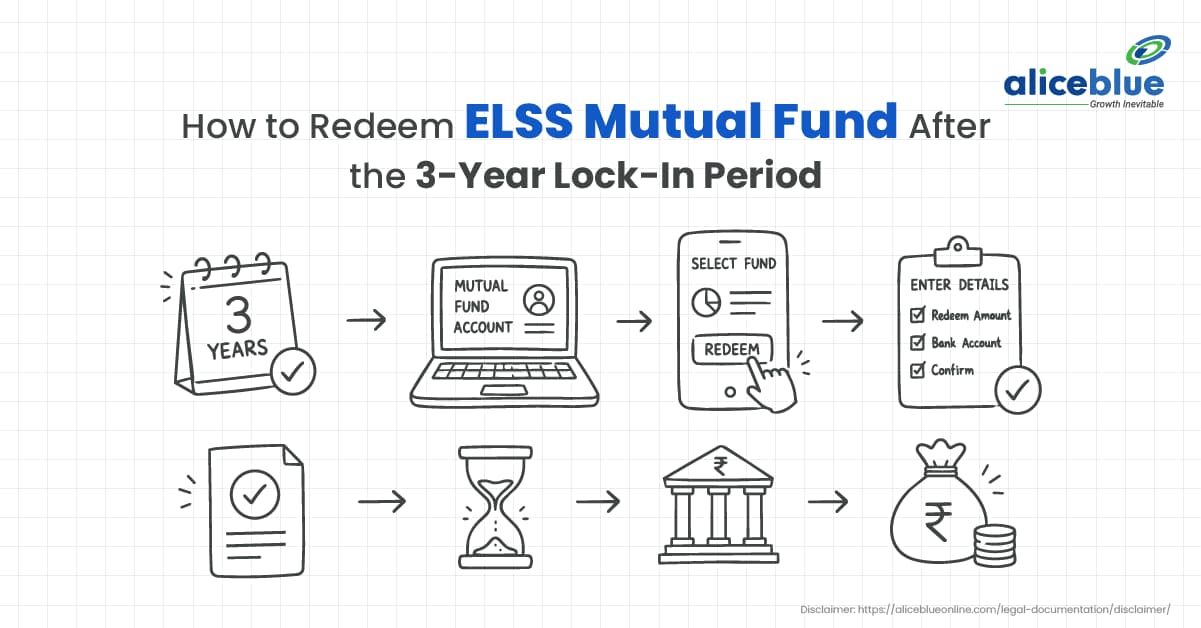
How to Redeem ELSS Mutual Fund After the 3-Year Lock-In Period
Here is a simple step-by-step process:
1. Check your folio and fund details
Log in to your mutual fund account, AMC website, RTA platform, broker account, or investment platform. Select the ELSS fund you want to review.
2. Check eligible units
Look for units that have completed the three-year lock-in. For SIPs, check each instalment separately.
3. Review fund performance
Compare the fund’s performance with its benchmark and category. Do not decide only on short-term returns.
4. Check your goal
Ask whether you need the money now. If the goal is still far away, continuing may be an option.
5. Check tax impact
Download the capital gains statement if available. Review whether the gains may cross the exemption limit for equity-oriented funds.
6. Choose full or partial redemption
If you need only part of the money, redeem only eligible units worth that amount.
7. Submit the redemption request
Enter the amount or number of units, confirm bank details, and submit the request.
8. Track credit to your bank account
The redemption amount is credited to the registered bank account after processing. The exact timeline depends on mutual fund processing rules, holidays, and platform cut-off time.
Conclusion
Redeeming ELSS after the 3-year lock-in period is simple when you understand how the lock-in works. Lump sum investments usually become eligible together, while SIP instalments unlock one by one based on their allotment dates.
The end of the lock-in period does not mean you must redeem immediately. First, check your goal, fund performance, tax impact, and market conditions. If the fund still fits your plan, you may continue holding. If you need the money or want to rebalance your portfolio, you can redeem eligible units after checking the details carefully.
Frequently Asked Questions
ELSS units can be redeemed only after completing the mandatory 3-year lock-in period. For SIPs, each instalment has a separate lock-in.
Each SIP instalment unlocks after three years from its own allotment date. The full SIP balance does not unlock at once.
You can withdraw ELSS online through the AMC website, RTA platform, broker, or investment platform such as Alice Blue, after checking eligible units.
The redemption timeline depends on the mutual fund’s processing rules, cut-off time, bank processing, and market holidays.
If your ELSS investment is held through Alice Blue/Rise, you can review your mutual fund holdings and redeem eligible units after the lock-in period.

Blog by Aliceblue News Desk


