How to Transfer Shares From One Demat Account to Another: Online and Offline Steps, Charges
Blog by Aliceblue News Desk
18 March 2026
10 minutes
You’ve built a portfolio worth ₹5 lakh, but your shares are spread across two or three demat accounts.
If you’re switching brokers or trying to consolidate your investments, selling everything and buying it again isn’t the only option.
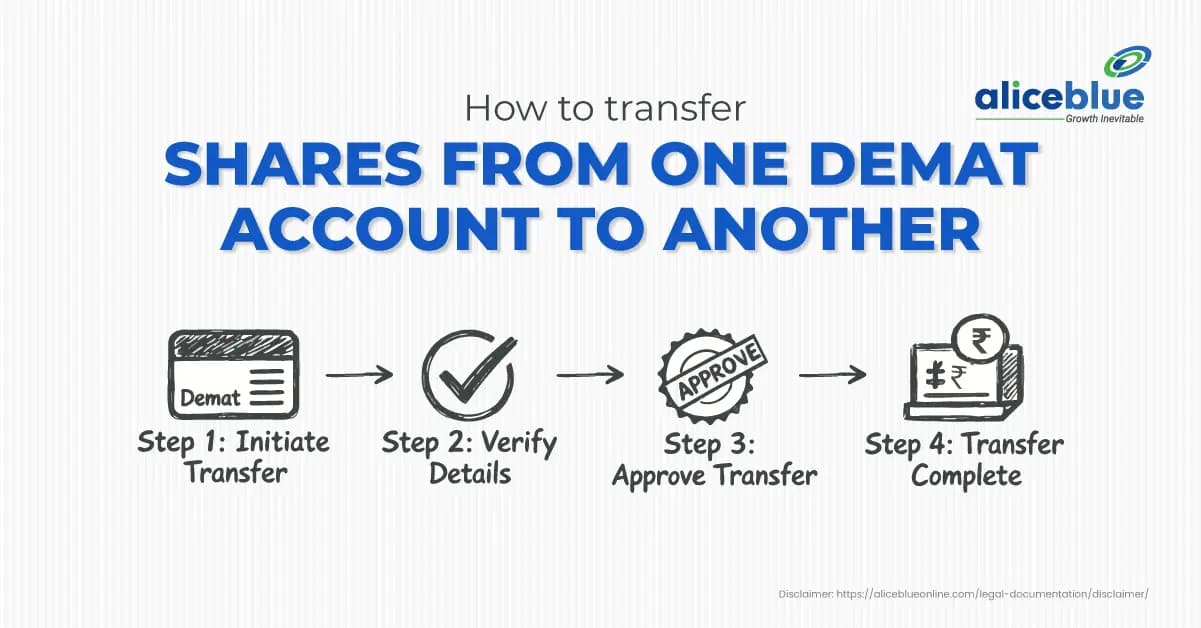
You can transfer your shares directly from one demat account to another without selling them on the stock exchange.
This is generally done through an off-market transfer using the depository system. Depending on the accounts involved, you can transfer securities through an online facility or by submitting a Delivery Instruction Slip (DIS) to your Depository Participant (DP).
In this guide, we’ll explain how the process works, what details you need, how long it can take, what charges may apply and what to check before submitting a transfer request.
Quick Definition
A demat transfer is the movement of securities such as shares, ETFs or bonds from one demat account to another without selling them on a stock exchange.
For example, if you have shares in your old demat account and want to move them to your new broker, you can transfer those holdings directly to the new account.
What Is an Off-Market Transfer?
An off-market transfer is a transfer of securities between demat accounts that does not happen through a stock exchange transaction.
It can be used when you:
- Move shares from an old broker to a new broker
- Consolidate holdings held across multiple demat accounts
- Move investments between your own demat accounts
- Transfer securities to another person as a gift
- Transfer securities for other permitted purposes
CDSL describes an off-market transaction as a transfer between two Beneficial Owner (BO) accounts within CDSL. Transfers involving different depositories are treated as inter-depository transfers.
Intra-Depository vs Inter-Depository Transfer
Type | What it means |
Intra-depository | Both demat accounts are with the same depository, such as CDSL to CDSL |
Inter-depository | The two accounts are with different depositories, such as CDSL to NSDL or NSDL to CDSL |
The process and charges can differ depending on the depository, DP and transfer method, so you should check the requirements of your DP before initiating the transfer.
What Details Do You Need to Transfer Shares?
The exact information required can vary by DP and transfer method, but you will generally need:
- ISIN of the security
- Name of the security
- Quantity of securities
- Target demat account details
- DP ID and Client ID or BO ID
- Reason or purpose of transfer, where required
- Your signature or electronic authentication
An ISIN is a unique identification code assigned to a security. Your DP can help you find the correct ISIN if you are unsure.
For a physical transfer request, the DIS normally contains the details required to identify the securities and the receiving account. Alice Blue’s current support documentation also lists the BO ID, ISIN, quantity and reason for transfer among the details used in a DIS.
How to Transfer Shares From One Demat Account to Another
There are two common ways to initiate a transfer:
- Online through the depository’s electronic facility
- Offline using a Delivery Instruction Slip (DIS)
The exact process depends on your depository and DP.
Online Method: CDSL Easiest or NSDL SPEED-e
If your demat account supports electronic transfer instructions, you may be able to transfer securities online.
Step 1: Register for the electronic facility
For CDSL accounts, this can be done through CDSL Easiest.
For NSDL accounts, SPEED-e provides an electronic way to submit delivery instructions.
Step 2: Add the receiving account
Enter the required details of the demat account receiving the securities.
Depending on the platform and transfer type, the beneficiary may need to be added and verified before the transfer can be submitted.
Step 3: Enter the securities details
Provide details such as:
- ISIN
- Quantity
- Target demat account
- Transfer reason or purpose
Step 4: Authenticate the request
The electronic transfer may require authentication such as OTP or another approved authentication method.
Step 5: Submit the transfer
Once the request is accepted and processed, the securities are transferred to the target demat account.
CDSL’s current operating instructions allow beneficiaries to be added before an off-market transfer and provide for electronic submission through Easiest or other permitted digital methods.
NSDL also supports electronic off-market instructions through SPEED-e, including beneficiary addition through its mobile platform.
Offline Method: Using a DIS
If you prefer the physical process, you can use a Delivery Instruction Slip (DIS) provided by your DP.
Step 1: Get a DIS
Request a DIS booklet from your current broker or DP.
Step 2: Fill in the required details
Depending on the format provided by your DP, you may need to enter:
- Your demat account details
- Recipient’s demat account details
- ISIN
- Security name
- Quantity
- Transfer type
- Reason or purpose of transfer
Step 3: Sign the DIS
Your signature should match the records maintained by your DP.
Step 4: Submit the DIS
Submit the completed slip to your broker or DP through its prescribed process.
Step 5: Wait for processing
Your DP will verify the instruction and process it through the depository system.
CDSL confirms that a DIS can be used for off-market and inter-depository transfers, while electronic facilities such as Easiest can be used without submitting a physical DIS for eligible transactions.
What If You Are Switching Brokers?
This is one of the most common reasons for transferring shares.
Suppose you have shares in your old demat account and have opened a new account with another broker.
You can transfer the existing holdings to the new account instead of selling them and buying them again.
Before starting the transfer, check:
- Whether both accounts are with CDSL, both with NSDL, or with different depositories.
- The DP ID and Client ID of the receiving account.
- The ISIN and quantity of each security.
- Whether the receiving DP requires a Client Master Report (CMR).
- Whether your existing broker has any specific transfer requirements.
For example, Alice Blue currently supports CDSL Easiest for CDSL-to-CDSL transfers and a manual DIS process for transfers such as inter-depository transfers. Its support documentation also specifies a CMR and DIS for certain manual transfers.
How Long Does a Demat Transfer Take?
There isn’t one fixed timeline that applies to every demat transfer.
The time can depend on:
- Depository involved
- Online or offline method
- Verification requirements
- Whether the receiving account has been added as a beneficiary
- Accuracy of the submitted details
- Your DP’s internal processing time
So, rather than assuming that every transfer takes 3–5 working days, check the expected timeline with your DP when submitting the request.
What Are the Charges for Transferring Shares?
There is no single standard charge for every demat transfer.
Charges can depend on:
- Your broker or DP
- Depository
- Type of transfer
- Online or physical mode
- Number of securities or ISINs involved
- Applicable statutory charges
Some DPs charge a transaction fee for off-market transfers, while others may have different pricing structures.
For example, Alice Blue currently states that it does not levy an additional charge for off-market share transfers and that stamp duty is applicable.
Before transferring your holdings, check your DP’s latest tariff sheet rather than relying on an older charge mentioned online.
Tax Implications of Transferring Shares
The tax treatment depends on why and how the securities are transferred.
1. Transfer Between Your Own Demat Accounts:
Moving shares between two demat accounts that belong to you does not by itself amount to selling the shares on the stock exchange.
However, you should maintain records showing that both accounts belong to you and that the transfer was only a movement of holdings.
2. Gifting Shares to a Relative:
The tax rules for gifts are different.
Under Section 56(2)(x), property received from a specified relative is generally outside the tax provision that applies to certain gifts. The Income Tax Department’s definition of specified relatives includes relationships such as spouse, parents, children and siblings, along with certain other specified relationships.
3. Gifting Shares to a Non-Relative:
For specified movable property received without consideration, the ₹50,000 threshold under the applicable tax rules is important.
If the applicable threshold is exceeded, the whole value, rather than only the amount above ₹50,000, can become taxable under the relevant provision.
For example, if shares worth ₹30,000 are gifted to a friend, the gift would generally fall below the ₹50,000 threshold. If shares worth ₹3 lakh are gifted to a friend without consideration, the tax treatment can be different and the recipient may have a tax liability.
Tax treatment can also depend on the nature of the transfer and the recipient, so consult a tax professional for a transaction involving a substantial amount or a third-party transfer.
Common Mistakes to Avoid
Before submitting your transfer request, check these details carefully:
- Entering the wrong ISIN: A company can have multiple securities, so don’t rely only on the company name. Verify the ISIN.
- Entering the wrong DP ID or Client ID: One incorrect digit can cause the request to be rejected or delayed.
- Using the wrong transfer type: Check whether the transfer is intra-depository or inter-depository before submitting the instruction.
- Forgetting the transfer reason: Some off-market transfers require the reason or purpose to be specified. CDSL’s operating requirements include reason or purpose information for applicable off-market transactions.
- Ignoring pledged or restricted holdings: Shares that are pledged, locked in or otherwise restricted may not be available for a normal transfer until the restriction is resolved.
- Not keeping the acknowledgement: Keep a copy of the DIS, electronic confirmation or transaction reference until the securities appear in the receiving account.
Final Takeaway
You don’t necessarily have to sell your shares when moving from one demat account to another.
An off-market transfer can allow you to move existing holdings directly to another account. The process may be online or offline depending on your depository and DP.
Before submitting the request, verify the ISIN, quantity, DP ID, Client ID/BO ID and transfer reason carefully. Also check the latest charges and documentation requirements with your DP.
For Alice Blue clients, the current support centre has dedicated information on share transfers, DIS requests and transfer documentation – Alice Blue Support
Frequently Asked Questions
Yes. Eligible securities can be transferred directly between demat accounts through an off-market or inter-depository transfer, depending on the accounts involved.
No. You can generally transfer selected securities and quantities, subject to the applicable process and restrictions.
Yes. This is commonly done when consolidating investments or moving holdings after changing brokers.
Yes, subject to the applicable depository and DP requirements. Transfers to another person may have different documentation and tax implications from a transfer between your own accounts.
No. Electronic facilities can be used for eligible transfers. For example, CDSL Easiest allows eligible users to submit transfer instructions electronically without a physical DIS.
There is no single charge applicable to all DPs. Your broker or DP may charge for an off-market transfer, and applicable statutory charges may also apply. Check the latest tariff before submitting the request.
Yes. This is an inter-depository transfer, subject to the requirements of the two DPs and the applicable depository process.

Blog by Aliceblue News Desk


