
Impact Cost in F&O: Meaning, Formula, Calculation, Examples & Ways to Reduce It
Blog by Aliceblue News Desk
18 August 2026
9 minutes
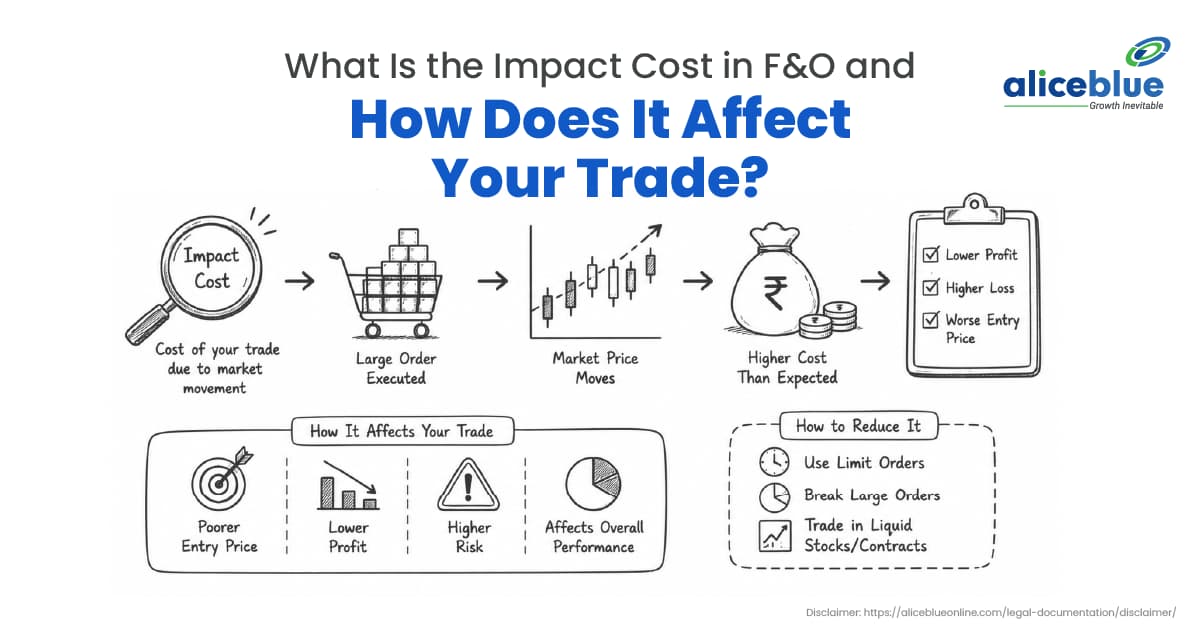
Impact cost in F&O refers to the percentage markup or markdown a trader incurs due to order book liquidity constraints when executing a specific transaction volume. It measures the direct deviation between a trade’s actual execution price and the ideal market price.
This article explains how impact cost is calculated, why it matters, and how you can reduce it.
Table of Contents
- Understanding Order Book Depth and Impact Cost
- How Impact Cost Works in Futures and Options Trading
- How to Calculate Impact Cost in F&O (Example)
- Factors That Increase Impact Cost
- How High Impact Cost Can Affect Your Trades
- How to Check Impact Cost Before Placing a Trade
- How to Reduce Impact Cost in F&O
- Impact Cost vs Slippage: What’s the Difference?
- Who Should Track Impact Cost?
- Conclusion
- Frequently Asked Questions
Understanding Order Book Depth and Impact Cost
To understand the true impact cost meaning, you have to look past the single last traded price (LTP) flashed on your trading terminal. The stock and derivatives markets function as a continuous double-sided auction house. The exchange matches buyers and sellers using an order book, which is a live ledger of buy and sell limit orders waiting to be fulfilled.
The order book consists of two main components:
- The Bid: The highest price a buyer is currently willing to pay.
- The Ask (or Offer): The lowest price a seller is currently willing to accept.
The ideal market price sits in the middle of these two numbers. But you can only trade at this ideal price if there is perfect liquidity. The concept of impact cost in F&O exists because order books have varying depths, meaning the price you want is tied directly to the size of the order you place.
How Impact Cost Works in Futures and Options Trading
The main reason for execution friction is the real-time availability of liquidity in futures and options. When an order hits the exchange, it clears out the order book layer by layer.
Step 1: Order Ingestion
A trader places a market order to buy or sell a specific number of lots in a futures contract or options strike.
Step 2: Evaluating Order Book Depth
The exchange matching engine evaluates the available volume sitting at the best available bid or ask price.
Step 3: Absorbing Liquidity Layers
If the order volume is greater than the volume available at the best price, the order moves deeper into the next price layer of the book, absorbing less favourable prices.
Step 4: Weighted Average Execution
The order is fully completed, and the final execution price is calculated as the weighted average of all the consumed price layers.
How to Calculate Impact Cost in F&O (Example)
Let’s look at a realistic scenario to see how to calculate impact cost in F&O. To visualise this process, consider the standard layout of a limit order book before an order is placed.
Imagine you want to buy 2,500 quantities of a specific stock option contract. The current sell side (ask) of the order book looks like this:
- Level 1 Ask: 1,000 quantities available at ₹101 (Best Ask)
- Level 2 Ask: 500 quantities available at ₹102
- Level 3 Ask: 1,000 quantities available at ₹103
(Assume the Best Bid on the buy side is currently sitting at ₹100)
1. Find the Ideal Price
The ideal price is the exact midpoint between the best bid and best ask:
Ideal Price = (100 + 101) ÷ 2 = ₹100.50
2. Calculate the Actual Execution Price
Because your order of 2,500 quantities is larger than the 1,000 quantities available at the best ask (₹101), your order eats through all three levels of the book:
Actual Execution Price = [(1,000 × 101) + (500 × 102) + (1,000 × 103)] ÷ 2,500
Actual Execution Price = (1,01,000 + 51,000 + 1,03,000) ÷ 2,500 = 2,55,000 ÷ 2,500 = ₹102.00
3. Determine the Impact Cost
Now, determine the percentage difference between your actual price and the ideal price:
Impact Cost (%) = [(102.00 − 100.50) ÷ 100.50] × 100 = (1.50 ÷ 100.50) × 100 = 1.49%
In this scenario, a thin order book forced you to pay 1.49% more than the ideal value of the contract.
Factors That Increase Impact Cost
Impact cost is never static. It fluctuates constantly based on real-time market dynamics and your own trading choices. Several key factors can cause the order book to thin out, forcing your trades to execute at less favourable prices:
- Large Order Size Relative to Market Depth: This is the most direct factor. If your order size dwarfs the available volume sitting at the best bid or ask, the exchange matching engine has no choice but to dig deep into the subsequent layers of the order book to fill your position. Current SEBI derivative norms fix contract notional value between ₹15 lakh and ₹20 lakh, so a single lot now consumes far more depth than it did under earlier lot sizes.
- Trading Illiquid Contract Profiles: Stock options that are deep In-the-Money (ITM) or far Out-of-the-Money (OTM) have very low participant interest. The same goes for far-month futures contracts. Because fewer traders are posting limit orders here, the order books are inherently shallow.
- High Market Volatility and Macro Events: During high-stakes events like corporate earnings announcements, RBI policy meets, or the Union Budget, institutional market makers often pull their limit orders out of the book to mitigate their own risk. This sudden evaporation of liquidity causes impact costs to rise sharply.
- Trading During Non-Peak Hours: The first and last 30 minutes of the trading day (9:15 AM to 9:45 AM and 3:00 PM to 3:30 PM) feature highly erratic order flows. Spreads widen and liquidity shifts rapidly during these windows, frequently leading to higher execution penalties for market orders.
How High Impact Cost Can Affect Your Trades
Ignoring this hidden cost poses serious risks to your trading account:
- Profit Margin Erosion: If you are an options scalper aiming for a quick 5% gain, entering with a 1.5% impact cost and exiting with another 1.5% cost means 30% to 60% of your strategy’s edge is wiped out before paying standard broker fees.
- Premature Stop-Loss Triggers: The moment a large market order fills at a worse price, your trading dashboard will show an immediate open loss. This artificial drawdown can hit your stop-loss level before the market even makes a real move.
How to Check Impact Cost Before Placing a Trade
While trading terminals do not display a live “Impact Cost %” tag, you can easily evaluate execution friction before placing an order on the Alice Blue ANT App or Web:
- Analyse Level 2 Market Depth: Open the market depth tool on your Alice Blue ANT terminal to view the top 5 bid and ask entry layers. If you plan to buy 2,500 quantities, sum up the available volume across the top ask prices to see how many price levels your order will consume.
- Monitor the Bid-Ask Spread: A wide bid-ask spread is a direct sign of low liquidity. If the gap between the highest buyer and lowest seller is large, placing a market order will trigger high impact costs.
- Track Volume and Open Interest (OI): Stick to liquid At-the-Money (ATM) or near-the-money option strikes where active contract volume ensures deep order books.
- Account for SEBI Lot Size Realities: With current SEBI mandates fixing derivative contract values between ₹15 lakh and ₹20 lakh, even single-lot positions carry high nominal value. Always verify depth before executing multi-lot trades.
How to Reduce Impact Cost in F&O
- Use Limit Orders Instead of Market Orders: Always place limit orders specifying your exact maximum entry or minimum exit price to avoid sweeping deeper order book levels.
- Deploy Alice Blue Iceberg Orders: For large quantities, use the Iceberg or Slice Order feature on the Alice Blue ANT platform. This automatically splits your total order into smaller automated legs, allowing market makers time to refill liquidity layers.
- Trade Liquid Underlying Assets: Stick to benchmark contracts like Nifty 50 derivatives. The NSE requires Nifty 50 constituent stocks to maintain an average impact cost of 0.50% or lower for a standard transaction size, ensuring reliable liquidity.
- Avoid Non-Peak Market Hours: Avoid placing market orders during the volatile opening window (9:15 AM to 9:45 AM), when market makers actively widen bid-ask spreads.
Impact Cost vs Slippage: What's the Difference?
Retail traders frequently mix up these two concepts. The table below highlights the key differences between impact cost and slippage:
Feature | Impact Cost | Slippage |
Primary Cause | Order volume and shallow order book depth | Execution time delays and rapid market movement |
Market Condition | Can happen in a completely static, quiet market | Happens during high-velocity, fast-moving markets |
Control Metric | Directly determined by your own order size | Determined by network latency and market volatility |
Prevention Tool | Order slicing and trading liquid contracts | Limit orders and low-latency execution setups |
Who Should Track Impact Cost?
- Scalpers and Intraday Traders: How impact cost affects your trade matters most for high-frequency traders, as tight execution margins determine overall profitability.
- Large Quantity Traders: Institutional desks and high-net-worth individuals must constantly track liquidity depth to avoid moving the market against themselves.
- Who can worry less? Long-term equity delivery investors, because a fractional percentage variance on a position held for several years has a negligible effect on final returns.
Conclusion
Impact cost is an essential concept that bridges the gap between theoretical trading strategies and actual market execution. Failing to account for it can quickly turn a winning strategy into a losing one.
By understanding how the order book functions, executing trades with limit orders, and sticking to highly liquid F&O contracts, you can protect your account from these hidden transaction costs. Always analyse the depth of your market before entering a position to ensure a smooth, efficient trade.
Frequently Asked Questions
Yes. Impact cost is highest during market open (9:15 AM to 9:45 AM) and right before close when volatility peaks. The safest, most liquid window with the lowest impact cost is generally between 11:00 AM and 2:00 PM.
A standard Market Order executes immediately at whatever prices are currently available in the order book, forcing your trade to eat through deeper, worse price layers if volume is thin. A Stop-Loss Limit (SL-L) order protects you by setting a mandatory price cap, so your trade will only fill at your specified limit price or better, eliminating unexpected impact cost spikes. Note: Indian exchanges have discontinued SL-M orders in the options segment to protect traders from these exact execution traps.
No. Impact cost is an invisible execution friction, not an external fee or tax. It is automatically baked into your average entry or exit price, quietly reducing your net profitability before any official charges are added.
During major events, institutional market makers pull their limit orders out of the book to protect themselves from high-velocity price swings. This suddenly thins out the order book depth, causing large impact cost spikes for retail market orders.
Yes. Far-month contracts always carry high impact costs due to low volume. For current near-month contracts, impact costs remain low for most of the month but can rise sharply in out-of-the-money (OTM) strikes during the final expiry week as traders aggressively roll over positions.
Disclaimer: This article is for educational purposes only and does not constitute investment advice. Investments in securities markets are subject to market risks. Read all related documents carefully before investing. Alice Blue Financial Services Private Limited, SEBI Registered Stock Broker.

Blog by Aliceblue News Desk


