
India’s Record US LPG Imports: Why This Energy Shift Matters for the Economy and Investors
Blog by Aliceblue News Desk
01 July 2026
7 minutes
India’s energy story has taken a new turn.
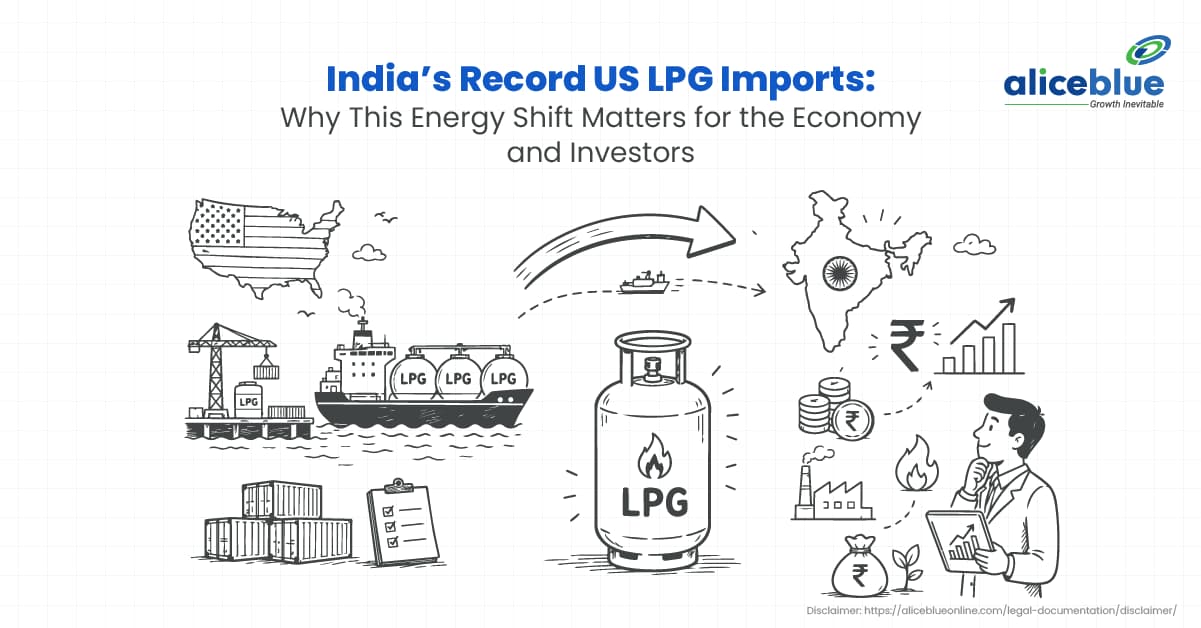
In June 2026, India’s liquefied petroleum gas imports from the United States are expected to cross 1 million tonnes, marking a record high. The reason is simple but serious: disruptions in the Middle East affected traditional supply routes, pushing India to look beyond its usual LPG suppliers.
At first, this may look like a fuel supply update. But it is much more than that. LPG is linked to household budgets, inflation, government spending, trade balance, currency movement, industrial costs, and even investor sentiment.
So, when India suddenly increases LPG purchases from the US, it becomes an important economic signal.
Why India Is Turning to the US for LPG
India has traditionally depended heavily on the Middle East for LPG imports. Reports suggest that the region earlier accounted for nearly 90% of India’s LPG supply. But geopolitical tensions and disruptions around key shipping routes created uncertainty in supply.
To avoid shortages, India increased purchases from the US. This was not just a buying decision; it was a risk-management move.
For a country like India, energy security is not optional. LPG is used by households, hotels, restaurants, small businesses, industries, and petrochemical companies. Any disruption can quickly affect daily life and economic activity.
That is why India moved fast to diversify its LPG sourcing.
The Kitchen-to-Economy Connection
LPG is not just another imported commodity. It is directly connected to Indian households.
Millions of families use LPG cylinders for cooking. If supply becomes tight or global prices rise, the pressure can eventually reach household budgets. Even when retail prices are controlled or adjusted gradually, the cost burden does not disappear. It may move to oil marketing companies, government subsidies, or import bills.
This is why LPG matters in inflation discussions.
Food inflation, fuel inflation, and household spending are closely connected. If energy becomes costlier, transport, packaging, production, and distribution costs can also rise. Over time, that can influence the price of many goods and services.
Impact on India’s Import Bill
India imports a large part of its energy requirements. When global energy prices rise or India buys from farther sources, the import bill can increase.
Buying LPG from the US may help India secure supply, but it can also come at a higher cost because of longer shipping distances and spot market premiums. Reuters reported that India ramped up spot purchases from the US at higher premiums to maintain domestic supply.
A higher import bill can affect India in three ways.
First, it can widen the trade deficit. Second, it can increase demand for dollars. Third, it can put pressure on the rupee if energy imports remain expensive for a long time.
This does not mean one month of higher LPG imports will shake the economy. But if such disruptions continue, energy costs can become a bigger macroeconomic concern.
Inflation: The Hidden Pressure Point
Inflation is one of the biggest areas to watch.
When energy costs rise, the impact may not always be immediate. Sometimes it enters the economy slowly through transport costs, manufacturing expenses, and input prices.
For the Reserve Bank of India, inflation is a key factor while deciding interest rates. If fuel and food inflation stay elevated, the RBI may remain cautious with rate cuts. That matters for investors because interest rates affect stock valuations, bond yields, borrowing costs, and corporate earnings.
In simple terms, LPG imports may look like a commodity story, but the chain reaction can reach financial markets.
What It Means for Businesses
Businesses that depend on LPG, propane, butane, or related petrochemical inputs may feel the impact of supply changes.
Restaurants, hotels, food processing units, small manufacturers, and industrial users can face higher costs when LPG prices rise or supply becomes uncertain.
During the recent disruption, India prioritised household LPG supply and took steps to restore non-household LPG availability after supply improved. Reuters reported that the government later increased LPG supplies to non-household users and restored part of the earlier suspended allocations.
This shows how energy supply decisions can affect different parts of the economy. Households may be protected first, while industries may temporarily face restrictions or higher costs.
Why Energy Security Is Becoming More Important
The biggest lesson from this development is energy security.
Depending too much on one region for critical fuel can become risky during geopolitical tensions. India’s move towards US LPG shows that diversification is now becoming a necessity.
A strong energy strategy may include:
Reducing dependence on one supplier region, building strategic reserves, increasing domestic production, improving logistics, expanding piped gas access, and encouraging cleaner alternatives where possible.
India has already asked local refiners to increase LPG production during the supply crunch, according to Reuters.
This tells us that the country is not only importing more but also trying to strengthen domestic availability.
The Global Trade Angle
This shift also reflects a bigger change in global trade.
Energy trade routes are being redrawn due to geopolitical risks. Countries are not only asking, “Who offers the cheapest fuel?” They are also asking, “Who can supply reliably during a crisis?”
For India, buying more LPG from the US can deepen energy trade between the two countries. It also gives India more bargaining power by reducing overdependence on any single region.
However, diversification does not always mean lower prices. Sometimes, it means paying more in the short term to avoid a bigger supply shock.
That is the real trade-off.
Impact on the Rupee and Markets
Energy imports are usually paid in dollars. When India imports more expensive energy, dollar demand can rise.
If crude oil, LPG, LNG, and other energy imports remain costly, the rupee may face pressure. A weaker rupee can make imports even more expensive, creating another layer of inflation risk.
For stock markets, the impact can be mixed.
Energy-sensitive sectors may face margin pressure. Consumer companies may worry about rural and household spending. Transport and logistics companies may watch fuel-related costs closely. On the other hand, companies linked to energy infrastructure, gas distribution, shipping, storage, and alternative sourcing may benefit from increased attention.
This is why investors should not look at such news in isolation.
Which Sectors Should Investors Track?
This development can influence several sectors.
Oil marketing companies may be watched closely because they handle fuel distribution and pricing pressure. City gas distribution companies may gain attention as India pushes piped gas and cleaner fuel access. Petrochemical companies may track propane and butane availability. Hotels, restaurants, and food businesses may monitor LPG costs. Logistics and manufacturing firms may watch broader fuel inflation trends.
No sector should be judged only based on one news event. But energy disruptions can become an important factor in sector analysis.
The Investor Lesson
Every investor should understand one thing: markets are not moved only by quarterly results.
Global events, shipping routes, energy prices, currency movements, and inflation trends can all shape market direction.
A disruption in the Middle East can affect LPG imports. LPG imports can affect inflation expectations. Inflation expectations can affect RBI decisions. RBI decisions can affect market valuations.
That is how connected the economy is.
For long-term investors, the takeaway is not to panic. The smarter approach is to observe patterns.
Are energy prices staying high? Is the rupee under pressure? Are companies reporting higher input costs? Is inflation becoming sticky? Are rate cut expectations changing?
These questions help investors make better decisions.
Why Investors Should Track This Closely
For investors, this is a reminder that market movements are not driven only by company results or stock-specific news.
Energy imports, global supply routes, inflation, currency pressure, and RBI decisions are all connected. When any one of these changes, different sectors can react differently.
This is where having access to market data, sector updates, research-backed insights, and easy-to-use trading tools becomes useful. Platforms like Alice Blue help investors stay connected with market trends, track opportunities, and make decisions with better context.
The goal is not to react to every headline, but to understand which developments can slowly shape the market direction.
Conclusion
India’s record LPG imports from the US are not just about fuel. They tell a bigger story about energy security, global uncertainty, inflation risk, and economic planning.
For India, the move shows flexibility. Instead of depending only on traditional suppliers, the country is building alternative supply lines.
- For households, it highlights how global events can quietly influence daily expenses.
- For businesses, it shows why energy costs must be tracked carefully.
- And for investors, it is a reminder that macroeconomic awareness is no longer optional.
A fuel shipment from the US may seem far away from your portfolio. But in today’s connected world, energy, inflation, currency, sectors, and stock markets often move together.

Blog by Aliceblue News Desk


