India’s Textile Waste Problem: The Circular Economy Gap
Blog by Aliceblue News Desk
15 October 2026
9 minutes
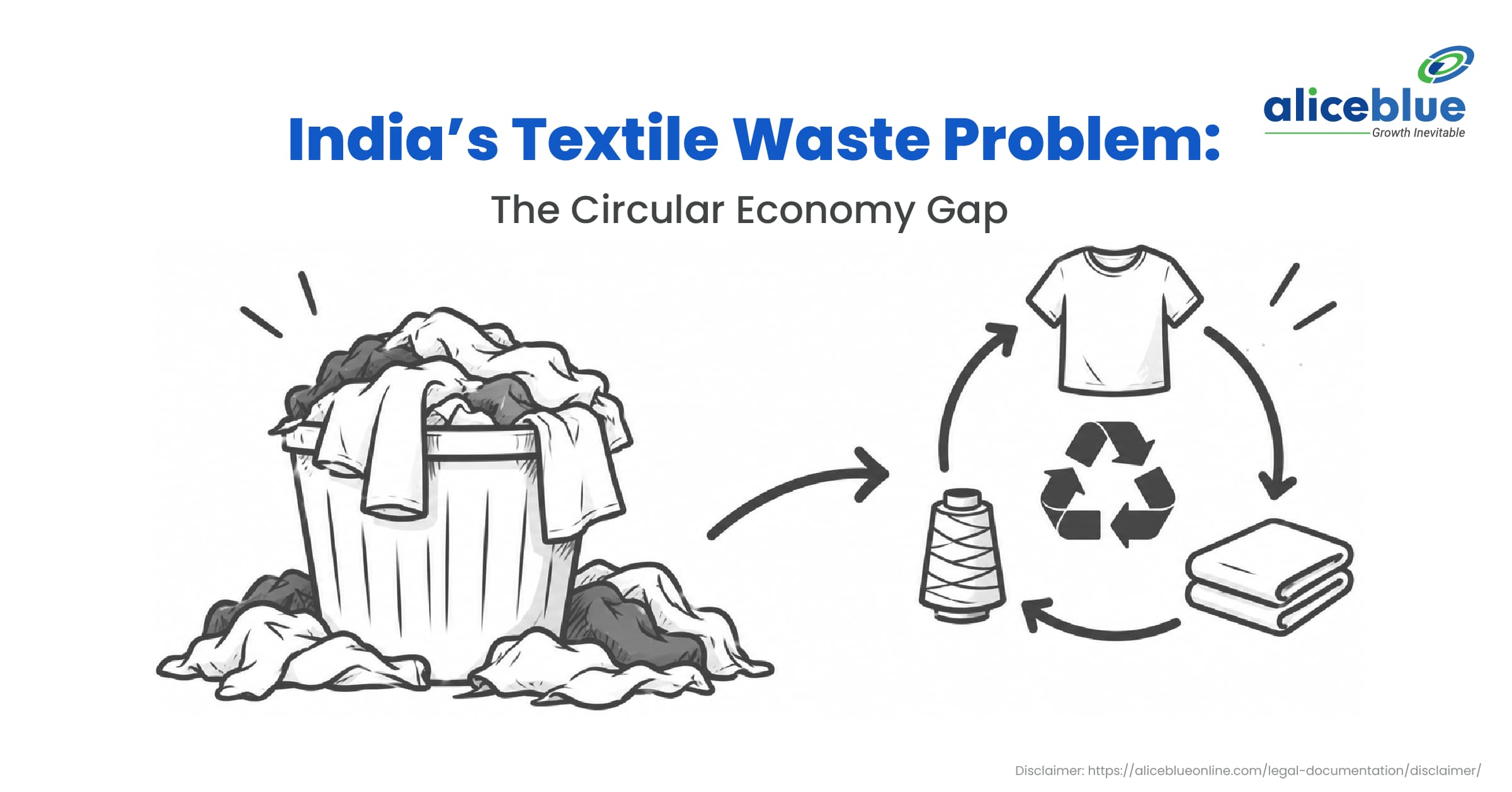
India’s textile industry is one of the country’s largest manufacturing and employment engines. It supports millions of livelihoods, contributes significantly to industrial output and has a deep presence across the entire value chain, from fibre and spinning to garment manufacturing and exports. But behind this scale sits a less visible problem: the amount of textile waste generated every year.
According to data mapped by the Ministry of Textiles, India generates around 7,073 kilotonnes of textile waste annually. Around 42% comes from pre-consumer sources, while the remaining 58% is generated after consumers discard textile products. The scale of this waste raises an important question for manufacturers, investors and policymakers: can India build a system where discarded textiles remain an economic resource instead of becoming low-value waste?
For investors looking at the sector, understanding this shift requires more than simply tracking demand for apparel. It also means understanding how manufacturing efficiency, recycling infrastructure, raw-material costs and changing consumption patterns could influence the future of the industry. This is where fundamental analysis of Indian stocks can provide a broader framework for assessing businesses operating within changing industries.
How Much Textile Waste Does India Generate?
India’s textile and apparel industry is deeply integrated into the economy. The sector is estimated to employ around 4.5 crore people directly, making it the second-largest employer after agriculture. It also contributes roughly 2% of India’s GDP and around 7% of industrial output.
India is the world’s second-largest vertically integrated textile producer after China and has the second-largest spinning capacity globally. That extensive manufacturing ecosystem also means that waste is produced at several stages of the value chain.
The estimated annual textile waste of 7,073 kilotonnes can broadly be divided into two categories:
- Pre-consumer waste: Approximately 42%, generated during manufacturing and processing.
- Post-consumer waste: Approximately 58%, generated when consumers discard garments and other textile products.
- Post-consumer waste: Around 4,100 kilotonnes annually.
- Garmenting: Accounts for approximately 70% of pre-consumer textile waste.
The distinction matters because the two waste streams have very different recovery possibilities. Manufacturing waste is generally easier to collect because it originates at identifiable facilities. Consumer waste is more dispersed and often mixed with other household waste, making collection, sorting and processing considerably more difficult.
The Bigger Problem Is Post-Consumer Waste
Pre-consumer textile waste has relatively established recovery channels in several manufacturing clusters. In fact, excluding soft spinning waste, around 97% of pre-consumer waste is estimated to be recovered.
But recovery does not always mean the material returns to the textile value chain at the same quality.
Around 1,500 kilotonnes of recovered pre-consumer waste remains within the textile economy, while another 1,000 kilotonnes is converted into lower-value applications such as stuffing, wiping materials and other products.
The situation becomes more challenging once textiles reach consumers.
Of the roughly 4,100 kilotonnes of post-consumer textile waste generated annually, estimates indicate that:
- Around 1,100 kilotonnes is reused directly.
- Approximately 1,150 kilotonnes is shredded or converted into shoddy material.
- Nearly 1,900 kilotonnes, or about 45%, is burned or buried.
- Less than 1% returns as fibre suitable for producing new textiles.
This highlights the central challenge facing India’s textile circular economy. The country already has methods for reusing and recycling textiles, but much of the recovered material is either diverted to lower-value applications or lost from the textile cycle altogether.
Three Different Paths for Textile Recovery
Textile recycling is not a single process. Different materials require different recovery methods, and the economic value of the resulting material can vary significantly.
Recovery route | How it works | Main challenge |
Reuse and upcycling | Garments and fabrics are reused or converted into other products | Requires collection, sorting and consumer participation |
Mechanical recycling | Textiles are shredded and processed into fibres | Fibre quality can decline with repeated processing |
Chemical recycling | Fibres are chemically processed back into usable raw materials | High technology and investment requirements |
Mechanical recycling is already relatively well established in India. The country has an estimated 900 mechanical recycling units, with major activity concentrated in textile hubs such as Panipat and Tirupur.
Chemical recycling, however, remains at an early stage. Commercial textile-to-textile recycling capacity is extremely limited, making it difficult to return large volumes of used textiles to fibre suitable for new clothing.
The economics are another barrier. Recycled fibre produced through advanced processes can be significantly more expensive than virgin fibre. This creates a difficult commercial equation for manufacturers: sustainability may require investment in collection and recycling infrastructure while the resulting material still needs to compete with lower-cost virgin alternatives.
Why Collection and Sorting Matter So Much
Recycling technology receives considerable attention, but collection is arguably one of the biggest bottlenecks.
Once discarded garments enter mixed household waste, separating textiles from other materials becomes more difficult and expensive. Different fibre compositions, colours, finishes and levels of contamination further complicate the sorting process.
Organisations working in waste recovery have highlighted this problem. Mixed textile waste can have significantly lower recovery potential than clean and properly segregated material.
For example, estimates from Hasiru Dala suggest that only around 25–30% of mixed textiles may be usable, compared with as much as 85% when textiles are clean and dry.
That difference demonstrates why the circular economy cannot depend entirely on recycling plants. The system also needs better collection, segregation and reverse logistics.
India Already Has a Textile Recycling Ecosystem
India is not starting from zero.
Textile recycling has existed for decades, particularly in manufacturing centres where waste is concentrated and has an established commercial value. Panipat, for example, has developed a large ecosystem around textile recycling and the production of recycled products.
The broader textile recovery economy also supports livelihoods. Textile recovery and recycling activities are estimated to support around 45 lakh livelihoods.
The challenge is therefore less about discovering whether textile waste has value and more about building the infrastructure needed to capture that value consistently.
This distinction is important. A circular economy requires material to remain within productive use for as long as possible. If a discarded garment moves from clothing to wiping cloth, stuffing or another low-value application before eventually being burned or buried, some value has been recovered, but the original fibre has not necessarily remained within the textile system.
The Policy Gap Is Still Significant
India’s textile recycling ecosystem also faces regulatory gaps.
There is currently no comprehensive notified Extended Producer Responsibility (EPR) framework specifically covering textile waste comparable to the systems developed for some other waste categories. There is also no broad national recycled-content mandate requiring textile manufacturers to use a defined proportion of recycled fibre.
Other issues include:
- No dedicated nationwide requirement for garment collection.
- Limited standardisation around textile waste classification.
- Lack of a clear HSN distinction between certain recycled textile fibres and virgin fibres.
- Limited infrastructure for large-scale textile-to-textile recycling.
- Fragmented collection and sorting systems.
These gaps matter because regulation can influence the economics of recycling. Clearer standards, collection requirements and demand for recycled materials could potentially make investment in recovery infrastructure more viable.
A New Waste-Economy Paradox
India’s changing waste-management framework adds another layer to the issue.
The 2026 Solid Waste Management Rules place textiles within the dry-waste stream while also encouraging greater use of waste-derived fuels in areas such as cement manufacturing and waste-to-energy.
This creates a potential tension.
Textile waste can be treated as a source of fuel, but the same material may also contain fibres that could be reused or recycled. From a circular-economy perspective, burning material can recover energy but eliminates the possibility of recovering its fibre value.
The policy challenge is therefore not simply deciding what to do with waste. It is deciding which recovery pathway preserves the greatest economic and material value.
What This Means for India’s Textile Industry
India’s textile industry is entering a period where sustainability and economics are becoming increasingly connected.
Global brands are facing greater pressure to understand their supply chains, reduce waste and increase the share of recycled materials. Indian manufacturers supplying global markets may therefore face increasing requirements around traceability, recycled content and waste management.
At the same time, domestic consumers are becoming more exposed to premium apparel, fast fashion and changing consumption patterns. As clothing volumes rise, the amount of material eventually entering the waste stream can also increase.
For companies across the textile value chain, this could create several areas of opportunity and investment interest:
- Textile recycling infrastructure
- Fibre recovery technologies
- Waste collection and sorting
- Recycled yarn and fabric production
- Textile traceability
- Circular-fashion business models
- Waste-management logistics
- Material innovation
For investors studying textile stocks, these developments provide another layer of industry analysis beyond revenue growth and export demand. Companies that can manage raw-material costs, improve manufacturing efficiency and adapt to changing sustainability requirements may operate in a very different environment from businesses that remain dependent on conventional production models.
The Economic Case for Keeping Textiles in the Loop
The circular economy discussion is often presented primarily as an environmental issue. But textile recovery also has a clear economic dimension.
Every tonne of material recovered represents potential value that can remain within the manufacturing ecosystem. It can support collection workers, recyclers, fibre manufacturers, yarn producers and downstream businesses.
The economic benefit becomes larger when material can move back into higher-value applications rather than being permanently downgraded.
That is why textile-to-textile recycling is strategically important. Reusing a garment or converting it into a lower-value product extends the life of the material. Turning discarded textile fibre back into fibre that can be used for new textiles takes the circular model further.
The challenge is making that process commercially viable at scale.
What Needs to Change?
India’s textile waste problem does not necessarily require one breakthrough technology. It requires several parts of the system to work together.
The key priorities include:
- Better collection: Create convenient channels for consumers to return unwanted textiles.
- Improved segregation: Keep textiles clean and separated from wet and mixed waste.
- More recycling capacity: Expand both mechanical and chemical recycling infrastructure.
- Stronger demand: Encourage manufacturers and brands to incorporate recycled fibres where technically and commercially feasible.
- Clearer regulation: Establish consistent standards for textile waste, recycling and producer responsibility.
- Better traceability: Track textile materials across manufacturing, consumption and recovery.
- Investment in technology: Support solutions capable of recovering higher-quality fibres.
Without these connections, individual recycling facilities can only address a fraction of the problem.
India’s Textile Waste Problem Is Also an Investment Story
India’s textile waste challenge reflects a broader transition taking place across the economy. Industries that were traditionally evaluated through production, consumption and export metrics are increasingly being examined through resource efficiency, waste management and material recovery.
For the textile sector, this transition could create new businesses around recycling, collection, technology and circular manufacturing. It could also change the cost structures and operating requirements of established textile companies.
The numbers make the scale of the opportunity clear. India generates more than 7 million tonnes of textile waste every year, yet a large share of post-consumer material still does not return to the textile value chain.
The country already has manufacturing expertise, recycling clusters and millions of people working across the textile ecosystem. What is missing is the connective infrastructure that can bring these pieces together.
The next phase of India’s textile story may therefore not be defined only by how much fabric the country produces. It may also depend on how effectively it can collect, recover, recycle and reuse the material it has already produced.
That is where the circular economy becomes more than an environmental idea. It becomes an industrial and economic opportunity.

Blog by Aliceblue News Desk