
What Is Oversubscription in IPO? How Does It Affect Your Allotment?
Blog by Aliceblue News Desk
04 May 2026
11 minutes
When Paras Defence and Space Technologies opened its IPO in September 2021, it closed with 304.26 times subscription. Over 71 lakh shares were on offer, and bids came in for 217.26 crore shares. Most retail investors who applied did not receive a single share. The same happened with Vibhor Steel Tubes in February 2024, which closed at 320.05 times overall subscription, and with Latent View Analytics in November 2021, which was subscribed to 326.49 times.
If you have ever applied for an IPO and received nothing back except a refund, oversubscription is why. This article explains what it means, how it works across investor categories, and exactly what happens to your allotment when demand far outpaces supply.
What Is Oversubscription in an IPO?
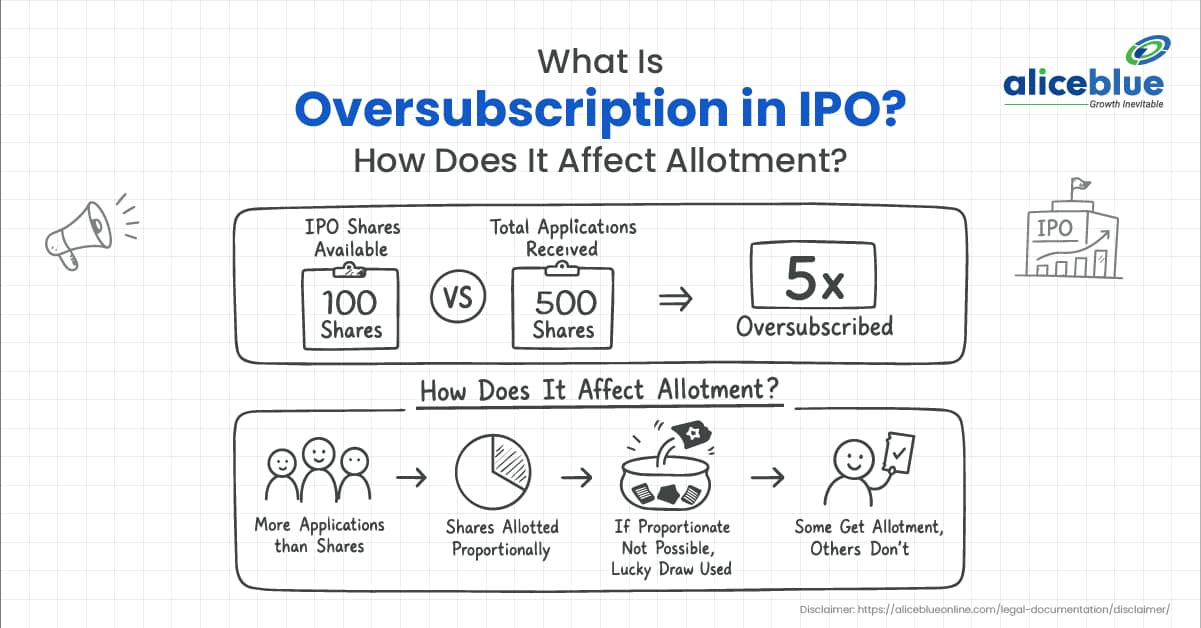
Oversubscription occurs when the total number of shares investors apply for exceeds the number of shares a company is actually offering through its IPO.
If a company puts 10 lakh shares on offer and receives applications for 80 lakh shares, the IPO is said to be 8x oversubscribed. Oversubscription is always reported as a multiple, and it is tracked separately for each investor category: retail, non-institutional investors (NII), and qualified institutional buyers (QIB).
The retail subscription multiple and the QIB subscription multiple for the same IPO can be very different. Vibhor Steel Tubes saw retail subscription of 201.52 times and NII subscription of 772.49 times, even though the overall figure was 320.05 times. Reading category-wise numbers tells you much more than the overall headline figure.
Why Do Certain IPOs Get Heavily Oversubscribed?
Several factors together create the conditions for extreme oversubscription.
Attractive pricing: When the IPO price is perceived to be lower than what the business is actually worth, investors see an immediate opportunity and apply in large numbers.
Strong business track record: Companies with growing revenues, a recognisable brand, or a strong order book in a sector that is in demand attract more applications. Latent View Analytics, a data analytics company, drew 326.49 times subscription in 2021, partly because of the sector’s growth visibility at that time.
Grey Market Premium (GMP): Before an IPO lists on the stock exchange, an informal grey market develops where shares change hands at a premium over the issue price. Paras Defence shares were trading at a GMP of around Rs 250 over the issue price of Rs 175 in the days before the subscription closed. High GMP signals expected listing gains, which drive retail participation up sharply.
Small issue size: When the total number of shares being offered is limited relative to the investor base interested in the company, even moderate interest creates a high subscription multiple. Several SME IPOs see extreme subscription multiples precisely because their issue sizes are small.
Positive broader market conditions: IPOs that open during a positive market phase attract investors who are more confident about near term gains.
How SEBI Divides IPO Shares
Every mainboard IPO in India follows a fixed allocation structure defined by SEBI. Understanding this structure is the foundation for understanding allotment.
Investor Category | Who Qualifies | SEBI Allocation |
Anchor Investors | Institutional investors allocated shares one day before the IPO opened | Up to 40% of the QIB portion (raised from 33% in November 2025) |
Qualified Institutional Buyers (QIB) | Mutual funds, insurance companies, foreign institutional investors | Up to 50% of the total issue |
Non-Institutional Investors (NII/HNI) | Investors applying for more than Rs 2 lakh worth of shares | 15% of the total issue |
Retail Individual Investors (RII) | Investors applying for up to Rs 2 lakh worth of shares | 35% of the total issue |
Anchor investors are a subset of QIBs. They commit capital the day before the IPO opens to the public, and their participation is seen as a strong confidence signal. Each anchor investor must invest a minimum of Rs 10 crore in a mainboard IPO. If the anchor portion is undersubscribed, the leftover shares are reallocated to the remaining QIB pool.
Each category is evaluated independently. A 200x retail subscription has no bearing on how QIB or NII shares are distributed.
How Oversubscription Determines Your Allotment
The allotment process changes based on how oversubscribed the retail category is. SEBI’s rules are clear on this.
- When applications are equal to or fewer than available lots: Every valid retail applicant receives the number of shares they applied for. No lottery is involved.
- When oversubscription is moderate, every applicant is first given one minimum lot. Any remaining shares are distributed on a proportionate basis among those who applied for more than one lot.
- When oversubscription is heavy: This is the scenario in most popular IPOs. When the number of applicants exceeds the number of available lots, SEBI mandates a computerised lottery managed by the IPO registrar. Every valid retail applicant gets exactly one entry in the draw. Whether you applied for 1 lot or the maximum 13 lots allowed within the Rs 2 lakh retail limit, your entry count is the same: one. Winners receive exactly one minimum lot. Everyone else receives nothing, and the blocked ASBA amount is released.
This is why applying for maximum lots in an oversubscribed IPO does not improve your odds. You are not buying additional lottery tickets. You are simply locking a larger amount of money in your bank account for the duration of the subscription period.
How NII and QIB Allotment Works
The NII and QIB categories do not use a lottery. Allotment in these categories is proportionate.
If the NII category is oversubscribed 20 times and an investor applied for 10,000 shares, they will receive approximately 500 shares (10,000 divided by 20). SEBI’s ICDR regulations require that each NII receive at least a minimum lot, and the proportionate reduction applies uniformly across all NII applicants.
For QIBs, the allotment is also proportionate. Institutions that apply for larger quantities receive shares in proportion to their application size relative to the total QIB demand. Because QIBs carry out detailed due diligence before applying, their subscription level is widely watched by retail investors as an indicator of institutional confidence.
Real Example: Paras Defence and Space Technologies IPO (September 2021)
Issue details:
Detail | Figure |
Total issue size | Rs 170.78 crore |
Price band | Rs 165 to Rs 175 per share |
Lot size | 85 shares |
Subscription open | 21 September 2021 |
Subscription close | 23 September 2021 |
Overall subscription | 304.26 times |
With an overall subscription of 304.26 times, bids came in for 217.26 crore shares against 71.40 lakh shares on offer. In the retail category, there were far more applicants than available lots. The registrar ran a computerised lucky draw. Statistically, a retail investor had roughly a 1 in 112 chance of receiving allotment (based on the retail category subscription of 112.56 times).
An investor who applied for 5 lots had the same one entry in the lottery as someone who applied for 1 lot. Both received one lot of 85 shares or nothing.
Most Oversubscribed IPOs in India
IPO | Year | Overall Subscription |
Latent View Analytics | 2021 | 326.49 times |
Vibhor Steel Tubes | 2024 | 320.05 times |
Paras Defence and Space Technologies | 2021 | 304.26 times |
The Grey Market Premium Connection
GMP and oversubscription influence each other in a cycle. When an IPO shows high GMP before the subscription window opens, retail investors interpret it as a signal of strong listing gains. This pushes up retail applications. More applications mean higher oversubscription. Higher subscription multiples, in turn, can push GMP even higher in the grey market as speculation grows.
Paras Defence shares were trading at a GMP of around Rs 250 over the Rs 175 issue price in the days before the IPO closed, and the IPO ended up at 304.26 times subscription. The stock was listed at a significant premium on 1 October 2021.
However, GMP is unregulated and unofficial. It can shift sharply overnight. Several IPOs with high GMP before listing have opened flat or below the issue price on the listing day. Use GMP as a data point, not a decision rule.
Oversubscribed vs Undersubscribed IPO
Factor | Oversubscribed | Undersubscribed |
Applications received | More than shares on offer | Fewer than shares on offer |
Retail allotment method | Lottery if heavily oversubscribed | All valid applicants receive shares |
Market signal | Strong investor demand | Weak interest or pricing concern |
Listing performance | Often positive, not guaranteed | Can be weak |
Minimum subscription required | Must reach 90% to proceed to allotment | Below 90% means IPO is cancelled and full refunds are issued |
What Is the Basis of Allotment?
The Basis of Allotment (BoA) is a public document published by the IPO registrar after the subscription closes and allotment is finalised. It explains exactly how shares were distributed across each investor category, how many applicants received allotment, how many did not, and what method was used (lottery or proportionate).
The BoA is filed with the stock exchange and is publicly available on the BSE and NSE websites after allotment is complete. Any investor who wants to understand why they did or did not receive shares can refer to the BoA for the specific IPO they applied to.
How to Check Your IPO Allotment Status
After the allotment date is announced, you can check your status through three channels.
- Through the BSE website: Go to bseindia.com, navigate to the IPO section, and enter your PAN number or application number to see your allotment outcome.
- Through the NSE website: Visit the IPO section on nseindia.com, select the IPO name, and enter your PAN or application number.
- Through the registrar’s portal: Each IPO has an appointed registrar, either KFintech or Link Intime (now MUFG Intime). Visit ipostatus.kfintech.com or the Link Intime portal, select the IPO name, and check using your PAN, application number, or demat account number.
Most broker apps also show allotment status under the IPO section. If you are not allotted, the ASBA block on your bank account is released within two to three working days after the allotment date.
SME IPO Allotment vs Mainboard IPO Allotment
SME IPOs listed on BSE SME or NSE Emerge follow a proportionate allotment system for all categories, including retail, even when they are heavily oversubscribed. There is no lottery mechanism in SME IPOs. This means applying for more lots in an SME IPO does improve the number of shares you receive, unlike mainboard IPOs, where the retail lottery treats all applicants equally.
This distinction matters because SME IPOs regularly see extreme subscription multiples. Vibhor Steel Tubes was listed on the mainboard and used the standard lottery system. Some smaller SME issues running at 300x to 400x subscription still distribute shares proportionately, which means even successful applicants may receive a very small number of shares.
Common Mistakes Retail Investors Make
- Applying for maximum lots to improve lottery odds: In a heavily oversubscribed mainboard IPO, every retail applicant has one lottery entry regardless of lot quantity. Applying for 13 lots blocks roughly Rs 2 lakh, but gives the same probability as applying for 1 lot.
- Treating subscription numbers as a listing guarantee: Subscription data reflects demand and sentiment at the time of application, not what happens on listing day. Market conditions, index movement, and sector news on listing day all affect the opening price.
- Applying at the lower end of the price band: Retail investors have the option to apply at the cut-off price, which means they agree to pay whatever final price is determined within the price band. Applying at the lower price point risks rejection if the final price is set higher. Applying at the cut-off price is the standard recommendation for retail applicants.
- Skipping the Red Herring Prospectus: The RHP contains financial statements, risk factors, objects of the issue, and promoter background. Many retail investors apply based on GMP or subscription data alone without reading even the summary financials in the RHP.
Conclusion
Oversubscription is simply what happens when more investors want shares than a company is offering. The higher the demand relative to supply, the lower your chances of allotment in the retail category, where a computerised lottery decides outcomes. Knowing how the allotment process works for your category, checking the Basis of Allotment after every IPO you apply to, and anchoring decisions to the company’s financials rather than GMP or subscription headlines are the habits that make IPO investing more informed and less speculative.
Frequently Asked Questions
It means investors applied for 304 times the number of shares on offer. In the case of Paras Defence, 217.26 crore shares were bid for against 71.40 lakh shares available. Most applicants in the retail category did not receive allotment.
No. SEBI rules require that when the retail category is heavily oversubscribed, allotment is done through a computerised lottery where every valid applicant gets one entry regardless of the lot quantity. Applying for more lots only blocks more capital.
You can check on the BSE website, NSE website, or the registrar’s portal, either KFintech at ipostatus.kfintech.com or Link Intime’s portal, using your PAN number, application number, or demat account number.
It is the official document published by the IPO registrar after allotment is finalised. It shows how shares were distributed across categories, which method was used, and how many applicants were allotted or rejected. It is publicly available on the BSE and NSE websites.
Anchor investors are a subset of QIBs who are allotted shares one day before the IPO opens for public subscription. They must invest a minimum of Rs 10 crore per application in mainboard IPOs. As of November 2025, SEBI raised the anchor investor allocation to 40% of the QIB portion.
The amount blocked through ASBA is released and credited back to your bank account within two to three working days after the allotment date. For UPI-based ASBA applications, the mandate is cancelled automatically.
No. Subscription reflects investor demand at the time of application. The actual listing price depends on market conditions on listing day, sector sentiment, and broader index performance. Several heavily oversubscribed IPOs have listed below their issue price.

Blog by Aliceblue News Desk


