IPO Refund Process: When and How You Get Your Money Back
Blog by Aliceblue News Desk
27 July 2026
10 minutes
Quick Definition
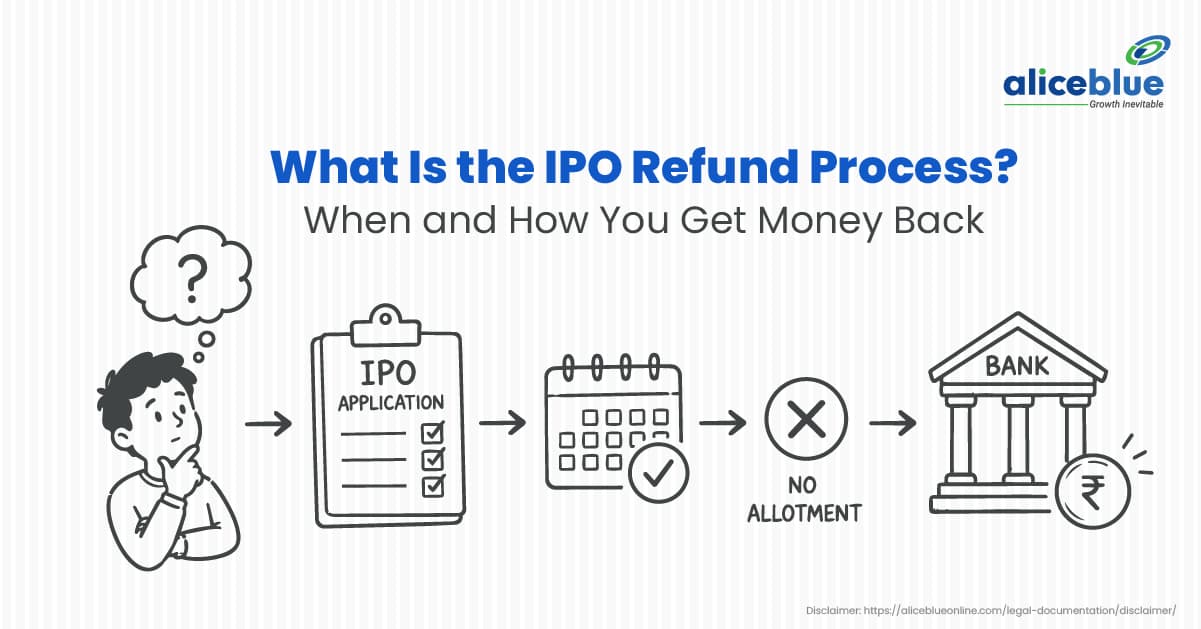
The IPO refund process is the release of your blocked IPO application money when you do not get shares or receive only a partial allotment. In most IPOs, the money is only blocked in your bank account and is deducted only if shares are allotted. Many first-time IPO investors worry when they see money blocked in their bank account. But in most cases, the money is not deducted right away. It is only kept on hold.
If you get shares, the required amount is taken from your bank account. If you do not get shares, the money is released. This is why an IPO refund is usually better understood as fund unblocking.
Table of Contents
- What Is the IPO Refund Process?
- How Does the IPO Refund Process Work?
- IPO Refund Time in India
- IPO Refund Example With Numbers
- Key Features of the IPO Refund Process
- Benefits of the IPO Refund Process
- Risks and Limitations
- What to Do If IPO Refund Is Not Received
- Tips for Beginners
- IPO Refund vs IPO Allotment
- Common Mistakes to Avoid
- Who Should Understand the IPO Refund Process?
- Conclusion
- FAQs
What Is the IPO Refund Process?
IPO refund simply means your blocked IPO money comes back when you do not get shares, when shares are not allotted to you.
In India, most IPO applications are made through ASBA or UPI. ASBA means Application Supported by Blocked Amount. In simple words, your bank keeps the IPO amount on hold until the IPO allotment result is finalised. SEBI explains the ASBA process as a method where the application amount is blocked in the investor’s bank account and debited only if shares are allotted.
Your full bank account is not blocked. Only the IPO application amount is kept on hold.
For example, if you apply for an IPO worth ₹14,400, only ₹14,400 is blocked. You can still use the remaining balance in your bank account.
If you get shares, the required amount is deducted. If you do not get shares, the blocked amount is released. If you get a partial allotment, only the share amount is deducted, and the balance is released.
You can check active and upcoming IPOs before applying.
How Does the IPO Refund Process Work?
Here is the step-by-step process.
- You apply for the IPO
You apply through your broker, bank, or investment platform. You enter details like PAN, Demat account, bid price, lot size, and bank details.
If you are applying for the first time, read this guide on how to apply for an IPO before placing your bid.
- Your bank blocks the IPO amount
After you submit the application, your bank blocks the IPO amount. If you apply through UPI, you must approve the UPI mandate.
Without UPI mandate approval, your IPO application may not be accepted.
- The IPO closes for bidding
Once the IPO closes, the registrar checks all valid applications. If many investors have applied, the IPO may become oversubscribed.
- IPO allotment is finalised
The registrar decides who gets shares. If the IPO is oversubscribed, retail investors may not get an allotment.
To understand how shares are distributed after an IPO closes, read about the IPO allotment process.
- Money is deducted if shares are allotted
If shares are allotted to you, the required amount is deducted from your bank account. The shares are credited to your Demat account before listing.
- Money is released if shares are not allotted
If shares are not allotted, your IPO amount blocked in the bank is released. If you get a partial allotment, the unused amount is released.
Planning to apply for an IPO? Open a Demat account with Alice Blue to apply for IPOs, track allotment status, and manage your investments from one platform.
IPO Refund Time in India
IPO refund time depends on two things: the IPO schedule and how fast your bank removes the hold.
Under the current shorter IPO timeline, allotment usually happens on the next working day after IPO closing. Fund unblocking generally happens after allotment and before listing. This shorter IPO timeline helps investors know allotment, refund status, and listing dates faster.
Stage | Usual Timeline |
IPO closes | T day |
Allotment finalised | T plus 1 working day |
Refund or fund unblocking | T plus 2 working days |
Listing | T plus 3 working days |
Here, T means the IPO closing day.
In most cases, your IPO refund after non-allotment should be released by the listing date. Sometimes, banks may take longer. In a few cases, the amount may remain blocked until the UPI mandate end date.
IPO Refund Example With Numbers
Let’s understand this with a simple example.
Particulars | Details |
IPO price | ₹120 per share |
Lot size | 125 shares |
Application amount | ₹15,000 |
Lots applied | 1 lot |
Amount blocked | ₹15,000 |
Case 1: You get the full allotment
If you receive 125 shares, ₹15,000 is deducted from your bank account. The shares are credited to your Demat account.
Case 2: You get no allotment
If you do not receive any shares, the full ₹15,000 is released back to your bank account.
Case 3: You get partial allotment
Suppose you apply for 2 lots worth ₹30,000, but you receive only 1 lot.
Particulars | Amount |
Total blocked amount | ₹30,000 |
Amount deducted for allotted shares | ₹15,000 |
Amount released | ₹15,000 |
So, if shares are not allotted, you do not lose the IPO application money. The unused amount becomes available again in your bank account.
Key Features of the IPO Refund Process
- Money is blocked, not fully deducted
Your IPO application amount is kept on hold. It is deducted only if shares are allotted. - Only the application amount is blocked
Your full bank balance is not blocked. You can use the remaining money in your account. - Refunds usually happen automatically
In most cases, you do not need to place a separate refund request. - A partial refund is possible
If you receive a partial allotment, the balance amount is released. - Bank timelines can differ
Some banks unblock funds quickly. Some may take more time. - UPI mandate approval is important
If you miss the UPI approval, your IPO application may fail.
Benefits of the IPO Refund Process
- The IPO refund process protects investors because the application money remains in their bank account until shares are allotted.
- It reduces the risk of unnecessary money transfers, since the amount is blocked rather than immediately deducted.
- If shares are not allotted, the blocked amount is usually released automatically, so investors do not need to submit a separate refund request.
- The process is also transparent because investors can track their application status, allotment, and fund release timelines easily.
- For beginners, it helps avoid confusion when money is blocked by ensuring that unused funds become available again shortly after the allotment process is complete.
Risks and Limitations
IPO refunds are usually simple, but beginners should know these points.
- Blocked money cannot be used
Even though the money is in your account, you cannot spend the blocked amount until it is released. - UPI mandate may fail
If you do not approve the mandate on time, your IPO application may not go through. - Refund may be delayed
Bank processing, UPI mandate issues, or technical problems can delay the unblocking. - Wrong details can cause rejection
Incorrect PAN, Demat, or bank details can create application issues. - Too many IPO applications can block cash
Applying for many IPOs at once can keep a large amount on hold.
What to Do If IPO Refund Is Not Received
If your IPO refund has not been received, first check whether the money has actually been deducted or is still marked as blocked in your bank account.
Follow these steps:
- Check your bank account or UPI app for terms such as blocked amount, lien amount, or mandate.
- Verify your IPO allotment status on the registrar’s website or through the NSE IPO allotment page.
- Wait until the IPO listing date, as some banks may take additional time to release the blocked amount.
- If the amount is still blocked after listing, contact your bank and share your application number, PAN, IPO name, and UPI mandate ID.
- If the bank cannot resolve the issue, contact the IPO registrar or registrar and transfer agent for further assistance.
In many cases, the money is not deducted but remains temporarily blocked and is released after the bank completes the processing.
Tips for Beginners
- Apply only with money you can keep blocked for a few days.
- Keep enough balance before applying.
- Approve the UPI mandate as soon as you receive it.
- Check PAN, Demat, and bank details before submitting.
- Do not apply only because an IPO is popular.
- Read the company’s business, risks, financials, and price band.
- Track the allotment date, refund date, and listing date.
Avoid applying for too many IPOs if you need cash for other expenses.
Choose a reliable broker and Demat account provider so you can apply for IPOs and track allotment updates easily.
IPO Refund vs IPO Allotment
Parameter | IPO Refund | IPO Allotment |
Meaning | Release of blocked IPO money | Distribution of IPO shares |
When it happens | After the allotment is finalised | Before listing |
Applies to | Investors with no or partial allotment | Investors who receive shares |
Money movement | The amount is released | The amount is deducted |
Result | Money becomes usable again | Shares come to a Demat account |
First, allotment is checked. Then your bank either deducts the share amount or releases your money.
Common Mistakes to Avoid
- Thinking IPO money is gone immediately
In most IPO applications, money is only blocked. It is deducted only if shares are allotted.
- Forgetting the UPI mandate
If you do not approve the UPI mandate, your IPO application may fail. Always check your UPI app after applying.
- Applying without enough balance
If your account does not have enough balance, the mandate may fail. Keep the required amount ready.
- Entering wrong details
Wrong PAN, Demat, or bank details can lead to rejection. Check everything before submitting.
- Expecting a guaranteed allotment
IPO application does not guarantee shares. If demand is high, allotment may happen through a lottery system for retail investors.
- Blocking too much money
Do not apply for every IPO without planning. Your money may remain blocked for a few days.
Who Should Understand the IPO Refund Process?
Anyone who applies for IPOs should understand how the IPO refund process works. It is especially important for first-time investors, retail applicants, and people who apply for multiple IPOs.
Knowing how refunds work can help you avoid unnecessary panic when you see money blocked in your bank account after applying for an IPO.
Even if you apply for IPOs only occasionally, understanding the refund process can help you track your application better and know when your money should be released.
If you plan to invest in IPOs regularly, having a Demat account can make the process easier. With Alice Blue, you can apply for IPOs and track allotments and listings from a single platform.
Conclusion
The IPO refund process protects investors because the application money stays in their bank account until allotment is finalised. If shares are allotted, the required amount is deducted. If you do not receive shares or get only a partial allotment, the unused amount is released back to you.
As a beginner, remember that IPO money is usually blocked, not immediately deducted. Keeping sufficient funds, approving the UPI mandate on time, entering the correct details, and tracking the allotment and refund dates can help you avoid unnecessary confusion and make your IPO investing experience smoother.
Frequently Asked Questions
The IPO refund process is the release of your blocked IPO application money when you do not receive shares or receive only a partial allotment.
IPO refunds or fund unblocking usually happen after allotment and before the listing date under the shorter IPO timeline.
No. In ASBA and UPI applications, the amount is usually blocked first and deducted only if shares are allotted.
If you do not receive shares, the entire blocked amount is released back to your bank account automatically.
Refunds can be delayed due to bank processing, UPI mandate issues, or technical problems. Check whether the amount is still blocked and contact your bank or the IPO registrar if needed.
Yes. In some cases, the amount may remain blocked because of banking or mandate delays. Contact your bank if this happens.
Yes. A Demat account is mandatory because allotted shares are credited electronically to your account.

Blog by Aliceblue News Desk


