
IPO Subscription Status: What QIB, HNI and Retail Subscription Numbers Mean
Blog by Aliceblue News Desk
07 April 2026
15 minutes
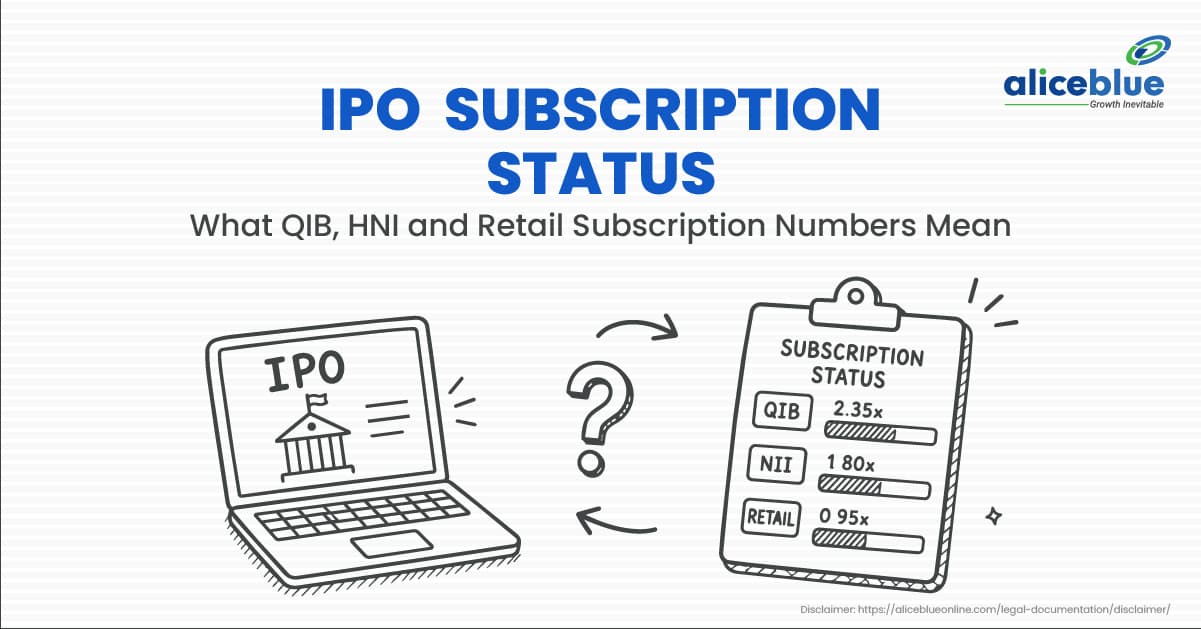
You open the NSE website on Day 2 of an IPO. The retail category shows 28x. You applied for 1 lot. Your friend applied for 15 lots. You both think the same thing. Will I get shares?
Here is something most beginners do not know. In the retail category, your friend’s 15 lot application does not improve their chances over your 1 lot application. At 28x subscription, the system runs a lottery. Both of you have the same odds.
That is just one reason why reading IPO subscription data properly matters. Once you understand what the QIB, HNI, and retail numbers actually say, you stop guessing and start making informed decisions about whether to apply, which category suits your budget, and what your allotment chances realistically look like.
What IPO Subscription Status Actually Tells You
When a company opens its IPO, it offers a fixed number of shares to the public over a window of typically three working days. Subscription status tells you, in real time, how many times those shares have been applied for.
If the company offers 1 crore shares and receives applications for 30 crore shares, the IPO is subscribed 30 times, written as 30x.
The number alone does not tell the full story. SEBI splits the subscription data across three investor categories because each group has a separate share reservation. An IPO can be 200x oversubscribed in the QIB category and only 7x in retail. Those two figures mean completely different things for your application.
The Three Investor Categories
QIB: Qualified Institutional Buyers
QIBs are registered financial institutions, including mutual funds, scheduled commercial banks, insurance companies, foreign portfolio investors, and pension funds. These are not individual investors. They invest crores per application and are regulated by SEBI.
Reservation: Up to 50% of the net offer
Within the QIB segment, there is a subcategory called Anchor Investors. These are institutional buyers who commit to a fixed allocation one day before the IPO opens to the public. Up to 60% of the QIB portion can go to anchors. When you see a strong anchor list featuring names like Mirae Asset, SBI Mutual Fund, or HDFC Life, it signals that large, experienced money has already evaluated the company. It does not guarantee listing gains, but it tells you that institutions found the valuation acceptable enough to commit capital before the IPO opened.
QIB allotment is done on a proportionate basis. If the QIB category is subscribed 100x, an institution that applied for ₹100 crore worth receives approximately ₹1 crore.
NII and HNI: Non-Institutional Investors
Anyone who applies for IPO shares worth more than ₹2 lakh and is not an institution falls into this category. This includes salaried professionals, business owners, and HUFs who choose to invest larger amounts.
Reservation: 15% of the net offer
SEBI divides this segment into two sub buckets:
- Small NII (sNII): Applications between ₹2 lakh and ₹10 lakh receive 1/3rd of the NII allocation
- Big NII (bNII): Applications above ₹10 lakh receive 2/3 of the NII allocation
Allotment here is proportionate. If the SNII bucket is subscribed 40x, you receive approximately 1/40th of what you applied for. On applications just above ₹2 lakh, this can result in getting less than one full lot, which means no allotment at all.
Many HNI investors take short-term financing to apply for large amounts, hoping the listing gain covers the interest cost. That strategy carries real risk, which is covered separately below.
RII: Retail Individual Investors
Retail investors are individuals who apply for IPO shares worth ₹2 lakh or less per application. This includes resident Indians, NRIs applying on a non-repatriation basis, and HUFs within this investment limit.
Reservation: Minimum 35% of the net offer
When the retail category is oversubscribed, SEBI mandates a computerised lottery system. Every applicant who submitted a valid application gets an equal shot at receiving one lot. There is no advantage to applying for more lots once the category is heavily oversubscribed. The system first ensures every eligible applicant gets a minimum of one lot. Only if shares remain after that are additional lots distributed.
This is why experienced retail IPO investors typically apply for exactly one lot in heavily oversubscribed IPOs. It costs less capital, and the allotment probability is identical.
The Cut Off Price Advantage for Retail Investors
When you fill out an IPO application, you will see a field asking for your bid price. You have two choices: enter a specific price within the price band or tick ‘cut-off price’.
When you select a cut-off price, you are telling the exchange that you are willing to pay whatever the final issue price is, as long as it falls within the announced price band. The final price is decided by the company based on demand from all bids received. You do not need to guess or calculate anything.
SEBI rules allow only retail individual investors to bid at the cut-off price. QIB and NII applicants must specify an exact bid price within the price band.
Here is why this matters in practice. Say an IPO has a price band of ₹72 to ₹76. You apply at ₹73. The final cut-off price comes in at ₹76. Your application at ₹73 is now below the cut-off price and gets rejected. You receive no allotment, even though you applied on time with the correct amount.
If you had ticked ‘cut-off price’ instead, your application would remain valid at ₹76 and you would stay in the lottery. For retail investors, there is almost no reason to bid at a specific price when the cut-off option is available. Use it every time.
How to Read the Numbers
Subscription Level | What It Means | Retail Allotment Odds |
Below 1x | Undersubscribed. Demand is below supply | Very likely |
1x | Fully subscribed | Near certain |
2x to 5x | Moderate demand | Moderate |
5x to 20x | Strong demand | Lower. Lottery begins to matter |
20x to 50x | Heavy oversubscription | 1 in 20 to 1 in 50 |
Above 50x | Extremely high demand | Below 2% per applicant |
One important point: an IPO needs a minimum 90% subscription of the total issue size to proceed. If it falls below this threshold, the company must cancel the IPO and return all application money.
Subscription Ratio in IPO: What "100x Oversubscribed" Really Means
“100x oversubscribed” is the single most-repeated IPO headline in Indian financial media, and it’s also the most commonly misunderstood. Here’s what the number actually does to your odds, and why the headline figure alone can mislead you.
- The math, made concrete. At 100x subscription, if the retail category received applications from 1 crore people for shares meant for 1 lakh applicants’ worth of lots, only 1 in 100 applicants gets an allotment, roughly a 1% chance per application. Applying for 5 lots instead of 1 does not improve this. It doesn’t give you 5 lottery tickets. It gives you exactly one, the same as everyone else.
- The headline number can hide the real story. As covered earlier in this guide, a single overall subscription figure can conceal very different demand across categories. An IPO reported as “100x subscribed” in the news could mean genuinely brutal retail odds (100x in the retail category itself), or it could mean the overall figure is being pulled up almost entirely by QIB demand, while retail sits at a much more approachable 8x or 10x. The two scenarios produce wildly different allotment odds for you specifically, and the only way to know which one you’re looking at is to check the category-wise breakdown, not the headline multiple.
- Not all 100x is equal, and HNI numbers deserve extra scepticism. A 100x QIB subscription reflects institutions with research teams independently deciding the pricing is acceptable. A 100x HNI/NII subscription is a different animal: much of that demand is leveraged, short-term borrowed money betting purely on a listing-day premium, not deep conviction about the business. If you’re weighing whether to apply in the HNI category based on a 100x figure, revisit the funding risk covered later in this guide before treating that number as a quality signal.
- What to actually do with a “100x” headline: don’t stop at the total. Open the category-wise breakdown on NSE or BSE, check where the 100x is actually concentrated, and use the retail-specific multiple (not the overall one) to estimate your real odds using the table above.
Why SME IPO Subscription Numbers Look Different
The QIB, HNI, and retail quota percentages explained above — 50%, 15%, and 35% — apply to mainboard IPOs listed on NSE or BSE.
SME IPOs are listed on separate platforms: BSE SME and NSE Emerge. These involve companies with a paid-up capital between ₹1 crore and ₹25 crore, raising typically between ₹10 crore and ₹100 crore. The investor category rules and reservation structures for SME IPOs are different, and the subscription numbers are not directly comparable to mainboard IPOs.
A mainboard IPO subscribed 40x, which reflects genuinely heavy demand. An SME IPO subscribed 200x may simply reflect how small the share pool is. Even modest retail interest pushes subscription numbers into triple digits when only a few lakh shares are on offer.
SME IPOs also carry a higher risk profile. They involve smaller, less established companies with limited liquidity after listing. Exiting your position quickly is harder than with a mainboard-listed stock. If you are reading subscription data for an SME IPO, keep this in mind: a high subscription number is often a size effect, not a quality signal.
A Real Example: Bajaj Housing Finance IPO, September 2024
The Bajaj Housing Finance IPO closed on September 11, 2024. Here is the verified final day subscription data:
Category | Final Subscription |
QIB | 209.36x |
NII | 41.51x |
Retail | 7.04x |
Overall | 63.61x |
For a retail applicant who applied for 1 lot:
The retail category closed at 7.04x. In the lottery, roughly 1 in every 7 retail applicants received an allotment. These were among the better retail odds seen that year, far better than IPOs that go 50x or 100x in the retail segment.
For an SNII applicant who applied for ₹3 lakh:
The NII category closed at 41.51x. Proportionate allotment at 41.51x means the investor receives roughly 1 divided by 41.51 of what they applied for, which is approximately 2.4% of the application value. On a ₹3 lakh application, that equals approximately ₹7,200 worth of shares. If the lot size was ₹15,000, this applicant received nothing because the proportionate allotment fell below one full lot.
For a QIB that applied for ₹500 crore:
At 209.36x oversubscription, they received approximately ₹500 crore divided by 209.36, which works out to around ₹2.39 crore worth of shares.
This is the gap between reading a headline subscription number and understanding what it actually means for your specific application.
What is ASBA, and Why Your Money is your money safe during the Subscription Period
A common worry among first-time IPO applicants is: Does my money leave my account the moment I apply?
No, it does not.
SEBI mandates a system called ASBA, which stands for Applications Supported by Blocked Amount. When you apply for an IPO, your bank simply blocks the application amount in your account. The money does not move. You continue earning interest on it during the subscription period. The blocked amount is only debited if you receive an allotment. If you do not get shares, the block is released immediately after the allotment process completes, typically within a few days of the IPO closing.
This protects both the investor and the company. Investors do not lose access to funds unnecessarily, and companies receive only the money corresponding to actual allotments.
GMP and Subscription Status: How They Connect
When you track an IPO, you will almost always see two numbers side by side: the subscription figure and the GMP or Grey Market Premium.
GMP is the premium at which IPO shares trade in the unofficial grey market before the company officially lists on the exchange. It is not regulated by SEBI and has no legal standing, but it reflects what buyers and sellers in informal circles expect the listing price to be.
A high GMP alongside strong subscription figures, especially strong QIB numbers, suggests positive listing day sentiment. A falling GMP even during high subscription can be a warning signal that grey market confidence is weakening.
GMP is speculative. It has no legal guarantee and can swing sharply between IPO close and listing day. Treat it as one data point among several, not the basis for your decision.
The HNI Funding Risk
Many investors borrow money specifically to apply in the HNI/NII category. The logic is straightforward: apply for ₹50 lakh worth, get a proportionate allotment, sell on listing day, use the gains to repay the loan, and pocket the profit.
This works when the IPO lists at a meaningful premium and the listing gain exceeds the interest cost on borrowed funds.
It fails when:
- The IPO lists flat or at a discount, and the investor is left holding shares they borrowed money to buy
- The allotment is very small due to heavy oversubscription and interest costs are fixed while gains on a tiny allotment become negligible
In a heavily oversubscribed BNII category, interest costs can easily wipe out the entire listing gain on a small proportionate allotment. Before borrowing to apply in the HNI category, calculate your break-even listing premium first. If the IPO needs to list at 20% above issue price just for you to cover the loan interest, ask yourself honestly whether that is a reasonable expectation for that particular company.
Advantages of Tracking Subscription Data
- Live demand signal: You see interest building or stalling across all three categories before the IPO closes
- Category-level clarity: Knowing that QIBs are piling in versus retail-only interest tells you something meaningful about who believes in the company’s valuation
- Allotment planning: If retail is already 40x on Day 1, you know the odds and can decide whether the capital is better deployed elsewhere
- Retail lottery fairness: Every small investor gets the same chance regardless of how many lots they apply for. One valid application equals one lottery entry
Common Mistakes Beginners Make
Applying for multiple retail lots, expecting better allotment odds
The lottery picks applications, not lot quantities. One lot or ten lots, the odds are the same. Apply for one lot in heavily oversubscribed IPOs and preserve your capital.
Looking only at the total subscription figure
A 70x overall figure can mean 150x QIB and only 8x retail. Category wise data is what determines your allotment math, not the headline total.
Treating QIB subscription as a guaranteed buy signal
Strong QIB interest is a useful data point, not a prediction. Assess the company’s fundamentals independently.
Ignoring the NII sub-categories
A ₹3 lakh application competes in the sNII bucket, not the bNII bucket. If sNII is subscribed 90x but bNII is subscribed 30x, applying just above ₹10 lakh statistically gives you a better proportionate allotment outcome.
Entering a specific bid price instead of selecting the cut-off price
Bidding at a specific price within the band risks rejection if the final cut off price lands above your bid. Always select the cut-off price as a retail applicant.
Borrowing to apply in the HNI category without calculating the break-even point
The funding strategy works only when listing gains exceed interest costs by a clear margin. Do the math before committing borrowed capital.
Subscription Numbers vs GMP vs Listing Price
Signal | What It Measures | How Much to Rely on It |
QIB Subscription | Institutional demand with real capital committed | Most reliable signal of considered demand |
Retail Subscription | Public interest that is largely sentiment-driven | Useful for allotment odds, not listing prediction |
GMP | Informal market expectation before listing | Treat as mood indicator, not a forecast |
Listing Price | Actual market clearing price on listing day | Definitive and known only after listing opens |
How to Check Live IPO Subscription Status
- NSE website: Go to Market Data, then New Issues, then select the IPO, then the Bid Details tab. Updated multiple times daily during the subscription window
- BSE website: Go to Market Issues, then Capital Market, then Current IPOs for subscription figures
- Alice Blue platform: The IPO section within your account shows live subscription updates during the bidding period
- Financial portals: Chittorgarh, Groww, and similar platforms Publish category-wise figures refreshed throughout the day with day-wise build-up data
One thing to note: QIB subscriptions almost always spike on Day 3, in the final two to four hours of the subscription window. Institutional investors deliberately wait until the last stretch before submitting bids. Low QIB numbers on Day 1 or Day 2 are normal and not a red flag.
Conclusion
Next time an IPO is open, pull up the category-wise data on NSE before Day 3 closes. Check where the QIB number sits, look at whether GMP is holding or dropping, and do the proportionate allotment math before committing capital in the HNI category. A retail applicant who understands the lottery odds and selects the cut-off price correctly is already better positioned than most first-time applicants who go in based on the headline subscription figure alone. The numbers are all publicly available. Knowing what each one means is the only edge you need at this stage.
Frequently Asked Questions
It means the shares available in that category received applications for 50 times the number of shares on offer. In the retail category at 50x, roughly 1 in every 50 applicants receives an allotment through the lottery. Applying for more lots does not change those odds.
Not necessarily. Strong QIB participation means institutions found the pricing acceptable. But listing performance also depends on broader market conditions on listing day, sector sentiment, and whether the company was priced aggressively. QIB-heavy IPOs have listed below the issue price before.
They refer to the same category. NII, or Non-Institutional Investor, is the SEBI term. ‘HNI’, or ‘High Net Worth Individual’, is the market shorthand. Anyone applying for more than ₹2 lakh, whether individual, corporate, or HUF, falls into this group.
Under ASBA, your money was never debited, only blocked in your bank account. The block is released within a few days of the allotment date, and the funds become freely available without any action needed on your end.
It depends on the IPO and your capital. In heavily oversubscribed IPOs, the retail lottery gives every applicant an equal shot at one lot. HNI allotment is proportionate, which means you could receive a fraction of a lot, or nothing at all, despite investing above ₹2 lakh. For most individual investors with limited capital, the retail lottery makes more practical sense.
It means the shares in that category received applications for 100 times what was on offer. In the retail lottery, this works out to roughly a 1% allotment chance per application, regardless of how many lots you apply for. The figure can also refer to just one category (often QIB or HNI) rather than the whole issue, so always check the category-wise breakdown before assuming it applies to your own odds.

Blog by Aliceblue News Desk


