
Mastering Long Straddle Options: Strategy And Risks
Blog by Aliceblue News Desk
07 April 2026
9 minutes
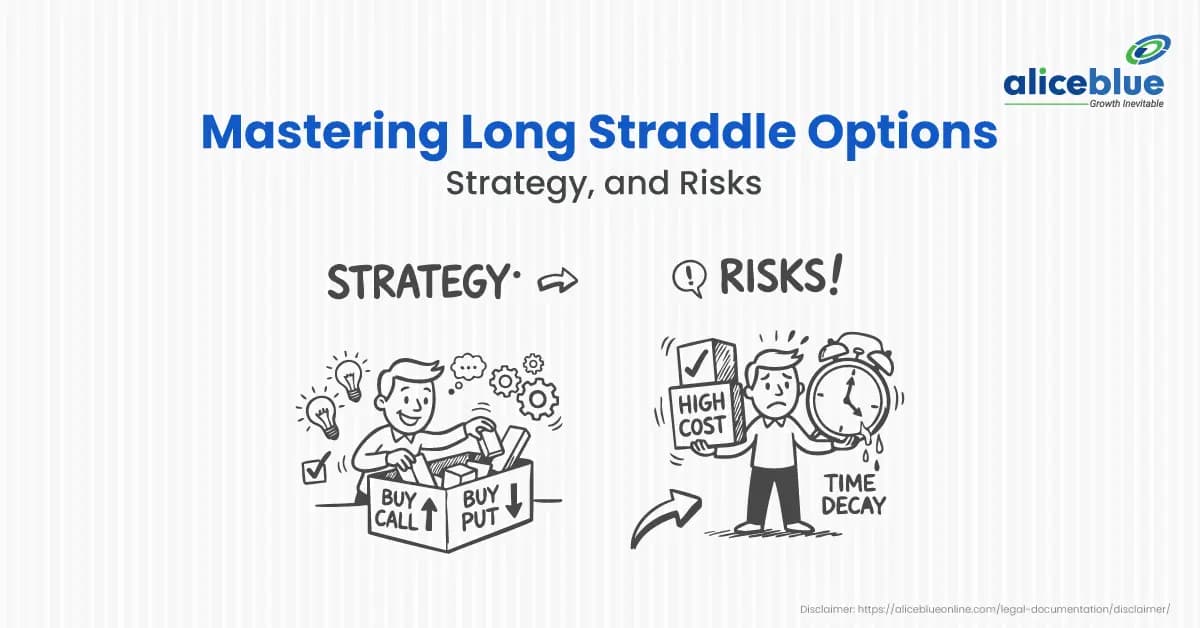
Have you ever expected a big move in the market but still ended up losing money because the move wasn’t strong enough or went in the opposite direction? This is a common challenge in options trading. Markets often reward volatility (big moves) more than simply predicting direction. The long straddle options strategy is designed for such situations. It allows you to profit from sharp price movements in either direction, without needing to predict whether the market will go up or down.
In this blog, we will explain what a long straddle is, how it works step by step, when it works best, and how to manage its risks in simple, easy‑to‑understand language.
What is the Long Straddle Options Strategy?
The long straddle options strategy profits from large price swings in either direction. Traders buy both a call and a put option with the same strike price and expiration date, positioning for high volatility from events like earnings reports or elections. Strong asset movement generates substantial gains.
Example of Long Straddle Strategy
Let’s understand the long straddle with a simple example using Nifty Spot.
Assume Nifty is at 22,000 today. You buy both ₹22,000‑strike options expiring in 30 days.
Trade details:
- Call option: ₹120 premium (right to buy Nifty at 22,000)
- Put option: ₹120 premium (right to sell Nifty at 22,000)
- Total cost: ₹240 per lot
- Max loss: ₹240 per lot (if Nifty stays near 22,000 at expiry)
Breakeven calculation:
- Upper breakeven = Strike + Total premium = 22,000 + 240 = 22,240
- Lower breakeven = Strike − Total premium = 22,000 − 240 = 21,760
Nifty must move above 22,240 or below 21,760 at expiry for the trade to start making a profit.
Three clear outcomes at expiry (per lot):
Final Nifty level | What happens | Profit / Loss (approx.) |
22,500 | Call intrinsic = 22,500 − 22,000 = ₹500; put expires worthless | 500 − 240 = ₹260 |
22,000 | Both options expire worthless | –₹240 (max loss) |
21,500 | Put intrinsic = 22,000 − 21,500 = ₹500; call expires worthless | 500 − 240 = ₹260 |
Note: This strategy can lose the full premium if the market stays flat.
How the Long Straddle Works?
A long straddle profits when the underlying asset makes a significant move away from the strike price, regardless of direction.
Components:
- Call option: Gains value when the price rises above the strike price.
- Put option: Gains value when the price falls below the strike price.
The total cost is the sum of both premiums paid upfront.
Profit Conditions:
You start making a profit only when the price moves beyond the breakeven levels:
- Upper breakeven: Strike price + total premium
- Lower breakeven: Strike price – total premium
If the price stays near the strike at expiration, both options expire worthless, and you lose the total premium paid.
Risk and reward:
- Maximum loss = Total premium paid (this is your worst‑case loss, no matter what happens).
- Maximum profit =
- On the upside (for stocks and indices): Theoretically unlimited, because the underlying price can keep rising and the call option keeps gaining value.
- On the downside (for stocks): Very large, but limited by the price going down to zero (the put cannot gain more than the strike price minus the premium).
How to Calculate Long Straddle Profits?
Calculating profits from a long straddle is straightforward. You only need three numbers: the strike price, total premium paid, and final stock price at expiration.
Step 1: Find Total Premium
Total Premium = Call premium + Put premium
This is your maximum possible loss.
Step 2: Calculate Distance From Strike
Measure how far the stock moved from the strike price:
Distance = ∣ Final Stock Price – Strike Price ∣
Use absolute value (always positive).
Note: This distance-based formula provides the payoff at expiry. However, option prices also depend on volatility and time before expiry.
Step 3: Simple Profit Formula
Profit/Loss = Distance – Total Premium
Multiply by lot size to get the actual rupee P&L.
What each result means:
- Positive number = Profit (stock moved far enough)
- Negative number = Loss (stock didn’t move enough)
- Zero = Breakeven
Breakeven Points (Where Profit Starts)
Upper breakeven = Strike + Total Premium
Lower breakeven = Strike – Total Premium
Key Point: Profit requires the stock price to cross either the breakeven point. The further it moves, the larger your profit. Losses never exceed your initial premium.
This single formula works for both upside and downside moves.
The Role of Volatility in Long Straddle Trading
Volatility plays a central role in long straddle trading. It decides if the trade makes money or loses.
Why Volatility Matters:
A long straddle strategy involves holding both a call and a put at the same strike. You win if the price moves big up or down. Volatility means how much the price swings. High volatility helps one option gain value fast to beat the cost paid. Low volatility hurts. Price stays flat, and both options lose value over time. You lose the full premium.
How It Works:
Enter when volatility is low but expected to rise, like before big news. Rising volatility lifts option prices, even if the stock price does not move much yet. This gives a profit chance before expiry.
If volatility drops after entry, premiums fall. Time decay adds loss.
Key Points:
- Profits need a big price move from volatility.
- Best setup: Low volatility start, high later.
- Max loss: Total premium if no move happens.
When to Use the Long Straddle Strategy?
The long straddle strategy works in times of high uncertainty. Use it when you expect a big price move but do not know if it will go up or down.
Best times to enter:
- Before big news like company earnings reports. Good or bad results can push the price far.
- Economic events such as interest rate changes or government announcements.
- Product launches, FDA approvals, or big court rulings that affect the stock.
- When market volatility is low now, but you think it will rise soon.
When not to use:
- Skip if price stays flat or moves slowly. Time decay eats your premium.
- Avoid if you know the direction. Just buy a call or put instead.
- Do not hold too long near expiry without a move. Loss grows.
Practical timing rules for beginners:
- As a beginner, prefer 2-4 weeks to expiry instead of 1-2 days. This gives the underlying more time to move while keeping time decay at a manageable level.
- Avoid buying straddles when implied volatility (IV) is already very high, which often happens right before earnings or big news, because the options are expensive and IV can “crush” after the event, hurting the trade even if the price moves.
Risks of Long Straddle Strategy
In a straddle setup, both a call and a put share the same strike and expiry. Risks are clear, but can lead to the full loss of money paid. The main risks are:
- Time Decay (Theta Decay) – Time decay hurts the most. Options lose value each day, especially near expiry. If the stock price stays near the strike, both options drop fast in value.
- IV Crush (Implied Volatility Crush) – The strategy is often bought when implied volatility is high, so premiums are expensive. After events like earnings, if the move is smaller than expected, volatility can drop sharply, and both options can lose value quickly.
- Low Volatility – Low volatility means small price changes. This hurts the trade. The price needs to jump far past the break-even points to make money. If the market stays flat and calm, both options lose value, and you get no profit.
- High Cost – High cost comes from paying premiums for both the call and put options. The total amount you pay upfront is large. The stock price must move more than this total cost just to break even and start gaining.
- No Direction Bias – Long straddle has no direction bias. It only works if the price makes a big move up or down. It fails if the price moves slowly or stays flat sideways.
- Liquidity & Bid‑Ask Spread Risk – In less liquid strikes or expiries, the gap between buy and sell prices can be wide. This increases entry cost and reduces exit value, quietly cutting profit or adding to loss.
- “Holding till expiry” Risk – Loss accelerates in the last few days. Time decay speeds up sharply in the final days. If the underlying is still near the strike, then the loss can grow fast, and there is little time left for a big move to rescue the trade.
Advantages of the Long Straddle Strategy
A long straddle means buying a call and a put option at the same strike price. It has good points when you expect a big price move.
1) Profit from Up or Down Move:
You win no matter if the price goes up or down. The call makes money if the price rises. The put makes money if the price falls. One of them gains big if the move is strong. You do not need to guess the direction.
2) Risk is Limited:
Your max loss is only the money you pay for both options. This is the total premium. Even if the price stays flat, you lose just that amount. No more loss can happen.
3) Big Profit Chance:
If the price moves far, gains can be very high. One option covers the cost of both and adds a lot of extras. For example, pay ₹10 total. Price jumps ₹20 away. Profit can be ₹10 or more.
4) Good for Big Events:
Use it before news like company earnings or big announcements. These cause sharp price changes. A low, calm market turns wild fast. Straddle catches that swing well.
Conclusion
The long straddle is a powerful volatility‑based strategy, not a directional one. It works best when markets are calm but expected to move sharply. Its success depends on timing, volatility conditions, and disciplined risk management. Used correctly, it can generate strong returns during major market events, but if misused, time decay and high premiums can quickly erode capital.
Focus on preparation, learning, and patience so you are ready to act when the next big opportunity appears.
FAQs
Use it when a big price change comes, but you do not know up or down. Good times: before earnings, RBI meet, budget, or big news. Enter when the market is calm, but change is expected. Skip slow markets, or if you know the direction, buy one option then.
Max loss is all the money paid for the call and put. If the price stays near strike at the end, both options are worth zero. You lose the full cost. No more loss after that.
Break-even is where profit starts. Upper = strike + total cost. Lower = strike – total cost. Example: Strike ₹100, cost ₹10. Break-even at ₹110 up or ₹90 down. Price passes one to gain more as it goes farther.
No. Low volatility means small changes. Cost not covered, and options lose value daily. Needs high swings for one option to win big. Check VIX, if low before the event, good.
Good if you know options basics. Practice fake trades first. Loses often (7-8 out of 10 times), so use little money like 1-2% total. Try Nifty weekly first.

Blog by Aliceblue News Desk


