
What Is Max Pain in Options? How to Use It for Trading Decisions
Blog by Aliceblue News Desk
18 April 2026
7 minutes
Imagine you’re watching Nifty options on a Tuesday expiry day. The index bounces around but always seems to settle near one strike price by the close, leaving most buyers empty-handed. That’s max pain in options at work, a real pattern in India’s F&O market that catches many new traders off guard.
This blog explains what it means, the math behind it, real Nifty examples from recent years, and steps to use it for smarter trades. By the end, you’ll know how to spot it on NSE data and decide if it fits your strategy.
What Is Max Pain in Options?
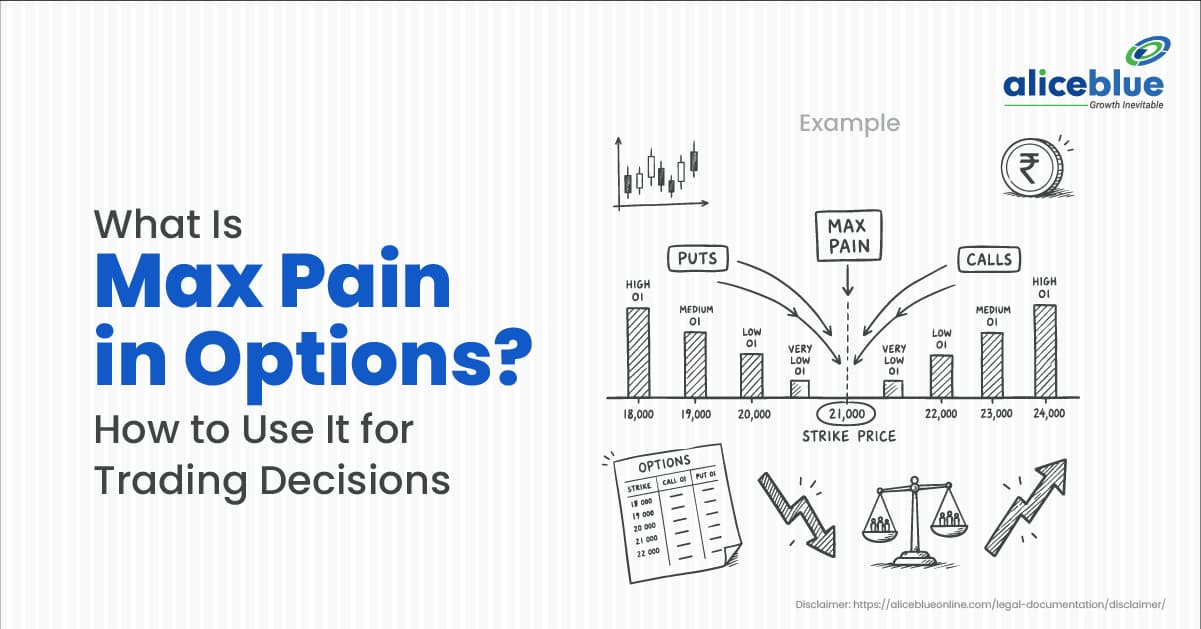
‘Max pain’ refers to the strike price at which option buyers experience the greatest losses upon expiry. When the underlying asset, such as Nifty or Bank Nifty, settles at this price, the majority of call and put options expire without value. Option sellers retain the full premium received.
Open interest determines this outcome. Open interest represents the number of outstanding option contracts. Market makers and large institutions maintain significant short positions across various strikes. These positions result in minimal payouts when the price settles at the max pain level. NSE data confirms this pattern in weekly index options, driven by high trading volumes.
Observations from global markets apply to NSE, particularly after F&O activity increased following 2020. The concept identifies the settlement level that maximises losses for buyers and gains for sellers.
How Max Pain Works?
Use the NSE options chain or Opstra to calculate max pain. For each strike, compute the total dollar loss option buyers would face if the underlying settles there. The strike with the highest total loss is max pain.
Step-by-step process:
- Collect data: Note open interest (OI) for all call and put strikes from NSE.
- Call pain (strikes above current price): Pain = OI × (Strike – Settlement Price) × Lot Size × Point Value
- Put pain (strikes below current price): Pain = OI × (Settlement Price – Strike) × Lot Size × Point Value
- Total pain per strike: Add call pain + put pain for that strike
- Identify max pain: Highest total pain across all strikes = max pain strike
Example numbers (Nifty, lot size = 25, point value = ₹1):
- 24,200 CE OI = 50,000 lots: Pain = 50,000 × 200 × 25 × 1 = ₹25 crore
- 23,800 PE OI = 40,000 lots: Pain = 40,000 × 200 × 25 × 1 = ₹20 crore
- 24,000 total pain = ₹45 crore (highest)
Option sellers delta-hedge by trading the underlying asset, gradually moving the price toward max pain. This effect strengthens on expiry day when volume drops. NSE live option chains and Alice Blue scanners provide real-time data and automation.
Real-World Example: Nifty Weekly Expiry
Scenario: Tuesday expiry (pre-Sep 2025 NSE schedule). Nifty opens 24,150. Max OI at 24,000 strike (6.2L calls + 5.8L puts, lot size 25).
Pain Table (Rs Cr):
Test Settlement | Calls Above (OTM) | Put Pain | Calls Pain | Total Pain (Rs Cr) |
23,900 | 6.2 L × 100 × 25 = 15.5 Cr | 5.8 L × 0 + other puts = 36.5 Cr | – | 52 Cr |
24,000 | All calls above 24,000 + all puts below = 58 Cr | 58 Cr total | – | 58 Cr (HIGHEST) |
24,100 | – | 5.8L × 100 × 25 = 14.5 Cr | Other calls = 40.5 Cr | 55 Cr |
- Day Flow: 24,150 open, 24,250 midday news, hedging pulls to 24,012 at close.
- Result: 24,000 buyers lose Rs 125 Cr premiums. Sellers gain Rs 150 Cr.
- Stats: NSE data shows 70% of 2025 Tuesday expiries (36/52) settled within 0.5% of max pain. The pattern continues on the current Tuesday cycle (post Sep 2025).
Key Features of Max Pain
- Max pain applies to NSE weekly index options, which follow a Tuesday expiry schedule.
- Calculations rely on open interest data rather than trading volume, necessitating end-of-day updates.
- The pinning effect strengthens near expiry due to hedging by option sellers.
- Performance remains consistent in range-bound markets but diminishes during major news events.
- Open interest data is accessible for free on the NSE website; platforms such as Sensibull provide charts.
Advantages for Traders
- Max pain helps traders identify strikes with high open interest for selling options, with success rates of 75 to 80 per cent on expiry days.
- It establishes safe boundaries for strategies like straddles and iron condors, which reduces time decay exposure.
- In India’s F&O market, where most traders incur losses, max pain reveals the advantage held by option sellers.
- Combine it with a put-call ratio below 0.7 to confirm potential for upward settlement.
Risks and Limitations
- Significant events can override max pain levels. For example, during the 2025 Budget expiry, Nifty gapped 400 points beyond the calculated level due to tax policy changes.
- Open interest shifts easily through large trades mid-week.
- The concept predicts settlement points rather than directional moves, so strong trends prevail.
- Outdated data lowers reliability, and an India VIX above 20 reduces hedging effectiveness.
Max Pain vs. Alternatives
Feature | Max Pain | Put-Call Ratio (PCR) | Gamma Exposure (GEX) |
What it measures | Total buyer loss at strike | Puts OI vs Calls OI | Dealer hedging sensitivity |
Best for | Expiry pinning | Overall sentiment | Intraday vol crush |
Data source | Full OI chain | Aggregate ratio | Greeks from the chain |
India example | Nifty Tuesday close | >1 bearish, <0.8 bullish | Bank Nifty zero-gamma flips |
Reliability | 70% on calm weeks | Daily bias check | Short-term moves |
Max pain excels for Tuesday plays; PCR adds context, GEX for day trades.
Common Mistakes Beginners Make
- Beginners often use outdated open interest data. Open interest changes daily, so recalculate max pain on Tuesday morning.
- Trading during known events leads to losses. Elections or RBI policy announcements override pinning effects.
- Lack of position sizing causes large drawdowns. Limit risk to 1 per cent of capital per trade.
- Using max pain alone reduces effectiveness. Confirm with trading volume and India VIX levels.
- Applying max pain to stocks fails due to low liquidity. Use it only for the Nifty and Bank Nifty indices.
Who Should Use Max Pain?
- Option sellers focusing on expiry days benefit most. Retail traders selling puts at max pain levels earned consistent premiums throughout 2025.
- Beginners practising F&O strategies through paper trading find it straightforward to apply.
- Directional traders and long-term investors gain little value, as max pain works in range-bound conditions.
- Professional traders integrate it with algorithmic systems for additional precision.
Trading Setups Using Max Pain
- Iron Condor for Expiry: Sell call spreads and put spreads around max pain plus or minus 100 points. Enter positions at Wednesday market close. Exit 30 minutes before expiry ends. In 2025, this setup averaged 12 per cent returns per trade, with Rs 3,750 risk per Nifty lot of 25 shares.
- Short Straddle at Pin Level: Sell at-the-money call and put options when the index nears max pain, confirmed by put-call ratio. Place stops at a 0.5 per cent price movement.
- Buyer Caution Zone: Avoid buying options beyond max pain plus or minus 200 points, as success rates drop significantly.
NSE backtest data from 2025 shows Nifty settled within 0.5 per cent of max pain in 42 out of 52 Tuesday expiries.
Practical Tips for Indian Traders
- Review the NSE options chain at 11 AM on Tuesday using any reliable platform.
- Focus on strikes that account for 60 per cent of total open interest.
- A put-call ratio below 0.8 indicates potential for higher settlement within the pinned range.
- Test setups first on simulation platforms such as Streak or Opstra.
- Set stop losses 150 points from the max pain level. Close all positions by 3:15 PM.
- Analyse results from 10 consecutive experiments to recognise recurring patterns.
Best Free Max Pain Tools for NSE
The NSE India website provides complete open interest data through its options chain.
Access live option chain at nseindia.com/option-chain to view all strikes, volumes, and open interest for Nifty and Bank Nifty.
Download raw CSV data for manual max pain calculations or real-time analysis during expiry sessions.
Conclusion
Max pain demonstrates how open interest positioning drives expiry settlements toward strikes where most options expire worthless. Traders use it to identify high-probability selling levels, particularly when combined with put-call ratio confirmation and proper risk controls.
Ready to apply max pain? Open the NSE options chain on Alice Blue today, analyse the next Tuesday expiry, and track your first setup.
Frequently Asked Questions
Max pain is the strike price that causes the highest losses to option buyers at expiry. Nifty frequently settles near this level on Tuesday weekly expiries due to open interest concentration.
For each strike, multiply open interest by the distance to a test settlement price, then sum call and put pain values. The strike with the highest total pain is max pain. Bank Nifty uses a lot size of 15.
Free options include the NSE India website and Maxpain.in. Paid platforms such as Opstra and Sensibull (available on Alice Blue) provide automated calculations and charts.
No. Max pain identifies likely settlement levels only. Use technical trends or momentum indicators for directional bias.
Max pain determines the specific strike price. The put-call ratio (PCR) shows bullish or bearish sentiment. PCR below 0.9 combined with max pain favours option sellers.

Blog by Aliceblue News Desk


