
Minor Demat Account: What It Is, How It Works, and What You Must Know
Blog by Aliceblue News Desk
10 April 2024
8 minutes
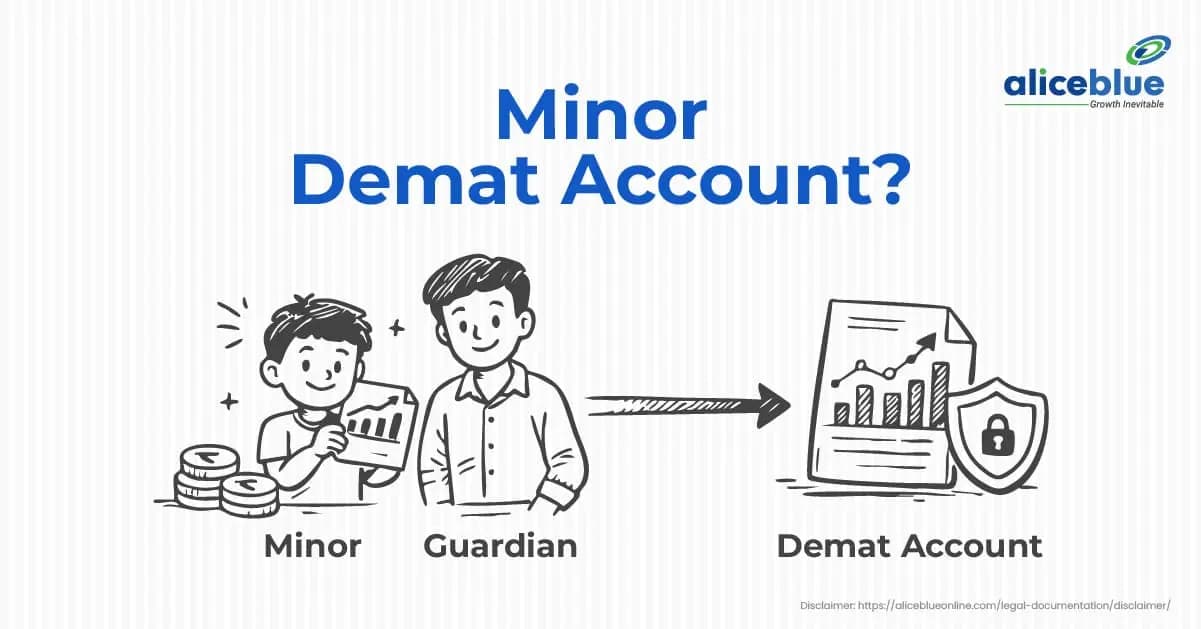
Most parents think about saving for their child through FDs or gold. A minor Demat account is a less talked-about but genuinely useful option. It lets you invest in stocks, mutual funds, and bonds in your child’s name, starting from day one of their life. But there are rules around who can operate it, what you can invest in, and how the income gets taxed. Getting these wrong creates problems later.
A minor Demat account is a Demat account opened in a child’s name (below 18 years). The child cannot operate it; a parent or legal guardian manages it entirely on the child’s behalf until the child turns 18.
What Is a Minor Demat Account?
A minor Demat account holds shares, mutual funds, and bonds in electronic form, exactly like a regular Demat account. The only difference is that the account belongs to a child under 18.
Because minors cannot sign legal contracts in India, the account sits in the child’s name, but a parent or legal guardian handles all transactions. The investments are the child’s assets. The guardian has no ownership over them.
SEBI Rules on Guardian Priority
SEBI has defined a strict order for who can act as a guardian. This is a regulatory rule, not a preference:
- Father — first in line
- Mother — only if the father is absent or deceased
- Court-appointed legal guardian — only if both parents are unavailable
If the father is alive and present, the mother cannot be listed as guardian. Only one guardian is permitted per account. A court order is required as proof if a legal guardian is appointed.
How to Open a Minor Demat Account
- Choose a DP — Select a SEBI-registered stockbroker or bank. Compare AMC charges before deciding; some offer zero AMC for minor accounts.
- Fill the account opening form — The form is in the child’s name. The guardian fills a separate section with their own details.
- Submit KYC documents — Both the child’s and guardian’s documents are required together (see table below).
- Complete Video KYC or in-person verification — Both the guardian and child must be present. Check your DP’s specific process.
- Link a trading account — The guardian’s trading account is linked to the child’s Demat account to enable transactions.
-
Document
Minor
Guardian
PAN Card
Required (Form 49A if not yet issued)
Required
Aadhaar Card
Required
Required
Birth Certificate
Required (proof of age)
Not required
Passport-size Photo
Required
Required
Bank Account Details
Not required
Required
Court Order
—
Required if court-appointed
A missing Aadhaar card for the minor is the most common reason for application rejection.
What You Can and Cannot Invest In
Allowed: Equity delivery shares, equity and debt mutual funds, government bonds, IPO applications, rights issues, and buybacks.
Not Allowed: Intraday trading, Futures and Options (F&O), margin trading, short selling.
The account is built strictly for long-term, buy-and-hold investing. Intraday or F&O orders placed through a minor account are rejected by the system outright.
Example with Numbers
Vikram opens a minor Demat account for his 8-year-old son, Arjun, in 2026. He starts a SIP of ₹5,000 per month in a diversified equity mutual fund.
At 12% annual return over 10 years:
- Total invested: ₹6,00,000
- Estimated value at age 18: ~₹11.6 lakh
That result comes purely from consistent investing over a decade, not market timing or active trading. One important note: this ₹11.6 lakh in gains is not taxed in Arjun’s hands. It gets added to Vikram’s income. The next section explains how.
Tax Implications
This is where most parents get caught off guard.
Section 64(1A) — Income Clubbing
All income from a minor’s Demat account, dividends, capital gains, and interest is clubbed with the higher-earning parent’s income. It gets taxed at the parent’s applicable rate, not the child’s.
Section 10(32) — Old Tax Regime Only
A parent can claim up to ₹1,500 per child per year against the clubbed income. It is a small offset but available under the old regime.
Capital Gains Tax Rates
- Short-term gains (equity held under 12 months): 20%
- Long-term gains above ₹1.25 lakh (equity held over 12 months): 12.5%
Exception: If the minor earns through their own skill or talent, such as prize winnings, that income is not clubbed. Investment income from a guardian-managed account always is.
Advantages
- Time works for the child. Starting at age 5 to 8 gives the portfolio 10 to 13 years of compounding before adulthood. That runway simply is not available when you start as an adult.
- Goal-based separation. A dedicated account keeps the child’s education or career corpus separate from household savings — easier to track, harder to spend.
- Broad investment access. Equity, debt funds, bonds, and IPOs are all accessible.
- Financial awareness. Involving children in conversations about their own accounts builds money habits that school does not teach.
Risks and Limitations
- All decisions rest with the guardian. Poor investment choices by the guardian affect the child, who has no say until age 18.
- High-income parents face a heavier tax burden. If you are in the 30% bracket, the clubbed investment income adds a real tax cost. Factor this in before deciding investment amounts.
- No active trading. Intraday, options, and leveraged strategies are off the table entirely.
- The account freezes on the 18th birthday. Not around that age, on the exact date. Active SIPs may pause. Plan conversion well in advance.
What Happens When the Child Turns 18
The account is frozen on the child’s 18th birthday. To convert it into a regular Demat account:
- Submit a new individual account opening form
- Provide fresh KYC, PAN, Aadhaar, bank proof, and a photograph
- Complete Video KYC or in-person verification
- Sign a new account agreement as an adult
Start this at least 3 to 4 weeks before the birthday. If SIPs are running, check with your fund house about the transition; some may pause during conversion.
Minor Demat vs Regular Demat Account
Feature | Minor Demat Account | Regular Demat Account |
Age | Below 18 years | 18 and above |
Who Operates It | Guardian only | Account holder |
Intraday / F&O | Not allowed | Allowed |
Joint Account | Not permitted | Permitted |
Tax on Income | Clubbed with parent’s income | Taxed in holder’s hands |
Conversion at 18 | Mandatory | Not applicable |
AMC | Free with select brokers | Varies |
Mistakes to Avoid
Not accounting for tax: Many parents invest aggressively without realising the gains are added to their own taxable income every year. Understand clubbing rules first.
Wrong guardian listed: Listing the mother when the father is available violates SEBI’s guardian priority rule. Always follow the mandated order.
Incomplete documents: The minor’s Aadhaar and birth certificate are both required. Missing either will delay or reject the application.
Waiting until 18 for conversion: The account freezes on the birthday itself. Starting paperwork on that day would result in weeks of an inactive account.
Who Should Open a Minor Demat Account?
Good fit for:
- Parents with a long investment horizon of 8 to 15 years
- Families saving for a specific goal, like higher education
- Those who are comfortable with delivery-based equity or mutual fund investing
Not ideal for:
- High-income earners in the 30% bracket, where the clubbing rule adds a significant tax burden
- Anyone expecting to use trading strategies or derivatives
Guardians are not confident in managing investments independently
If you’re planning to start investing, you can open a demat account with Alice Blue and get started.
Frequently Asked Questions
A Demat account in a child’s name (below 18) operated entirely by a parent or legal guardian. The child cannot access it independently until they turn 18 and complete the conversion process.
The natural father is first in line, then the natural mother, then a court-appointed legal guardian. Only one guardian is permitted, and the order is mandatory.
Yes, in the parents’ hands, not the child’s. Under Section 64(1A), all income is clubbed with the higher-earning parent’s income. Under the old tax regime, a ₹1,500 deduction per child is available under Section 10(32).
The account is immediately frozen. The child must submit fresh KYC, complete verification, and sign a new account agreement to convert it into a regular Demat account.
Intraday trading, futures and options, margin trading, and short selling are all prohibited.
For the minor: PAN card, Aadhaar, birth certificate, and photo. For the guardian: PAN card, Aadhaar, bank account details, and photo. A court order is additionally needed if the guardian is court-appointed.

Blog by Aliceblue News Desk
The Alice Blue Team is a passionate group of analysts delivering expert market insights, comprehensive coverage of stocks, economy, commodities, and personal finance through clear, actionable research.


