
Mutual Fund SIP Pause vs Stop vs Redeem: Which Option Should You Choose?
Blog by Aliceblue News Desk
14 May 2026
12 minutes
Your salary got delayed this month. Or you just switched jobs, and there is a 45-day income gap. Or markets fell 18%, and you are staring at a red portfolio, wondering if pulling the money out makes more sense than staying invested.
In January 2026 alone, 5.5 million SIP accounts were closed across India, according to AMFI data. The SIP stoppage ratio crossed 109% in early 2025, meaning more SIPs were being cancelled than new ones being started. Most of those investors were reacting to pressure, not planning. Many made the wrong call.
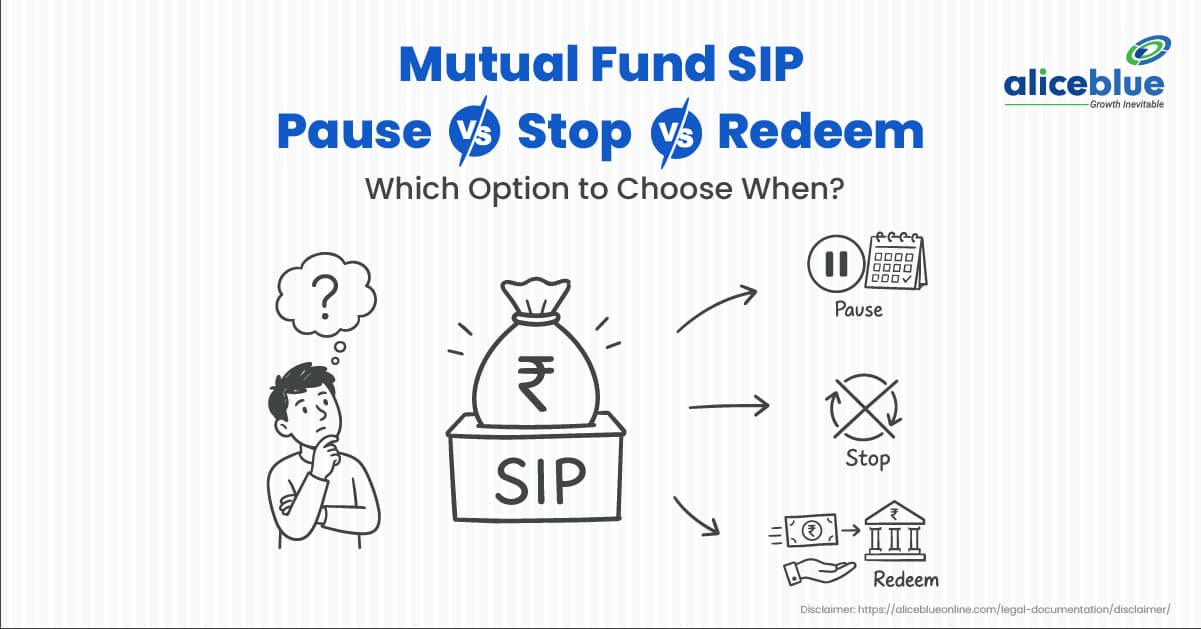
You have three options when your SIP feels unsustainable: pause it, stop it, or redeem the money you have already invested. Each one does something completely different to your financial future. This guide explains what each option actually does, what it costs you, and which one fits your situation.
What You Are Actually Choosing Between
Most investors treat these three options as versions of the same thing. They are not.
Pausing stops your future monthly instalments temporarily. Your existing units stay invested. The SIP restarts automatically after the pause window ends.
Stopping cancels your SIP permanently. Your existing units remain in the fund untouched, but no new money flows in after cancellation.
Redeeming is the only action that actually moves money out of your investment. You sell your units and receive cash in your bank account.
The most common beginner mistake is assuming these overlap. Stopping a SIP does not withdraw your money. Redeeming your units does not cancel your SIP. They are completely separate actions.
What SIP Pause Means and When to Use It
A SIP pause is a facility offered by most AMCs that lets you skip 1 to 6 monthly instalments without cancelling the SIP. After the pause period ends, deductions restart automatically. Your invested corpus stays in the market and continues to grow or absorb volatility during the pause. Not a single unit is sold.
When pause is the right call:
- You are between jobs for 1 to 3 months with a clear resumption date
- A large one-time expense, like a medical bill or home repair, has drained your monthly budget
- You are on unpaid leave for a defined period
- You need 2 to 3 months to rebuild your emergency fund before resuming contributions
Before you submit the pause request, check these conditions:
- Most AMCs require the SIP to have run for at least 6 continuous months before the pause option becomes available
- Submit the request at least 15 to 20 days before your next SIP date. If you submit too late, that month’s deduction will still go through
- When the SIP restarts automatically after the pause, ensure your bank account has a sufficient balance. A failed ECS deduction attracts a bounce fee of ₹250 to ₹500 per failed transaction from your bank.
What Stopping a SIP Means and What It Actually Does
Stopping a SIP, also called cancelling a SIP, permanently ends all future auto-debit instructions. No further monthly deductions happen after the cancellation is processed.
Here is what most beginners get wrong: your existing units stay invested in the fund after you stop the SIP. Nothing is sold. Nothing is withdrawn. The corpus you have already built continues to work in the market. You can redeem those units separately at any point, or leave them untouched for years.
When stopping is the right decision:
- You are switching to a better-performing fund in the same category
- Your income has reduced significantly for the long term, not just for a few months
- You are rebalancing your portfolio and changing your asset allocation
- The fund has consistently underperformed its benchmark for 2 to 3 years
One warning most investors never read about:
If your SIP auto-debit fails for 3 consecutive months due to insufficient bank balance, most AMCs automatically cancel the SIP mandate. Your bank charges a bounce fee every time an ECS mandate fails. If you are struggling to fund the SIP, submit a formal pause or stop request before the bouncing starts. Do not let the failures accumulate.
Processing a stop request typically takes 15 to 30 business days. One or two more deductions may still happen after you submit the request, so plan your bank balance accordingly.
What Redemption Means and When It Is Actually Justified
Redemption means selling your mutual fund units and receiving the proceeds in your bank account. This is the only one of the three options that actually takes money out of your investment.
You can redeem fully or partially. You can also redeem while your SIP is still running since redemption and SIP continuation are completely independent actions.
When redemption makes genuine sense:
- Your financial goal is complete. You saved for a house down payment, a child’s admission fee, or a fixed expense, and that money is now needed
- A real financial emergency where your emergency fund is exhausted, and there is no other liquid source available
- The fund has fundamentally changed in terms of fund manager, investment mandate, or 3-year consistent underperformance versus its category peers.
- You want to book losses at year’s end to offset capital gains elsewhere in your portfolio.
When redemption is the wrong move:
Markets have fallen, and your NAV is down. This is the single worst time to redeem. AMFI data shows millions of investors exited during the 2020 correction and the 2022 drawdown, only to miss the sharp recoveries that followed. When you redeem during a fall, you convert temporary paper losses into permanent real losses and remove yourself from the recovery entirely.
The Real Rupee Cost of Interrupting Your SIP
This is the calculation most investors skip before making a decision.
A 6-month pause on a ₹10,000 per month SIP can cost approximately ₹2 lakh in lost final corpus over 15 years, according to Economic Times analysis. That is not just the ₹60,000 you skipped investing. That is the compounding value of those 6 missed months multiplied over 15 years.
Money Control reported that panic pauses can cost investors ₹4 to 5 lakh over a decade, depending on the SIP amount and market conditions at the time of interruption.
SIP Amount | Tenure | Expected Rate | Uninterrupted Corpus | With a 6 Month Pause | Approx. Corpus Lost |
₹5,000 per month | 15 years | 12% per annum | ₹25.1 lakh | ₹24.1 lakh | ₹1 lakh |
₹10,000 per month | 15 years | 12% per annum | ₹50.2 lakh | ₹48.1 lakh | ₹2.1 lakh |
₹15,000 per month | 15 years | 12% per annum | ₹75.3 lakh | ₹72.2 lakh | ₹3.1 lakh |
These numbers are estimates based on a 12% annual return. Your actual outcome depends on the fund you hold and market timing.
The point is not fear. It is context. When you know what a pause actually costs over time, the decision becomes easier to make clearly.
The Option Most Investors Do Not Know Exists
Before you pause or stop, check whether your AMC allows you to reduce your SIP amount temporarily.
If you are investing ₹10,000 per month and cash is tight, reducing to ₹2,000 per month keeps the SIP active, keeps your investment habit intact, and keeps the compounding clock running. The corpus loss from a reduced SIP is far smaller than the corpus loss from a full pause, and you eliminate the risk of forgetting to restart.
This is the most underused option in Indian mutual fund investing, and it is often the most sensible path for salaried investors going through a difficult few months.
Which Option Fits Your Situation
Your Situation | Best Option |
Temporary income gap of 1 to 3 months | Pause SIP |
Cash is tight, but you can invest a smaller amount | Reduce SIP amount |
Long-term income reduction with no clear timeline | Stop SIP |
Moving to a different mutual fund | Stop the current SIP, start a new one |
Financial goal achieved, and money is needed | Redeem units |
Market has fallen, NAV is down, feeling anxious | Do nothing or pause only if cash flow demands it |
Genuine emergency with no other liquid funds | Partial redemption |
Fund underperforms for 3 or more years | Stop SIP and consider switching |
Not sure which row fits you? If the problem resolves in under 6 months, pause. If it is a longer term, stop. If the goal is done or the emergency is real, redeem. If none of these apply clearly, reduce the amount first.
Full Comparison: Pause vs Stop vs Redeem
Feature | Pause SIP | Stop SIP | Redeem Units |
Future instalments | Temporarily halted | Permanently cancelled | Continues as normal |
Existing units | Stay invested | Stay invested | Converted to cash |
Auto restart | Yes, after a pause period | No | Not applicable |
Minimum SIP tenure needed | Usually 6 months | None | None |
Exit load triggered | No | No | Yes, if within the load period |
Capital gains tax triggered | No | No | Yes, on profits earned |
Processing time | 15 to 20 days’ notice required | 15 to 30 business days | T plus 3 days for equity funds |
Bank bounce risk | Yes, at restart, if the balance is low | No | No |
Note: Stopping and redeeming are always separate actions. Stopping your SIP does not trigger any redemption automatically.
Tax Rules to Know Before You Redeem
- Equity mutual funds:
Units held for less than 12 months attract Short Term Capital Gains tax at 20%. Units held for more than 12 months attract Long Term Capital Gains tax at 12.5% on profits above ₹1.25 lakh per year.
- Debt mutual funds (rule changed from April 2023):
All gains from debt funds, regardless of how long you held them, are now taxed at your applicable income tax slab rate. The earlier 20% with indexation benefit no longer applies to debt funds purchased after April 2023.
- ELSS funds:
Each instalment carries a mandatory 3-year lock-in period from its individual purchase date. The system will not allow redemption before this period ends, regardless of the reason.
- How tax works in a SIP specifically:
In a SIP, each monthly instalment is treated as a separate purchase with its own acquisition date. When you redeem, the oldest units get sold first under the FIFO method. Those older units are more likely to qualify for long-term capital gains treatment, which is the lower tax rate.
Mistakes That Cost Investors Money
- Redeeming during a market fall
A falling NAV is not a signal to exit. It is the point where your monthly SIP is buying more units at lower prices. Redeeming at this point permanently locks in the loss and removes you from the recovery.
- Assuming a stopped SIP means the investment is closed
Many investors stop their SIP, assume everything is wrapped up, and move on. Their corpus sits in an old fund for years without review. Check your portfolio regularly, even after stopping.
- Not checking the exit load before redeeming
Most equity funds charge 1% exit load on units redeemed within 1 year of each purchase date. Since every SIP instalment has its own purchase date, some units may still be within the load window even if you have been investing for 2 years.
- Letting the SIP bounce instead of formally stopping it
Three consecutive ECS failures trigger automatic SIP cancellation at most AMCs and attract bank penalty charges per bounce. Submit a stop or pause request before this happens.
- Trying to redeem ELSS before the lock-in is complete
ELSS units cannot be redeemed within 3 years of each instalment purchase. The transaction will simply not go through. Plan redemptions accordingly.
Tax and Exit Load: A Quick Reference
Fund Type | Holding Period | Tax Rate | Exit Load |
Equity Fund | Less than 12 months | STCG at 20% | Usually 1% if redeemed within 1 year |
Equity Fund | More than 12 months | LTCG at 12.5% above ₹1.25 lakh | Nil after 1 year |
Debt Fund | Any period | Slab rate of investor | Varies by fund |
ELSS Fund | Less than 3 years | Cannot be redeemed | Lock-in applies |
ELSS Fund | More than 3 years | LTCG at 12.5% above ₹1.25 lakh | Nil |
Conclusion
Most investors who pause a SIP think they are saving ₹10,000 for a month. What they are giving up, based on actual compounding data, is anywhere from ₹1 lakh to over ₹5 lakh over 15 years, depending on their SIP amount and market timing. The maths does not factor in your reason for pausing. It just stops working the moment you do.
That is not an argument to never pause. It is an argument to decide with full information rather than in a moment of panic or convenience.
If the situation is temporary, pause and mark the restart date in your calendar. If it is a longer term, stop the SIP and let the existing corpus keep growing until you need it. If the goal is done, redeem and move on. And if you are not sure, reduce the amount rather than stopping entirely.
You can pause, stop, reduce, or modify your SIP directly from the Alice Blue platform in a few steps without needing to call anyone or visit a branch.
Frequently Asked Questions
Pausing temporarily halts monthly instalments for 1 to 6 months, after which the SIP restarts automatically. Stopping permanently cancels future deductions. In both cases, your existing units stay invested in the fund until you separately submit a redemption request.
No. Stopping only ends future auto-debits. The units you have already accumulated remain in the fund. They are not sold or withdrawn. You need to submit a separate redemption request to access that money.
Most AMCs automatically cancel the SIP mandate after 3 consecutive ECS failures. Your bank also charges a bounce fee of ₹250 to ₹500 per failed transaction. If you are unable to fund the SIP, submit a formal pause or stop request before the failures accumulate.
Yes. Most fund houses allow you to modify the SIP amount downward. Reducing from ₹10,000 to ₹2,000 keeps the investment active, keeps compounding running, and removes the pressure of a large monthly outflow without the corpus loss that comes from a full pause.
On a ₹10,000 per month SIP running for 15 years at a 12% expected annual return, a 6-month pause costs approximately ₹2.1 lakh in the final corpus. On a ₹15,000 per month SIP under the same conditions, the loss is approximately ₹3.1 lakh. These are estimates based on consistent 12% returns.
No. Stopping a SIP does not trigger exit load or capital gains tax. Tax and exit load only apply when you later redeem the accumulated units. At that point, equity fund gains held under 12 months are taxed at 20% and gains held over 12 months are taxed at 12.5% above ₹1.25 lakh per year.
Yes. Redemption and SIP continuation are independent of each other. You can withdraw part or all of your accumulated units without it affecting the ongoing monthly SIP deductions in any way.

Blog by Aliceblue News Desk


