
NEFT vs RTGS vs IMPS: Which Is Better for Money Transfer in India? (2026 Guide)
Blog by Aliceblue News Desk
14 April 2026
7 minutes
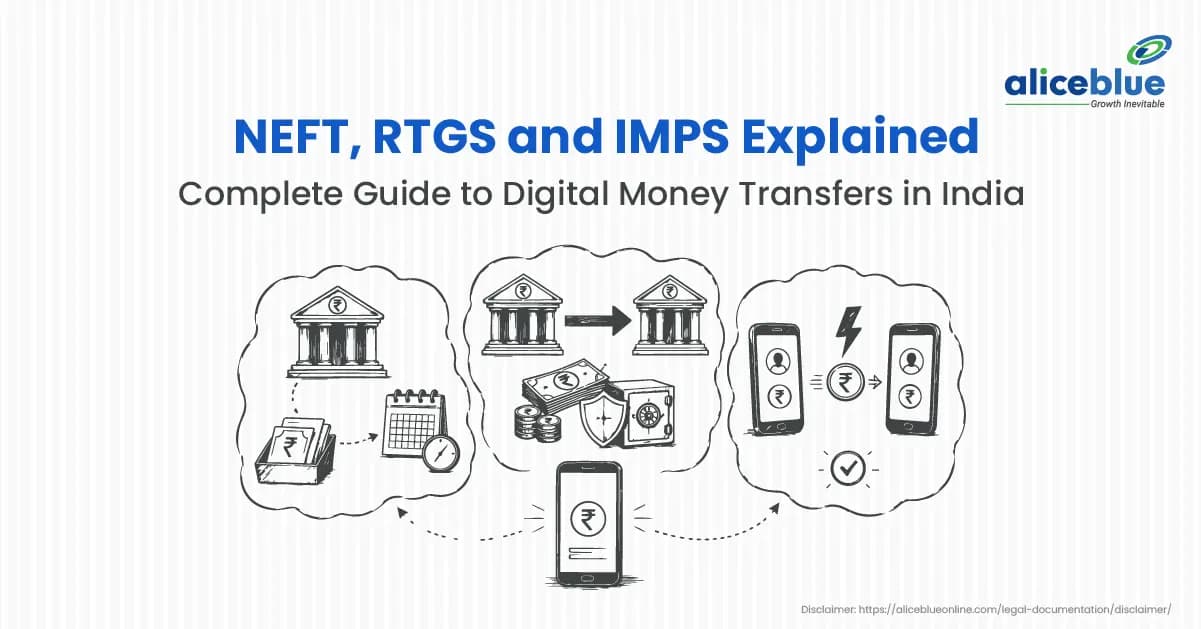
In 2026, Indians move more than ₹10 lakh crore daily through digital bank transfers, using NEFT, RTGS, and IMPS, and these remain the three most trusted systems for sending money from one bank account to another one, especially when UPI limits or merchant restrictions don’t work.
Yet, every time, most users pause at the payment screen and wonder, “Which one should I select this time, and are there any extra charges?” And, the right choice depends on 3 factors: amount, urgency, and cost. Picking incorrectly could result in delays.
So, this updated guide for 2026 explains each system clearly, including limits, charges and a comparison table so you can decide quickly, you’ll know when to use NEFT, when to switch to RTGS and when IMPS might be the smartest option.
What Are NEFT, RTGS, and IMPS?
These three are RBI- and NPCI-backed systems for moving money directly between bank accounts (different from UPI):
- NEFT → National Electronic Funds Transfer (RBI)
- RTGS → Real-Time Gross Settlement (RBI)
- IMPS → Immediate Payment Service (NPCI)
All of these are now available 24×7, 365 days a year (including Sundays and bank holidays), thanks to RBI upgrades, and since April 2025, beneficiary name lookup (like during UPI payments) has become mandatory for NEFT and RTGS, so you can verify the name before hitting “Send”.
What is NEFT (National Electronic Funds Transfer)?
Launched: 2005 (fully 24×7 since December 2019)
How it works: Money is sent in batches every 30 minutes. Funds are credited to the beneficiary’s account within 30 minutes to 2 hours max.
Limits:
- Minimum: ₹1
- Maximum: No limit set by RBI (banks may set their own per-transaction or daily caps, often ₹50 lakh+ for online transfers)
Best for: Salary credits, bill payments, rent, non-urgent medium-to-large transfers.
Pros:
- Extremely cost-effective (often completely free online)
- Works for any amount
- Highly reliable
Cons:
- Not instant (though still very fast)
Real-life example: If you want to pay your landlord the ₹45,000 rent due today, then NEFT is a perfect choice, but if you want to start trading/investing right away after opening an account on the stock market/crypto, then NEFT may not be the best choice due to the 30-minute to 2-hour wait.
What is RTGS (Real-Time Gross Settlement)?
Launched: 2004 (24×7 since 2020)
How it works: One-to-one, real-time settlement, and the moment your bank debits your account, the beneficiary’s bank credits it instantly.
Limits:
- Minimum: ₹200,000
- Maximum: No upper limit (bank-specific daily limits usually ₹25-50 lakh for retail customers; corporates can go higher)
Best for: Property payments, business vendor payments, urgent high-value transfers, and medical emergencies above ₹2 lakh.
Pros:
- Truly real-time
- Zero settlement risk
- Ideal for large amounts
Cons:
- Cannot be used for amounts below ₹2 lakh
Real-life example: If you’re buying a flat and need to pay ₹45 lakh to the seller’s account before the registry, then RTGS is the only safe and instant choice, but for paying rent to your landlord, like ₹45,000, it’s not possible using RTGS due to the minimum limit.
What is IMPS (Immediate Payment Service)?
Launched: 2010 (always 24×7)
How it works: Instant, 24×7, one-to-one transfer using Account Number + IFSC, Mobile Number + MMID, Aadhaar, or UPI ID.
Limits:
- Minimum: ₹1
- Maximum: ₹500,000 per transaction (most banks; some allow up to this daily too, confirm with your bank, while some banks may limit to ₹2 lakh-₹3 lakh)
Best for: Urgent small-to-medium transfers when you need the money credited immediately.
Pros:
- Truly instant (seconds)
- Works even at 3 AM
- Multiple identifiers (super convenient)
Cons:
- Slightly higher charges than NEFT for larger amounts
- Per-transaction cap of ₹5 lakh
Real-life example: Your friend needs ₹80,000 urgently for a medical bill at midnight; then IMPS is easily the best choice because the transaction gets completed in seconds. Also best for depositing money for quick investments on stock market/crypto platforms.
NEFT vs RTGS vs IMPS: Detailed Comparison Table
Feature | NEFT | RTGS | IMPS |
Full Form | National Electronic Funds Transfer | Real-Time Gross Settlement | Immediate Payment Service |
Operator | RBI | RBI | NPCI |
Settlement | Batch (every 30 mins) | Real-time (one-by-one) | Real-time (instant) |
Minimum Amount | ₹1 | ₹200,000 | ₹1 |
Maximum Amount | No RBI limit | No RBI limit | ₹500,000 per transaction |
Speed | 30 mins to 2 hours | Instant | Instant (seconds) |
Availability | 24×7, 365 days | 24×7, 365 days | 24×7, 365 days |
Beneficiary Name Lookup | Yes (mandatory since Apr 2025) | Yes (mandatory since Apr 2025) | Yes (always available) |
Charges (Online) | Usually ₹0 (savings accounts) | Usually ₹0 | ₹0-₹15 + GST (bank-wise) |
Best Used For | Any non-urgent transfer | High-value urgent transfers | Urgent small-medium transfers |
Quick Decision Matrix:
Your Need | Choose |
Urgent + amount < ₹2 lakh | IMPS |
Urgent + amount ≥ ₹2 lakh | RTGS |
Not urgent (any amount) | NEFT |
Medium amount + want zero charges | NEFT |
How to Transfer Money Using NEFT, RTGS & IMPS (Step-by-Step)
Via Mobile App / Net Banking:
- Log in to your bank app
- Go to “Fund Transfer” → “NEFT / RTGS / IMPS”
- Add beneficiary (use name lookup: it will show the exact account holder name)
- Enter amount + remarks
- Verify with OTP / UPI PIN
- Done! You get instant confirmation.
Tip: Always enable “Beneficiary Name Lookup”, which will save you from account errors. Branch and ATM options are available, but they are slower and may incur extra charges.
Charges & Fees: What Banks Actually Charge
NEFT:
- Online (most savings accounts): ₹0
- If charged: Max ₹2.50 (up to ₹10k) → ₹25 (above ₹2 lakh) + GST
- Inward: Always free
RTGS:
- Online: Usually ₹0 in 2026 (major banks)
- Branch: ₹25-₹55 + GST (rarely used now)
IMPS (Bank-wise examples as of 2026):
- SBI: Free up to ₹25,000; ₹2 for ₹25k-₹1L transactions; ₹6 for ₹1L-₹2L; and ₹10 for ₹2L-₹5L + GST
- HDFC: ₹2.50-₹15 + GST
- ICICI: ₹2.50-₹15 + GST
When to Use Which One? Real-Life Scenarios and Tips
Real-life Scenarios:
- College fees ₹3.5 lakh (urgent): → RTGS
- Salary to employee ₹80,000: → NEFT (free)
- Help friend at midnight ₹1.2 lakh: → IMPS
- Vendor payment ₹22 lakh: → RTGS
- Monthly rent ₹35,000: → NEFT
Tips for 2026:
- Always use the beneficiary name lookup
- Set transaction limits in your app for safety
- For amounts near ₹2 lakh, calculate charges; sometimes NEFT + IMPS combo works better
- Save beneficiary details once; future transfers take 10 seconds
Security Tips & Common Mistakes to Avoid in 2026
- Never skip name lookup; it’s free and mandatory now.
- Double-check the account number even after a name match on lookup.
- Never share OTP or UPI PIN.
- Use only official bank apps.
- If the transfer fails, don’t retry immediately; check the status first (money is usually safe).
- Report fraud immediately to the bank and +1930 (cyber helpline).
Conclusion
In 2026, India’s digital payment system is world-class, but only if you know the rules.
- Need it fast and small? → IMPS
- Need it fast and big? → RTGS
- Want it cheap and flexible? → NEFT
Next time your friend calls you for emergency funds, you’ll know exactly what to do.
Share this guide with anyone who still asks, “NEFT or RTGS?”
Frequently Asked Questions
UPI is excellent for small, everyday P2P and merchant payments with very low or zero charges, but it usually has lower per-transaction and daily limits (often ₹1 lakh for many users). NEFT, RTGS, and IMPS are designed for direct bank-account-to-bank-account transfers with higher limits, making them better for salary credits, rent, property deals, or business payments. Use UPI for quick pocket-money transfers and switch to these three when UPI limits or restrictions don’t work.
Most banks show real-time status directly in their mobile app or net banking under “Transaction History” or “Fund Transfer Status”. For NEFT, you can also use the RBI’s NEFT Tracker on the RBI website by entering the reference number. IMPS and RTGS usually reflect instantly, so status updates appear within seconds.
Even with beneficiary name lookup, if the name matches but you confirm a wrong account, the money will be credited to that account. Reversing it is difficult and time-consuming (you may need to contact both banks and file a dispute). Always double-check every digit before confirming. The name-lookup feature helps, but it is not foolproof.
- IMPS and RTGS: Almost impossible once processed (they are instant and real-time).
NEFT: Possible only if the batch hasn’t been processed yet, so contact your bank immediately. In all cases, act fast and provide the reference number; success is not guaranteed.
- Yes, NRIs can send or receive money using these methods from their NRE or NRO accounts to any Indian bank account, and the same limits, timings, and charges apply.
Yes, most banks and payment portals accept NEFT and IMPS for credit card bill payments and many government tax/challan payments. RTGS is also accepted for high-value tax or vendor payments.

Blog by Aliceblue News Desk


