Nifty Lot Size 2026 and Bank Nifty Lot Size After SEBI Revision
Blog by Aliceblue News Desk
10 June 2026
7 minutes
If you trade Nifty or Bank Nifty options, there is one number you need to check before placing any order. That number is the lot size. It tells you how many units sit in one contract. That number decides your total premium, your margin, and your profit or loss.
After the 2026 revision, the lot sizes changed again. If you still use the old numbers, your calculations will go wrong.
This guide breaks down the updated lot sizes in simple language. It shows how they work in real trades. It clears up the doubts beginners ask most often. If you are new to futures and options, start with What is futures trading to get the basics right.
What is the lot size in Nifty and Bank Nifty?
Lot size is the fixed number of units in one futures or options contract. You cannot buy or sell one unit of Nifty or Bank Nifty on its own. You must trade in a lot. The exchange sets the lot size.
Take Nifty. If the lot size is 65, one contract means 65 units of the index. If the premium trades at ₹100, the contract value becomes ₹6,500 before charges.
That is why lot size matters in F&O. It decides how much money goes in. It decides how much you can make. It decides how much risk you carry.
New lot size after the 2026 revision
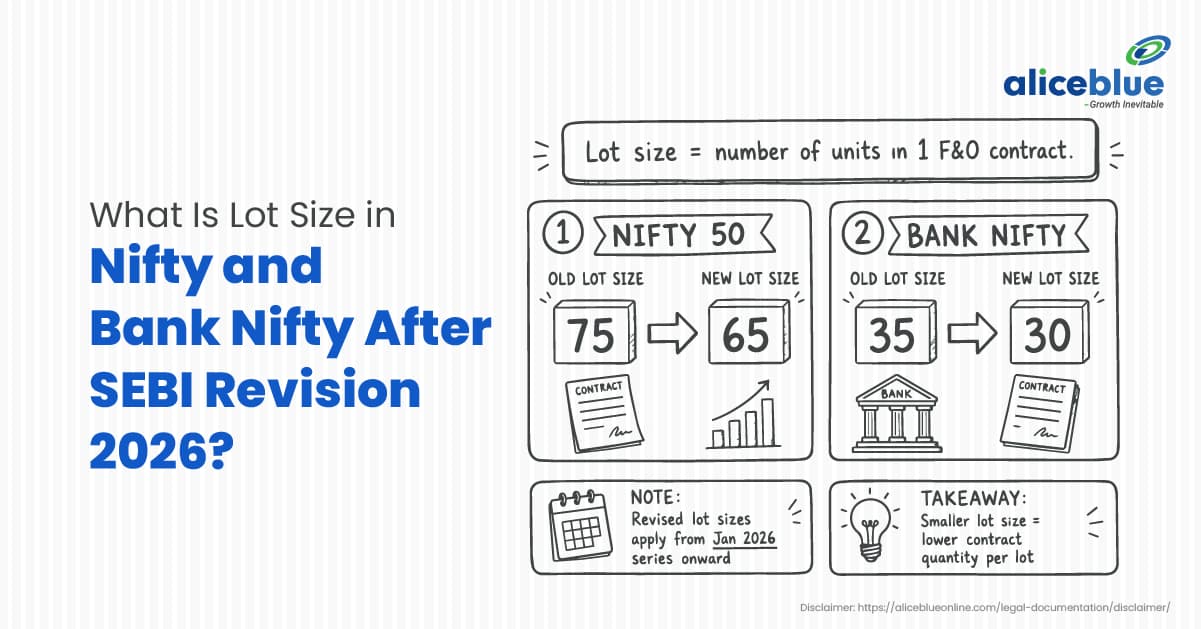
From the January 2026 contract series, NSE reduced the lot sizes for major index derivatives.
Index | Old Lot Size | New Lot Size |
Nifty 50 | 75 | 65 |
Bank Nifty | 35 | 30 |
Nifty Financial Services | 65 | 60 |
Nifty Mid Select | 140 | 120 |
Nifty Next 50 | Unchanged | Unchanged |
Sensex | 20 | 20 |
These numbers come from the NSE circular FAOP70616 dated 03 October 2025. Nifty 50 now sits at 65. Bank Nifty sits at 30. Nifty Next 50 did not change.
Why SEBI changed the lot size
SEBI watches the notional value of index derivative contracts. When the index rises, and the lot size stays the same, the contract value grows larger. That makes the trade too big for many retail traders.
To keep contract values in a workable range, NSE revised the lot sizes. The goal was not to make trading risk-free. The goal was to keep contracts usable while the index keeps moving higher.
This change follows SEBI Master Circular SEBI/HO/MRD-PoD2/CIR/P/2024/00181 dated 30 December 2024.
Exact expiry dates for weekly and monthly contracts
This is where traders get confused. The change did not happen randomly. There was a clear cut-off.
Weekly contracts (Nifty only)
Date | Status |
23 December 2025 | Last expiry with old lot size (75) |
6 January 2026 | First expiry with new lot size (65) |
Monthly contracts (Nifty, Bank Nifty, FinNifty, Mid Select)
Date | Status |
30 December 2025 | Last expiry with old lot size |
27 January 2026 | First expiry with the new lot size |
Quarterly and half-yearly contracts
Contract type | Last expiry with old lot size | First expiry with the new lot size |
Nifty quarterly | December 2025 | March 2026 |
Bank Nifty quarterly | December 2025 | March 2026 |
If you check the wrong contract series, your margin and premium calculations will be off. Always verify the expiry date before placing a trade. For expiry day dynamics, read How to trade options in India.
How lot size works in trading
Here is how it works in plain terms.
- Look at the lot size.
- Check the premium or futures price.
- Multiply the two.
- That is your contract value.
- Use that number to estimate margin, profit, and loss.
If a Nifty option premium is ₹120 and the lot size is 65, one lot costs ₹7,800 before charges. If the premium rises to ₹150, your gain is ₹30 × 65 = ₹1,950 per lot. If it falls to ₹90, your loss is ₹30 × 65 = ₹1,950 per lot.
The moment the lot size changes, the math changes. Margin plays a big role here. You can learn more about margin in Intraday trading.
Real example
Let us say you buy one Nifty call option when the premium is ₹120.
With the old lot size of 75:
- Total cost = ₹120 × 75 = ₹9,000.
- If the premium rises to ₹170, profit = ₹50 × 75 = ₹3,750.
With the new lot size of 65:
- Total cost = ₹120 × 65 = ₹7,800.
- If the premium rises to ₹170, profit = ₹50 × 65 = ₹3,250.
The trade is cheaper now. But the rupee value of each point move is lower too. Beginners often miss this. A smaller lot does not reduce risk if you keep adding more lots.
What happens to open positions
After a lot size revision, traders ask this question all the time.
Old open contracts continued under the earlier lot size until expiry. New contracts from the revised series used the updated lot size. The lot size did not change in the middle of an existing running contract.
If you trade monthly, weekly, quarterly, or long-dated contracts, always check the exact expiry and series before placing the order. That is the only way to avoid confusion when contract specifications change.
Key features
- Lot size is fixed by the exchange.
- It affects both futures and options contracts.
- It decides contract value and per-point rupee movement.
- It changes when NSE revises contract specifications.
- It helps keep index derivative contracts within a standard size range.
Advantages of the new lot size
Lower entry cost is the biggest benefit. A trader now needs less money to take one lot of Nifty or Bank Nifty than before.
Smaller lots give better position control. If you want to build a trade carefully, a smaller lot makes it easier to manage exposure. For hedging, investors can protect portfolios without blocking too much capital at the start.
Risks and limitations
The lower lot size can tempt traders to take more contracts than they should. Risk grows fast here. If you add lots only because the trade looks cheaper, your total loss can become much larger.
Transaction costs also matter more if you increase the lot count to match the old exposure. Brokerage, exchange charges, and taxes still apply. Even if the trade feels lighter, the full account impact can still be heavy. To understand contract differences, read Difference between futures and options.
Before vs after
Factor | Before 2026 | After 2026 |
Nifty lot size | 75 | 65 |
Bank Nifty lot size | 35 | 30 |
Entry cost | Higher | Lower |
Per-point value | Higher | Lower |
Exposure per lot | Larger | Smaller |
Flexibility for beginners | Lower | Better |
Common mistakes beginners make
- A common mistake is using the old lot size in fresh trades. That gives the wrong premium calculation and the wrong margin estimate.
- Another mistake is confusing lot size with contract value. Lot size is the number of units. Contract value is the lot size multiplied by the index price. They are not the same thing.
- Beginners also forget about charges when they increase the number of lots. A trade that looks fine on paper can become far less attractive once costs are added. The last mistake is thinking a smaller lot removes risk. It does not. It only changes the size of each contract.
Who should pay attention?
This topic matters most to option buyers, futures traders, intraday traders, and investors who hedge portfolios with index derivatives. These are the people whose margin and P&L change directly with lot size.
It is also useful for beginners who want to enter F&O with smaller capital. But if you do not understand margin, expiry, and contract value yet, start small and keep position size controlled.
Quick checklist before you trade
- Check the current lot size.
- Check the expiry month.
- Check the premium or futures price.
- Check your margin.
- Check the total charge impact.
If one of these numbers is wrong, the trade plan can go wrong too.
Conclusion
The 2026 revision changed Nifty and Bank Nifty lot sizes. That affects every trader who uses index derivatives. Nifty 50 now trades in lots of 65. Bank Nifty trades in lots of 30.
That lowers the entry cost. But it also changes profit, loss, and margin calculations. If you trade these contracts, update your numbers before placing the next order. For deeper insight into pricing and settlement, see Futures trading in India.
Frequently asked questions
The Nifty 50 lot size is 65 units in the revised contract series.
The Bank Nifty lot size is 30 units in the revised contract series. More details on Bank Nifty trading are available in What is Nifty Bank Index.
The first weekly Nifty expiry with the revised lot size is January 6, 2026.
The first monthly expiry with the revised lot size for Nifty, Bank Nifty, FinNifty, and Midcap Select is January 27, 2026.
The lot size revision is covered by NSE circular FAOP70616, issued in line with SEBI circular SEBI/HO/MRD-PoD2/CIR/P/2024/00181.
No. Nifty Next 50 remained unchanged in the revised lot size list.

Blog by Aliceblue News Desk


