
What Is an Off-Market Transfer in a Demat Account? (Complete 2026 Guide)
Blog by Aliceblue News Desk
15 May 2026
11 minutes
If you are switching brokers and do not want to sell your shares just to move them, or you want to gift stocks to your child without placing any order on NSE or BSE, an off-market transfer is how you do it. Most investors in India come across this at least once, yet very few know the exact steps, the charges involved, or what changed in 2024. This article covers all of it.
What Is an Off-Market Transfer?
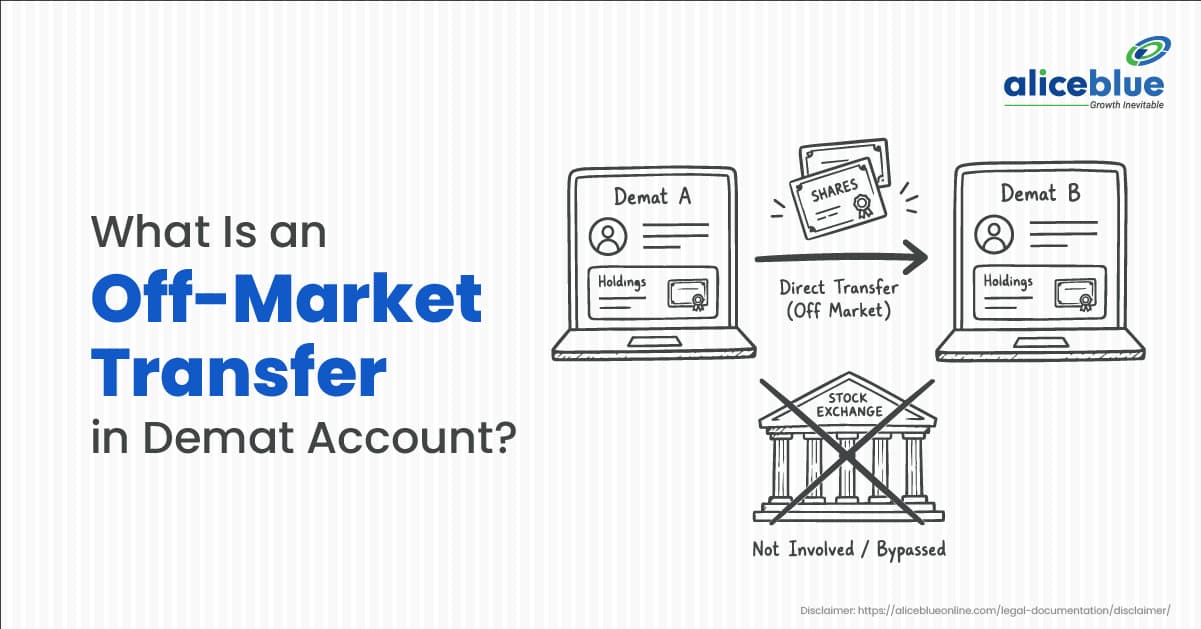
When you move shares directly from one demat account to another without placing any buy or sell order on a stock exchange, that is called an off-market transfer.
In a regular stock market trade, your order goes through NSE or BSE, gets matched, and a clearing corporation settles it. In an off-market transfer, none of that happens. The two parties settle the transaction directly through their Depository Participants (DPs), which are the brokers or banks where their demat accounts are held.
The transfer can happen within the same depository, NSDL to NSDL or CDSL to CDSL, or across depositories, NSDL to CDSL or CDSL to NSDL.
When Do You Need an Off-Market Transfer?
Off-market transfers apply to situations where the stock exchange simply does not come into the picture:
- Broker switching: Moving your portfolio from one broker to another without selling and rebuying, which avoids capital gains tax
- Gifting shares: Transferring stocks to a family member or friend
- Inheritance: Passing on shares of a deceased investor to legal heirs, called transmission
- Own account transfers: Consolidating holdings from two demat accounts into one
- Private sales: Selling shares of unlisted companies that cannot be traded on any exchange
- Pledge transfers: In specific lending or financing arrangements
How an Off-Market Transfer Works in 2026 — The Complete Process
Step 1: Register the Recipient as a Beneficiary
This is the step most people skip and then wonder why the transfer fails. Before you can submit any instruction, you must register the recipient’s demat account as an approved beneficiary in your own demat account.
You give your DP the recipient’s DP ID and Client ID. The DP enters this into the NSDL or CDSL system. A verification link is then sent to your registered mobile number or email. You confirm via OTP. Only after this one-time step is complete can you move to the next stage.
Step 2: Get a Delivery Instruction Slip (DIS)
A DIS is the official instruction you give your broker to debit shares from your demat account. It works like a signed cheque. You can get a physical DIS booklet from your broker or use a digital DIS through your broker’s app if they support it.
Step 3: Fill the DIS Correctly
The DIS requires:
- The ISIN of each security to be transferred
- Quantity of shares
- DP ID and Client ID of the recipient
- Execution date (the date from which the transfer should be processed)
- Reason code for the transfer
Reason Codes Used in DIS Forms
Code | When to Use |
Off-Market Trade | Private sale between two parties |
Inter-Depository Transfer | Moving shares between NSDL and CDSL accounts |
Own Account Transfer | Transfer between your own demat accounts |
Gift | Transfer to family or friends without payment |
Transmission | Transfer due to the death of the account holder |
Pledge | Transfer related to a lending arrangement |
Selecting the wrong reason code will get your instruction rejected or delayed by the DP.
Step 4: Submit Supporting Documents
For a gift transfer, a gift deed is typically required. For an off-market sale, you need to fill out an Off-Market Sale Annexure that captures payment details. For inheritance transfers, legal documents such as a will or succession certificate are required.
Step 5: OTP Authentication
Once the DIS is submitted, your registered mobile number receives an OTP. The transfer will not proceed without this confirmation. SEBI made OTP authentication mandatory for all off-market transfers following a rise in fraudulent transfer complaints.
Step 6: Recipient Submits a Receipt Instruction Slip (RIS)
This part is missing from almost every other blog on this topic. The recipient must also submit a Receipt Instruction Slip to their own DP to accept the incoming shares. The delivery instruction from your side and the receipt instruction from the recipient’s side must match exactly in ISIN, quantity, and execution date, or the transfer will not go through.
Step 7: DP Processes the Transfer
After both instructions are verified, the DP submits to NSDL or CDSL. The shares move electronically. This typically takes one to three business days, depending on when the DIS is submitted relative to the DP’s daily cut-off time.
Online Transfer Method: CDSL EASIEST and NSDL SPEED-e
You do not have to visit your broker’s office or fill out a physical form every time. Both depositories have online platforms:
- CDSL EASIEST (easiest.cdslindia.com): You register once by submitting a physical registration form to your DP. This is a one-time offline step. After your DP activates your EASIEST account, all future transfers can be initiated online using your credentials and OTP.
- NSDL SPEED-e (speed-e.nsdl.com): Same concept. Submit a one-time registration form through your DP, and transfers can be done electronically with OTP confirmation.
Most brokers, including Alice Blue, Zerodha, and Groww, now allow transfers through their apps, which run on these depository platforms.
A Realistic Example
Arjun holds 300 shares of HDFC Bank and 200 shares of Infosys in his Zerodha demat account under CDSL. He opens a new demat account with Alice Blue, also under CDSL, and wants to move all his shares without selling them.
Here is what happens:
- Arjun logs into Zerodha and registers his Alice Blue DP ID and Client ID as a beneficiary, confirms via OTP
- He fills a digital DIS with both ISINs, quantities (300 and 200), Alice Blue’s DP details, reason code “Own Account Transfer,” and an execution date two days ahead.
- He submits the DIS and confirms the OTP
- His Alice Blue account DP processes the incoming RIS on their side
- Within two business days, both holdings appear in his Alice Blue account
Arjun pays no brokerage, no STT, and no capital gains tax. He only pays DP transfer charges: 2 ISINs transferred means ₹25 multiplied by 2 = ₹50 plus 18% GST = ₹59, plus applicable stamp duty.
Charges Involved
Off-market transfers are not free. Here is exactly what you pay:
Charge | Rate | Who Pays |
DP transfer fee | ₹25 per ISIN per transaction + 18% GST | Sender |
Stamp duty (equity delivery) | 0.015% of transaction value | Sender or buyer (depends on DP) |
Video verification (if transfer value exceeds ₹5 lakh) | Varies by DP | Sender |
Erroneous transfer reversal | ₹100 per transaction (CDSL rate) | The party at fault |
Key point on DP charges: the fee is calculated per ISIN, not per share. If you transfer 500 shares of one company, you pay ₹29.50 (₹25 + 18% GST). If you transfer 100 shares each of three different companies in the same DIS, you pay ₹88.50 (₹75 + 18% GST).
Tax Implications
- Transferring between your own accounts: No tax. Moving shares between two demat accounts you own is not a sale or gift. Cost of acquisition and holding period remain unchanged.
- Gifting to a specified relative (parents, siblings, spouse, children): Fully exempt from tax in the recipient’s hands regardless of the value, under Section 56(2) of the Income Tax Act.
- Gifting to a non-relative: If the total market value of shares gifted from non-relatives in a financial year exceeds ₹50,000, the full amount becomes taxable as Income from Other Sources in the recipient’s hands.
- Off-market sale: The seller pays capital gains tax. Short-Term Capital Gains (STCG) at 20% if the shares were held for less than one year. Long-Term Capital Gains (LTCG) at 12.5% above the ₹1.25 lakh annual exemption if held for more than one year, as per the revised rates from Budget 2024.
If you are transferring shares worth more than ₹5 lakh, speaking with a tax advisor before initiating the transfer will save you surprises at filing time.
Important Restriction for Unlisted Private Company Shares
If you hold dematerialised shares of a private limited company and want to transfer them off-market, check whether the company’s Articles of Association restrict share transfers. Private companies typically have pre-emption clauses, meaning existing shareholders have the first right to buy shares before they can be transferred to an outsider. An off-market transfer that bypasses this can be legally challenged by the company or its shareholders.
Off-Market Transfer vs. On-Market Trade
Factor | Off-Market Transfer | On-Market Trade |
Exchange involvement | None | NSE or BSE |
Clearing corporation | Not involved | Mandatory |
Settlement guarantee | No | Yes |
Unlisted shares | Yes | No |
Capital gains triggered | Only if it is a sale | Yes, on every sell |
Brokerage | No brokerage | Standard brokerage applies |
Stamp duty | 0.015% on delivery | Applicable to all trades |
OTP required | Yes | No |
RIS from the recipient is required | Yes | No |
Common Mistakes to Avoid
- Skipping beneficiary registration: Many investors fill out the DIS and submit it, then wait days for a transfer that never happens. Since 2024, registering the recipient as a beneficiary first is mandatory. The DIS alone will not work.
- Forgetting the RIS: The sender submits the DIS, but the recipient forgets to submit the RIS. The two instructions must match. Without the RIS from the recipient’s side, the transfer stays pending.
- Writing today’s date as the execution date and submitting after the cut-off time: If you fill in the execution date as today but submit the DIS after your DP’s cut-off time (often 4:00 PM), the instruction is rejected because the execution date has already passed from the system’s perspective. Always put a date that is at least one business day ahead.
- Wrong reason code: Using “Off-Market Trade” when the transfer is a gift means your DP may ask for payment documentation that does not exist, causing delays or rejection.
- Not accounting for the per-ISIN charge structure: Investors who hold ten or more stocks and want to consolidate accounts are sometimes surprised by the cumulative DP charges. If you have 10 ISINs to transfer, that is ₹295 in DP fees (₹25 multiplied by 10, plus 18% GST) before stamp duty. Know this before you start.
Who Should Use Off-Market Transfers?
Works well for:
- Investors moving their portfolio to a new broker without wanting to trigger capital gains
- Parents or grandparents gifting shares to children or grandchildren
- Legal heirs transferring inherited shares to their own accounts
- Business partners or promoters transferring unlisted company shares with proper legal documentation
- Investors who hold the same stock across multiple accounts and want to consolidate
Think carefully before using this if:
- You are selling shares to someone you do not know personally. With no exchange guarantee, the risk of non-payment or non-delivery sits entirely with you. Proper legal documentation and escrow arrangements are advisable.
- You are transferring shares of a private limited company without checking the Articles of Association first.
Conclusion
An off-market transfer lets you move shares between demat accounts directly without involving any exchange. The process changed in 2024 when SEBI made beneficiary registration and OTP authentication mandatory. One step that most guides miss entirely is the Receipt Instruction Slip that the recipient must also submit. Get the reason code right on your DIS account for per-ISIN charges rather than a flat fee, and understand the tax treatment before you initiate any transfer involving gifts or private sales.
If you’re planning to start investing, you can open a demat account with Alice Blue and get started.
Frequently Asked Questions
It is the direct movement of shares between two demat accounts without involving a stock exchange or clearing corporation. It is used for gifting, broker switching, inheritance, and private share sales.
CDSL charges ₹25 per ISIN per transaction plus 18% GST as the DP fee. Stamp duty of 0.015% of the transaction value also applies to delivery-based transfers.
Yes. SEBI has made OTP authentication compulsory for all off-market transfers. The transfer will not proceed without confirmation from the registered mobile number.
Yes. Cross-depository transfers are possible using the Inter-Depository Transfer reason code on the DIS form.
The RIS is the instruction submitted by the recipient to their DP to accept incoming shares. The details in the DIS from the sender and the RIS from the recipient must match exactly for the transfer to go through.
No. Moving shares between two demat accounts you own does not trigger any tax. Cost of acquisition and holding period stay the same.
CDSL EASIEST is the online platform for initiating transfers without a physical DIS. First-time registration requires submitting a one-time physical form through your DP. Once activated, all future transfers can be done online.

Blog by Aliceblue News Desk


