
Paytm IPO vs Zomato IPO: How Two 2021 Listings Delivered Completely Different Returns
Blog by Aliceblue News Desk
11 August 2026
12 minutes

How did Paytm and Zomato perform after their 2021 IPOs? In short: an investor who bought Zomato at its issue price of ₹76 has seen a substantial gain by mid-2026, while an investor who bought Paytm at ₹2,150 is still sitting on a significant loss nearly five years later. Both companies were loss-making at listing, priced on future potential rather than current earnings, and attracted enormous retail enthusiasm. Still, a January 2024 RBI regulatory action against Paytm’s banking arm, combined with a fragmented business model, sent the two stocks in opposite directions.
Note: Zomato Limited was renamed Eternal Limited in March 2025 and now trades under the ticker ETERNAL. This guide uses “Zomato” throughout, since that’s the name most investors still search for and recognise.
This guide walks through the actual numbers: issue price, listing performance, drawdowns, current value, and CAGR, before explaining why the outcomes diverged so sharply.
Table of Contents
- Paytm vs Zomato IPO: Quick Comparison
- Paytm vs Zomato IPO Performance: Key Numbers
- IPO Performance Chart (Indexed)
- Paytm IPO Timeline: 2021-2026
- Zomato IPO Timeline: 2021-2026
- Why Did Paytm and Zomato Perform Differently?
- If You Invested ₹1 Lakh in Paytm vs Zomato
- Maximum Drawdown and CAGR Comparison
- New-Age Tech IPOs vs Traditional IPOs
- How a Tech Startup IPO Works in India
- Key Characteristics of Startup IPOs
- Advantages of Investing in Tech IPOs
- Risks of Investing in Startup IPOs
- Tips Before Investing in a Startup IPO
- Common Mistakes to Avoid
- Who Should Consider Investing in Startup IPOs?
- Key Investor Lessons from Paytm vs Zomato
- Data Sources
- Conclusion
- Frequently Asked Questions
Paytm vs Zomato IPO: Quick Comparison
Factor | Paytm | Zomato |
IPO Year | 2021 | 2021 |
IPO Issue Price | ₹2,150 | ₹76 |
Business | Fintech (payments, lending, insurance) | Food delivery / quick commerce |
Profitability at IPO | Loss-making | Loss-making |
Major Risk | Regulatory exposure + high valuation | Valuation + path to profitability |
Major Post-IPO Event | RBI action against Paytm Payments Bank (Jan 2024) | Blinkit’s expansion into profitable quick commerce |
Approx. 2026 Position | Trading below issue price | Trading well above issue price |
Paytm vs Zomato IPO Performance: Key Numbers
Metric | Paytm | Zomato |
IPO Issue Price | ₹2,150 | ₹76 |
Listing Day Open | ~₹1,950 (-9.3%) | ₹116 (+52.6%) |
Listing Day High/Close | High ₹1,961; closed ~₹1,560 | Rose toward ₹169.10 by Nov 2021 |
All-Time Low | ~₹476.65 (late 2022/early 2023) | ~₹40.55-41.65 (26-27 Jul 2022) |
All-Time High | ₹1,459.50 (52-week high, 2026) | ₹368.45 (Oct 2025) |
Current Price* | ~₹1,400 (as of 3-8 Aug 2026) | ~₹315 (as of 7-9 Aug 2026) |
Return Since IPO | ~-35% | ~+315% |
Maximum Drawdown (peak to low) | ~-75.7% | ~-75.5% |
Approx. CAGR Since IPO | ~-9% annually | ~+32% annually |
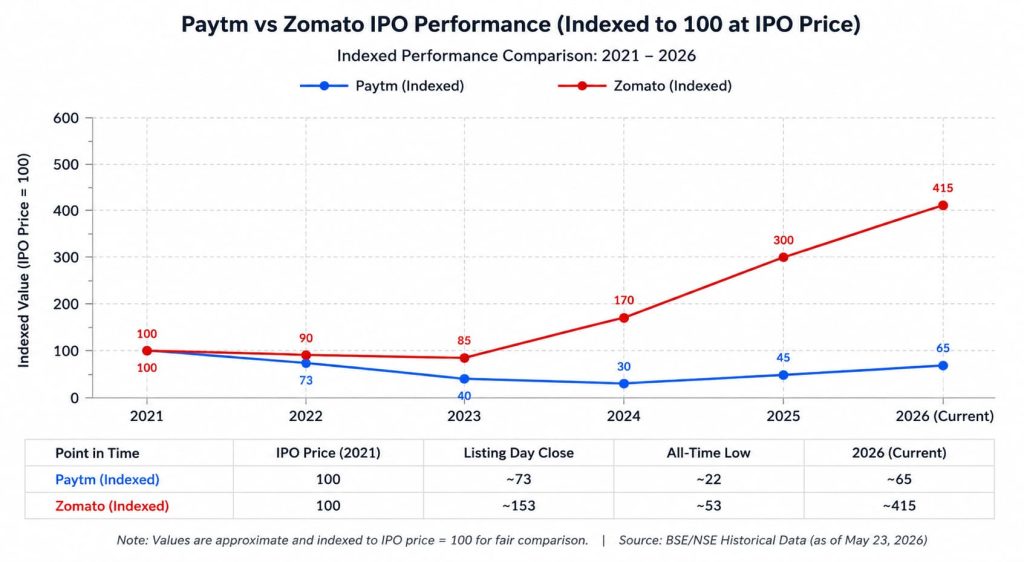
IPO Performance Chart (Indexed)
Indexed to 100 at IPO price, for a fair visual comparison despite the very different nominal prices:
Paytm IPO Timeline: 2021-2026
November 18, 2021 – IPO and listing: Paytm listed at an issue price of ₹2,150, opening around ₹1,950 on the NSE – a 9.3% listing-day loss. The stock touched an intraday high of ₹1,961 that same day before closing around ₹1,560.
Early-to-mid 2022 – Continued decline: The stock fell to ₹1,000 by January 2022, then to ₹511 by May 12, 2022, as markets continued questioning the business’s path to profitability.
Late 2022 to early 2023 – New lows: The decline continued, with the stock touching ₹483.30 in November 2022 and eventually bottoming near ₹476.65.
January 31, 2024 – RBI action against Paytm Payments Bank: The Reserve Bank of India ordered Paytm Payments Bank Limited to stop offering most banking services, effective March 15, 2024, citing persistent compliance concerns. [Link directly to RBI’s official notification before publishing.]
FY24-FY25 – Business disruption and restructuring: Revenue fell from roughly ₹9,978 crore in FY24 to approximately ₹6,900 crore in FY25, reflecting the loss of payments bank operations. Net losses narrowed from roughly ₹1,417-1,423 crore in FY24 to about ₹658.7 crore in FY25.
Q1 FY26 (2025) – First-ever quarterly net profit: Paytm reported a net profit of ₹122.5 crore in Q1 FY26, its first profitable quarter since listing.
2026 – Current position: As of early August 2026, the stock traded around ₹1,400, still roughly 35% below its IPO issue price, despite the recent turn toward profitability.
Zomato IPO Timeline: 2021-2026
July 23, 2021 – IPO and listing: Zomato listed at an issue price of ₹76, opening at ₹116 on the NSE – a 52.6% listing-day gain.
September-November 2021 – Continued climb: The stock rose through the following months, reaching approximately ₹169 by November 2021.
July 26-27, 2022 – All-time low: The stock fell sharply to an all-time low of roughly ₹40.55-41.65, as markets punished ongoing cash burn and questioned whether food delivery could generate sustainable margins.
FY24 – Return to profitability: Zomato posted its first full-year net profit of ₹351 crore on revenue of ₹12,114 crore, with Blinkit beginning its transition from a cost centre toward a genuine growth business.
March 20, 2025 – Renamed to Eternal Limited. The company formally changed its name from Zomato Limited to Eternal Limited, now trading under the ticker ETERNAL, while continuing to operate the Zomato food delivery brand.
FY25 – Profit growth continues: Net profit rose to ₹527 crore on revenue of ₹20,243 crore.
October 2025 – New all-time high: The stock reached an all-time high of ₹368.45.
Early-to-mid 2026 – Pullback and recovery: The stock fell to a 52-week low of ₹212.60 by March 2026, before recovering to around ₹315 by early August 2026.
FY26 – Continued expansion, with a caveat: Reported revenue climbed sharply to roughly ₹54,364 crore, though this figure is significantly influenced by an accounting change in how Blinkit’s inventory-led sales are recorded, not purely organic growth. Net profit for the year was ₹366 crore.
Why Did Paytm and Zomato Perform Differently?
- Valuation at IPO: Zomato’s ₹76 issue price left more room for the market to reward execution over time. Paytm’s ₹2,150 issue price priced in aggressive growth assumptions with little margin of safety.
- Revenue and Profitability: Zomato moved from losses to sustained profitability starting FY24 and has stayed profitable since. Paytm’s path was disrupted directly by the RBI action, which removed a revenue stream at a critical point, though its Q1 FY26 profit suggests a turnaround underway.
- Business Model: Zomato’s food delivery and quick-commerce focus gave it a clear, single-threaded business to fix. Paytm’s model spans payments, lending, insurance, and ticketing – a broader regulatory surface area alongside broader ambition.
- Regulatory Exposure: Zomato’s regulatory environment (labour classification, local commerce rules) has been comparatively stable. Paytm’s core payments business sits directly under RBI’s banking oversight, and the January 2024 action demonstrated how quickly that can change the business.
- Execution and Unit Economics: Zomato’s management specifically targeted delivery margins and converted Blinkit from a cash-burning experiment into a genuine contributor. Paytm’s Q1 FY26 profit suggests similar discipline is now underway, several years later.
If You Invested ₹1 Lakh in Paytm vs Zomato
Paytm | Zomato | |
Initial Investment | ₹1,00,000 | ₹1,00,000 |
IPO Price | ₹2,150 | ₹76 |
Approx. Shares Purchased | ~46 | ~1,315 |
Approx. Value in Aug 2026* | ~₹64,400 | ~₹4,14,225 |
Approx. Gain/Loss | ~-36% | ~+314% |
Maximum Drawdown and CAGR Comparison
Maximum drawdown measures the largest percentage decline from a stock’s peak to its subsequent low during the period being analysed.
Stock | Peak | Subsequent Low | Maximum Drawdown |
Paytm | ₹1,961 (listing day intraday high) | ~₹476.65 | ~-75.7% |
Zomato | ~₹169 (Nov 2021) | ~₹41.65 (Jul 2022) | ~-75.5% |
CAGR from IPO price to 2026
CAGR = (Current Price ÷ IPO Price)^(1/Years) − 1
- Paytm: (1,400 ÷ 2,150)^(1/4.75) − 1 ≈ -8.6% annually
- Zomato: (315 ÷ 76)^(1/5.08) − 1 ≈ +32.3% annually
Interestingly, both stocks experienced almost identical maximum drawdowns (~75%) at their respective lows – the real difference between them is what happened after the bottom, not how far each one fell.
New-Age Tech IPOs vs Traditional IPOs: What's the Difference?
For most of Indian market history, evaluating an IPO was relatively straightforward. You looked at profits, assets, P/E ratios, and dividend history. Manufacturing companies, banks, and infrastructure businesses were enterprises with decades of financial data, tangible assets, and earnings you could anchor a valuation to.
Internet-platform businesses broke that framework. Zomato and Paytm listed before making a single rupee in net profit. Their valuations were built on user counts, market share projections, and the theoretical monetisation of digital scale – none of which shows up cleanly in a traditional financial statement.
This doesn’t make them uninvestable. It means evaluating a fundamentally different kind of asset, with a different analytical toolkit.
How a Tech Startup IPO Works in India
- The Private Growth Stage: Venture capitalists fund aggressive expansion, accepting cash burn in exchange for rapid user acquisition and market share.
- Pricing and Valuation: When the company files its Red Herring Prospectus with SEBI, tech stocks are typically valued on a Price-to-Sales ratio, since there are no earnings to price against.
- The Public Transition: The IPO splits into a Fresh Issue (money to the company) and an Offer for Sale (money to early investors/promoters cashing out). The ratio between the two indicates who actually benefits from the listing.
- Post-Listing Reality: Once public, the company faces quarterly earnings calls, institutional scrutiny, and a stock price reacting to every operational update.
For the mechanics of applying to a similar listing, see our guide on how to apply for an IPO and what to check before investing in an IPO.
Key Characteristics of Startup IPOs
- High growth volatility means the stock price can swing significantly on quarterly results rather than moving on steady annual dividends.
- Valuation disconnect is structural: these companies price on future projections, and when those projections are tested against reality, repricing can be sharp – as both Paytm’s and Zomato’s ~75% drawdowns demonstrate.
- Institutional holders have significant influence on price discovery post-listing, since large domestic and foreign funds typically hold a substantial share of the float.
- Regulatory sensitivity is elevated because these are new business models operating in spaces where the regulatory framework is still evolving – Paytm’s RBI action is a direct example of how quickly that can change a business.
Advantages of Investing in Tech IPOs
- Early access to platform businesses can be rewarding when the underlying unit economics eventually work – Zomato is a documented example, up over 300% from its issue price.
- The scalability argument is real: a food delivery or fintech platform can grow revenue without proportionally scaling factories or headcount.
- Liquidity tends to be strong, since prominent consumer tech names attract heavy daily trading volumes.
- For investors who understand digital business metrics – dark store density, Monthly Transacting Users, take rates – there’s a genuine analytical edge unavailable in traditional industries reporting only quarterly financials.
Risks of Investing in Startup IPOs
- Overvaluation on listing day is a defining risk of hyped startup IPOs. When the issue price already assumes years of optimistic growth, there is limited margin of safety, and a regulatory shock or missed quarter can trigger a sharp repricing.
- The cash burn trap is real: some startups spend aggressively just to retain customers who would otherwise leave, and when spending slows, growth often slows with it.
- Retail investors typically have less access to detailed operational data than institutional investors with direct management access – worth keeping in mind when comparing your information to what’s pricing the stock.
Tips Before Investing in a Startup IPO
- Read the OFS ratio carefully. A large Offer for Sale component means early investors are cashing out rather than the company raising growth capital – not automatically disqualifying, but worth noting.
- Separate the app from the stock. Using a company’s product regularly doesn’t mean you’ve understood the business well enough to hold through a 75% drawdown, as both Paytm and Zomato investors experienced.
- Use a wait-and-watch approach. Anchor investors are locked in for two tranches – 50% of their allocation for 30 days from allotment, and the remaining 50% for 90 days – so watching how they behave at each unlock date, alongside two or three quarters of earnings, gives you more information than buying on listing day.
Common Mistakes to Avoid
- Bidding purely because an IPO is trending on social media is one of the most expensive habits in retail investing.
- Underestimating regulatory risk is a subtler version of the same problem – a business model that looks resilient today can be disrupted by a single compliance order, as Paytm’s case demonstrates.
- Averaging into a structurally challenged story only makes sense if the underlying fundamentals are genuinely improving. A falling price alone isn’t value if margins, regulation, and management direction are all still moving against the business.
Who Should Consider Investing in Startup IPOs?
Startup IPOs suit investors who understand digital platform businesses, can tolerate drawdowns in the 70-75% range without panic-selling (based on what both Paytm and Zomato investors actually experienced), and are investing with a multi-year horizon.
If you need capital preservation, predictable returns, or regular income, these are not the right instruments – an honest match of risk profile to asset class, not a judgment on the businesses themselves.
Key Investor Lessons from Paytm vs Zomato
Paytm and Zomato’s outcomes weren’t a matter of luck. Both stocks fell by roughly the same magnitude (~75%) from their post-listing peaks – the real divergence is what happened next. Zomato had a focused business model, executed consistently on unit economics, and operated in a comparatively stable regulatory environment. Paytm carried a broader, more fragmented business, a listing valuation with little margin of safety, and direct exposure to a regulator that ultimately intervened – though its recent return to profitability suggests its story isn’t finished.
Data Sources
This analysis draws on IPO issue documents (RHP/DRHP filings), NSE and BSE price and listing data cross-checked across multiple brokerage data platforms, company annual reports and quarterly results, and RBI’s public notifications regarding Paytm Payments Bank.
Conclusion
The lesson isn’t “avoid startup IPOs” – it’s “evaluate them with the numbers, not the narrative.” Check what the valuation assumes, understand who’s selling in the OFS, know what regulatory risks the business carries, and if you can’t answer those questions confidently before the listing, wait until the answers show up in the quarterly numbers, the way Paytm’s and Zomato’s eventually did.
Frequently Asked Questions
Paytm’s IPO was priced at ₹2,150 per share, listing on November 18, 2021.
Zomato’s IPO was priced at ₹76 per share, listing on July 23, 2021.
Investors who bought at the IPO issue price and held through August 2026 were sitting on an approximate loss of 35-36%, with the stock trading around ₹1,400 against its ₹2,150 issue price – though this can shift as the company’s recent return to profitability plays out.
Yes. Investors who bought at the ₹76 issue price and held through August 2026 saw an approximate gain of over 300%, with the stock (now Eternal Limited) trading around ₹315.
The stock fell due to a high issue price with little valuation margin of safety, and – more significantly – a January 2024 RBI action against its Paytm Payments Bank division that removed a core part of its original business model.
Management improved delivery unit economics and converted Blinkit from a cash-burning venture into a profitable quick-commerce business, helping the company reach sustained net profitability from FY24 onward.

Blog by Aliceblue News Desk


