
How to Give Trading Access to Someone Else Using a POA in a Demat Account
Blog by Aliceblue News Desk
05 May 2026
7 minutes
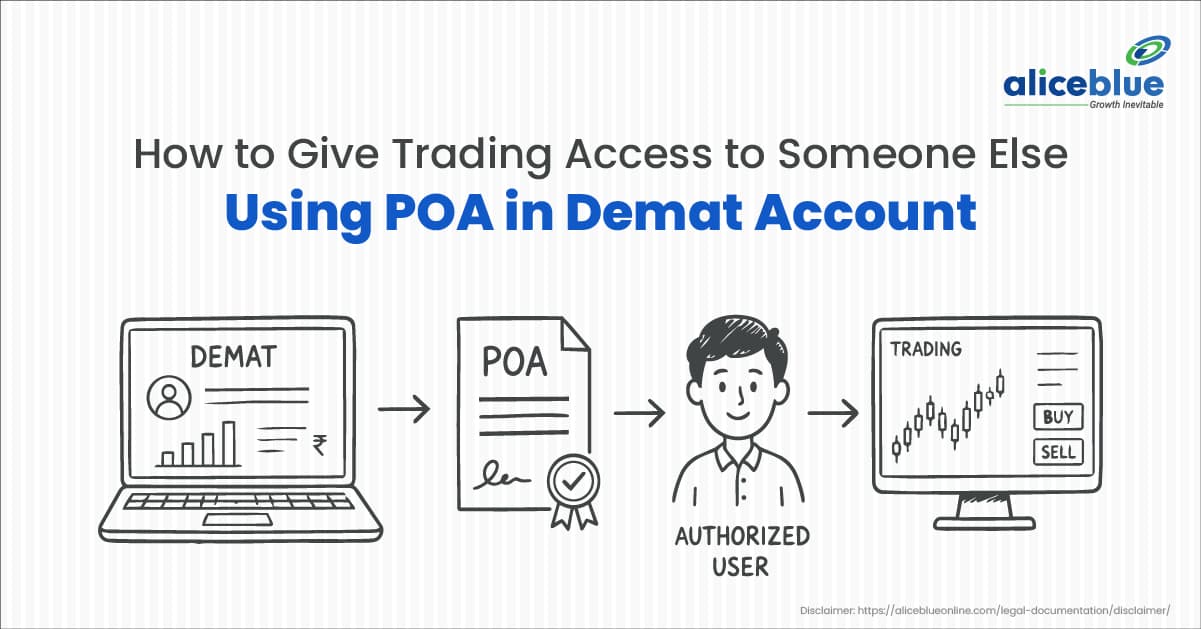
Many Indian investors want help with trading or settlement tasks and ask whether another person can operate their Demat account. The usual answer is no, unless proper permission is given. One common way is a Power of Attorney, or POA, which allows a broker or trusted person to handle specific account actions on your behalf. In India, this sits within the broker and depository framework shaped by SEBI, CDSL, and NSDL, so the scope of permission should always be checked carefully before signing.
This article explains what POA means, how it works, when it is used, what risks it carries, and why many investors now prefer TPIN, e-DIS, or DDPI-style consent for better control.
What is POA in a Demat Account?
POA means Power of Attorney. In a Demat account, it is a legal document that allows another person or entity to act on your behalf for certain account-related tasks. In stock market use, it has mainly been used for settlement work, where shares move out of your Demat account after a sell order.
POA does not transfer ownership of your shares. The shares still belong to you. It only gives the other party permission to do the actions written in the document. That is why the exact wording matters. A narrow POA gives limited access. A broad one can give more control than most investors need.
Why POA Exists?
POA was introduced to make settlement and back-office work easier. When an investor sells shares for delivery, those shares need to be debited from the Demat account before settlement is completed. Earlier, brokers often used POA to handle this process without asking for manual approval each time.
This was part of the standard workflow in the Indian market when delivery trades were settled through broker-led authorisation. Today, many brokers also use TPIN, e-DIS, or DDPI-type consent systems. That means POA is no longer the only way to support trading-related access. For many retail investors, the newer consent-based methods are safer because they keep control closer to the account holder and align better with current market practice under the depository system.
How does it work?
Here is how POA usually works in practice:
- A POA document is signed in favour of the broker or authorised person.
- The document clearly states what they can do and what they cannot do.
- When a sell order is placed for delivery, the broker may use that authority to debit shares from the Demat account for settlement.
- The shares are moved only for the purpose allowed in the document.
- The account holder remains the owner of the shares and should still check contract notes, holdings, and statements regularly.
The point is simple: POA is permission for a specific job, not a free pass to the account. In a regulated market structure, the scope of authority should match the investor’s actual consent. If the scope is too wide, the risk goes up. If the scope is narrow, the arrangement is easier to manage.
Example
A trader holds 300 shares in a Demat account and decides to sell 100 shares for delivery. A POA is signed that allows the broker to debit shares only for settlement purposes. A sell order is placed for 100 shares at Rs. 250 each, so the trade value is Rs. 25,000. When settlement takes place, the broker uses the POA authority to move only those 100 shares out of the Demat account. The remaining 200 shares stay in the account. The broker cannot use that POA to sell additional shares unless the document clearly permits it.
Key Features of POA
- POA is a legal authorisation document used in Demat account operations.
- Settlement-related tasks are the most common use case.
- Ownership of shares stays with the account holder.
- The scope depends on how the document is written.
- The authorised person should have clearly defined limits.
- It can usually be revoked through the broker or depository process.
In the Indian market, this is not just a convenience document. It is also a control and compliance document, which is why the wording should never be ignored.
POA vs TPIN, e-DIS, and DDPI
Many Indian investors now use TPIN, e-DIS, or DDPI instead of POA. These options are more transaction-specific, which means you approve the sell order before shares move out of your Demat account.
Aspect | POA | TPIN / e-DIS / DDPI |
Permission type | Legal authorisation document | Transaction-level approval |
Scope | Can be broad or narrow | Usually limited to one transaction |
Control | More broker-side handling | More investor-side control |
Risk | Higher if written too broadly | Lower because approval is given each time |
Best for | Users who understand the legal terms well | Most beginners and retail investors |
For most new investors, transaction-by-transaction approval is easier to manage. That is why many brokers now prefer these consent-based systems under current depository and compliance practice.
Advantages
POA can still be useful in some situations:
- Settlement work becomes easier and faster.
- Delivery trades need fewer manual steps.
- Limited delegation is possible when needed.
- Broker-side processing can move more smoothly.
- Experienced investors may find the arrangement practical.
- Convenience is the main benefit when the authorisation is narrow and clearly worded.
In real brokerage workflows, this can save time and reduce operational friction. The benefit is strongest when the investor understands exactly what permission is being given.
Risks or Limitations
POA also has real risks:
- A broad POA can give more access than the investor intended.
- Poor wording can create confusion later.
- If the wrong person gets access, misuse becomes possible.
- Beginners may sign without understanding the terms.
- It may not be needed if the broker already offers TPIN, e-DIS, or DDPI.
The real risk is not POA itself. The risk comes from giving too much authority without checking the document carefully. That is why it should never be treated like a routine form.
Common Mistakes
Beginners often make these mistakes:
- Signing without reading the clauses.
- Assuming POA is required for every Demat account.
- Thinking POA transfers share ownership.
- Giving broad access when only settlement access is needed.
- Ignoring newer options like TPIN, e-DIS, or DDPI.
- Forgetting to revoke old authorisations when changing broker or account setup.
Who Should Use a POA in a Demat Account?
POA may suit investors who want settlement convenience and understand the legal terms clearly. It can also work for active traders who deal with delivery trades and want the broker to handle specific transfer steps.
It may be less suitable for:
- Complete beginners.
- Investors who want to approve every transaction themselves.
- People who trade only occasionally.
- Anyone who can use TPIN, e-DIS, or DDPI instead.
For most retail investors, a transaction-based approval system is the safer choice.
Conclusion
POA can make trading and settlement easier, but only when the permissions are clear and limited. For most investors, the safer approach is to understand exactly what access is being given, keep control as tight as possible, and check whether TPIN, e-DIS, or DDPI can do the job without a broad authorisation. Since this process sits within the SEBI, CDSL, and NSDL-linked market structure, every clause should be read with care before signing.
Before agreeing to any authorisation, compare it with the approval method your broker offers today and choose the option that gives the least risk with the right amount of convenience.
Frequently Asked Questions
No. Most brokers now offer other approval methods, such as TPIN, e-DIS, or DDPI, so a POA is not always required.
It can only be if the document is written very broadly. If the scope is limited, the access stays limited too. That is why every clause should be checked carefully.
No. A POA only permits the holder to act on the account holder’s behalf. The shares still belong to the Demat account holder.
It can be safe only when the permissions are narrow and the terms are clearly understood. Beginners should be extra careful before signing it.
For most beginners, TPIN, e-DIS, or DDPI is better because approval is given for each transaction instead of giving broader standing access.

Blog by Aliceblue News Desk


