
Quant Funds in India (2026): Returns, Risks, Top Funds & Should You Invest?
Blog by Aliceblue News Desk
13 May 2026
5 minutes
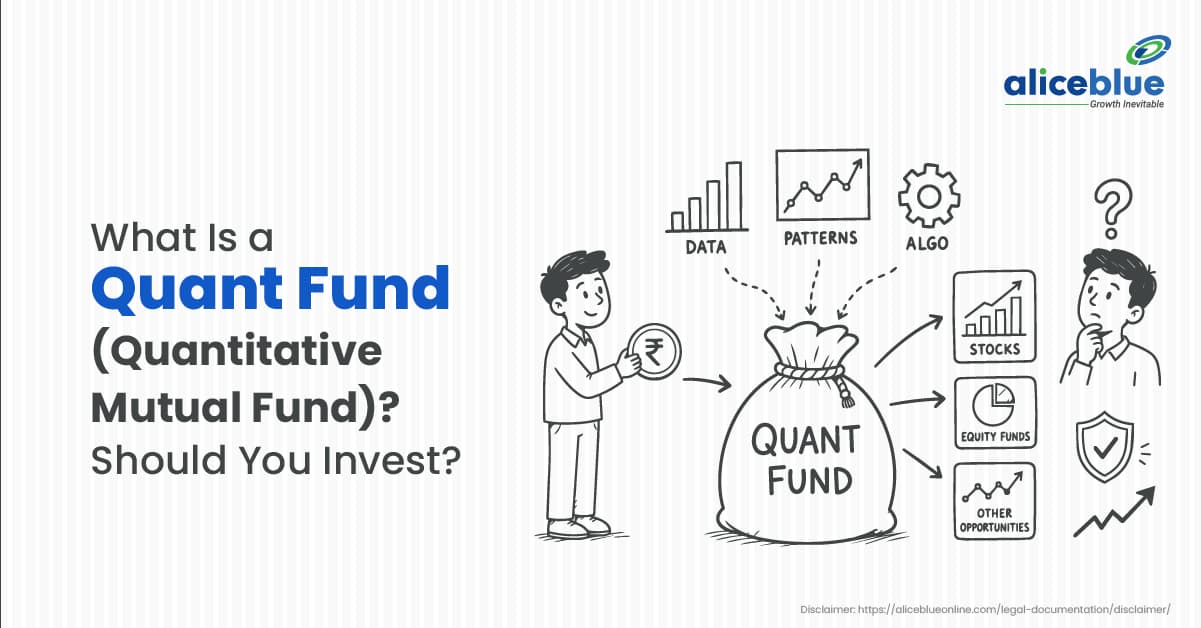
As of April 2026, quantitative mutual funds in India manage billions using data, algorithms, and predictive models instead of human intuition.
Quant funds use data and algorithms to systematically pick stocks, aiming to remove human bias, but they introduce model risk instead.
For example, Quant Active Fund alone manages ₹9,000+ crore in AUM (2026), reflecting growing investor interest in algorithm-driven strategies.
A quant fund is a mutual fund that uses mathematical models, data, and algorithms to select investments instead of human fund managers.
With the new SEBI Mutual Fund Regulations 2026:
- Lower expense caps
- Daily Information Ratio disclosures
- Stronger risk management
This guide breaks down:
- What quant funds are
- How they work
- Pros & cons
- Whether you should invest
What Are Quant Mutual Funds in India?
A quant fund is a mutual fund that uses mathematical models, data, and algorithms to select investments instead of human fund managers.
A quant fund (quantitative mutual fund) uses:
- Mathematical models
- Big data
- AI algorithms
…to make investment decisions instead of relying on human judgment.
Simple Comparison:
Active Fund | Index Fund | Quant Fund |
Human manager picks stocks | Tracks Nifty/Sensex | Uses data-driven algorithms |
How Do Quant Funds Work in the Indian Market?
They follow a strict, rules-based process:
- Data Collection:
Prices, earnings, volumes, sentiment, etc.
- Factor Modelling:
Identifies winning factors like:
- Value
- Momentum
- Quality
- Low volatility
- Backtesting:
Strategies tested on historical data
- Portfolio Construction:
Algorithms decide:
- Stock weights
- Sector allocation
- Execution:
Automated, low human interference
Some fund houses use proprietary frameworks (like VLRT: Valuation, Liquidity, Risk Appetite, Time), though these are not standardized across the industry.
Types of Quant Funds in India (Single vs Multi-Factor)
Single-Factor | Multi-Factor | Quantamental |
Focus on one factor (e.g., momentum) | Combine multiple strategies (most common) | Blend of quant + human input |
Top Quant Funds in India (2026) With Returns
Here are some of the most tracked quantitative mutual funds based on recent performance and consistency:
- Quant Active Fund
- 3-Year Return: ~18-22% CAGR
- 5-Year Return: ~20%+ CAGR
- Nippon India Quant Fund
- 3-Year Return: ~16-19% CAGR
- 5-Year Return: ~17-18% CAGR
- ICICI Prudential Quant Fund
- 3-Year Return: ~15-18% CAGR
- 5-Year Return: ~16-17% CAGR
Note: Returns are indicative and may vary with market conditions. Always check the latest fund factsheets.
Quant Funds vs Active vs Index Funds in India
Feature | Quant Funds | Active Funds | Index Funds |
Decision | Algorithms | Human manager | Index-based |
Emotion Bias | None | High | None |
Cost | Medium (0.6-0.9%) | High (1.5-2.2%) | Low (0.2-0.5%) |
Speed | Very fast | Slow | Passive |
Transparency | High | Medium | Very high |
Pros and Cons of Quant Funds in India
Pros | Cons |
No emotional bias | Can underperform in unknown scenarios |
Faster reaction to market changes | Feels like a “black box.” |
Historically, some quant funds have outperformed benchmarks in specific cycles (especially momentum-driven markets) | Higher turnover → more transaction costs |
Expense ratios are typically lower than traditional active funds due to reduced human intervention, but higher than index funds | Recent short-term performance has been mixed (2026 volatility) |
Follows a rules-based framework, though exact models are not fully disclosed (‘black box’ nature remains) | Still subject to market risk |
Should You Invest in Quant Funds in 2026?
Ideal for you if:
- Long-term horizon (7+ years)
- Want to reduce dependency on fund managers
- Comfortable with volatility
- Believe in data-driven investing
Avoid or Limit If:
- You panic during market drops
- You need money within 3 years
- You prefer human-driven investing
How to Choose the Best Quant Fund in India
Checklist:
- Look at 3-5 year returns
- Check the expense ratio
- Evaluate AUM size
- Study drawdowns
- Track Information Ratio (daily now)
- Check rolling returns (not just point-to-point returns)
- Compare performance across different market cycles (bull vs correction phases)
Taxation of Quant Mutual Funds in India (2026):
- LTCG above ₹1.25 lakh → 12.5% tax after 1 year
When Do Quant Funds Underperform? (Reality Check)
- Factor strategies can underperform for years (e.g., value investing cycles)
- Overfitting risk: models may work in backtests but fail in real markets
- Crowding risk: too many funds using similar factors reduces edge
Conclusion
Quant funds are no longer experimental and are now a mainstream investment strategy in India.
They won’t:
- Make you rich overnight
- Protect you from every crash
Smart Approach would be:
- Starting small
- Stay disciplined
- Diversify
- Think long-term
Alice Blue’s ANT Plus API provides the necessary infrastructure to transition quantitative models into live market execution while adhering to current SEBI regulations.
Disclaimer: This content is for educational purposes only and not financial advice. Mutual fund investments are subject to market risks. Please consult a financial advisor before investing.
Frequently Asked Questions
It tracks the fund’s consistency. If the ratio drops while the market is steady, it’s a signal that the fund’s mathematical model is losing its “edge” and failing to beat the benchmark efficiently.
Yes, since models rely on historical patterns, unprecedented events (like a sudden war or pandemic) can cause errors. The 2026 SEBI guidelines now mandate “circuit breakers” to stop automated trading during extreme anomalies.
While they save on star manager salaries, they incur high costs for AI infrastructure, massive data sets, and specialized data scientists. The tech-heavy nature keeps fees higher than passive funds.
No, you trade “Human Error” for “Model Risk.” If the logic behind the code is flawed or a specific factor (like Value) stays out of favor for years, the fund will strictly follow that losing path until the code is updated.
Time horizon. Trading bots seek profits in seconds or minutes. A Quant Mutual Fund uses AI to select a portfolio for months or years, aiming for long-term wealth rather than daily scalping.
No, but it increases Transaction Costs. While you only pay tax when you sell your fund units, the fund pays brokerage and STT (Securities Transaction Tax) every time the algorithm rebalances, which can slightly lower the NAV.
- Liquidity. Algorithms need to exit positions quickly. In Small-caps, there often isn’t enough trading volume to sell large chunks without crashing the price, which disrupts the model’s efficiency.

Blog by Aliceblue News Desk


