
How to Redeem Mutual Fund Units Online in India: A Complete Guide (2026)
Blog by Aliceblue News Desk
11 May 2026
11 minutes
Your daughter’s college admission just came through, and you need ₹2 lakh within the week. Your SIP has been running for three years, and the money is sitting in an equity mutual fund. Most investors at this point are not confused about whether to redeem. They are confused about how, how fast, and how much exit load and tax will eat into the amount they actually receive.
This guide walks through the full process, from picking the right platform to understanding exactly when the money hits your bank account.
What is a mutual fund redemption?
When you invest in a mutual fund, the AMC allots units to you based on the NAV on the date of your investment. Redemption is the reverse. You sell those units back to the AMC at the current NAV, and the AMC credits the proceeds to your registered bank account after deducting the exit load if it applies.
The calculation works like this:
Redemption Amount = Units Redeemed × Applicable NAV (minus Exit Load if any)
One thing most beginners miss, the NAV applied to your redemption is not a live market price at the moment you click confirm. It depends entirely on the time you submit the request relative to the cut-off time for that fund category.
Types of Redemption
- Redemption by units: You specify how many units to sell. What you receive depends on the NAV on the day your request is processed.
- Redemption by amount: You enter the rupee amount you want, say ₹75,000, and the platform works backwards to calculate how many units need to be sold at the current NAV to match that figure.
- Systematic Withdrawal Plan (SWP): Instead of redeeming everything at once, you schedule fixed monthly or quarterly withdrawals. The AMC automatically redeems the required units on the date you choose and credits the amount to your bank account. Retirees and investors who want regular income from their corpus without fully exiting the fund use this option most often.
- Instant redemption: This applies only to liquid and overnight funds and only for resident individual investors. You can withdraw up to ₹50,000 or 90% of your investment value, whichever is lower, per day per scheme, and the money arrives in your bank account within minutes through IMPS.
Where Can You Redeem Online?
- AMC website directly: Log in to the specific fund house website using your folio number and PAN. This works well if all your investments sit with one or two AMCs.
- MF Central (mfcentral.com): Built jointly by CAMS and KFin Technologies, this platform lets you view and redeem across all your mutual fund folios from a single login — regardless of which AMC you invested with.
- CAMS (camsonline.com) and KFin Technologies (kfintech.com): These are the two main Registrar and Transfer Agents in India. Most AMCs use either CAMS or KFin to maintain folio records. You can log in with your PAN and OTP to redeem directly without visiting the AMC website.
- Third-party investment platforms: If you invested through Alice Blue, Groww, Zerodha Coin, or any other platform, you must redeem through that same platform. Units purchased on Alice Blue will not appear in Groww or vice versa.
- One important point on Direct vs Regular plans: A direct plan folio and a regular plan folio are separate accounts even if the fund scheme name is identical. If you bought a direct plan on the AMC website, you cannot redeem it through a distributor app or third-party regular plan platform. The folio simply will not appear there. Always use the exact route through which you originally purchased.
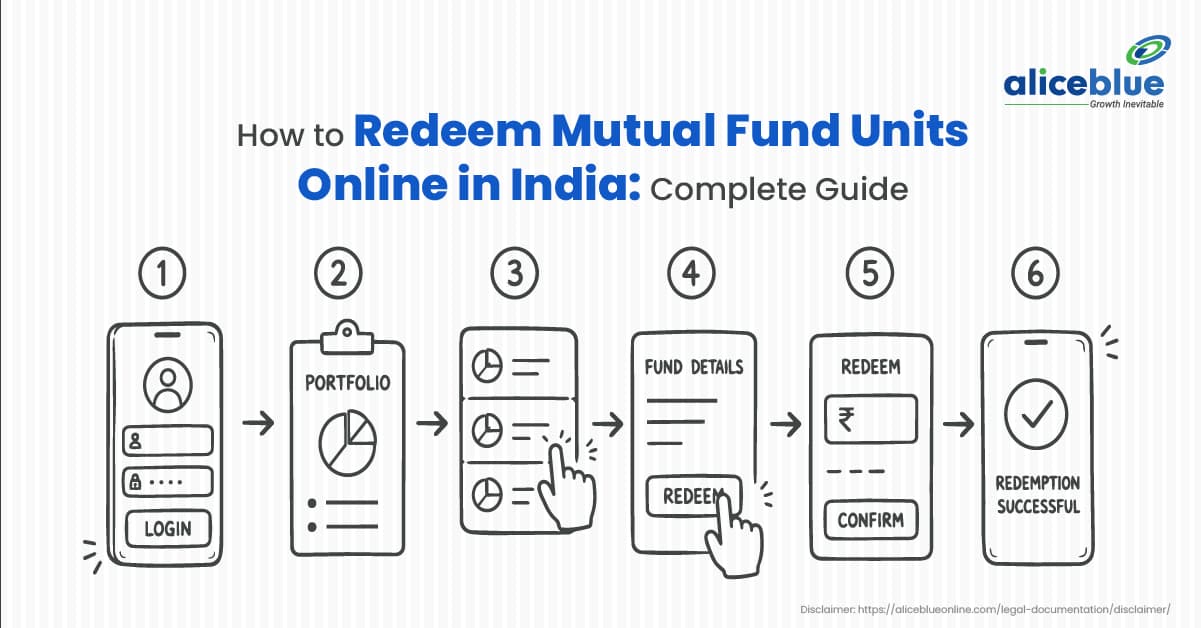
How to Redeem Mutual Fund Units on Alice Blue
- Log in to your Alice Blue account using your registered mobile number and MPIN
- Go to the Portfolio section from the main menu
- Select Mutual Funds from your holdings
- Choose the mutual fund scheme you want to redeem
- Tap on Redeem
- Select whether you want to redeem by units or by amount
- Enter the number of units or the rupee figure you wish to withdraw
- Review the redemption details, including estimated NAV and exit load if applicable
- Confirm the request using the OTP sent to your registered mobile number
- Save or note the confirmation number sent via SMS and email for your records
The redemption proceeds will be credited to the bank account registered against your mutual fund folio within the standard settlement period for that fund category.
How to Redeem Through CAMS, KFin, or MF Central
- Visit camsonline.com, kfintech.com, or mfcentral.com
- Log in using your PAN and the OTP sent to your registered mobile number
- Select the folio and the specific scheme you want to exit
- Choose between full redemption and partial redemption
- Enter the units or the rupee amount
- Confirm using OTP
- Proceeds are credited to the bank account registered with that folio
NAV Cut-Off Times: Why the Clock Matters
Fund Category | Cut-Off Time | NAV Applied |
Liquid and overnight funds | 1:30 PM | Same day NAV |
Equity, debt, and hybrid funds | 3:00 PM | Same day NAV |
Any request after the cut-off | After the above times | Next business day NAV |
If you submit after the cut-off or on a market holiday, your redemption is processed on the next working day at that day’s NAV. A ₹1 crore redemption submitted at 3:15 PM instead of 2:55 PM can mean a different NAV and a meaningful difference in the amount you receive.
How Long Does Redemption Take?
Fund Type | Typical Settlement |
Equity funds | T+3 working days |
Debt funds | T+2 working days |
Liquid and overnight funds | T+1 working day |
Instant redemption (liquid funds only) | Same day via IMPS |
T is the transaction date, the day your request is accepted. The 7 working day figure you sometimes see quoted is the outer legal limit SEBI allows under extraordinary circumstances. Under normal market conditions, settlements happen well within the timelines above.
A Realistic Example
Priya invested ₹1,00,000 in an equity mutual fund in April 2024. She received 8,000 units at a NAV of ₹12.50.
By April 2026, the NAV has risen to ₹19.00.
She decides to redeem 4,000 units to fund a home renovation and keep the remaining 4,000 units invested.
Redemption amount = 4,000 × ₹19.00 = ₹76,000
Cost of those 4,000 units = 4,000 × ₹12.50 = ₹50,000
Long-term capital gain = ₹76,000 — ₹50,000 = ₹26,000
Since she has held the units for over 12 months and her total LTCG for the year is below ₹1.25 lakh, no tax applies here. The fund carries no exit load after 12 months, so the full ₹76,000 goes to her bank account.
Tax on Mutual Fund Redemption (2026)
Fund Type | Holding Period | Tax Rate |
Equity mutual funds | Less than 12 months | 20% STCG |
Equity mutual funds | More than 12 months | 12.5% LTCG above ₹1.25 lakh |
Debt mutual funds | Any period | As per your income tax slab |
ELSS funds | After a 3-year lock-in only | 12.5% LTCG above ₹1.25 lakh |
For resident Indians: TDS is not deducted on mutual fund redemptions. You report capital gains yourself when filing your ITR.
For NRIs: TDS is deducted at source before proceeds are credited. Equity STCG attracts 20% TDS. Equity LTCG above ₹1.25 lakh attracts 12.5% TDS. Debt mutual fund gains attract 30% TDS.
Exit Load: Check the Exact Date, Not the Approximate Month
Exit load is a fee the AMC deducts if you redeem before a specified holding period. It comes out of your redemption amount before the proceeds reach your bank.
In September 2025, SEBI reduced the maximum exit load any mutual fund can charge from 5% to 3%. Most equity schemes currently charge 1% if you exit within 12 months.
Practical example: You redeem ₹1,00,000 from a fund with a 1% exit load. You receive ₹99,000. The ₹1,000 goes to the fund.
Exit load rules vary across schemes. Check the Scheme Information Document on the AMC website before placing any redemption request.
ELSS Funds: Redemption Before 3 Years Is Not Possible
ELSS (Equity Linked Savings Scheme) funds carry a mandatory 3-year lock-in. There is no partial exit, no emergency exit, no exception. The platform will reject the request outright.
For SIP investors in ELSS, the 3-year lock-in applies to each instalment separately from its own purchase date, not from the day you started the SIP. An instalment made in January 2024 becomes redeemable in January 2027. The February 2024 instalment unlocks in February 2027. If you started an ELSS SIP two years ago, only the earliest instalments may be redeemable today.
Instant redemption is not available for ELSS funds under any condition.
Advantages of Redeeming Online
- No physical forms, no signatures, no branch visit at any point
- Before confirming, you can see the applicable NAV, estimated exit load deduction, and the final amount you will receive
- Partial redemption means you withdraw only what you need, while the rest stays invested and continues to grow
- CAMS, KFin, and MF Central let you handle folios across multiple AMCs from one login without juggling multiple websites
- You get an SMS and email confirmation the moment the request is registered
Risks and Limitations to Keep in Mind
- Redeeming at a market low locks in losses. If your goal is not immediate, giving equity markets time to recover before redeeming is worth factoring in.
- A few days can cost you 1% exit load. Many investors estimate they are “close to one year” and redeem early. Check the exact date your exit load period ends. Being off by even a week is an avoidable cost.
- Tax rate differences between months matter. An equity fund held for 11 months and 15 days is taxed at 20% STCG. Hold it for 15 more days, and the same gain above ₹1.25 lakh is taxed at 12.5% LTCG. The difference is meaningful for large amounts.
- SEBI allows AMCs to restrict redemptions in rare cases. In extreme market disruption, AMCs can pause redemptions for up to 10 working days within any 90 days for amounts above ₹2 lakh, subject to board and SEBI approval. This is rare but worth knowing.
- A closed or inactive registered bank account will delay or fail your redemption. Update your bank details with the AMC or RTA before submitting a redemption request if your account details have changed.
Online Redemption vs Offline Redemption
Feature | Online Redemption | Offline Redemption |
Method | App, website, or platform | Physical form at the AMC branch or RTA |
Speed | Faster | Slower due to form processing |
Convenience | Done from anywhere | Requires a branch visit |
Real-time tracking | Yes, SMS and email updates | Limited |
Best suited for | Most investors with internet access | Investors not comfortable with digital tools |
Common Mistakes to Avoid
- Attempting ELSS redemption before the 3-year mark: The request will be rejected. For SIP investors, track the purchase date of each instalment individually.
- Using the wrong platform: Units bought through Alice Blue do not appear on Groww or any other app. Redeeming through a different platform than where you invested will not work.
- Mixing up direct and regular plan folios: These are two separate folios even within the same scheme. Many investors assume switching platforms consolidates their holdings. It does not.
- Estimating the exit load period instead of checking it: Exit load is calculated to the day, not the month. If your fund imposes a 12-month exit load, check the exact calendar date before submitting a redemption.
- Not verifying your registered bank account is active: If the account linked to your folio has been closed or changed, the proceeds have no valid destination. Contact your AMC or RTA to update account details before initiating any redemption.
- Ignoring per-instalment holding periods in SIPs: Every SIP instalment is a separate unit lot with its own purchase date and tax classification. Some instalments may qualify for LTCG while others attract STCG. Redeeming without checking results in a larger tax bill than necessary.
When to Redeem and When to Wait
Redeem when:
- Your original investment goal has been met: a child’s education, a property down payment, a retirement milestone
- You are rebalancing your portfolio from equity to debt as you get closer to your financial target
- You genuinely need emergency funds and have no other liquid option available
Hold off when:
- Markets have fallen this week, and your goal is still 18 to 24 months away
- Someone advised you that the fund “is not performing” without comparing it against its benchmark over 5 years
- You want to move into a different scheme within the same AMC, use the Switch option instead of redeeming and reinvesting, as it saves you from creating an unnecessary tax event
Conclusion
Getting your money out of a mutual fund online is straightforward once you know which platform to use, what cut-off time applies to your fund, whether an exit load will be deducted, and whether your registered bank account is active and updated. The mechanics take a few minutes. What genuinely deserves time is deciding when to redeem, how much to redeem, and whether a partial redemption or an SWP better serves what you are trying to achieve financially.
You can track your mutual fund portfolio, monitor NAV in real time, and place redemption requests directly through Alice Blue without juggling multiple apps or AMC portals.
Frequently Asked Questions
Yes, for most equity and debt funds. You will typically face a 1% exit load if the scheme has one, and your gains will be taxed as STCG at 20%. ELSS funds are an exception — redemption before 3 years is blocked entirely.
The request is queued and processed on the next working day. The NAV applied is that next working day’s NAV, not the NAV from the day you submitted the request.
Contact the bank’s investment desk or use their mobile banking app if they have one. You can also redeem directly through the AMC website or through CAMS or KFin using your folio number and PAN.
For resident Indian investors, no TDS is deducted. You report capital gains in your annual ITR. For NRIs, TDS is deducted before the proceeds are paid: 20% on equity STCG, 12.5% on equity LTCG above ₹1.25 lakh, and 30% on debt fund gains.
Yes, through AMC websites or platforms that support NRI accounts. The proceeds go to the NRE or NRO bank account registered with the folio. Instant redemption is not available for NRI investors.

Blog by Aliceblue News Desk


