
What Is the Difference Between Regular and Direct Plan NAV?
Blog by Aliceblue News Desk
13 May 2026
10 minutes
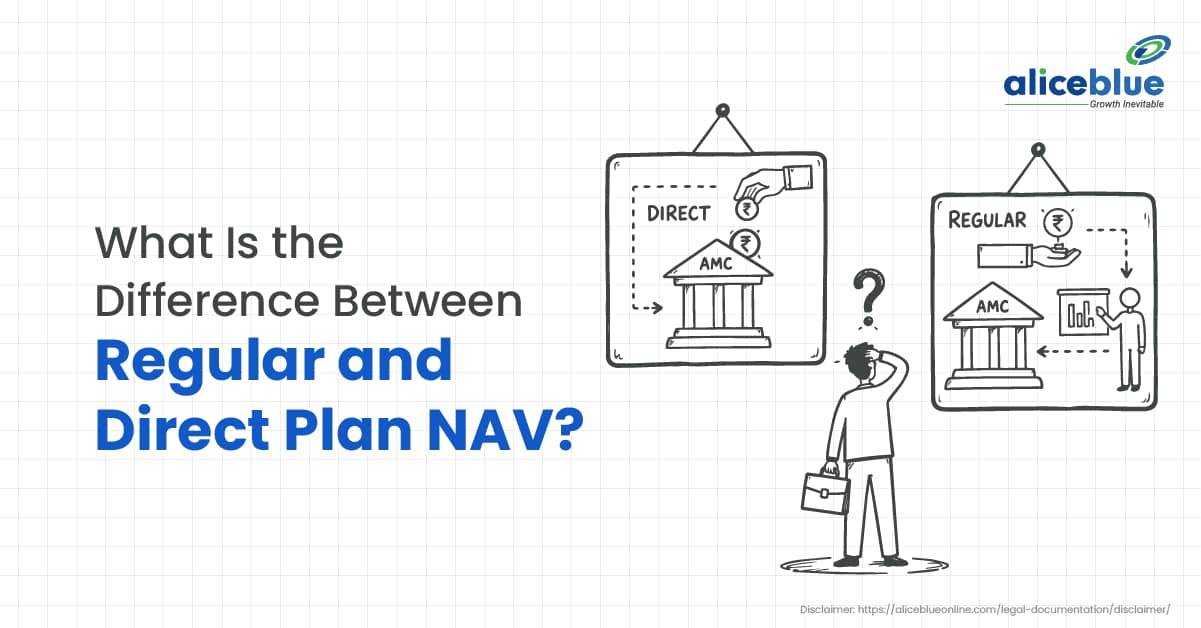
If you are new to mutual fund investing in India, you may have seen the same fund name offered as a Regular Plan and a Direct Plan. The confusing part is that both show different NAVs even though they hold the same stocks or bonds. For many beginners, the higher NAV in the Direct Plan feels like a “more expensive” option, but that is not how it actually works.
In this article, you’ll understand Regular and Direct Plans, why their NAVs differ, and how that affects your returns and choice of plan. By the end, you’ll read mutual fund pages more confidently and know whether to pay for advice or keep more of your returns for yourself.
What Is NAV in a Mutual Fund?
NAV stands for Net Asset Value. It is the price of one unit of a mutual fund on a given day. The NAV is worked out like this:
NAV = (Total Assets − Total Liabilities) ÷ Total Number of Units Outstanding
When you invest ₹10,000, the number of units you get is:
Units = Investment amount ÷ NAV
So if the NAV is ₹20, you get 500 units; if the NAV is ₹25, you get 400 units. The total value on day‑one is still the same, but the number of units changes. What matters over time is how much the NAV grows and how much is taken out in fees.
What Are Regular and Direct Plans?
The same mutual fund scheme is sold in two formats:
- Regular Plan: Sold through brokers, distributors, or banks.
- Direct Plan: Bought directly from the fund house or via a digital platform, with no distributor.
The portfolio, the mix of stocks, bonds, or hybrid assets, is identical in both plans. The only difference lies in who gets paid and how much is deducted from the fund’s value every day, the Total Expense Ratio or TER.
How Fees Affect the NAV?
To see how NAVs differ, you need to understand where the money goes.
- Regular Plan:
- The fund house pays a commission to the distributor or broker (this is built into the TER).
- So your investment is, in practice, used to cover management costs plus distributor fees.
- Because more is deducted daily, the NAV grows a bit slower compared to the Direct Plan.
- Direct Plan:
- There is no distributor involved.
- The fund still charges for management, but there is no trailer commission.
- The TER is lower, so less is taken out of the fund every day.
- This lets the Direct Plan NAV grow slightly faster, which is why it ends up higher over time.
Put simply, Direct Plan NAV is higher than Regular Plan NAV for the same scheme, because its fees are lower.
A Simple Example With Indian Numbers
Let’s use a common example to make this real.
Suppose you invest ₹1 lakh in a well‑known equity fund, say “XYZ Equity Fund”, over 10 years. Assume:
- Gross annual return (before expenses): 12%
- Regular Plan TER: about 2.25%
- Direct Plan TER: about 1.25%
Assume on the first day:
- Regular Plan NAV: ₹15
- Direct Plan NAV: ₹16
Now see how units work:
- Regular Plan Investor (Investor A)
Units = 1,00,000 / 15 = 6,667 units
- Direct Plan Investor (Investor B)
Units = 1,00,000 / 16 = 6,250 units
So Investor A gets more units because the Regular NAV is lower, and Investor B gets fewer units because the Direct NAV is higher. But on day one, both investors have ₹1 lakh in the fund.
What Happens After 10 Years?
Because the Direct Plan deducts less in fees, its NAV compounds more.
Assume the net annualised returns (after TER) are:
- Regular Plan: about 9.75%
- Direct Plan: about 10.75%
After 10 years:
- Investor A (Regular):
1,00,000 × (1 + 0.0975)10 = ₹2,55,000
- Investor B (Direct):
1,00,000 × (1 + 0.1075)10 = ₹2,78,000
The Direct Plan delivers about ₹23,000 more despite starting with fewer units. That gap comes from lower TER and slightly faster NAV growth.
Common Misunderstandings About NAV
Many investors get confused and think:
- “If Direct NAV is higher, it must be more expensive.”
That is not true. A higher NAV just means the fund’s net value per unit is higher. The cost to you depends on the number of units you own and the total value, not the NAV level. - “I should buy when the NAV is low.”
For the same fund, the NAV level does not tell you if it is “cheap” or “expensive”. What matters more is:- The underlying stocks or bonds
- The fund’s consistency of returns
- The expense ratio (Regular vs Direct)
Buying a low‑NAV Regular Plan instead of a high‑NAV Direct Plan of the same scheme will not save you money; it will only increase your fees and reduce your long‑term returns.
Myth vs Fact: NAV of Direct and Regular Plans
Myth | Fact |
Direct Plan NAV is higher, so it is more expensive. | A higher NAV only means the fund’s net value per unit is higher. The Direct Plan actually charges lower fees, so your net returns are often better. |
Lower NAV means a better deal. | For the same fund, the NAV level itself does not decide value. A Regular Plan’s lower NAV often comes from higher fees, not better pricing. |
I should switch from Direct to Regular to get more units. | Getting more units in a Regular Plan does not help if the TER is higher. Over time, the Direct Plan usually gives a larger corpus because of lower deductions. |
This table helps you recognise when you are reacting to NAV level instead of thinking about fees and compounding.
Key Differences: Regular Plan NAV vs Direct Plan NAV
Feature | Regular Plan | Direct Plan |
Who sells it | Distributors, brokers, banks | Direct from AMC or an online platform |
Distributor commission | Yes, included in TER | No |
Expense ratio (TER) | Higher | Lower |
NAV level (same scheme) | Lower | Higher |
Number of units (same investment) | More units | Fewer units |
Long‑term return potential | Slightly lower due to higher fees | Slightly higher due to lower fees |
Suitable for | Investors who need guidance and support | Investors who can manage independently |
The takeaway: Direct Plan NAV is higher because less is taken out in fees every day, not because it is more expensive.
When Regular Plans Make Sense
Regular Plans are useful if:
- You are new to mutual funds and want help in choosing the right funds and deciding how much to invest.
- You like having a broker or advisor review your portfolio, suggest rebalancing, and explain tax‑related points.
- You are not yet comfortable using online platforms to track your own investments.
In short, you are paying for advice and hand‑holding. Regular Plans are not wrong; they are a service‑based model where your fees fund both management and distribution.
When Direct Plans Are Better
Direct Plans usually work better if:
- You are comfortable using apps (broker, AMC, or digital platforms) and can read basic fund facts on your own.
- You want to keep fees as low as possible so more of the returns stay with you.
- Your investment horizon is long (10-15 years or more), where even a 1% difference in net return can add up to lakhs.
For disciplined, self‑investing readers who will track their funds from time to time, Direct Plans are typically the more cost‑efficient choice.
Practical Risks and Limitations
Even though Direct Plans are cheaper, there are a few things to keep in mind:
- You are on your own for guidance
If you choose Direct Plans, you will not get regular calls or updates from a distributor. You have to track your funds, rebalance when needed, and decide when to exit or change schemes. - Switching is not always free
Moving from Regular to Direct can trigger:- Exit load (if you are within the exit‑load period)
- Capital gains tax on short‑term profits
These costs may eat into the benefit of lower TER, at least in the short term.
- Direct does not mean “better” in every case
A low‑fee Direct Plan that does not match your risk or goal is still a poor choice. The wrong fund in Direct is not better than the right fund in Regular just because the TER is lower.
When Should You Consider Switching?
Switching from a Regular to a Direct Plan is not a one‑time move. It makes sense in a few situations:
- Start new SIPs in Direct Plans for fresh goals like child education or retirement.
- If you have a large, long‑term Regular‑plan SIP and are comfortable managing on your own, consider a partial or staggered switch after checking exit load and tax.
- If a Regular‑plan fund has a high TER and poor returns, it may be better to exit and move to a suitable Direct‑plan fund instead of just switching within the same name.
- If you use a fee‑only advisor, keep mutual funds in Direct Plans to keep TER low and avoid paying for distributor commissions.
Common Mistakes Beginners Make
- Focusing only on NAV: A low NAV is not a “good deal” and a higher NAV in Direct usually means lower fees, not higher cost.
- Ignoring expense ratio: Regular Plans may show similar returns on paper, but higher fees cut into your actual gains.
- Switching in a rush: One‑off, panic‑driven switches can trigger tax and exit charges; always check tenure, tax, and exit load.
- Picking Direct just because it’s cheaper: A low‑fee but unsuitable fund can still underperform; always match the fund to your risk and goals.
Who Should Choose Regular vs Direct?
Type of Investor | Suggested Plan | Why |
Total beginner who wants guidance | Regular Plan | Gets advice from a broker or advisor during the early learning years. |
Busy investor who wants periodical reviews | Regular Plan | Can rely on professionals to review portfolio health and suggest tweaks. |
Self‑investor comfortable with apps and research | Direct Plan | Saves on fees and keeps more of the returns. |
Investor with long‑term goals and large SIPs | Direct Plan | Small TER differences can add up to lakhs over 10-15 years. |
An investor using a fee‑only planner | Direct Plan | Pay the planner a clear, separate fee; keep mutual fund costs low. |
There is no single “correct” answer for everyone. The right choice depends on how involved you want to be and how much you are willing to pay for advice.
Frequently Asked Questions
Direct Plan NAV is higher because its expense ratio is lower. Less is deducted from the fund’s value every day, so the NAV compounds more. Regular Plan NAV is lower because more is taken out as fees, including distributor commission.
Direct Plans usually offer slightly higher net returns because they are cheaper. However, if you need guidance and are not comfortable managing your investments, Regular Plans may be more suitable for you.
Yes, you can switch existing Regular‑plan investments to Direct if you meet exit‑load rules and are okay with the tax impact. New SIPs can usually be started directly in Direct Plans.
No. For the same fund, the NAV level itself does not make it “cheap” or “expensive”. The key things are the expense ratio, the underlying assets, and your time horizon, not the NAV number.
For the same lump‑sum amount, you get more units in the Regular Plan because its NAV is lower. You get fewer units in the Direct Plan because its NAV is higher. Over time, however, the Direct Plan’s NAV often grows faster, which can lead to a larger total value.
No. The risk comes from the type of fund (equity, debt, hybrid) and the companies or bonds it holds, not from whether it is Regular or Direct. Both plans of the same scheme have the same underlying risk; only the cost structure is different.
Beginners can start with Regular Plans to get guidance and understand how mutual funds work. As they grow more confident and comfortable with research and tracking, they can move new SIPs (and, where sensible, existing holdings) to Direct Plans.

Blog by Aliceblue News Desk


