
What Is Remittance? How It Works for Indian Workers Abroad
Blog by Aliceblue News Desk
14 April 2026
5 minutes
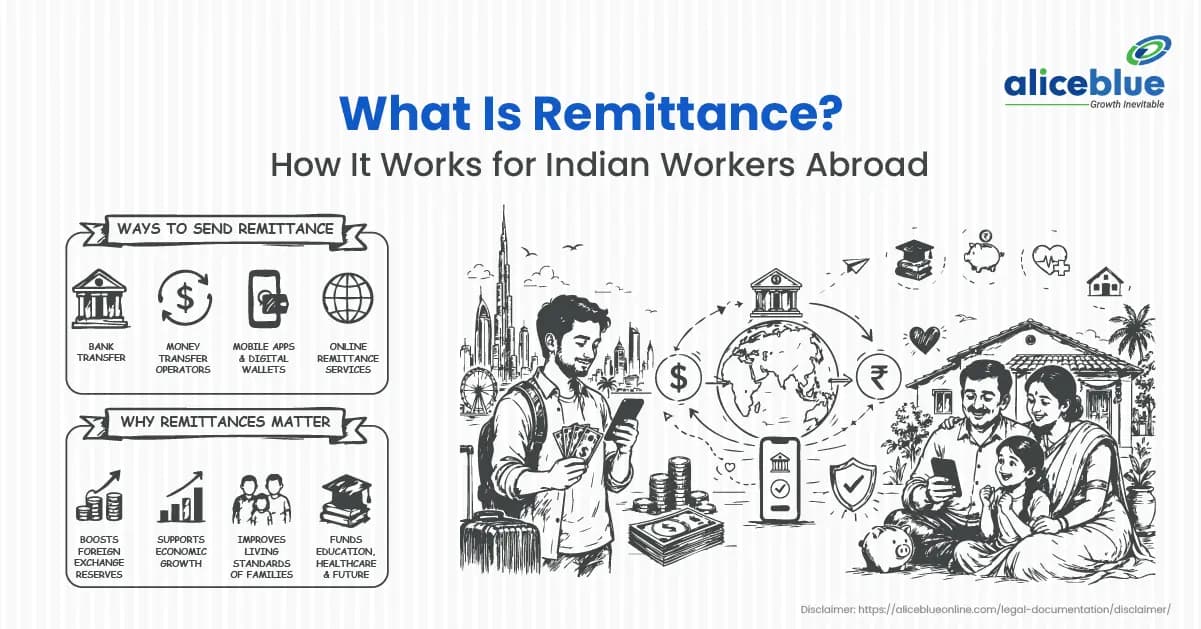
Indians who are working overseas leave their homes to support their families back in India. Picture a mother in Kerala checking her phone to see funds from her son’s salary arrive just in time for a medical bill or wedding costs. These remittances help families with daily needs and strengthen India’s economy.
If you’re new to this and receive or send money like this, this simple guide explains everything clearly. You’ll learn what remittances are, how they work step by step, current costs, real examples, basic rules, and easy ways to invest in stocks.
What Is Remittance?
Remittance describes monetary transfers across country lines, usually by workers abroad to their families in India. A Dubai foreman sends monthly pay to relatives in Tamil Nadu. Or a healthcare worker in Australia pays medical bills in Uttar Pradesh.
Millions of Indians live abroad, many in Gulf countries. This makes India the top recipient. The Reserve Bank of India oversees this under FEMA rules for financial stability. Remittances come from salaries, unlike loans.
Digital tools have broadened access by 2026, and banks handle big amounts. Funds go to school, homes, or stock accounts.
How does remittance work?
Here’s the simple step-by-step process to send money home:
- Senders use a banking portal, an online provider like Wise, or an operator such as Western Union for transfers to India.
- They provide the recipient’s name, bank account, IFSC code, and amount.
- The interface reveals charges alongside the day’s exchange rate.
- Payments move along the SWIFT system in banking channels, arriving within minutes to up to two days.
- Recipients get a notification, and the money shows up in their savings account or NRE account right away.
RBI allows unlimited inward remittances for most cases, but outbound remittances under LRS (Liberalised Remittance Scheme) have a yearly limit with TCS (Tax Collected at Source). UPI supports small cross-border payments up to daily limits set by banks.
Real-Life Example
Anil earns QR 5,000 monthly as a Qatar driver. He sends QR 2,000 (₹45,000) to his wife in Hyderabad for family expenses.
- Remitly charges QR 10 with an exchange rate of QR 1 = ₹22.65, compared to banks at QR 22.40.
- The recipient gets ₹45,300 in the SBI account in 20 minutes.
- Bank transfers cost QR 50 plus a 2% margin, yielding only ₹44,000.
Difference: ₹1,300 loss = one month’s basic groceries.
Benefit: Digital platforms provide faster and lower-cost delivery of funds.
Key Features
Current remittance services offer:
- UPI supports small transfers from Gulf countries.
- Tracking through mobile notifications and RBI portals.
- Fees range from low amounts on apps to higher bank charges.
- TCS applies to outbound transfers over certain limits; inbound family money is generally exempt.
- NRE accounts provide tax benefits on interest.
- Biometric verification for quick setup.
All this makes transfers safer and quicker for everyone involved.
Advantages for Indian Workers
- Overseas workers can send reliable support back home, especially when local jobs are scarce.
- Digital services often cost less than banks.
- Funds arrive much faster than traditional methods.
- Extra money can go into mutual funds or stock accounts.
- RBI reference rates help manage currency changes.
Risks and Limitations
- Fake websites steal account details. Use only RBI-approved services.
- Exchange rates can reduce the amount received.
- TCS applies to large outbound transfers.
- Bank delays occur during holidays and festivals.
- Undeclared gifts from non-family may attract taxes and penalties.
- Always choose licensed providers for safety.
Remittance Methods Comparison
Method | Time Required | ₹1 Lakh Expense | Protection Level | Primary Suitability |
Bank Wire | 1-3 days | ₹800-2,000 | High | Large amounts, NRE accounts |
Online Services (Wise) | Minutes | ₹250-600 | High | Routine kin support |
Western Union | Immediate | ₹500-1,000 | Standard | Account-free collections |
Global UPI | Immediate | ₹50-200 | High | Quick payments from your phone |
Unregulated Paths | 1 day | Zero | Minimal | Avoid—risks fines and scams |
Key takeaway: Digital platforms suit expatriates for frequent transfers, while banks offer greater security for large amounts.
Investing Remittances in Stocks
Remittances received in bank accounts can support stock investments. Investors may allocate funds to a demat account for shares such as HDFC Bank or Reliance Industries, where historical returns have exceeded fixed deposit rates.
NRIs often use NRE accounts for Indian equities. Residents typically invest savings through systematic plans. Consistent contributions help build long-term wealth.
Gulf workers value speed for regular sends. Professionals manage higher volumes. Local income holders may prefer direct investments.
2026 Regulatory Updates
RBI refined UPI corridors last quarter, doubling ceilings to ₹2 lakh amid pilot success with UAE banks. TCS schedules hold 20 per cent LRS tail, with 5 per cent concessions for verified education outflows. New biometric mandates cut fraud 40 per cent year-over-year. Projections peg FY26 totals near $140 billion, buoyed by tech sector migrations.
Conclusion
Remittances provide essential financial support for Indian families by channelling overseas earnings into practical uses like education and healthcare. Key takeaways include selecting cost-effective transfer methods, adhering to RBI regulations, and allocating surplus funds toward investments such as stocks.
Ready to turn your remittances into growing investments? Open a free demat account with Alice Blue today and start trading stocks like HDFC Bank or Reliance with zero account opening fees.
Frequently Asked Questions
Family remittances received in India generally incur no tax. Outbound transfers under LRS exceeding certain limits attract TCS. Non-family gifts above basic thresholds require declaration.
Digital services typically charge lower fees than traditional banks for UAE-India routes.
India places no general limit on inbound remittances. Sending countries may have their own restrictions.
Yes, received funds can be transferred to demat accounts for stock market investments. NRIs often use NRE accounts for Indian equities.
Major banks like State Bank of India, HDFC Bank, and ICICI Bank offer reliable NRI remittance services with varying fee structures.

Blog by Aliceblue News Desk


