
Sensex 0DTE by 1LyAlgos: How This Expiry Day Strategy Works
Blog by Aliceblue News Desk
28 August 2026
11 minutes

Sensex 0DTE by 1LyAlgos sells a Sensex call and a put at the same strike price on expiry day. It enters at 1:00 PM and exits by 3:20 PM, or earlier if the premium drops 30%. The trade makes money when Sensex stays quiet for the rest of the day. Over a 15-month backtest, it won 63.32% of the time and made ₹77,603 on ₹3,20,000 of capital.
Table of Contents
- What Is Sensex 0DTE by 1LyAlgos?
- How the Strategy Works
- What Actually Happened in August 2026
- Key Features
- Advantages
- Risks and Limitations
- Tips for Beginners
- Short Straddle vs Hedged Alternatives
- Common Mistakes to Avoid
- Who Should Use This Strategy?
- How to Access This Strategy
- Conclusion
- FAQs
Say you check Sensex at 2:45 PM on a Thursday. The index has barely moved all day. That quiet session is exactly what a short straddle is built to profit from. A short straddle means selling both a call option and a put option at the same price level, so you earn money if the market stays flat.
Sensex 0DTE by 1LyAlgos is a strategy built on this idea. It follows fixed rules to sell options on the day they expire and closes the trade the same afternoon. It bets on the market staying calm, not on picking a direction. Below you will see how it works, what it has actually earned in recent months, and where it can hurt you.
What Is Sensex 0DTE by 1LyAlgos?
0DTE means zero days to expiry. The option contract expires on the same day it is traded. Sensex options currently expire every Thursday on the BSE. So a Sensex 0DTE trade opens and closes within one Thursday session. Nothing is carried overnight.
Sensex 0DTE by 1LyAlgos uses this same-day window to run a short straddle. It sells one call and one put at the same strike price. A strike price is simply the price level at which the option can be exercised. The strategy collects the premium, meaning the price the buyer pays for the option, upfront. It profits if Sensex does not move much before the market closes.
The trade is placed and managed by a program on Alice Blue’s 1LyAlgos platform. This program follows a fixed set of coded rules to decide when to buy or sell, without a person watching the screen live. Alice Blue’s algo trading section and its options trading section on the website explain the basics if you want to read up before trying this.
How the Strategy Works
- The system waits until 1:00 PM. No trade is placed at market open. By early afternoon, most of the day’s price movement has already happened, so the remaining option premium gives a fairer sense of how much room is left for the market to move.
- It sells a call and a put at the same strike. This combination is the short straddle. Selling means the strategy receives money upfront instead of paying for it.
- The premium collected is the maximum possible profit. There is no separate profit target. The goal is simply to keep as much of that premium as possible.
- Time decay works in its favour. Options lose value every hour as expiry gets closer. This is called theta decay, or simply time decay. Since the trade is entered on the actual expiry day, this decay happens fast.
- Two exit rules run side by side. The trade closes at 3:20 PM. Or it closes earlier if the combined premium has already dropped 30% from entry. Whichever happens first wins.
- The system buys back both options. This closes the position. The gap between what was collected at entry and what was paid to exit becomes the trade’s net result.
- The cycle restarts the next Thursday, since Sensex has a weekly expiry.
What Actually Happened in August 2026
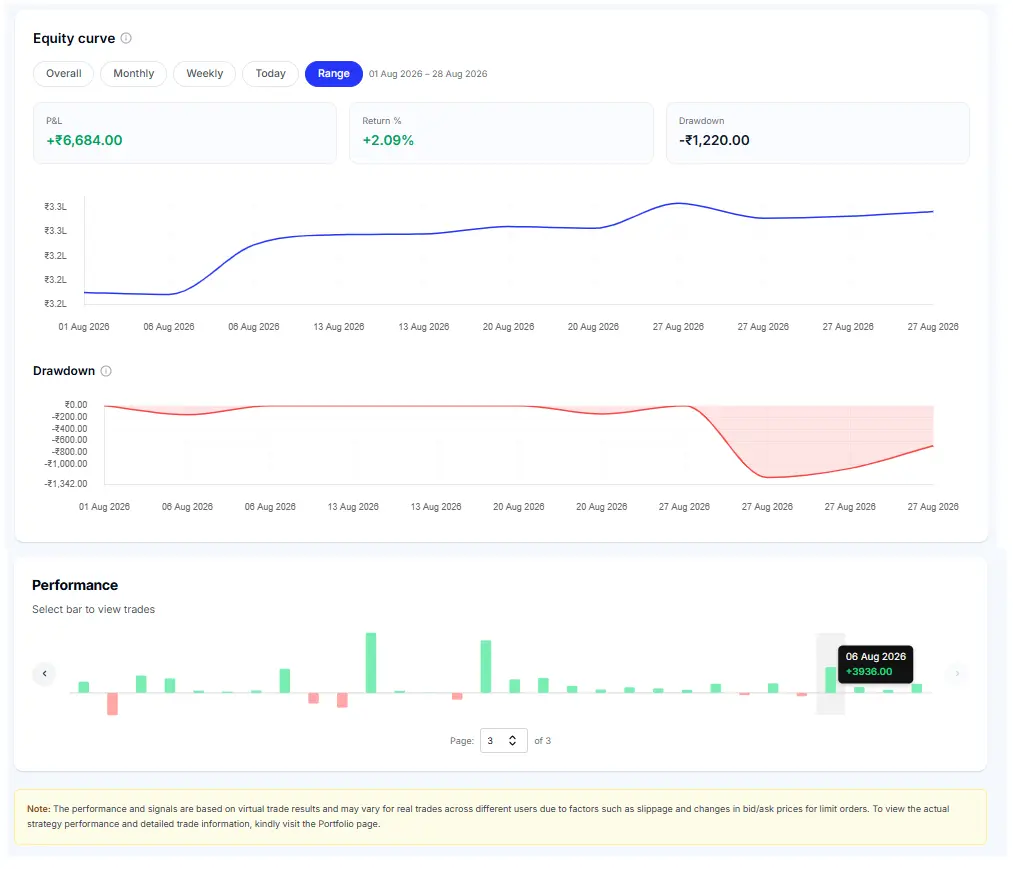
Here is the trade log from the strategy’s factsheet.
Expiry Date | Net P and L |
06 Aug 2026 | plus ₹3,936 |
13 Aug 2026 | plus ₹901 |
20 Aug 2026 | plus ₹466 |
27 Aug 2026 | plus ₹1,381 |
Total (August 2026) | plus ₹6,684 |
On ₹3,20,000 of capital, that works out to about a 2.1% gain for the month. This gain came from four separate trades, not one big bet.
Now zoom out to the full backtest period of 1 year, 3 months, and 10 days. Over that stretch, the strategy shows a 63.32% win rate and made ₹77,603 in net profit on the same ₹3,20,000. In plain terms, roughly 6 out of every 10 Thursdays were profitable. The other 4 were losses that the winning trades had to make up for.
Key Features
- Market neutral. The trade does not need Sensex to go up or down. It needs Sensex to stay roughly where it started.
- Fixed entry and exit time. Entry at 1:00 PM, exit at 3:20 PM, or the 30% decay rule. There is no guessing about timing.
- No overnight exposure. The position never carries past the trading session, so there is no risk from a sudden price jump caused by news breaking after market hours.
- Automatic execution. The program enters and exits exactly as coded. There is no manual override during the session.
- Weekly cycle. It runs every Thursday. Results build up expiry by expiry, not from a single trade.
Advantages
- No overnight risk. Nothing stays open past 3:20 PM, so a Budget day surprise or an overseas market move overnight cannot hit an open position.
- Profits in quiet markets. Many strategies need a big move to work. This one is built for a far more common situation: an afternoon where the index barely moves.
- Removes decisions made under pressure. Entry and exit are automatic, so a trader is not tempted to hold a losing trade a bit longer, hoping for a reversal.
- Small, repeatable gains add up. The August 2026 data shows four modest wins, not one large one. That is a steadier pattern than aiming for a single big trade.
Risks and Limitations
- The loss side has no limit. A short straddle can, in theory, lose an unlimited amount if Sensex makes a sharp move in either direction after entry. Both the call and the put can lose money at the same time.
- Close to 4 in 10 trades lose. A 63.32% win rate means losses happen regularly. They are not a rare exception.
- ₹3,20,000 is real, blocked capital. Selling options without a hedge, meaning a protective second trade, requires the broker to hold margin for the full duration of the trade. That money cannot be used elsewhere meanwhile.
- Event days can break the range. An RBI policy announcement, a Union Budget day, or sudden global news can move Sensex sharply within the entry to exit window. A market neutral strategy has no built-in defence against that.
- Backtests describe the past, not the future. ₹77,603 over 15 months is a historical result. Market conditions change, and the same setup can behave differently going forward.
Tips for Beginners
- Start with the smallest position size your broker allows. Scale up to the full ₹3,20,000 margin only once you are comfortable with how the trade behaves live.
- Never add more money to a losing straddle mid-trade to average it out. That increases risk instead of controlling it.
- Keep your own log of every expiry’s result. This helps you track your actual win rate, separate from the published backtest.
- Skip trading this strategy on days with scheduled major events, like Budget day or an RBI rate decision. These can cause sharp Sensex moves outside the normal range.
- Learn the basics of theta, meaning time decay, and implied volatility, meaning the market’s guess at how much the index will move, before running any straddle. Alice Blue’s option chain page shows this data live if you want to check it before you trade.
Short Straddle vs Hedged Alternatives
A short straddle with no protection is not the only way to trade a quiet expiry day. Traders who want to limit their downside often switch to a hedged version instead. Here is a plain language look at each one.
Strategy | What It Means | Max Profit | Max Loss | Best For |
Short straddle (this strategy) | Sell a call and a put at the same strike, no protection | Premium collected | Unlimited | Traders okay with unlimited risk |
Short strangle | Same as a straddle, but the call and put strikes are set apart, giving more room before a loss starts | Premium collected | Unlimited, but a wider safety margin | Traders wanting more breathing room |
Iron condor | A short strangle plus one extra option bought on each side to cap the loss | Premium collected minus hedge cost | Capped at a known amount | Beginners wanting a defined risk limit |
Iron butterfly | A short straddle plus one extra option bought on each side to cap the loss | Premium collected minus hedge cost | Capped at a known amount | Traders wanting defined risk in a tight range |
A short straddle collects more premium upfront than its hedged versions. The trade-off is that losses are not capped. Iron condors and iron butterflies buy one extra option on each side specifically to put a ceiling on the loss, even though this slightly reduces the profit. This is usually the next step for traders who find the plain straddle too risky after trying it in small size.
Common Mistakes to Avoid
- Letting a losing trade run past 3:20 PM. Holding on, hoping for a reversal, removes the one advantage this strategy is built on, which is no overnight risk.
- Trading without the full margin available. Entering without the full ₹3,20,000 in place can trigger a forced square off by the broker at a bad price.
- Assuming a 63.32% win rate means no risk. Sizing every trade as if it will win ignores that nearly 4 in 10 trades, historically, did not.
- Overriding the program mid-session. Manually closing or holding a position against the coded rule is usually driven by fear or greed, and it tends to make outcomes worse, not better.
- Skipping F and O activation on your trading account. Some traders find out only on expiry day that their account is not approved for futures and options trading. Alice Blue’s demat account page explains how to check and activate this. Skipping this step blocks the trade entirely.
Who Should Use This Strategy?
This strategy suits intraday traders who already understand options basics and are comfortable selling premium rather than buying it. It works best for people who want an automatic, rule-based approach and have the margin capital to support it.
It is a poor fit for someone who has never placed an options trade before. A plain short straddle carries a loss potential with no upper limit, which a new trader may not be ready to sit through. It also does not suit traders who strongly believe Sensex will move sharply in one direction, since this strategy is built for the opposite situation. Long-term investors focused on equity or mutual funds have no real use for a same-day expiry strategy like this one.
How to Access This Strategy
Sensex 0DTE runs on 1LyAlgos, Alice Blue’s algo trading platform. Ready-made strategies like this one can be subscribed to and run automatically on your account, without writing any code
- Open or link an Alice Blue trading account.
- Go to the 1LyAlgos section.
- Review the strategy’s live performance and risk category.
- Subscribe with your chosen capital allocation.
- Check the platform’s current live numbers before subscribing, since performance shown live can differ slightly from a specific backtest report depending on the period covered. It also helps to check your brokerage costs and your margin requirement on Alice Blue’s calculator pages before you commit capital.
Conclusion
Sensex 0DTE by 1LyAlgos sells a call and a put on Sensex’s expiry day. It enters at 1:00 PM and exits by 3:20 PM, or on a 30% premium drop. The goal is to profit from a quiet market, not a directional move. Its backtest shows a 63.32% win rate and ₹77,603 net profit on ₹3,20,000 capital over 15 months. August 2026 alone added ₹6,684 across four expiries [file:1]. This strategy works well for traders who understand premium selling and margin. But it carries a loss potential with no upper limit on sharp moves. Do not start it with capital you cannot afford to lose, or without understanding the risk first.
Frequently Asked Questions
- 0DTE stands for zero days to expiry. The option contract expires the same day it is traded. For Sensex, that day is currently every Thursday on the BSE.
- Not as a first options trade. A short straddle carries a loss potential with no upper limit. It is better suited to someone who already understands margin, premium, and time decay.
- The strategy’s factsheet lists ₹3,20,000 as the margin required to run one lot of the short straddle [file:1].
- It means selling a call and a put at the same strike price and expiry date. The seller keeps the combined premium if the underlying does not move much, but the loss has no upper limit if it moves sharply.
- By 1:00 PM, less time value remains in the options, so time decay accelerates during the trade window. The day’s price range is also clearer by then than it would be at market open.
- Yes. Close to 4 in every 10 expiries in the backtest were losses. Because losses on a short straddle have no upper limit, one bad day can offset the gains from several smaller wins.

Blog by Aliceblue News Desk


