
Short Term vs Long Term Capital Gains: Key Differences Explained
Blog by Aliceblue News Desk
01 April 2026
12 minutes
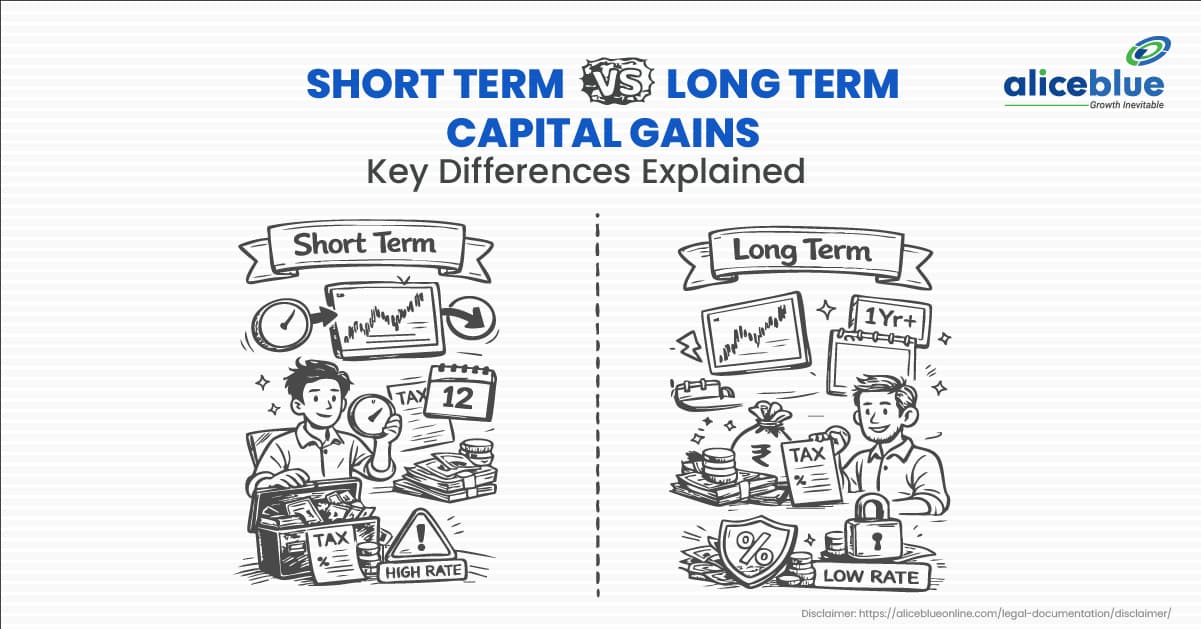
Whether you invest in SIPs, stocks, property, or gold, there is one rule: you do not pay tax when you put money in, but you may pay tax when you sell and make a profit.
These two rules decide how much tax you pay:
- Asset type:
- Equity mutual funds & listed shares
- Debt funds & bonds
- Property (land, house, flat)
- Gold (jewellery, coins, digital gold, ETFs, Sovereign Gold Bonds)
- Time you hold:
- Short‑term = held up to an asset‑specific threshold (12, 24, or 36 months)
- Long‑term = held beyond that threshold
In this blog, we will explain STCG vs LTCG simply, so beginners can save thousands in taxes legally.
What Are Capital Gains?
Capital gains mean the profit you earn when you sell an asset like mutual fund units, shares, property, or gold at a higher price than what you originally paid.
Simple formula:
- Capital Gain = Sale Price – Purchase Price
- Capital Gain = Sale Price – Purchase Price
Why SIPs and stocks are special:
With SIPs, you invest every month. With stocks, you often buy in many small steps. Because of this, you buy units at different prices each time. When you sell, the system uses the FIFO (First In, First Out) method: the units you bought first are treated as sold first.
Example:
- Jan 2025: ₹5,000 buys 100 units at ₹50 each
- Feb 2025: ₹5,000 buys 90 units at ₹55 each
- Mar 2025: ₹5,000 buys 85 units at ₹59 each
Total: 275 units, ₹15,000 invested.
You sell 150 units in July 2026 at ₹70 each = ₹10,500 received.
FIFO applies: first 100 units (Jan) + 50 units from Feb.
- Cost of 150 units = ₹5,000 + ₹2,775 = ₹7,775
- Profit = ₹10,500 − ₹7,775 = ₹2,725 (this is taxed as capital gain)
Same idea for stocks, property, and gold:
- Every time you buy, the date of purchase is recorded, and tax is calculated on the profit made on each separate buy or each group (lot) of units you sell.
- For property, you can reduce your taxable profit if you hold it for more than 24 months. This is called the indexation benefit.
- For gold, the tax depends on how long you held it:
- If you held it for 36 months or less, it is treated as short‑term and taxed at your normal income tax rate.
- If you hold it for more than 36 months, it is treated as long‑term and taxed at 20% after adjusting for inflation (indexation).
Key Point: Capital gains are not specific to SIPs. They apply whenever you sell stocks, mutual funds, property, or gold at a profit. The only change is how much tax you pay, based on:
- What you’re selling (equity, debt, property, gold type)
- How long you held it (STCG vs LTCG)
Short-Term Capital Gains
You pay STCG tax if you sell your equity mutual fund units within 12 months of buying them.
Equity funds = funds that keep 65% or more money in stocks (shares of companies).
Complete Step-by-Step Calculation:
- Determine which units are being redeemed (FIFO method).
- Calculate gain per unit: Sale NAV – Purchase NAV for each installment.
- Total STCG = (Gain per unit × Number of units) across all STCG units.
- STCG Tax = 20% × Total STCG
- Add 4% Health & Education Cess on the tax amount.
Real-World Example with Numbers
Scenario: You did a ₹10,000 monthly SIP in an equity fund for 6 months (Total ₹60,000).
NAV when you bought: Around ₹12-15 per unit.
You redeem everything after 8 months when NAV = ₹18.
FIFO sells your oldest 6 installments first:
- Total units bought: ~4,500 units
- Sale value: 4,500 × ₹18 = ₹81,000
- Total cost (SIPs): ₹60,000
- STCG = ₹21,000
- Tax = 20% × ₹21,000 = ₹4,200 + 4% cess = ₹4,368
Your net profit after tax = ₹16,632 (instead of ₹21,000 pre‑tax).
Why STCG is Costly
- No tax‑free exemption (unlike LTCG).
- Higher 20% rate vs LTCG’s 12.5%.
- No indexation benefit (can’t adjust for inflation).
- Only offsettable against Short‑Term Capital Losses (STCL).
In simple terms, frequent buying and selling can eat into your profits because of higher taxes.
Long-Term Capital Gains (LTCG)
Total LTCG across ALL your equity investments (MFs + stocks):
- ₹0 to ₹1.25 lakh: COMPLETELY TAX‑FREE every financial year
- Above ₹1.25 lakh: 12.5% flat tax rate
Detailed Calculation Process
- Calculate LTCG from this redemption using FIFO.
- Add LTCG from ALL other equity investments this FY.
- Apply ₹1.25 lakh exemption on total LTCG.
- Tax remaining amount @ 12.5% + 4% cess.
Comprehensive 15-Year SIP Example
Your 15‑year SIP journey:
- Monthly SIP: ₹5,000 × 12 months × 15 years = ₹9 lakhs total invested
- Current value after growth: ₹25 lakhs
- You’re retiring, want to redeem ₹5 lakhs this year
Tax calculation:
- LTCG from this redemption = ₹5 lakhs sale – proportionate cost = ₹3.5 lakhs gain
- If no other LTCG this year: First ₹1.25 lakhs tax‑free
- Taxable LTCG = ₹3.5L – ₹1.25L = ₹2.25 lakhs
- Tax = 12.5% × ₹2.25L = ₹28,125 + cess = ₹29,250
- Net cash in hand = ₹4.71 lakhs
Important Notes on Equity LTCG
- ₹1.25 lakh exemption applies to your total LTCG from ALL equity investments yearly.
- Exemption resets every financial year (April 1 – March 31).
- Only offsettable against Long‑Term Capital Losses (LTCL).
- No indexation benefit for equity funds (removed in Budget 2023).
Short-Term vs Long-Term Capital Gains in Stocks & Mutual Funds
These rules apply not only to SIPs, but also to listed shares and equity mutual funds. The idea is the same. Hold longer, pay less tax, but the exact thresholds and rates stay the same across stocks and equity‑oriented mutual funds.
Feature | Short-Term Capital Gains (STCG) | Long-Term Capital Gains (LTCG) |
Applicable to | Listed equity shares, equity‑oriented mutual funds | Listed equity shares, equity‑oriented mutual funds |
Holding period (STCG) | Held ≤ 12 months from date of purchase | – |
Holding period (LTCG) | – | Held > 12 months from date of purchase |
STCG tax rate | 20% flat on STCG (plus 4% cess) | – |
LTCG tax rate | – | 12.5% on LTCG above ₹1.25 lakh per FY |
Tax-free amount (LTCG) | Nil | First ₹1.25 lakh of LTCG across all listed equity (stocks + equity MFs) is tax‑free each FY |
Indexation benefit | No | No (removed for listed equity from FY 2024-25) |
Loss set-off | Only against STCG (equity & equity MFs) | Only against LTCG (equity & equity MFs) |
Example gain: ₹2 lakh | Tax = 20% × ₹2 lakh = ₹40,000 (+cess) | Tax only on ₹0.75 lakh (₹2L – ₹1.25L) = ₹9,375 (+cess) |
One‑line takeaway for stocks & equity MFs:
Hold beyond 12 months to shift from 20% STCG to 12.5% LTCG with the first ₹1.25 lakh profit tax‑free every financial year.
Short-Term vs Long-Term Capital Gains in Property & Gold
For property and gold, the rules change. The changed thresholds are 24 or 36 months, and indexation becomes more relevant.
Asset / Feature | Short-Term Capital Gains (STCG) | Long-Term Capital Gains (LTCG) |
Property (land, house, flat) | Held ≤ 24 months | Held > 24 months |
STCG tax rate (property) | Gain added to income; taxed at your slab rate (up to 30% + cess) | – |
LTCG tax rate (property) | – | Either 12.5% without indexation or 20% with indexation, whichever is lower (from 23 Jul 2024) |
Indexation (property LTCG) | No | Yes, if choosing 20% with indexation route |
Tax-free exemption (like ₹1.25L) | No | No blanket exemption; only indexation / Section‑54‑type roll‑over benefits |
Gold (jewellery, coins, bars, digital) | Held ≤ 36 months → STCG at your slab rate | Held > 36 months → LTCG at 20% with indexation (original regime) |
Gold ETFs / FOFs (after 1 Apr 2023) | Any period → taxed at slab rate, no indexation | Same: slab rate, no indexation |
Sovereign Gold Bonds (SGBs) – sale before maturity | Listed on exchange; ≤ 12 months treated as STCG (slab‑like) | > 12 months treated as LTCG (commonly ~10%, check latest CBDT) |
SGBs – redemption at maturity | N/A (not taxed) | Capital gains exempt |
How to Calculate SIP & Stock Taxes (Step-by-Step)
Capital gains tax is the tax you pay on profit from selling shares, mutual funds, or property. Beginners can calculate it with easy steps using sale minus buy price.
Steps:
- Find profit: Sale price minus what you paid (plus any fees).
- Check time held:
- Under 1 year (for stocks/equity MFs) → Short‑term (higher tax).
- Over 1 year (for stocks/equity MFs) → Long‑term (lower tax).
- Pick rate:
- Short‑term shares/equity MFs = 20%.
- Long‑term shares/equity MFs = 12.5% only on profit above ₹1.25 lakh (running total across all equity sales that FY).
- Subtract the tax‑free part, then multiply by the rate.
Platforms like Alice Blue provide clear FIFO reports showing exact buy dates and gains for your ITR.
Example: Buy shares for ₹1 lakh, sell for ₹2 lakh after 2 years.
- Profit = ₹1 lakh.
- LTCG = ₹1 lakh, which is below ₹1.25 lakh → ₹0 tax (if no other equity LTCG that FY).
Latest 2025-26 Tax Updates (Still Valid in 2026)
Budget 2024 changes (effective from FY 2024-25, still valid in 2026):
Category | Old Rules (STCG) | New Rules (2024-26) |
STCG rate (equity shares/MFs) | 15% | 20% |
LTCG rate (equity) | 10% | 12.5% |
LTCG exemption (equity) | ₹1 lakh | ₹1.25 lakh |
Debt funds at maturity | LTCG with indexation | Taxed at slab rate; no LTCG benefit |
Indexation for debt funds | Available | Removed (all funds) |
Key Implications for Investors:
- A higher STCG rate (20%) makes short‑term holding more expensive.
- Increased LTCG exemption (₹1.25L) benefits long‑term investors more.
- Debt SIPs lost their LTCG advantage – now taxed at slab rates regardless of holding.
- FIFO is mandatory across all platforms.
- FY 2026-27 Status: No further changes announced as of March 2026. Watch Union Budget 2026 for updates.
Smart Tax Saving Strategies
Smart tax saving strategies help beginners in India pay less tax legally by using simple investments and rules before March 31, 2026. Top blogs like ClearTax, Bajaj Finserv, and HDFC Funds highlight easy options under Section 80C and health insurance for salaried people.
Top Strategies:
- Invest in PPF: A government savings account with 7-8% interest. Put up to ₹1.5 lakh yearly under 80C. No tax on interest or maturity.
- Choose ELSS Funds: Stock‑based mutual funds with a 3‑year lock‑in. Saves ₹1.5 lakh tax under 80C and grows faster than PPF. You can start ELSS SIPs easily with Alice Blue’s Rise app. They offer direct mutual funds with zero commission fees.
- Buy Health Insurance: Claim ₹25,000 under 80D for self/family premiums. Add ₹50,000 if parents are senior citizens.
- Hold equity investments > 12 months to stay under 12.5% LTCG and use the ₹1.25 lakh exemption.
- For property, consider holding over 24 months to unlock better LTCG options.
- For gold, think of the 36‑month rule for jewellery; SGBs held till maturity are tax‑efficient.
Short Term vs Long Term: Which is Better?
Long‑term capital gains are almost always better for beginners in India because they have lower tax rates and a free limit on profits. Short‑term gains tax you more, so hold investments over 1 year when possible (for stocks and equity MFs), and think in 24-36 months for property and gold.
Holding Time:
- Short‑term means you sell shares or equity funds within 12 months. Tax hits fast at 20% flat rate.
- Long‑term is selling after 12 months. Tax is just 12.5% on profits over ₹1.25 lakh (that amount is tax‑free each year).
Tax Comparison:
- Long‑term saves money on big profits. Example, ₹2 lakh profit short‑term = ₹40,000 tax. Same long‑term = tax only on ₹75,000 (₹2L – ₹1.25L) = ₹9,375 tax.
Type | Hold Time (Equity) | Tax Rate | Free Limit |
Short‑Term | Under 12 months | 20% | None |
Long‑Term | Over 12 months | 12.5% | ₹1.25 lakh/year |
When Short‑Term Wins:
Only if you need cash fast or expect a market fall. Otherwise, wait for the long term; your SIP units, stocks, and SGBs grow tax‑efficiently
Common Misconceptions about Capital Gains
People often get capital gains tax wrong. These five common mistakes can cost you money or trouble:
- Long-term profit is always tax-free – First ₹1.25 lakh long profit from shares or equity funds has no tax each year. More than that pays 12.5% tax. This limit adds up all your sales in one year.
- All sip units have the same holding time. Each monthly SIP buy starts its own 1-year period from the buy date. Sell the oldest buys first to pay less tax.
- Short-term tax uses your salary slab rate – Shares and equity funds pay a flat 20% short-term tax. Debt funds pay like your salary tax rate.
- Losses can offset any gains – Short losses cut only short profits. Long losses cut only long profits. Save unused losses for 8 years.
- Property sales get inflation adjustment – After 2023, most house long profits pay 12.5% tax. No price rise helped except for old buyers before 2001.
Conclusion
Short‑term and long‑term capital gains tax applies to SIPs, stocks, property, and gold. The basic idea is that holding longer usually means paying less tax on your profits. For equity mutual funds and stocks, staying invested for more than 12 months moves you from 20% short‑term tax to 12.5% long‑term tax, with the first ₹1.25 lakh of LTCG in a year tax‑free. For property and gold, holding for 24 or 36 months can also reduce tax through indexation or better LTCG rules.
By planning your SIPs, stocks, property, and gold around these periods, you can save tax legally while giving your money time to grow steadily.
FAQs
You pay capital gains tax only when you sell something (like shares, SIPs, property, or gold) and make a profit. You do not pay tax when you invest.
STCG means you sell an asset within a short period (like 12, 24, or 36 months, depending on the asset), and you usually pay more tax. LTCG means you hold the asset for a longer period, and the tax is lower with some benefits like exemptions or indexation.
No. You pay no tax when you invest in SIPs, stocks, property, or gold. Tax comes only when you sell or redeem and earn a profit.
For stocks and equity mutual funds (including SIPs):
- If you sell in 12 months or less, it is short‑term; taxed at 20%.
- If you sell after 12 months, it is long‑term; first ₹1.25 lakh of LTCG in a year is tax‑free, then the rest is taxed at 12.5%.
Yes. Short‑term loss can be used only against short‑term gain. Long‑term loss can be used only against long‑term gain. Unused losses can be kept for up to 8 years if you file your income tax return every year.
You can save tax by holding equity SIPs, stocks, property, and gold for longer wherever possible. Use the ₹1.25 lakh LTCG exemption, match losses with gains, and think of tax‑friendly options like SGBs held till maturity.

Blog by Aliceblue News Desk


