
How MFDs Can Conduct Successful SIP Drives: 7 Proven Strategies for Mutual Fund Distributors in India
Blog by Aliceblue News Desk
12 June 2026
17 minutes
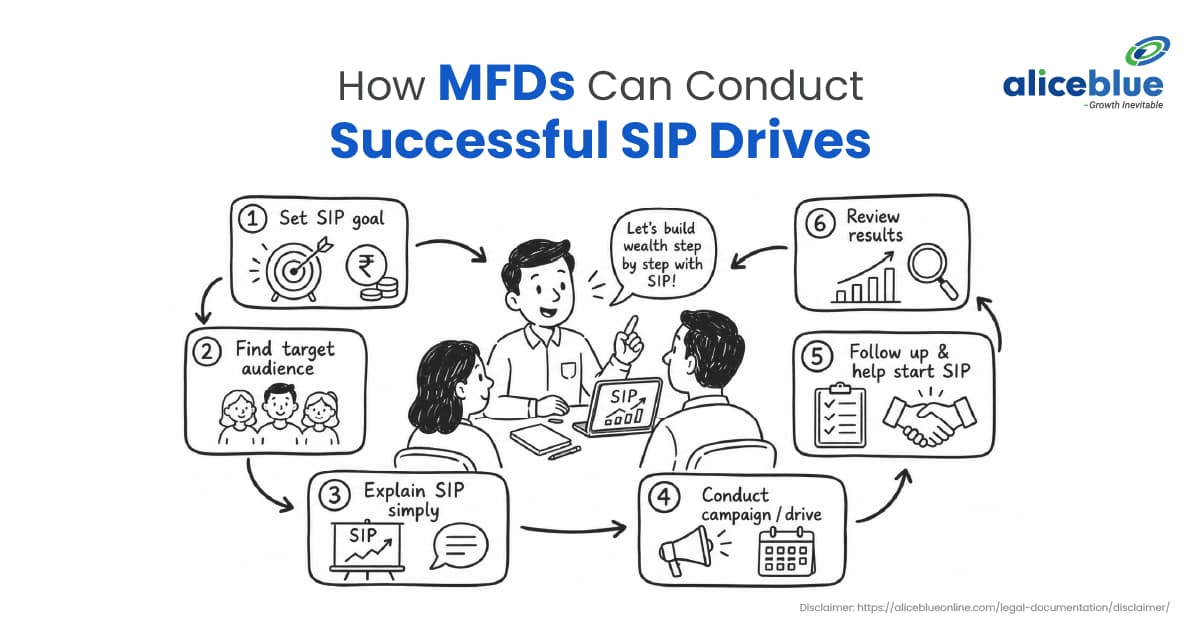
Most Mutual Fund Distributors in India struggle to grow beyond their existing client base. They wait for clients to call instead of building a steady stream of Systematic Investment Plan investors.
A SIP drive changes this. It is a focused campaign where you approach potential investors with a clear goal to convert them into monthly SIP investors. SIPs matter because they create recurring trail commissions for you while helping investors build wealth consistently.
Top MFDs across India have completed over 100 SIPs in a single day through focused campaigns. Others have built monthly SIP books exceeding 1.50 crore through consistent quarterly drives.
This guide shows how to plan and execute SIP drives. It includes real strategies, mistakes to avoid, and industry data from AMFI to show why this opportunity is real and growing.
What are SIP Drives for MFDs
A SIP drive is a targeted campaign where Mutual Fund Distributors actively approach investors to start Systematic Investment Plans. Unlike regular sales, where you wait for inquiries, a SIP drive involves reaching out to a specific group with a defined goal and timeline.
SIP drives matter because the numbers show the opportunity clearly. SIP contributions in India surged 45.24 percent on-year in FY2025 to reach 2.89 lakh crore. SIP assets now account for 20.31 percent of the overall mutual fund industry AUM as of March 2025.
The total number of contributing SIP accounts rose to 8.11 crore in March 2025, up 27.17 percent compared to April 2024.
This growth creates a direct business opportunity for MFDs who run organised SIP drives.
SIP drives work better when tied to themes. Common themes include:
- Retirement planning (show how early starts reduce the monthly burden)
- Children’s education (connect SIP amounts to future costs)
- Financial independence (demonstrate building passive income)
- Diwali special (position SIP as auspicious investment start)
- New Year goals (leverage resolution mindset)
The goal is not just selling one fund. It is building a SIP book that generates steady trail income while helping investors develop disciplined habits.
How SIP Drives Work: Step-by-Step Process
Step 1: Set SMART Targets
Do not say “I want more SIPs.” Say “I will complete 50 SIPs on March 15th.”
Use the SMART framework:
Element | What It Means | Example |
Specific | Clear numerical goal | “50 SIPs,” not “more SIPs.” |
Measurable | Track progress daily | “30 done, 20 remaining.” |
Achievable | Realistic based on your network | 50 if you have 400 contacts |
Realistic | Matches your capacity | Do not aim for 500 if you are new |
Time-bound | Fixed date | “By March 15, 2025” |
Calculate how many people to approach. If your conversion rate is 10 to 15 percent, you need to contact 10 times your target. For 50 SIPs, reach out to 500 people.
Step 2: Build Your Prospect List
Create a list in this order:
- Existing clients without SIPs – They already trust you, the highest conversion rate
- Friends and family – Warm relationships, easier to explain
- Professional contacts – Doctors, CAs, business owners with disposable income
- Community members – Religious groups, alumni networks, local associations
- Cold leads – Last resort, lower conversion, but expands reach
Pre-screen prospects. Focus on people with a monthly disposable income of at least 5,000. Do not waste time calling everyone in your phone book without checking if they can afford SIPs.
Step 3: Prepare Documentation Beforehand
Have these ready before the drive:
- KYC forms (digital or physical)
- Bank mandate forms
- e-Signature setup on tablet
- Mutual fund scheme brochures
- SIP benefit charts showing compounding
If investors say yes, but you need to return with documents, most will postpone. Delays kill conversions. Complete everything in one meeting.
Step 4: Run Investor Awareness Programs (IAPs)
Many MFDs use Investor Awareness Programs conducted by mutual fund houses to attract larger audiences. AMFI’s investor education initiatives support MFDs in reaching potential investors at scale. These programs provide credibility and help you reach 50 to 100 people at once instead of meeting them individually.
Step 5: Execute the Drive
On the drive day:
- Set up a comfortable meeting space with refreshments
- Have a colleague help with paperwork (splits workload)
- Keep meetings focused (15 minutes per investor)
- Offer same-day completion to reduce drop-offs
- Take photos of completed forms for your records
Top-performing MFDs across India follow this approach. They prepare prospect lists, meet people in structured batches, and complete documentation on the spot. Those who do this consistently build strong SIP books within 12 to 18 months.
Step 6: Follow Up Systematically
Most conversions happen after 3 to 5 interactions. MFDs who follow up within 48 hours convert more interested but non-converted prospects.
Create a follow-up schedule:
- Day 1: Call those who showed interest but postponed
- Day 3: Send educational WhatsApp about SIP benefits
- Day 7: Call again with answers to their questions
- Day 14: Final attempt, then move to long-term nurture
Send thank you messages to completed investors. Some MFDs give small gifts like plants. This creates goodwill and increases referrals.
Real Example: How SIP Drives Build Monthly SIP Books
Here is a realistic example based on industry benchmarks and AMFI data on average SIP amounts.
Case Study: A Consistent Monthly Drive Model
Background:
An MFD in a Tier 2 city runs one focused SIP drive every month on a fixed date. Using AMFI data showing the average SIP contribution per account at 3,167, here is how the numbers look over 18 months:
Metric | Details |
Drive frequency | Once per month, fixed date |
Target | 40 SIPs per drive |
Average SIP | 5,000 per investor (above AMFI average of 3,167) |
Prospect list size | 400 names before each drive |
Conversion rate | 10 percent (40 from 400 contacts) |
Follow-up | 3 calls within 10 days for non-converted |
Theme | Rotating: Retirement (Jan), Education (Apr), Diwali (Oct), New Year (Dec) |
Results After 18 Months:
- Total SIPs completed: 720
- Monthly SIP book: 36 lakh
- Annual trail commission at 1 percent: 3.60 lakh recurring annually
- Cost per drive: 18,000 (refreshments, printing, marketing)
- Total drive cost over 18 months: 3.24 lakh
- ROI by Month 12: Positive and compounding
What Makes It Work:
- Consistency: Same date every month creates a habit and momentum
- Existing clients first: Highest conversion rate since trust already exists
- Digital documentation: Reduces per-investor time from 45 to 15 minutes
- No fund-specific pitch: Focus on SIP strategy, not one scheme
- Top-up SIPs: Encourage existing SIP investors to add a 10 percent annual increase
Key Features of Successful SIP Drives
Clear Numerical Targets
Successful drives have specific goals. “100 SIPs on March 15” works better than “increase SIPs this quarter.”
Theme-Based Approach
Drives tied to life goals convert better. Retirement, education, marriage, or festival themes create emotional connection and urgency. Avoid personal dates like your birthday. Clients do not feel connected to your anniversary.
Time-Bound Campaign
SIP drives are concentrated efforts, not ongoing activities. Common formats:
- One-day drive (most common)
- Weekend drive (Saturday-Sunday)
- Week-long campaign (for larger markets)
Mutual Fund House Support
Many asset management companies support SIP drives with:
- Marketing collateral (banners, brochures)
- Training sessions on SIP benefits
- Investor presentation decks
- Sometimes, incentives or contests for top performers
Focus on First-Time Investors
As of March 2025, India had 5.34 crore unique individual MF investors, of which 25.91 percent were women. A large proportion of Indians are still outside the mutual fund ecosystem. These people represent the biggest opportunity for SIP drives.
Digital-First Documentation
Modern SIP drives use digital KYC, e-signatures, and online bank mandate setup. This reduces completion time from 45 minutes to 15 minutes per investor, allowing you to serve 20 plus people in one day.
Post-Drive Follow-Up
Do not stop after the drive. Call everyone who showed interest. Send educational content between calls. Investors who convert after the drive often need 3 to 5 touchpoints before committing.
Advantages of SIP Drives
For MFDs
Recurring Trail Income
SIP investments create predictable trail commissions. A 5,000 SIP at 1 percent trail generates 600 annually per investor. At 500 SIP investors with an average SIP of 5,000 each, this becomes 25,000 monthly recurring income that grows as your book expands.
Business Stability
A strong SIP book protects you during market downturns. When lump sum investments decrease in volatile markets, SIP investments often continue because investors use auto-debit mandates. This balance keeps your income steady.
Better Client Retention
Investors who start SIPs with you stay longer. Auto-debit mandates create habits, making them less likely to switch distributors. The AMFI Annual Report FY2025 shows that the proportion of SIP assets held for more than five years has increased substantially from March 2020 to March 2025, indicating investors are staying invested longer.
Scalable Process
Once you develop a SIP drive process, you repeat it monthly. The same preparation work generates consistent results over time.
For Investors
Disciplined Investing
SIPs enforce financial discipline by auto-deducting money before you can spend it. This helps investors who struggle with saving consistently.
Rupee Cost Averaging
When markets fall, 5,000 buys more units. When markets rise, it buys fewer units. Over time, this averages the purchase price and reduces timing risk.
Affordable Entry
Investors can start with 500 monthly, making mutual funds accessible to middle-class families who cannot invest large lump sums.
Compounding Benefits
At a 12 percent historical return:
- 5,000 monthly for 10 years = 1.15 crore
- 5,000 monthly for 15 years = 4.90 crore
- 5,000 monthly for 20 years = 12.86 crore
Early starters benefit significantly from compounding.
Risks and Limitations
Market Risk for Investors
SIPs do not guarantee returns. If markets fall consistently, investors may see negative returns in the short term. Some panic and stop SIPs during downturns, defeating the purpose.
How to Handle: Educate investors about market cycles before they start. Show historical data of SIP performance during the 2008 and 2020 market crashes and recoveries.
SIP Stoppage Rate
This is a real and documented risk. AMFI data shows the SIP stoppage ratio reached 75.63 percent in FY2025, with 514.17 lakh SIPs discontinued against 679.85 lakh new registrations. In February 2025, the stoppage ratio reached 122 percent, meaning more SIPs were stopped than started that month.
This is why investor education before and after starting a SIP matters more than the drive itself.
How to Handle: Conduct quarterly portfolio review calls. Investors who understand their financial goals continue SIPs through volatility. Address concerns before they become cancellations.
High Upfront Time Investment
SIP drives require 2 to 3 weeks of preparation for concentrated execution. Return on time investment takes 6 to 12 months to materialise through trail commissions.
How to Handle: Start small with 20 to 30 SIPs to build your process. Scale to 50 plus SIPs once you are comfortable.
Over-Promising Returns
Some MFDs make unrealistic return claims to convert investors. This creates trust issues when actual returns differ and damages your reputation long-term.
How to Handle: Always show historical returns with disclaimers. Explain that past performance does not guarantee future results. Focus on goals, not returns.
Compliance Requirements
MFDs must follow SEBI regulations: proper commission disclosure, risk factor explanation, and no unauthorised investment advice. You need a valid ARN (AMFI Registration Number) and a current AMFI certification.
How to Handle: Stay updated with AMFI certification requirements and SEBI circulars. Maintain documentation for all recommendations.
Comparison: SIP Drive vs Regular Client Acquisition
Aspect | SIP Drive | Regular Client Acquisition |
Timeframe | Concentrated (1 day to 1 week) | Ongoing, spread across months |
Target | Specific numerical goal (e.g., 50 SIPs) | No specific target |
Approach | Proactive outreach to many people | Reactive, waiting for inquiries |
Conversion Rate | 10 to 20 percent (higher due to focused effort) | 3 to 8 percent (typical warm inquiry rate) |
Preparation Time | High (2 to 3 weeks pre-planning) | Low to moderate |
Cost Per Acquisition | Higher upfront cost | Lower upfront cost |
Long-term Value | High (recurring SIP book) | Variable (depends on investment type) |
Best For | Building the SIP book quickly | Servicing existing clients |
SIP drives work better when you want to build a systematic SIP book quickly. Regular acquisition works for maintaining a steady business flow.
What NOT to Do During SIP Drives
These are industry-recognised practices that reduce conversion rates. Avoid them:
Do Not Use Your Birthday as a Theme
Clients do not feel connected to your personal anniversary. Use their goals instead, such as education, retirement, or marriage.
Do Not Run Fund-Specific Drives
Keep it scheme-agnostic. Focus on SIP as a strategy, not promoting one specific fund. This builds trust and avoids appearing biased.
Do Not Split One SIP Into Multiple Schemes
Follow a “one client, one SIP” starting policy. This gives accurate conversion numbers and prevents confusion. If someone wants 10,000 monthly, start with one scheme and review later.
Do Not Try to Acquire Brand New Clients During Drives
Existing clients convert faster. New clients need relationship-building time. Focus first on your existing base, then expand.
Do Not Ignore Top-Up SIPs
Existing SIP investors often want to increase amounts. Add an “inflation-beat” theme where investors increase SIP by 10 percent annually. This grows your SIP book without finding new clients.
Do Not Skip Follow-Up
Most conversions happen after multiple follow-ups. Giving up after one no means missing most of your potential conversions.
Do Not Target Without Screening
Some MFDs call everyone in their contact list without screening. Focus on people with a disposable income of at least 5,000 monthly. Do not waste time on those who cannot afford SIPs.
Common Mistakes Beginners Make
1. No Clear Target
Many MFDs start without specific goals. Without “50 SIPs on March 15,” you cannot measure success or stay motivated.
Fix: Write exact numbers before starting. Share your target with a colleague for accountability.
2. Poor Prospect List Quality
Approaching people who cannot afford SIPs wastes time.
Fix: Pre-screen based on income, financial goals, and investment awareness. Focus on people with a 5,000-plus monthly disposable income.
3. Focusing Only on Returns
When you talk only about returns, investors focus on short-term performance. They stop SIPs when markets fall.
Fix: Talk about financial goals, not returns. Show how SIPs help achieve education or retirement goals regardless of market conditions.
4. No Documentation Ready
If investors say yes, but you need documents from the office, many postpone.
Fix: Carry all forms, have digital KYC ready, and use tablet-based bank mandates. Complete everything in one meeting.
5. No Follow-Up System
Most conversions happen after multiple interactions. MFDs who give up after one no-miss, most potential conversions.
Fix: Call interested but non-converted investors within 48 hours. Send educational content between calls.
6. Ignoring Existing Clients
Many MFDs focus only on new clients. Existing clients with lump sum investments who have not started SIPs are the easiest to convert.
Fix: Review your existing client list first. These people already trust you and need only education to start SIPs.
7. Choosing the Wrong Theme
Generic themes like “invest in mutual funds” do not create urgency.
Fix: Use specific themes like “Start child’s education fund before school fee hike” or “Build 1 crore retirement corpus with 10,000 monthly.”
SIP vs US Dollar-Cost Averaging (DCA)
Systematic investing is not unique to India. In the US, investors use a similar strategy called Dollar-Cost Averaging (DCA). The AMFI Annual Report FY2025 notes that in the US, equity mutual fund AUM stood at USD 14,408.5 billion as of March 2025.
Feature | Indian SIP | US DCA |
Minimum Amount | 500/month | 50/month |
Tax Benefit | ELSS: 1.5 lakh deduction under 80C | 401(k): Pre-tax contributions |
Average Returns | 12 to 15 percent (equity MF historical) | 7 to 10 percent (S&P 500 historical) |
Popular Platforms | Groww, Zerodha, Alice Blue | Fidelity, Vanguard, Schwab |
Account Opening | 15 to 30 minutes (digital KYC) | 10 to 20 minutes (online) |
Warren Buffett recommends regular investing. In his 2013 Berkshire Hathaway shareholder letter, he instructed his trustee to invest 90 percent of his wife’s inheritance in an S&P 500 index fund through regular purchases. This is the same principle as a SIP.
The US 401(k) system enforces automatic monthly deductions from paychecks, similar to SIP auto-debit mandates in India. This shows that systematic investing works across markets and cultures.
Micro-SIP Strategy: Start Small, Grow Big
Do not wait for big-ticket clients. Encourage investors to start with 500 or even 250 monthly. Small SIPs build trust and consistency.
The logic behind this approach:
Micro-SIP → Consistency → Relationship → Bigger SIP → Referrals → AUM growth
Even 500 per month:
- Is affordable for most income levels
- Builds an investing habit that is hard to break
- Often grows to 2,000 to 5,000 as income and trust increase
- Creates a first-time investor who refers others to you
AMFI data shows the average SIP contribution per account is 3,167 as of December 2025. Many of these accounts started small. This shows most investors begin below the average and increase over time.
Portfolio Health Checks Before Selling
Before offering SIPs, conduct a free portfolio check for your prospect:
- Review existing insurance coverage and identify gaps
- Check savings account idle funds that earn low interest
- Review current investments for overlap or underperformance
- Identify financial goals that have no investment backing
Every portfolio assessment shows gaps that SIPs can fill. This builds trust before selling and improves conversion rates.
Who Should Use SIP Drives
Ideal for These MFDs
New MFDs Building Their Book
If you recently started as a mutual fund distributor with fewer than 50 clients, SIP drives help build a solid foundation quickly. Recurring income from SIPs provides stability as you grow.
MFDs in Tier 2 and Tier 3 Cities
AMFI data shows that Chandigarh, Himachal Pradesh, and Dadra and Nagar Haveli have SIP AUM accounting for more than 40 percent of their respective state total MF AUM as of March 2025. This confirms strong SIP adoption in non-metro markets. Cities like Indore, Jalandhar, Nagpur, and Coimbatore represent growing markets with lower MFD competition.
MFDs with Strong Local Networks
If you have good connections in your community, professional circle, or religious group, SIP drives leverage these relationships effectively.
Distributors Focused on Trail Income
If your business model prioritises long-term trial commissions over upfront commissions, SIP drives work well with your goals. A strong SIP book creates predictable income month after month.
MFDs Who Can Dedicate Focused Time
SIP drives require 2 to 3 weeks of preparation and concentrated execution. If you can block time for this, you will see results.
May Not Be Suitable For
MFDs with Only HNI Clients
If your entire client base consists of High Net-worth Individuals investing lakhs as lump sums, SIP drives may not align with your business model. These clients typically do not need SIPs.
Distributors Without AMFI Certification
You must have a valid ARN (AMFI Registration Number) and current AMFI certification to legally distribute mutual funds in India. Without these, you cannot conduct SIP drives.
MFDs Unwilling to Do Follow-Up
If you prefer one-time transactions and do not want to maintain relationships, SIP drives will not work. Success requires follow-up and investor education.
Those Seeking Quick Income
SIP drives build long-term income. Trail commissions take 6 to 12 months to materialise significantly. If you need immediate cash flow, this approach may not suit your current situation.
Digital Education Strategy
Use modern tools to support your SIP drives:
- Share SIP education through WhatsApp broadcasts to your prospect list
- Create short videos or Reels explaining SIP benefits in simple language
- Use digital onboarding platforms for a fully paperless SIP setup
- Conduct quarterly portfolio review calls with all SIP clients
- Send reminders when clients cross SIP milestones (1 year, 2 years, 5 years)
- Post SIP milestone celebrations on social media to build credibility
These tools help you reach more people with less effort and build trust before and after the drive.
Conclusion
Successful SIP drives need planning, preparation, and consistent execution. Set specific numerical targets using the SMART framework. Build quality prospect lists starting with existing clients. Choose emotionally resonant themes like retirement or education. Prepare all documentation for instant completion. Follow up systematically with non-converted prospects.
India’s mutual fund industry AUM reached 65.74 lakh crore at the end of March 2025, up 23.11 percent from the previous year. SIP contributions surged 45.24 percent in FY2025 to 2.89 lakh crore. Contributing SIP accounts stood at 8.11 crore with 27.17 percent growth year on year.
Yet India’s MF AUM to GDP ratio is only 19.9 percent as of March 2025, well below that of developed economies globally. This gap is the opportunity for every MFD that masters SIP drives.
Start small with 20 to 30 SIPs to build your process, then scale up. Focus on investor education over return promises. Prioritise long-term relationships over quick conversions. A strong SIP book creates recurring trail income, protects your business during market downturns, and builds genuine long-term client relationships.
Frequently Asked Questions
A SIP drive is a focused campaign where Mutual Fund Distributors actively approach potential investors to start Systematic Investment Plans. It has specific targets, timelines, and themes, often resulting in 50 to 100 plus SIPs in a single day.
MFDs earn trail commissions typically ranging from 0.5 to 1.5 percent annually on SIP investments. For example, a 10 lakh monthly SIP book at 1 percent trail generates 10,000 monthly recurring income. Multiple successful drives build this book steadily over time.
If your conversion rate is 10 to 15 percent, approach 10 times your target. For 50 SIPs, contact 500 people. Pre-screening based on income and financial awareness improves conversion rates significantly.
Popular themes include retirement planning, children’s education, Diwali special investments, New Year financial goals, and financial independence. Theme selection depends on your audience. Festival themes like Diwali and New Year typically show high conversion rates because of the goal-setting mindset investors bring.
Successful SIP drives require 2 to 3 weeks of preparation. This includes building prospect lists, preparing educational materials, coordinating with mutual fund houses for support, and scheduling meetings. The actual drive happens in one day or over a weekend.

Blog by Aliceblue News Desk


