
Systematic Withdrawal Plan (SWP): Meaning, Benefits, Tax & How to Start in 2026
Blog by Aliceblue News Desk
07 April 2026
7 minutes
Picture this: It’s the year 2035. You’ve finally built that hard-earned ₹50 lakh corpus in mutual funds after years of SIPs and smart investing. But now retirement is here, or your child’s education fees are due every month, or inflation is quietly eating away at your savings. You don’t want to sell everything in one go and risk running out of money. You also don’t want your money sitting idle in a bank FD where interest gets taxed at your full slab rate.
What if there was a way to withdraw a fixed amount every month, say ₹40,000, while the rest of your investment keeps growing? That’s exactly what a Systematic Withdrawal Plan (SWP) does.
Every individual has different financial needs. Some love lump-sum investing, others swear by SIPs for growth. But if you’re someone who now needs regular income from your investments, SWP is one of the smartest tools mutual fund houses offer. In this updated 2026 guide, we’ll cover everything, from the meaning of SWP to real examples, benefits, tax rules, and exactly how to start one.
What is SWP?
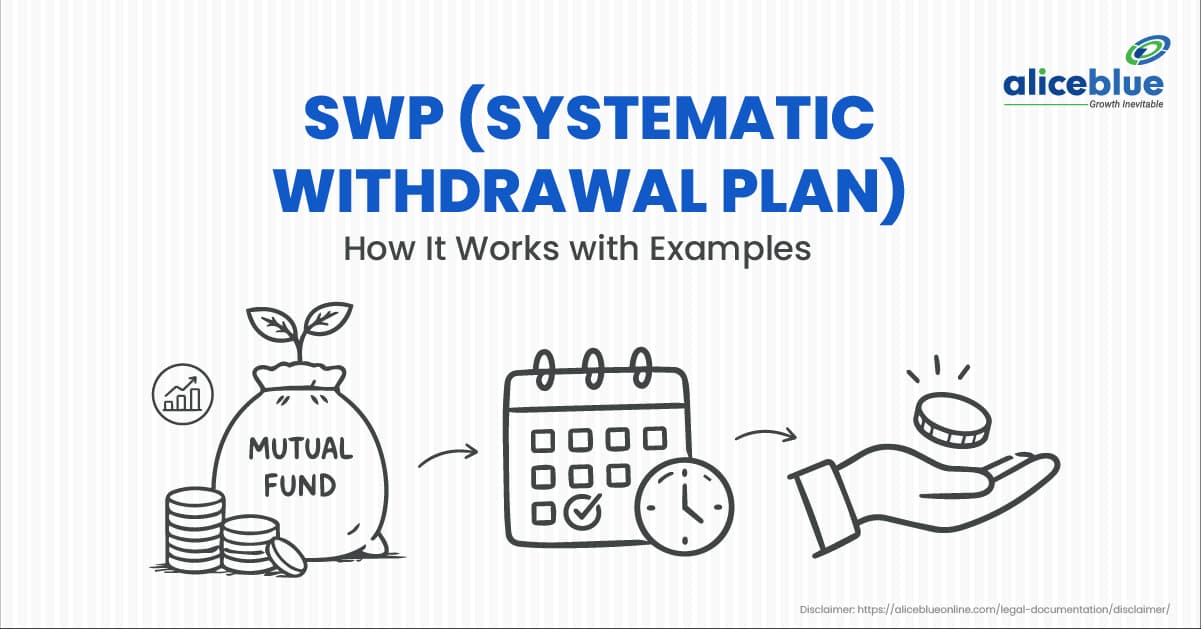
A Systematic Withdrawal Plan (SWP) is a mutual fund facility that allows investors to withdraw a fixed amount at regular intervals while keeping the remaining investment growing.
You can choose the amount and frequency of withdrawal. You can also choose to just withdraw the gains on your investment, keeping your invested capital intact. At the set date, units from your portfolio are sold, and the funds are transferred directly to your bank account.
Key Features of SWP
- It’s a facility to redeem units regularly.
- You can choose the frequency of withdrawals (monthly, quarterly, or yearly)
- You can either withdraw a fixed amount or only the capital appreciation
- It is ideal for investors seeking regular income from their investments
How Does a Systematic Withdrawal Plan Work? (Step-by-Step)
- You invest a lump sum (or already have existing units) in a mutual fund scheme.
- You activate SWP through your AMC app, Rise by AliceBlue, and select the withdrawal amount, frequency, start date, and type.
- On the chosen date each cycle, the fund house automatically sells the exact number of units needed to meet your withdrawal.
- The money is credited to your linked bank account (usually within 1–2 working days).
- Your remaining units stay invested and continue to earn market-linked returns.
Types of SWP
- Fixed Amount SWP: You withdraw a fixed amount (most popular).
- Appreciation SWP: You withdraw only the capital gains; your original principal stays untouched (perfect if you want to preserve capital).
Benefits of a Systematic Withdrawal Plan (SWP)
Here are some benefits offered by a systematic withdrawal plan:
Rupee Cost Averaging:
Whether you purchase or redeem units in installments, you benefit from Rupee Cost Averaging. Markets are volatile. With SWP, you redeem units regularly, selling fewer units when NAV is high and more when NAV is low. This averages your exit price and protects you from selling everything at the wrong time.
Ideal in a Bull Run:
While most investments offer great returns in a bull run, if your annual withdrawal is lower than the scheme’s returns, your corpus lasts much longer. You can pocket gains during the bullish phase while the remaining investment keeps growing.
Investment Discipline:
Just like SIP teaches disciplined investing, SWP prevents you from making panic withdrawals during market corrections. It enforces a structured income plan.
SWP in Action: Real-Life Example with Rupee Cost Averaging
Sahil invested ₹5 lakh in a mutual fund scheme in April 2026. The NAV was ₹500, so he received 1,000 units. At the end of 5 months, he withdrew ₹2.5 lakh in one go.
Pranav invested the same amount in the same scheme at the same NAV but opted for an SWP of ₹50,000 every month for 5 months.
Here’s how the NAV moved over 5 months:
- 500 → 515 → 510 → 525 → 530 → 498
Sahil’s lump-sum withdrawal:
- In the final month (NAV ₹ 498), he redeemed 502 units to get ₹2.5 lakh. Units left: 498. Value left: ₹ 2,48,004.
Pranav’s SWP outcome:
Month | NAV | SWP Amount (₹) | Units Redeemed | Units Left | Remaining Value (₹) |
Start | 500 | – | – | 1,000 | 5,00,000 |
Month 1 | 515 | 50,000 | 97 | 903 | 4,65,045 |
Month 2 | 510 | 50,000 | 98 | 805 | 4,10,550 |
Month 3 | 525 | 50,000 | 95 | 710 | 3,72,750 |
Month 4 | 530 | 50,000 | 94 | 616 | 3,26,480 |
Month 5 | 498 | 50,000 | 100 | 516 | 2,56,968 |
Pranav ended with a higher remaining value (₹ 2,56,968) even after withdrawing the same total amount, all thanks to rupee-cost averaging.
SWP vs SIP – Quick Comparison
Feature | SIP | SWP |
Purpose | Regular investing | Regular withdrawals |
Best for | Wealth creation | Regular income |
Market benefit | Buys more units when cheap | Sells fewer units when expensive |
Ideal phase | Any market | Bull run or stable markets |
Tax Implications of SWP in India (2026 Updated Rules)
Unlike the old Dividend Distribution Tax (DDT) days, SWP has no tax deducted at source. Only the capital gains portion of each withdrawal is taxed; your original principal comes back tax-free.
2026 Capital Gains Tax on SWP:
- Equity-oriented funds (>65% equity):
- Short-term (<12 months): 20%
- Long-term (>12 months): 12.5% on gains above ₹1.25 lakh per financial year
- Debt / non-equity funds (invested after April 1, 2023): Taxed at your income tax slab rate
Ideal: Start your SWP after holding units for at least 12 months in equity funds to enjoy the lower tax rate and ₹1.25 lakh exemption. Many retirees keep their annual gains under ₹1.25 lakh in the initial years for zero tax.
Effective Uses of SWP
Creating a regular source of secondary income:
In today’s times, an additional source of income is needed to tide over the rising cost of living. Investing in mutual funds and withdrawing via SWP is a great way to create a steady secondary income.
Create your own pension:
Whether or not you have a formal pension, build a corpus 5 years before retirement, invest according to your risk profile, and start SWP post-retirement.
Protect your capital:
If you are highly risk-averse, invest in arbitrage or conservative hybrid funds, earn near-zero-risk returns, and use SWP for regular income without touching your principal.
Risks and Disadvantages
- Market risk: If returns are poor for a long time, your corpus can deplete faster.
- Inflation risk: Fixed withdrawals may lose purchasing power over time.
- Opportunity cost: In very high-growth markets, withdrawing regularly may mean missing some upside.
How to Start SWP in Mutual Funds (2026 Guide)
- Log in to Rise by AliceBlue, or your AMC app.
- Go to your portfolio and select the fund.
- Choose “Start SWP” or “Systematic Withdrawal”.
- Enter amount, frequency, start date, and type (fixed or appreciation).
- Confirm, it’s usually live within minutes.
Minimum withdrawal is typically ₹500–₹1,000 per installment (varies by fund house).
Common SWP Mistakes to Avoid
- Starting SWP in the first year (exit load may apply).
- Withdrawing too aggressively (stick to a 4–6% annual rate for longevity).
- Ignoring taxes.
As you can see, a Systematic Withdrawal Plan is a good tool to have, whether you are a newbie or an experienced investor. An SWP can be used effectively to achieve your financial goals, especially when you need regular income without emptying your corpus.
Ready to turn your mutual fund investments into a steady income stream? Open your portfolio today on Rise by AliceBlue and explore SWP options.
Frequently Asked Questions
Yes, you can easily start an SWP from units accumulated through SIPs. You don’t need to redeem the entire SIP corpus first. Just select the same fund in your portfolio on Rise by AliceBlue or your AMC app and activate SWP on the accumulated units. This is one of the most common ways retirees convert their long-term SIPs into retirement income.
The only reason to do both simultaneously is if you are “rebalancing”, that is, withdrawing gains from a risky equity fund (SWP) to move them into a safer debt fund (SIP) to lock in your profits.
Absolutely, in most cases. Dividend payouts are not guaranteed and depend on the fund house’s decision. SWP gives you full control over the exact amount and timing, and only the gain portion is taxed (no DDT anymore). Plus, your remaining corpus continues to grow, which dividends don’t allow.
It depends on the fund’s policy and when you started investing. Most equity and hybrid funds charge an exit load only if you redeem (including SWP) within the first 12 months of purchase. After one year, there is usually no exit load on SWP installments. Always check the specific scheme’s exit load structure before starting.
The fund house uses the FIFO (First-In-First-Out) method. It assumes the oldest units are redeemed first. You only pay tax on the difference between the purchase price of those redeemed units and the current NAV. Your original principal portion comes back completely tax-free. Most apps like Rise by AliceBlue show the gain vs principal breakup in the transaction statement. Since your oldest units are most likely to have been held for over 12 months, your monthly withdrawals will likely qualify for the lower 12.5% LTCG rate (and the ₹1.25 lakh exemption) rather than the 20% STCG rate.

Blog by Aliceblue News Desk


