
Theta Decay in Options: What It Is and How to Sell Time Value Profitably
Blog by Aliceblue News Desk
10 June 2026
12 minutes
You bought a Nifty 24,200 Call option last Thursday. Premium paid: ₹120. By Monday morning, Nifty had moved up 50 points in your favour, but your premium was sitting at ₹88. You expected a profit. Instead, you were looking at a loss of ₹32 per unit, ₹2,400 on a single lot of 75.
Nothing went wrong with your market view. Time worked against you.
This is theta decay. It is one of the least understood forces in options trading. Once you understand how it works, you can stop being on the wrong side of it and start using it to generate consistent income.
What Is Theta Decay?
Every option premium is made up of two parts.
Intrinsic Value is the actual in-the-money value of the option. If Nifty is at 24,500 and you hold a 24,000 Call, the intrinsic value is ₹500.
Time Value is the extra amount traders pay above intrinsic value, purely for the possibility that the option moves in their favour before expiry.
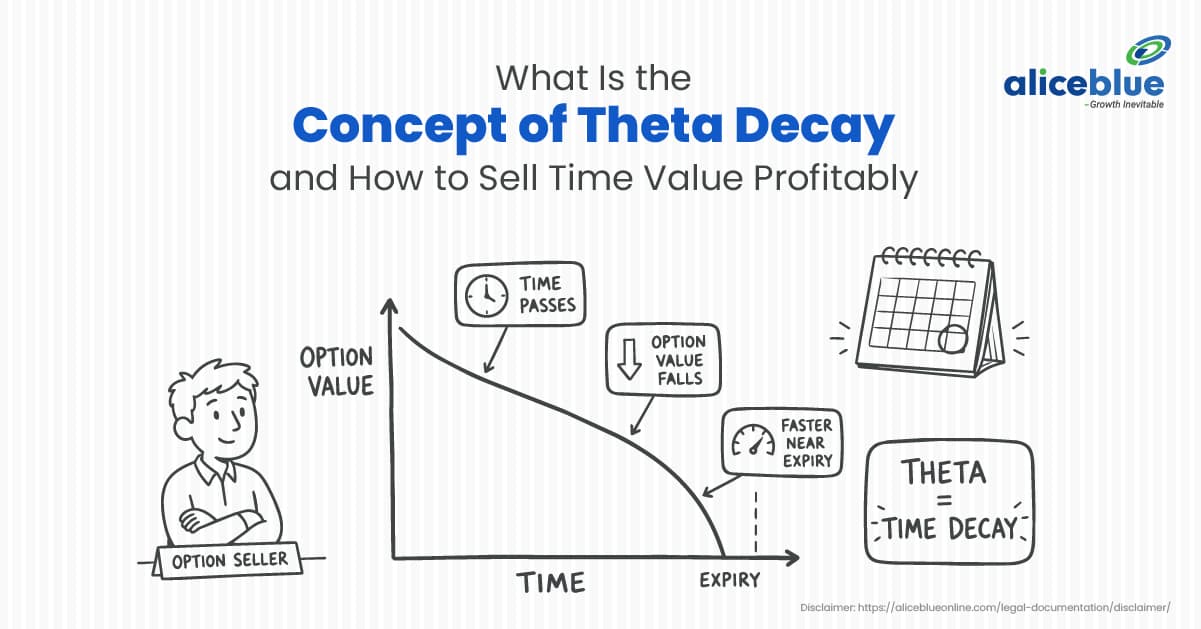
Theta is the option Greek that measures how much an option loses in premium each day purely due to the passage of time, assuming everything else stays the same, including spot price, volatility, and interest rates.
If an option has a theta of 12, the premium falls by ₹12 every single day. On a Nifty lot of 75, that is ₹900 lost per day because the calendar moved forward.
Theta is always negative for option buyers and always positive for option sellers. That is the core asymmetry this article is built around.
How Theta Decay Works
Theta does not eat into premium at a flat, consistent rate. It follows a curve that is slow and almost invisible early in the contract’s life, then accelerates sharply in the final days before expiry.
A Nifty ATM option with 20 days to expiry might lose ₹6 to ₹8 per day. The same strike in its final 3 days can lose ₹20 to ₹30 per day. The total rupee destruction in the last week far exceeds what happened in the first three weeks combined.
If you plot an option’s time value against days to expiry, the graph looks like a ski slope. Relatively flat at the top, then dropping steeply as you approach expiry day.
The Three Phases of Decay
Phase 1: 30 or More Days to Expiry
Time value erodes slowly. A Nifty ATM option might lose ₹5 to ₹8 per day. This phase feels stable for buyers, but the decay is already running.
Phase 2: 15 to 7 Days to Expiry
The rate picks up. Daily decay for ATM options rises to ₹10 to ₹20. Even a mildly sideways market starts hurting option buyers noticeably here.
Phase 3: Final Week and Expiry Day
Decay becomes aggressive. Premiums can fall 30 to 50 per cent on expiry day alone for OTM options. This is where option sellers are at their most profitable.
The Weekend Trap
Theta does not pause on weekends. The NSE is closed Saturday and Sunday, but time still passes. Three days of decay, including Friday, Saturday, and Sunday, are typically priced into Friday afternoon premiums. If you buy options at 3 PM on Friday and hold over the weekend, your option will almost certainly open lower on Monday, even if Nifty is completely flat. Many beginners discover this the hard way in their first few trades.
How to Calculate Your Theta Cost Before Entering a Trade
On Alice Blue’s ANT platform, Zerodha Kite, and Angel One, theta is visible directly in the option chain under the Greeks column. It appears as a negative number next to each strike.
Use this formula before entering any options buy trade:
Projected Theta Loss = Theta Value x Days Held x Lot Size
For theta of 18, holding 4 days on a Nifty lot of 75:
18 x 4 x 75 = ₹5,400 in time decay alone
This number is separate from any directional loss if Nifty moves against you. Knowing this before you enter a trade changes how you size positions and select expiry dates.
Real Example: Theta at Work on a Bank Nifty Weekly Option
Here is a weekly Bank Nifty option scenario that reflects what thousands of Indian traders experience every Monday.
Detail | Value |
Bank Nifty Spot | 52,000 |
Strike Bought | 52,500 CE (OTM) |
Premium Paid | ₹180 |
Theta | 20 |
Lot Size | 35 |
Days to Expiry | 5 |
Day by day premium erosion due to theta alone, assuming Bank Nifty stays flat:
Day | Daily Theta Loss | Remaining Premium |
Monday | ₹20 | ₹160 |
Tuesday | ₹22 | ₹138 |
Wednesday | ₹25 | ₹113 |
Thursday Expiry | ₹30 or more | ₹80 or less |
The daily loss increases as expiry approaches because theta accelerates. By Thursday, if Bank Nifty has not crossed 52,500, this option is likely worth ₹20 to ₹30 or even zero.
Now look at this from the seller’s side. Someone who sold the 52,500 CE on Monday for ₹180 can buy it back on Wednesday for ₹113, booking a profit of ₹67 per unit or ₹2,345 per lot, without Bank Nifty needing to move at all.
Key Features of Theta
- Theta is always negative for buyers and always positive for sellers. It never switches sides.
- ATM options carry the highest theta in absolute terms and decay the fastest.
- OTM options are made up entirely of time value, making them fully exposed to theta.
- Deep ITM options have a large intrinsic value component, so theta’s impact is relatively smaller on them.
- Weekly options on Nifty, Bank Nifty, and FinNifty experience sharper theta acceleration than monthly options because the entire lifecycle is compressed into a few days.
- Theta runs seven days a week, including weekends and market holidays.
How to Sell Time Value Profitably
When you sell an option, you collect the premium upfront. Your goal is for the option to lose value over time so you can either buy it back cheaper or let it expire worthless. Here are three strategies Indian traders actively use.
Short Strangle
What it is: Sell an OTM Call and an OTM Put on the same index and same expiry.
Example: Nifty at 24,000. Sell 24,500 CE at ₹60 and sell 23,500 PE at ₹55. Total premium collected: ₹115 x 75 = ₹8,625.
When to use it: Low IV environment with the market consolidating in a range.
Approximate margin: ₹1.2 lakh to ₹1.5 lakh per lot for Nifty. Check the current SPAN margin on Alice Blue’s margin calculator before entering.
Stop loss rule: Exit if either leg doubles in premium. If you sold the 24,500 CE at ₹60, exit when it reaches ₹120.
Risk: A sharp directional move past either strike produces losses that exceed the premium collected.
Short Straddle
What it is: Sell an ATM Call and an ATM Put at the same strike. ATM options carry the highest theta, so decay works fastest here.
Example: Nifty at 24,000. Sell 24,000 CE at ₹150 and 24,000 PE at ₹145. Total premium: ₹295 x 75 = ₹22,125.
When to use it: Low volatility, no major events expected. Avoid this strategy ahead of RBI policy announcements, Union Budget, or election result days.
Stop loss rule: Exit the full position if Nifty moves more than 1.5 per cent in either direction.
Risk: A higher premium is collected, but directional exposure is greater than a strangle.
Covered Call Writing
What it is: You hold a long Nifty futures position of one lot and sell a Call option against it to earn income from time decay.
Example: You are long one Nifty futures lot. Sell a 24,500 CE for ₹60. Even if Nifty stays flat, the ₹60 premium or ₹4,500 total is yours as theta decays the Call toward zero.
When to use it: When you expect the market to stay flat or rise gradually. Works best as an income strategy on an existing long position.
Risk: If Nifty surges past 24,500, gains on your futures position are capped at the strike level.
Theta vs. Vega: Why Premiums Sometimes Rise Despite Time Passing
This confuses many traders. You sold an option for ₹100, and theta is working in your favour, but the premium is now ₹130. How?
Vega is the Greek letter that measures an option’s sensitivity to changes in implied volatility (IV). When IV spikes ahead of a major news event, or during a sudden market fall, premiums rise across the board even as theta is eating away at time value.
Think of theta as a slow, predictable leak from a pipe. Vega is someone suddenly turning on the tap. During high volatility events, the tap overpowers the leak.
The practical implication for sellers: sell options when IV is elevated. India VIX, available on the NSE website and on most trading platforms, including Alice Blue, measures expected market volatility. When India VIX rises above 16 to 18, option premiums are elevated, which is a better environment to sell. Avoid selling when India VIX is below 12 because the premium collected is thin relative to the risk you are taking on.
Advantages of Selling Time Value
- Every day that passes adds to your profit as long as the index stays away from your sold strike.
- In sideways or slow-trending markets, sellers profit steadily while directional buyers wait for a move that never comes.
- Weekly expiries in India mean you can run 4 to 5 theta selling cycles per month instead of just one with monthly options.
- Statistically, the majority of options in India expire out of the money, meaning option sellers win more frequently in terms of trade count.
Risks You Must Understand Before Selling Options
- A single sharp market move can wipe out multiple weeks of steady theta income in one session.
- Gap openings triggered by global cues, RBI decisions, or geopolitical events can breach your sold strike before you can react.
- IV spikes can push sold option premiums higher and create mark-to-market losses even as theta works in your favour.
- Selling options requires a significant upfront margin, which reduces your capital flexibility.
- There is no hard cap on losses when selling naked options. Position sizing and stop loss planning are not optional.
Option Buyer vs. Option Seller: A Direct Comparison
Parameter | Option Buyer | Option Seller |
Theta Impact | Enemy, premium drops daily | Ally, the daily premium drop equals profit |
Ideal Market Condition | Strong directional move, quickly | Sideways, range-bound, low volatility |
Maximum Risk | Limited to premium paid | Unlimited without a stop loss |
Maximum Reward | Unlimited | Capped at the premium collected |
Win Frequency | Lower | Higher |
Capital Required | Lower (premium only) | Higher (margin required) |
Weekly Expiry Impact | Cheap entry but rapid decay | A faster decay cycle creates more income opportunities |
Common Mistakes Indian Options Traders Make
- Buying OTM options on expiry day
OTM options on Thursday weekly expiry can lose 60 to 80 per cent of their value in a few hours if the index does not make a sharp move. The probability is very low, and theta is running at maximum speed. - Not calculating theta in rupees before entering
Theta of 15 sounds small. On two Nifty lots of 75 each, that is ₹2,250 per day in time cost alone. Always multiply theta by lot size and planned holding period before entering any options buy trade. - Selling options in very low IV without adjusting size
When India VIX is below 12, premiums are thin. Selling a Nifty strangle for ₹40 total while risking a ₹200 index move is not good risk-reward, regardless of how well theta normally works. - Having no predefined stop loss on short option positions
Most large losses in short option positions happen because there was no predefined exit level. Define your stop loss before you enter, not after the trade starts moving against you.
Holding short options into major event days
RBI meetings, FOMC decisions, election result days, and quarterly results of index heavyweights cause sudden IV explosions. Close or hedge short option positions before such events. The theta collected over three days can disappear in a single candle.
Who Should Use Theta Selling?
Well-suited for:
- Traders who understand basic option Greeks and can monitor positions during market hours
- Those with sufficient capital to meet margin requirements, typically ₹80,000 to ₹1.5 lakh or more per Nifty lot for short options
- Traders who prefer a rule-based approach over directional speculation
- Those who are comfortable operating in range-bound or low volatility market phases
Not well suited for:
- Traders new to options who have not yet read an option chain or paper traded
- Those with limited capital who cannot handle short-term mark-to-market swings
- Traders who cannot actively monitor positions during market hours
Watch a full weekly Nifty expiry cycle without trading first. Observe how ATM and OTM premiums decay from Monday to Thursday. The pattern becomes obvious within one week and gives you a much better foundation before committing real capital.
Conclusion
Theta decay is predictable and measurable. For option buyers, it is a daily cost that must be recovered through the right directional move within the right timeframe. For sellers, it is a steady income source that works even when the market does nothing.
The Indian options market, with four weekly expiries per month, is one of the most active environments in the world for theta selling. That opportunity comes with real risk. Consistent sellers are disciplined; they sell when IV is reasonable, size positions conservatively, and always have an exit plan in place before entering.
Frequently Asked Questions
Yes. The NSE is closed on weekends, but time still passes. Saturday and Sunday decay are reflected in lower premiums when markets open on Monday. Buying options on Friday afternoon means you are paying for this upcoming decay upfront.
Open the option chain on Alice Blue’s ANT platform, Zerodha Kite, or the NSE website directly at nseindia.com/option-chain. Look for the Greeks column. Theta appears as a number next to each strike. Multiply it by your lot size and planned holding days to get your rupee cost.
Yes. Weekly options have a compressed lifecycle, so the steep part of the theta curve arrives much faster. The final two days of a weekly option can destroy 40 to 60 per cent of the remaining time value. Monthly options lose time value more gradually across a longer period.
Theta reaches its peak rate on expiry day. OTM options far from the current index level can lose nearly all their remaining value in the first few hours of trading. By 2:30 PM on a Thursday expiry, many OTM premiums have collapsed to ₹1 to ₹5.
Yes. If the index makes a large move toward or past your sold strike, the directional loss can exceed your theta gain. A sharp rise in India VIX can also push sold premiums higher and increase your mark-to-market loss even as time passes.
Most experienced option sellers in India initiate short strangles or straddles on Tuesday or Wednesday of expiry week. By this point, premiums are meaningful, but the theta acceleration for the remaining days is steep, meaning the decay works faster in your favour over a shorter holding period.
Use the formula: Theta Value x Days Held x Lot Size. If theta is 18, you plan to hold for 4 days, and the lot size is 75, your projected theta cost is ₹5,400. This helps you decide whether the expected directional move justifies the time decay you are paying.

Blog by Aliceblue News Desk


